
How much do lead generation services cost for plumbers?

- How much do plumbing lead generation services cost, and how is each one priced?
- How are plumbing lead generation services priced?
- How does pay-per-lead pricing work for plumbers?
- Why are shared plumbing leads cheaper than exclusive ones?
- How does pay-per-booked-job pricing work?
- What do monthly lead generation retainers include?
- How does ad spend plus a management fee compare?
- How do I compare plumbing lead prices across different models?
- How do I know what a plumbing lead should cost in my market?
- What should I ask before I agree to a lead price?
- Which pricing model fits which plumbing jobs?
- When is paying for plumbing leads a bad deal?
- What's different about lead pricing for plumbing companies
- A worked example: three lead offers, one plumbing shop
- Frequently asked questions
- Key takeaways
- More in this section
- Sources
The short version
- Four common models: per lead, per booked job, flat monthly fee, or ad spend plus a management fee.
- Shared leads cost less each but book less often; exclusive leads cost more each.
- Ask exactly what counts as a lead or a booked job, and what you can get credited.
- Compare every offer on cost per booked job, including your office's time.
For plumbing owners comparing lead offers that are priced in different ways and want to know which one actually costs less per job.
Get a free visibility audit · Book a growth call
How much do plumbing lead generation services cost, and how is each one priced?
Lead generation services for plumbers are priced in four main ways: a price per lead, a price per booked job or appointment, a flat monthly fee, or ad spend paid to Google plus a management fee. The price per lead or per month tells you very little on its own, because a cheap lead that’s shared with other plumbers or rarely books can cost more per job than an expensive one. Compare every offer on the same number: what you paid in total for the month divided by the jobs it actually booked.
Our own pricing is the fourth model: you pay Google directly for ads, and a flat monthly package covers the management, tracking and reporting, with a cost-per-lead breakdown every month. Every tier is listed on our packages page. See how it fits plumbing companies, or browse more plumbing marketing questions.
How are plumbing lead generation services priced?
Almost every offer fits one of these models, or a mix:
- Pay per lead. You pay for each call, form or message the service sends you, whether or not it books.
- Pay per booked job or appointment. You pay only when a lead turns into a scheduled job, usually at a much higher price per unit.
- Flat monthly fee. A retainer or subscription for a set service, whatever the lead count.
- Ad spend plus a management fee. You pay Google or Meta directly for the ads, and pay someone a fee to run them. The leads come to you, under your name, from accounts you own.
Some offers also add a setup fee, a minimum monthly spend or a contract term. Those belong in the price too.
None of these is cheap or expensive on its own. Each moves a different risk onto you or onto the seller, and the only fair way to compare them is the cost of each job they book.
How does pay-per-lead pricing work for plumbers?
You pay a set or auction price for each contact, and the risk that it doesn’t book is yours. The biggest questions are what counts as a lead and whether anyone else got it.
Google’s Local Services Ads are the best-known pay-per-lead option, and the rules in How leads work show what a lead definition looks like in practice. Google charges for valid leads, which include a call you answer, a text or email, a voicemail, a booking request, and a call you miss during business hours if the caller stays on the line for more than 20 seconds. Lead prices may vary by location, job type, type of lead and bidding mode, and message leads are typically priced lower than phone leads, though not always.
Get the same clarity from any pay-per-lead seller: does a wrong number count? A caller outside your area? A homeowner who wanted a quote for a job you don’t do? If the answer is “yes, that’s a lead,” price that in.
Why are shared plumbing leads cheaper than exclusive ones?
Because you’re not the only one buying them. A shared lead goes to several plumbers at once, and the homeowner usually hires whoever reaches them first and sounds right. You pay for every one, but you only win some.
An exclusive lead comes only to you. It costs more each, but you’re not racing other trucks to the phone. Local Services Ads even price message leads partly on whether the customer has already contacted other advertisers.
Shared leads can still work if your office calls back within minutes, every time. If calls get returned after lunch, the cheaper price is mostly paying for jobs another plumber books. Marketplace-style lead services work this way, and whether they’re worth it for your shop is covered in whether lead marketplaces are worth it for plumbers.
How does pay-per-booked-job pricing work?
The seller takes more of the risk, so the price per unit is much higher than per lead. That can be a good deal, because you only pay for work that reaches your calendar. The catch is in the definitions:
- What counts as booked? Scheduled, or completed and paid? A booked job that cancels the next morning is a lot different from a finished one.
- Who decides? If the service tracks bookings through its own phone line or your field software, ask how disputes are settled.
- Is the price the same for every job? Paying the same fee for a faucet repair and a sewer line replacement makes the small jobs expensive.
Pay-per-job deals are harder to find for emergency work, where the lead and the job happen within the hour. They show up more for estimates on bigger work.
What do monthly lead generation retainers include?
A flat monthly fee buys a service, not a number of leads. It might cover running your ads, managing your Google Business Profile, building pages or answering calls. The lead count goes up and down with the season, your market and how well the work is done; the fee stays put.
Retainers make sense when the work builds something you keep: your ad account, your website, your reviews, your rankings. They make less sense when you’d own nothing if you stopped paying. Ask what happens to the accounts, phone numbers and pages on the day you cancel. The answer tells you whether you’re renting leads or building a channel.
Curious what your marketing is actually booking?
Get a free visibility audit — no obligation, no sales pitch.
How does ad spend plus a management fee compare?
It’s the most transparent model, because you see both halves. Ad spend goes straight to Google, and you can see every click and every lead in your own account. The fee pays for the people who run it.
This is how our packages work. Essentials is $3,500 a month and includes Google Ads management for up to $2,500 a month in ad spend. Growth is $4,500 a month, adds Local Services Ads management, and covers Google Ads spend up to $5,000 a month. Ad spend isn’t included in any package; you pay it directly to Google or Meta. Every package includes call tracking and monthly reports with a cost-per-lead breakdown.
The trade-off: you carry the risk that ads don’t book, the same as pay-per-lead. The difference is you own the data and the accounts, and you can see exactly where the money went.
How do I compare plumbing lead prices across different models?
Put every offer through the same three steps:
- Total monthly cost. Lead charges or the fee, plus ad spend, setup costs spread over the contract, and any tools you need for it.
- Booked jobs. Not leads. Count the jobs that actually got on the schedule from that source, using your field software’s lead source report or call tracking.
- Divide. Total cost divided by booked jobs is your cost per booked job.
Then add one thing most owners forget: your office’s time. Twenty shared leads that each need three callback attempts take hours of dispatcher time a week. That’s a real cost, even if it isn’t on the invoice.
If you don’t know your own number yet, what a booked plumbing job really costs by channel shows how to work it out for each source.
How do I know what a plumbing lead should cost in my market?
Not from a national average. Lead prices depend on your town, the job type and how many plumbers are competing, and a sewer lead in a big metro isn’t priced like a drain lead in a small town.
Two ways to price your own market:
- Google Ads Keyword Planner. Its keyword data shows a top-of-page bid low and high range for each keyword, roughly the 20th and 80th percentile of what advertisers have historically paid, based on your location settings. Set it to your service area and look up the jobs you want.
- Local Services Ads. Your own account shows what each lead cost once it’s running, and the bidding options let you set a target cost per lead or let Google maximize leads for your budget.
The ceiling, though, comes from your margins, not the market. Work it out in how much you can afford to pay for a plumbing lead, and see what a qualified plumbing lead costs in your market for the local side.

What should I ask before I agree to a lead price?
- Exclusive or shared? And if shared, with how many other plumbers?
- What exactly counts as a lead or a booked job? Get it in writing.
- What can I get credited? Spam, duplicates, wrong areas, wrong job types, and how long you have to ask. On Local Services Ads, Google keeps crediting low-quality leads automatically, but no longer credits leads for job types or areas you don’t serve, so your settings matter.
- Is there a minimum spend, setup fee or contract term?
- Can I pause when the schedule’s full or a tech is out?
- Who owns the phone numbers, recordings and customer details?
- Can I limit towns and job types to the work I want?
For a fuller checklist, including red flags in the contract, see how to vet a lead generation company for your plumbing business.
Which pricing model fits which plumbing jobs?
- Emergency service calls. Speed decides who gets the job, so exclusive leads or Local Services Ads tend to beat shared leads, unless your office answers instantly around the clock.
- Water heaters, repipes and sewer work. These carry more margin, so a higher price per lead or per booked estimate can still pay. Track them separately so cheap service-call leads don’t hide what the big jobs cost.
- Steady, long-term growth. Ad spend plus a fee, or work on your own profile and site, builds something you keep. Bought leads stop the day you stop paying.
When is paying for plumbing leads a bad deal?
When the lead price is fine but the jobs don’t follow. The usual reasons: calls go to voicemail, callbacks take hours, leads are shared with too many others, or the leads are for jobs and towns you don’t want. In each case the fix is on your side before it’s on the seller’s.
And when the math doesn’t work. If your cost per booked job from a source is above what that job leaves you after parts and labor, that source is losing you money, however cheap each lead looks. The bigger question of whether to buy leads at all is in whether paying for plumbing leads is worth it.
Talk it through with someone who runs this every day
A 15-minute growth call: your market, your numbers, and what a realistic budget looks like. No pressure.
What's different about lead pricing for plumbing companies
Emergency leads go stale in minutes. A homeowner with a burst pipe calls until someone answers. Any lead model that adds delay, like a form that’s emailed to you or a lead shared with several plumbers, costs more in lost jobs than it looks.
Ticket sizes swing wildly. The same lead price can be cheap for a water heater replacement and expensive for a running toilet. Ask for job-type targeting, and track cost per booked job by job type, not as one blended number.
Freezes and storms flood the phones. On the morning after a hard freeze, pay-per-lead costs can run up quickly while your crew is already booked. Know how to cap or pause each service before that morning comes.
A worked example: three lead offers, one plumbing shop
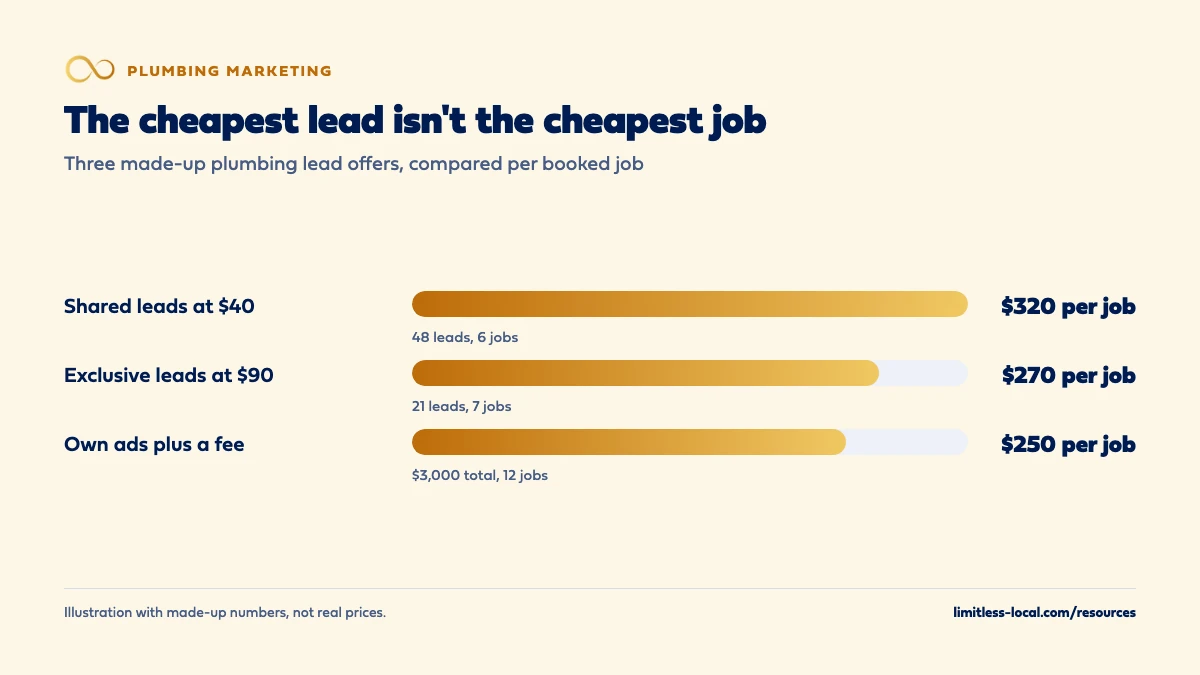
These numbers are made up to show the math, not prices from any real service. A plumbing shop compares three offers for one month.
- Shared leads at $40 each. The shop buys 48 for $1,920. With other plumbers calling the same homeowners, 1 in 8 books, or 6 jobs. Cost per booked job: $320.
- Exclusive leads at $90 each. The shop buys 21 for $1,890. About 1 in 3 book, or 7 jobs. Cost per booked job: $270.
- Its own ads. $2,000 in ad spend paid to Google plus a $1,000 management fee is $3,000. The ads bring 32 calls and forms, and 12 book. Cost per booked job: $250.
The cheapest lead was the most expensive job, and the most expensive option on the invoice booked the most work. Add the dispatcher hours spent chasing 48 shared leads and the gap widens. A free visibility audit can run this same comparison on your real sources.
Frequently asked questions
Are exclusive plumbing leads worth the higher price?
Often, for emergency work, because you’re not racing other plumbers to the phone. Check by comparing cost per booked job, not price per lead.
Can I get my money back for bad leads?
It depends on the seller’s credit policy, so get it in writing before you start. On Local Services Ads, Google filters spam and duplicates and credits low-quality leads automatically, usually within 30 days.
Is a setup fee normal for lead generation?
Some services charge one, especially if they build pages or ad campaigns. Spread it across the contract when you compare offers, and ask what you keep if you leave.
Should I sign a long contract to get a lower lead price?
Only if you’ve already seen the leads book. Start with the shortest term you can, measure cost per booked job, and commit longer once the numbers hold up.
Do lead services work in the slow season?
Lead volume usually drops with demand, and per-lead prices can shift too. A flat fee keeps costing the same, so check what you’re getting for it in slow months.
How do I track which lead service booked a job?
Give each source its own tracking number or tag it in your field software, then run a lead source report. Without that, every service will claim the same jobs.
Key takeaways
- Plumbing lead services charge per lead, per booked job, a flat monthly fee, or ad spend plus a management fee.
- Shared leads cost less each but book less often; speed of callback decides whether they pay.
- Get the definition of a lead or booked job, and the credit policy, in writing.
- Price your own market with Keyword Planner and your own Local Services Ads data, not national averages.
- Compare every offer on total monthly cost divided by booked jobs, plus your office’s time.
- Bought leads stop when the payments stop; owned channels keep working.
Ready to compare options?
Book a short growth call and we'll walk through the math for your service area, including when we're not the right fit.
More in this section
- How do I vet a lead generation company for my plumbing business?
- What does a qualified plumbing lead cost in my market?
- Is it worth paying for plumbing leads?
- How do I get more plumbing leads?
- How much does a plumbing marketing agency cost per month?
Sources
- How leads work — Google Local Services Help
- How bidding works for Local Services Ads — Google Local Services Help
- About Automated Local Services Ads lead credits — Google Local Services Help
- About Keyword Planner forecasts — Google Ads Help