
Is $1500 a month too much for electrician marketing past referrals?

- Is $1,500 a month a reasonable marketing budget for an electrician growing beyond referrals?
- Is $1,500 a month a lot for electrical marketing?
- How many jobs does $1,500 a month have to book to pay for itself?
- Why does a referral-based electrician need paid marketing at all?
- What can $1,500 a month actually buy?
- Where should a referral-based electrician put the first $1,500?
- When is $1,500 a month too much?
- When is $1,500 a month too little?
- How should I split $1,500 between ad spend and everything else?
- How long should I give $1,500 a month before deciding?
- How do I keep referrals coming while I add paid marketing?
- What's different about this budget for electricians
- A worked example: does $1,500 a month pay?
- Frequently asked questions
- Key takeaways
- More in this section
- Sources
The short version
- Break-even = $1,500 ÷ gross profit per job.
- At $500 profit per job, 3 extra booked jobs a month covers it.
- Put it in one tracked channel, not four small ones.
- It's too much if you can't take more work or can't track what booked.
- Keep asking for referrals; paid marketing adds to them, it doesn't replace them.
For referral-based electrical shops weighing their first steady marketing budget, and wondering whether $1,500 a month is too much, too little or about right.
Get a free visibility audit · Book a growth call
Is $1,500 a month a reasonable marketing budget for an electrician growing beyond referrals?
Not usually. $1,500 a month pays for itself when it books enough extra jobs to cover it, and the break-even is easy to work out: divide $1,500 by the gross profit on an average job, so if a job leaves you $500, you need 3 extra booked jobs a month. It becomes too much when the crews can’t take more work, when nobody tracks which calls booked, or when it’s spread so thin across channels that none of them works. For a shop moving past referrals, that money works best in one tracked channel, usually Google search ads for the jobs you want, alongside the free work on your Google profile and reviews.
When $1,500 a month is working and you want more out of it, that’s usually the point to compare doing it yourself with paying someone to run it. Our packages start with Essentials at $3,500 a month for one location, which includes Google Ads management, Google Business Profile management, review generation and call tracking; ad spend is paid directly to Google. At $1,500 a month total, you don’t need us yet. Our electrical contractor marketing page explains how we work with electrical shops, and the electrical marketing questions library goes question by question.
Is $1,500 a month a lot for electrical marketing?
It depends on what the shop brings in. A small-business marketing article on the SBA’s site, How to Get the Most From Your Marketing Budget, says there’s no hard and fast answer, and that many businesses use a percentage of revenue as a guide. It also suggests checking with your industry trade association for benchmarks, because budgets vary so widely.
For a quick gut check, set $1,500 against your monthly revenue. A shop invoicing $40,000 a month would spend 3.75% of it, which most owners would call modest. A one-truck shop invoicing far less will feel it more, and needs to be stricter about what it buys.
But percentage only tells you whether the number fits your size. The better test is whether it books enough jobs to pay for itself, which the next section works out. How much an electrical contractor should spend on marketing covers the percentage method and the job math in more depth.
How many jobs does $1,500 a month have to book to pay for itself?
Fewer than most owners expect. The formula is one line:
Break-even jobs per month = $1,500 ÷ gross profit per job
Gross profit is what’s left from an average invoice after materials and the labor to do the job. Work it out from your last few months of invoices, not a guess. A few examples:
- If a typical job leaves $500 of gross profit, 3 extra booked jobs a month covers the $1,500.
- If you mostly do small service calls that leave less, you need more of them.
- If the marketing books even one panel upgrade or generator install a month on top of service calls, that one job can cover a big share by itself.
Count only jobs the marketing actually brought in, not referrals that would have called anyway. And remember that a new customer who comes back next year, or sends a neighbor, is worth more than one invoice. How much an electrician can afford to pay to get a new customer shows how to count that repeat work.
Why does a referral-based electrician need paid marketing at all?
Referrals are the best leads you’ll ever get, but they have three limits. They depend on how many customers you served last year, so they grow slowly. You can’t turn them up when the schedule has a gap. And they bring whatever work your past customers happen to need, which may not be the panel upgrades, EV chargers or generators you’d rather be doing.
Paid marketing fixes those three things: it adds new customers on top of the ones referrals bring, you can turn it up or down, and you choose which jobs and towns it goes after. That’s what “past referrals” really means. Not replacing them, but adding a source you control.
If you’re happy at your current size and referrals keep the schedule full, you may not need to spend at all. Whether an electrician can get enough leads without paid ads covers when that works and when it stops working.
What can $1,500 a month actually buy?
At this level, most of the money should reach homeowners, because every dollar spent on fees and tools is a dollar that doesn’t. Here’s what it can cover:
- Google search ads. Spent entirely on ads, $1,500 a month is about $49 a day. Google’s page on average daily budgets explains that you divide a monthly amount by 30.4, the average number of days in a month, to set the daily budget.
- Local Services Ads. You pay per lead instead of per click. Google’s page on how leads work lists what counts, including answered calls, messages and booking requests, and a missed call during your business hours when the caller stays on the line for more than 20 seconds.
- Call tracking, so each call shows which ad or listing it came from.
- A little outside help, like a freelancer to set up the campaign, if you’ll run it day to day.
What it usually can’t stretch to is ads, SEO, Local Services Ads and social media all at once, each done properly. Pick one or two.
Curious what your marketing is actually booking?
Get a free visibility audit — no obligation, no sales pitch.
Where should a referral-based electrician put the first $1,500?
Do the free work first, then put the money into one place:
- Your Google Business Profile. Google says the Business Profile is free. Fill in every service, add real photos and answer every review.
- Reviews. Ask every customer, including the referral jobs. Reviews help Maps, Local Services Ads and every ad you run.
- One tracked paid channel. For most referral-based shops that’s Google search ads for one or two job types in the towns you most want, sent to a page about that job. If you’re already verified for Local Services Ads with a healthy set of reviews, those are a good alternative.
- Tracking. Tag every call by source so you can see paid jobs next to referral jobs.
Before you start, check what clicks cost in your towns. Google’s Keyword Planner shows estimates of monthly searches and forecasts for the keywords you enter, which tells you roughly how far $1,500 will go. How much an electrician should spend on Google Ads each month walks through the math.
When is $1,500 a month too much?
When it can’t pay off, no matter how good the ads are. Watch for these:
- You can’t take more work. If crews are booked out three weeks, new calls turn into lost jobs and bad reviews. Hire or raise prices first.
- Nobody answers the phone. Calls from paid ads that go to voicemail are money spent on someone else’s job.
- There’s no tracking. If you can’t tell which calls came from the marketing and which booked, you’re guessing whether it worked.
- It’s spread across too many places. Four channels at a few hundred dollars each rarely give any one of them enough to work.
- Cash is too tight. If one slow month of results would mean missing payroll, start smaller and build up.
In any of those cases, fix the problem first or start lower, then raise the budget once you can see booked jobs coming in.
When is $1,500 a month too little?
When the goal is bigger than one channel can deliver. $1,500 a month may not be enough if:
- Clicks are expensive in your market, so $49 a day buys only a handful of visits.
- You want several job types in several towns. Splitting the same budget across panel upgrades, EV chargers, generators and service calls in five towns leaves each one underfunded.
- You’re trying to fill another truck. Adding a crew means adding a crew’s worth of booked jobs every month, which often takes more than one channel.
- You want ads and SEO at the same time. SEO typically takes 3-6 months to show meaningful organic growth, so paying for it while also funding ads to carry the calls costs more than either alone.
If that’s you, start where $1,500 does the most good and plan to raise it in steps as results show up, rather than spreading it thin from day one.

How should I split $1,500 between ad spend and everything else?
Keep the bulk of it as ad spend, the money that actually puts you in front of homeowners. Then take out only what you need to make that spend work:
- Call tracking, because without it you can’t judge anything.
- Setup help, if you’ve never built a campaign. A one-time setup cost is easier to carry than a monthly fee at this level.
What about your own time? Running the ads yourself costs hours each week: checking search terms, adding negative keywords, reading the call log. Count that time honestly. If those hours would earn more on a job, part of the $1,500 may be better spent on someone else doing the work.
Keep two numbers on one sheet every month: what the marketing cost in total, and how many booked jobs it brought in. That’s the only scorecard you need at this budget.
How long should I give $1,500 a month before deciding?
Ads can generate leads within days of launch, so you’ll know within the first couple of weeks whether the phone is ringing. Whether it’s paying off takes longer, because you need enough booked jobs to judge. For most shops at this budget, that’s two to three months of tracked data.
Use the first month to fix things: search terms you don’t want, an ad pointing to the wrong page, calls arriving at times nobody answers. Judge months two and three on cost per booked job against your break-even.
If you’re adding SEO, give that part longer. It typically takes 3-6 months to show meaningful organic growth, and judging it in month two will only tell you it hasn’t started yet. How many jobs marketing should produce before you add budget helps decide when to spend more.
How do I keep referrals coming while I add paid marketing?
Paid marketing works best on top of a referral habit, not instead of one. Keep doing what brought you here:
- Ask happy customers, at the end of the job, who else they know who might need an electrician.
- Thank every referral, every time, so people keep sending them.
- Stay in touch with past customers between jobs, with a seasonal note about generator checks or EV chargers.
- Keep builders, property managers and other trades who send you work close.
And track the two side by side. When a referred customer calls, write down who sent them. When a paid ad brings a call, the tracking number shows that. After a few months, you’ll know exactly what each source brings in. Getting more referrals from past electrical customers has the details.
Not sure which of these is costing you jobs?
A free visibility audit checks the Google profile, reviews, site and tracking, and shows what to fix first.
What's different about this budget for electricians
Job values swing widely. An electrician’s month might include small service calls and a few panel upgrades, EV chargers or generators. Point the $1,500 at the bigger jobs and the break-even comes down fast; spend it on generic “electrician near me” clicks and it fills up with small calls.
Referrals often come from builders and trades. Many electrical shops get much of their work from general contractors, HVAC companies and remodelers. Paid marketing is what brings the homeowner work those partners don’t send.
Emergency calls need someone on the phone. If your ads run at night and nobody answers, the budget pays for calls you’ll never book. Schedule ads to the hours you cover.
Licensing limits where you can grow. Ads can reach any town, but only spend on the ones your license and drive time let you serve well.
A worked example: does $1,500 a month pay?
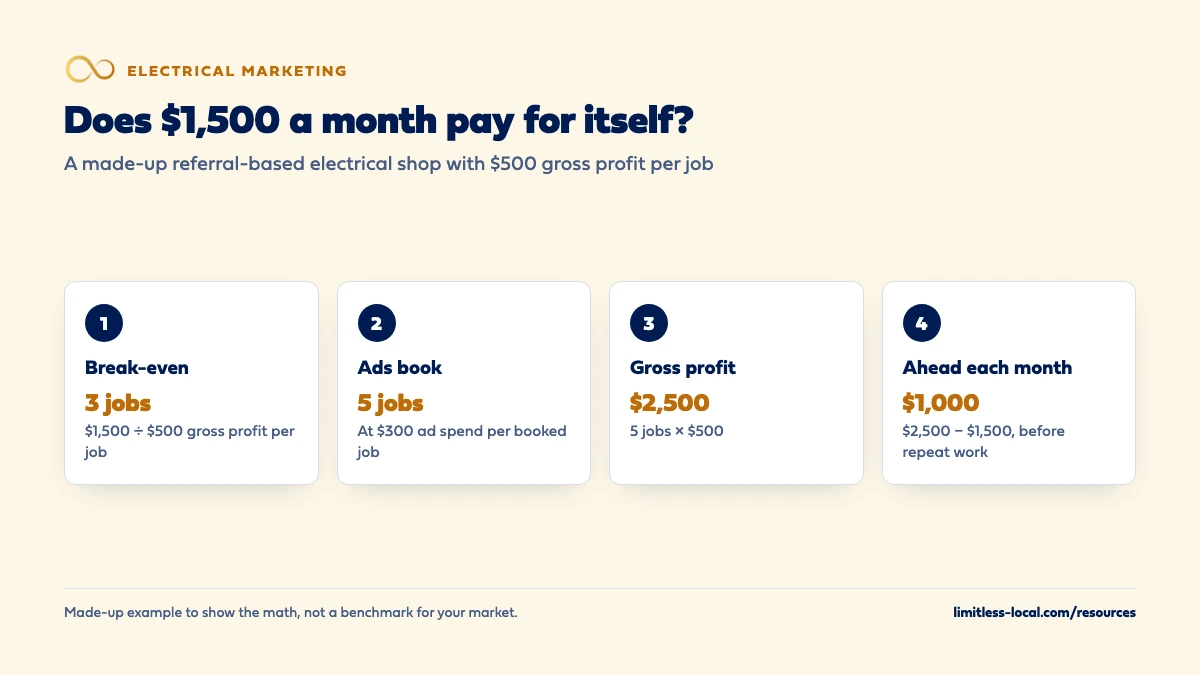
These numbers are made up to show the math, not a benchmark for your market. Say a referral-based shop’s average invoice is $1,100, and each job leaves $500 of gross profit after materials and labor. The owner puts all $1,500 a month into Google search ads for panel upgrades and service calls, with call tracking.
- Break-even: $1,500 divided by $500 is 3 booked jobs a month.
- What the ads book: say each booked job ends up costing $300 in ad spend. $1,500 divided by $300 is 5 booked jobs.
- Gross profit from those jobs: 5 times $500 is $2,500.
- After paying for the ads: $2,500 minus $1,500 leaves $1,000 a month ahead, before any repeat work or referrals from the new customers.
Now flip it. If each booked job cost $600 instead, the ads would book 2 or 3 jobs, below break-even. Same budget, different answer, which is why the number to watch is cost per booked job. In that case the owner should fix the ads, landing page or phones before spending more, not just cut the budget.
Frequently asked questions
Does $1,500 a month include the ad spend?
On this page, yes: $1,500 is the total, ad spend included. If someone quotes you $1,500 for management, ask whether ad spend is on top, because it usually is paid to Google separately.
Should I spend $1,500 on Local Services Ads or Google search ads?
If you’re already verified with a healthy set of reviews, Local Services Ads are simpler to run and charge per lead. If not, search ads let you pick the jobs and towns and can start sooner. Either way, track cost per booked job.
Is $1,500 a month enough for SEO for an electrician?
It can pay for some SEO work, but SEO is slow to show results, and at this budget it usually means no ads to carry calls in the meantime. Most referral-based shops do better starting with ads and doing the free Google profile and review work themselves.
Can I spend $1,500 only in busy months?
You can, but ads start fastest when they keep running, and slow months are when you need calls most. Lower the budget in slow months if you must, rather than turning it off and starting over.
What if $1,500 is more than I can afford right now?
Start with the free work: Google profile, reviews and past customers. Then try a smaller ad budget on your single most profitable job type, and raise it as booked jobs pay for it.
Key takeaways
- $1,500 a month breaks even at $1,500 divided by your gross profit per job; at $500 a job, that’s 3 extra booked jobs.
- Put it into one tracked channel, usually Google search ads for the jobs you want most.
- It’s too much if you can’t take more work, don’t answer the phone or can’t track what booked.
- It’s too little if clicks are expensive, you want many towns and job types, or you’re filling another truck.
- Keep asking for referrals; paid marketing adds a source you control on top of them.
Want a second set of eyes on your setup?
We'll look at how you show up locally and where calls are leaking, then send you a plain-English breakdown.
More in this section
- How much should an electrical contractor spend on marketing?
- What should electricians include in their monthly marketing budget?
- How much does a marketing agency cost for an electrician?
- What is a good cost per booked job for electrical marketing?
- How many jobs a month does an electrician need to hit a revenue goal?
Sources
- How to Get the Most From Your Marketing Budget — U.S. Small Business Administration
- About average daily budgets — Google Ads Help
- How leads work — Google Local Services Help
- Get Listed on Google – Google Business Profile — Google
- Use Keyword Planner — Google Ads Help