
Is direct mail still worth it for HVAC companies?

- Do postcards and EDDM mailers still bring HVAC companies booked jobs?
- Does direct mail still work for HVAC companies?
- What's the difference between EDDM and mailing my customer list?
- How much does an EDDM mailing cost?
- How do I choose which neighborhoods to mail?
- When is direct mail a better bet than Google for an HVAC company?
- When is direct mail a waste of money for HVAC?
- What should an HVAC postcard actually say?
- How do I track calls and visits from a mailer?
- How do I mail past customers without wasting postage?
- How do I judge whether direct mail paid off?
- What's different about direct mail for HVAC companies
- A worked example: what one EDDM mailing needs to book to pay for itself
- Frequently asked questions
- Key takeaways
- More in this section
- Sources
The short version
- Mail reaches homeowners before they need you; Google reaches them when they do.
- USPS Every Door Direct Mail costs $0.26 per piece in postage at the Post Office, plus design and printing.
- Put a unique tracking number and a tagged web link on every mailing.
- Judge it by cost per booked job across several drops, not one mailing.
For HVAC owners weighing postcards and door-to-door mailers against Google, and wondering how to tell whether a mailing actually paid off.
Get a free visibility audit · Book a growth call
Do postcards and EDDM mailers still bring HVAC companies booked jobs?
Direct mail can still be worth it for an HVAC company, mostly as a way to reach past customers and the neighborhoods you already serve before their system breaks, not as a replacement for showing up on Google when it does. There’s no reliable published response rate that will tell you what a mailing will do in your town, so the only honest test is a tracked one: a unique phone number and web link on every piece, and a count of the booked jobs it produced. If a mailing’s cost per booked job beats or matches your other channels after a few drops, keep it; if you can’t measure it, you can’t know.
We’ll say it up front: we don’t sell or run direct mail. Our marketing packages cover Google, Maps, ads and lead follow-up, and every one includes call tracking and a monthly report with a cost-per-lead breakdown, which is the same yardstick you’d hold a mailer to. Our HVAC marketing page shows how those channels fit together, the HVAC lead generation guide compares the ways to bring in leads, and the rest of the HVAC marketing questions library goes question by question.
Does direct mail still work for HVAC companies?
It can, but nobody can honestly tell you how well before you try it in your own market. You’ll see response rates quoted for direct mail, but none we’ve found comes from a published, checkable study of HVAC companies, and a national average says little about a postcard landing in your ZIP codes in April versus July. So we won’t quote one.
What we can say is what mail is good at. A postcard reaches a homeowner whether or not they’re looking for HVAC help that day. Google search, the map pack and ads reach the homeowner who is already looking, usually because something stopped working. In our judgement those are different jobs: mail plants your name before the need, search catches the need. A mailing that’s measured properly will tell you which one is paying for itself in your town.
What's the difference between EDDM and mailing my customer list?
They’re two different tools.
- Every Door Direct Mail (EDDM) is the U.S. Postal Service’s saturation option. You pick carrier routes on a map, the pieces are addressed simply to “Postal Customer”, and they’re delivered to every address on the routes you chose (USPS). You don’t need names or a list.
- Addressed mail goes to specific people, such as customers in your field software. Some field software can send it for you. ServiceTitan’s Marketing Pro, for example, can send a sequence of up to four postcards to an audience you build from your customer records, with the cards printed, addressed and handed to USPS usually within 48 hours of launch (ServiceTitan Help).
EDDM is for finding new customers in a neighborhood; addressed mail is for bringing back the ones you already have. In our judgement the second is where most HVAC companies should start, because those homeowners already know your name and your techs have been in the house. Getting more repeat customers covers the rest of that work.
How much does an EDDM mailing cost?
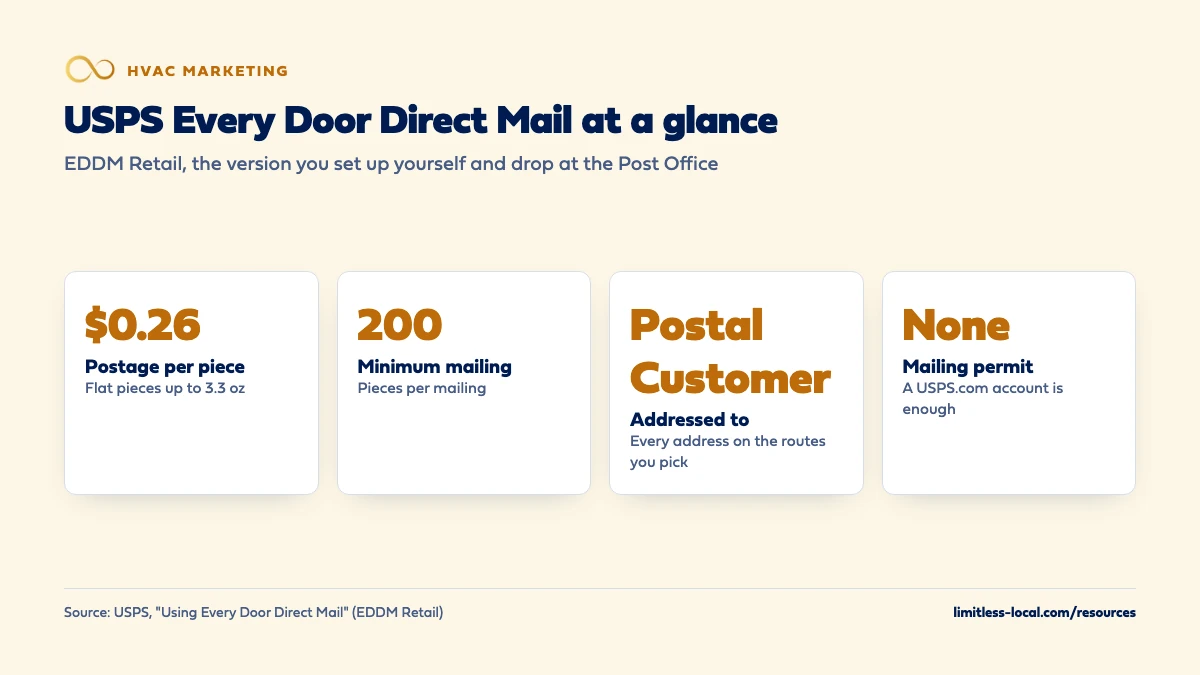
Postage is the part USPS publishes. For EDDM Retail, the version you set up yourself and drop off at the Post Office, pieces up to 3.3 ounces (USPS prices them as Marketing Mail flats) are currently $0.26 per piece. Larger mailings entered at a USPS Business Mail Entry Unit with a bulk permit can be as low as $0.259 per piece (USPS).
The rules for EDDM Retail:
- You send at least 200 pieces, and up to 5,000 pieces per day per ZIP code.
- You need a USPS.com account but no mailing permit.
- Every piece carries the EDDM Retail postage mark, and you bundle the pieces with a facing slip on each bundle.
- You drop the mailing at the Post Office that delivers to the routes you chose, or ship it there.
Design and printing are on top of postage, and those prices depend on your printer, size and paper. USPS points to its printer directory and approved vendors if you want help with design, printing and drop-off; it notes that private vendors may add their own charges.
How do I choose which neighborhoods to mail?
The EDDM Online Tool lets you search by address, city or ZIP code, see each carrier route in a table, and filter by residential count, age, household size and income, using U.S. Census data (USPS). You can select several routes for one mailing.
For an HVAC company, our suggestions for narrowing it down:
- Stay inside your real service area. A postcard that brings a call from a town your trucks don’t go to is wasted twice. Deciding which towns and ZIP codes to target covers how to draw that line.
- Start near your best jobs. Routes around neighborhoods where you’ve already done installs or have plan members are a reasonable first test, since your trucks and yard signs are already familiar there.
- Look at the residential count. Routes with a lot of non-residential addresses spend postage on businesses that won’t call about a home AC.
These are judgement calls, not rules. The point of the first mailings is to find out which routes answer.
Curious what your marketing is actually booking?
Get a free visibility audit — no obligation, no sales pitch.
When is direct mail a better bet than Google for an HVAC company?
In our judgement, mail earns its place in a few specific situations:
- Bringing back past customers. A tune-up reminder to people who’ve already used you, before the first heat wave or cold snap.
- Neighborhoods around a recent install. Homes of a similar age often have equipment of a similar age.
- A new location or a new service area, where nobody knows your name yet and your Google profile has few reviews.
- Maintenance plan sign-ups, which homeowners decide on when nothing is broken, the moment they aren’t searching Google.
Search wins when the system has already failed. A homeowner with no cooling looks at the phone, not the stack of mail on the counter, which is why showing up in the map pack and answering the phone come first.
When is direct mail a waste of money for HVAC?
The common ways it goes wrong, in our judgement:
- No tracking. If the postcard shows your main number, every call it brings looks like any other call, and you’ll never know whether it worked.
- One drop, then a verdict. A single mailing tells you very little in either direction.
- No clear offer. USPS’s own advice is that mail with a clear offer and call to action helps generate responses. A postcard that only shows your logo and a list of services asks the homeowner to do the work.
- Nobody to answer. A mailer that lands the week the office is swamped sends calls to voicemail. How fast you respond to new leads matters just as much for mail as for ads.
- Mailing outside your service area, or to routes heavy with apartments or businesses when you want homeowners.
What should an HVAC postcard actually say?
One offer, one way to act, and enough to trust you. Our checklist:
- A single offer with an end date, such as a seasonal tune-up or a maintenance plan sign-up.
- A tracking phone number used only on this mailing, in large type.
- A short web address or QR code that goes to a page about that offer, with a tag so your analytics knows it came from the mailer.
- The towns you serve, so a homeowner knows you’ll come to them.
- Proof that’s true, like your star rating and review count on Google, as long as you keep it current.
Keep the rest off. Every extra line competes with the phone number.
How do I track calls and visits from a mailer?
Give the mailing its own phone number and its own web link, then record the source when the job books.
- A tracking number. CallRail describes source tracking as one unique tracking number for each marketing campaign, and lists a direct mail campaign as an example (CallRail Help). ServiceTitan recommends attaching a unique tracking number to each campaign, including mailers and door drops, to get accurate return-on-investment data (ServiceTitan Help).
- A tagged link or QR code. Google Analytics reads utm_source, utm_medium and utm_campaign tags on a link, and shows the campaign in the Traffic acquisition report (Analytics Help). Put the tagged address behind the QR code, for example utm_source=postcard, utm_medium=mail, utm_campaign=spring-tuneup.
- A lead source in your field software. Add “Mailer” to the list. Housecall Pro’s lead source can be tracked on customers, jobs and estimates, so you can report which sources bring good jobs (Housecall Pro Help).
Then ask every new caller how they heard about you. Some people will keep the postcard and search your name instead of dialing the number on it. Tracking whether your marketing is paying off covers the setup that ties all of this to booked jobs.
How do I mail past customers without wasting postage?
Clean the list first and let your software stop the mail when it’s done its job. ServiceTitan’s direct mail tool shows what to look for (ServiceTitan Help):
- Stop conditions. You can stop sending to a customer once they’ve called the campaign’s number or booked a job, so nobody gets a fourth postcard after they’ve already scheduled.
- Do-not-mail flags. Customers marked Do not mail or Do not service are left out.
- Bad addresses. ServiceTitan says that, according to USPS, a typical return amount is about 10% of the volume shipped, most often because of mail-forwarding problems or a missing unit or apartment number. That’s returned mail, not a response rate, but it’s a reason to clean addresses before you print.
EDDM has its own version of the last point: if someone asks to be taken off your mailings, USPS lets you list that address in the Do Not Deliver column on the bundle’s facing slip. If you’d rather reach the same customers for less, email marketing for HVAC covers the cheaper reminder channel.
How do I judge whether direct mail paid off?
The same way as any other channel: total cost divided by booked jobs it produced.
- Total cost is postage, design, printing and any vendor fees.
- Booked jobs are the ones you can tie to the mailer: calls to its tracking number, visits from its tagged link, and customers who said “the postcard” when asked.
- Revenue matters too. A mailer that books three tune-ups and one system replacement can beat one that books ten small service calls.
Give it more than one drop before you decide. Compare it against the same season last year, not the month before, because HVAC demand moves with the weather. If the cost per booked job is in line with your ads after a few rounds, mail has earned a spot; if not, move the money to whatever is booking cheaper.
Not sure which of these is costing you jobs?
A free visibility audit checks the Google profile, reviews, site and tracking, and shows what to fix first.
What's different about direct mail for HVAC companies
Timing follows the seasons. A tune-up postcard works best when it lands before the first heat wave or cold snap, while there’s still room on the schedule. Mail that arrives once demand has already spiked competes with every no-cool call you can’t get to.
Equipment age is the hook. Your records show which customers have older systems. In our judgement, a postcard about a maintenance plan or a replacement check is more relevant to those homes than a generic “we do heating and cooling” mailer.
Phone numbers outlive the campaign. Homeowners stick HVAC mailers on the fridge or the furnace for years. Use a tracking number you plan to keep, forwarded to your main line, so an old postcard still rings your office.
A worked example: what one EDDM mailing needs to book to pay for itself
These numbers are made up to show the math, except the postage rate, which is USPS’s current EDDM Retail price. It isn’t a forecast of what a mailing will do for you.
- You mail 600 homes on two routes near your shop.
- Postage: 600 × $0.26 = $156.
- Design and printing, say $0.20 a piece: 600 × $0.20 = $120.
- Total cost: $156 + $120 = $276.
Now say an average tune-up or service call leaves you $150 after parts and labor. Divide $276 by $150 and the answer is a little under two, so two booked jobs covers the mailing. A single replacement booked from it would cover it many times over; zero bookings means you’ve learned something for $276.
That’s the test to run before you scale up: a tracked mailing, a break-even number written down in advance, and a count of booked jobs against it. We don’t run direct mail ourselves, but our Essentials package, at $3,500 a month, includes call, web and form tracking with basic attribution, which is the same yardstick for the channels we do run. Whether those are worth it for your company is what a free visibility audit is for.
Frequently asked questions
Do I need a mailing permit for EDDM?
Not for EDDM Retail. You need a USPS.com account, and you pay online or at the Post Office. Bulk EDDM mailings entered at a Business Mail Entry Unit use a bulk mailing permit.
Can I choose only homeowners with EDDM?
No. EDDM delivers to every address on the routes you pick. The online tool lets you filter routes by residential count, age, household size and income from Census data, but you choose routes, not individual homes.
How long does a postcard take to arrive?
It depends on how you send it. ServiceTitan says its direct mail postcards are usually handed to USPS within 48 hours of launch and then take about five to seven business days to deliver on average.
Should I use a toll-free or local tracking number on a mailer?
For a mailing in your own area, a local number usually fits. ServiceTitan’s setup suggests a local number for a local campaign and a toll-free number for a regional or national one.
Can I put a QR code on an HVAC postcard?
Yes. Point it at a web address with utm_source, utm_medium and utm_campaign tags so Google Analytics shows the visits under that campaign. Google says those three tags should always be used.
What do I do if a homeowner asks to stop getting my mailers?
Take them off. For EDDM, USPS lets you list the address in the Do Not Deliver column on the facing slip; in software like ServiceTitan, mark the customer Do not mail.
Key takeaways
- Direct mail reaches homeowners before they need you; Google reaches them when they do.
- Start with your own customer list before mailing whole neighborhoods with EDDM.
- EDDM Retail postage is $0.26 a piece, with a 200-piece minimum and no permit needed.
- Every mailer needs its own tracking number and tagged web link, or you can’t judge it.
- Decide your break-even before you mail, and judge cost per booked job over several drops.
Want a second set of eyes on your setup?
We'll look at how you show up locally and where calls are leaking, then send you a plain-English breakdown.
More in this section
- Do Facebook ads work for getting HVAC calls?
- How do I set up email marketing for my HVAC company?
- Is SEO worth it for a small HVAC company?
- Are Google Local Services Ads worth it for an HVAC company?
- How do I track whether my HVAC marketing is paying off?
Sources
- Using Every Door Direct Mail — USPS
- Create Direct Mail campaigns — ServiceTitan Help
- Add marketing campaigns in ServiceTitan — ServiceTitan Help
- Source tracking basics — CallRail Help Center
- URL builders: Collect campaign data with custom URLs — Google Analytics Help
- How to use lead sources — Housecall Pro Help Center