
How do I market for the pool projects I want more of?
- How do I get more of the pool jobs I actually want: new builds, renovations, luxury pools or add-ons?
- Why does a pool builder get the wrong mix of projects?
- Step 1: Which pool projects should I want more of?
- Step 2: Who buys those projects, and what do they search?
- Step 3: Does my website show off the projects I want?
- Step 4: Does my gallery lead with the right work?
- Step 5: What should my Google Business Profile say?
- Step 6: How do I point Google Ads at the projects I want?
- Step 7: What about social media and ads on Facebook and Instagram?
- Step 8: How do referrals and partners fit in?
- How do I stop attracting projects I don't want?
- How do I know it's working?
- What's different about choosing your project mix as a pool builder
- A worked example: comparing two project types
- Frequently asked questions
- Key takeaways
- More in this section
- Sources
The short version
- Choose project types by profit per crew-week, close rate and season fit, not by habit.
- Lead with those projects on your website, gallery and Google profile.
- Give each wanted project type its own ad campaign, budget and landing page.
- Track leads and contracts by project type to see the mix change.
For pool builders who are busy with the wrong mix of work and want their website, Google profile, ads and referrals to bring in more of the jobs that pay best and fit their crews.
Get a free visibility audit · Book a growth call
How do I get more of the pool jobs I actually want: new builds, renovations, luxury pools or add-ons?
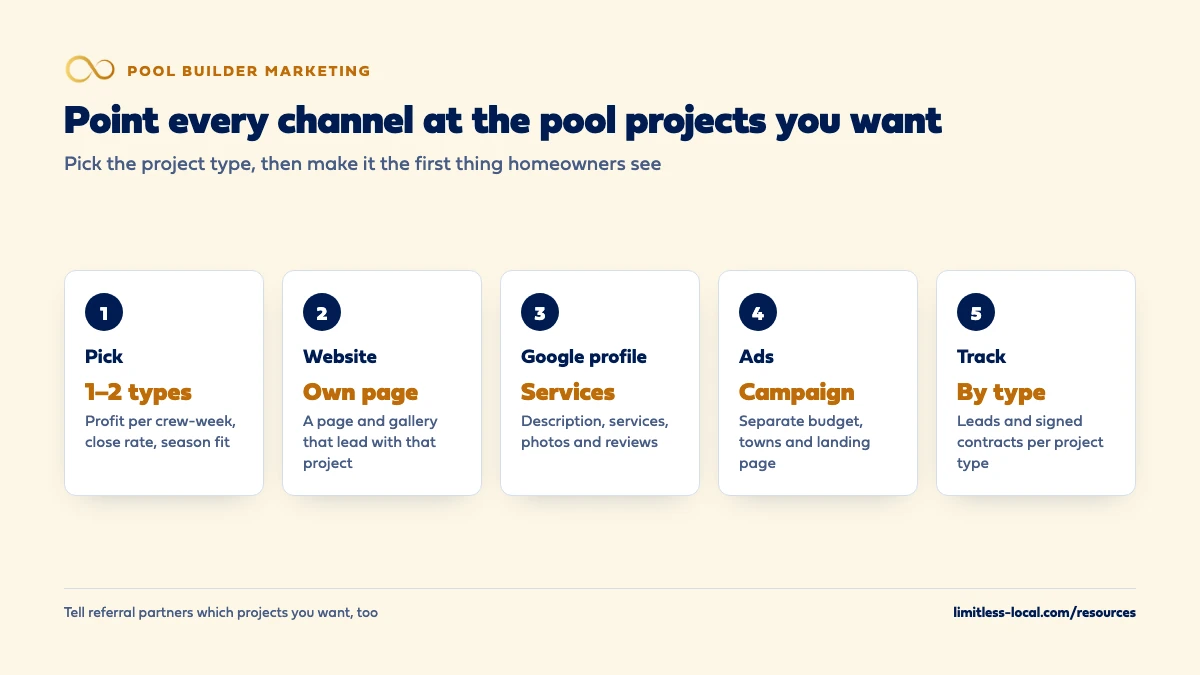
Pick the one or two project types you want more of, based on profit per week of crew time, close rate and how they fit your season, then make those projects the first thing homeowners see everywhere you market. Give each its own website page and gallery, list it in your Google Business Profile services and photos, run it as its own Google Ads campaign with its own budget, and tell referral partners exactly which jobs you want. Track leads and signed contracts by project type, so you can see the mix shift over a season.
Your website is usually where the mix gets decided, because it’s where a homeowner sees what you’re proud of. Our website builds start at $3,750 for a themed site of up to 25 pages, or $3,000 with any Limitless Engine package, which is plenty of room for a page and gallery for each pool project you want. Our marketing for pool builders page shows how the site, SEO and ads work together, and the rest of the pool builder marketing questions library goes one question at a time.
Why does a pool builder get the wrong mix of projects?
Because marketing brings in whatever it shows. If your website opens with a mix of everything you’ve ever built, your Google profile lists every service under the sun and your ads run on “pool builder” across the whole metro, you’ll get a mix of everything: small repairs, budget fiberglass shoppers, the occasional dream build. The phone rings, but not with the jobs you’d pick.
Homeowners decide fast whether you’re the builder for their project. A buyer planning a high-end gunite pool with a spa and outdoor kitchen wants to see that you build those, and so does someone who just wants their old plaster resurfaced. When every channel leads with the same few project types, both the right buyers and Google get the message.
Step 1: Which pool projects should I want more of?
Don’t go on gut feel or on which jobs are the most fun to post. Score each project type you do on a few things:
- Profit per week of crew time, not just profit per job. A smaller job that ties up a crew for less time can earn more per week than a big build.
- Close rate: how many consultations for that type turn into signed contracts.
- Season fit: whether it can fill slow months, like renovations or equipment upgrades in the off-season.
- Crew fit: whether your crews and subs do it well and want to do more of it.
- Headaches: change orders, callbacks, permit delays and warranty claims.
Pick one or two winners. Trying to push five project types at once spreads your budget and your message too thin to change anything.
Step 2: Who buys those projects, and what do they search?
Each project type has its own buyer. A first-time pool buyer compares builders, financing and timelines. A homeowner with a tired pool searches for resurfacing, remodels or new equipment and often decides faster. A luxury buyer cares about design, materials and who’s built something similar nearby.
Write down how each buyer describes the project in their own words, such as “fiberglass pool installation”, “pool remodel”, “pool and spa” or “saltwater pool conversion”, plus the towns where they live. Google’s SEO Starter Guide suggests thinking about the words your readers might search for, since someone new to a topic may use different words than an expert. Those phrases become your page headings, your ad keywords and your profile services.
Which marketing channels work best for custom pools versus simpler builds covers how those buyers shop differently.
Step 3: Does my website show off the projects I want?
Give every project type you want more of its own page. Fill it with things that are only true of that type: your own finished projects, how you build it, how long it takes, what yards and budgets it suits and what the consultation looks like. The same starter guide says content that’s easy to read, unique, up to date and helpful will likely influence your presence in search more than anything else, so write it from what you actually know, not from a template.
Then put those projects up front. The home page, the main menu and the first gallery photos should lead with the work you want. Projects you’d rather do less of can stay on the site, lower down.
Whether a pool builder needs separate pages for each pool type covers how to build those pages without creating near-copies.
Step 4: Does my gallery lead with the right work?
Your gallery is the most persuasive page you have, and most builders sort it by date. Sort it by the project you want more of instead. Put your best two or three examples of that type at the top, with a short caption: the project type, the town, what made it hard and how long it took.
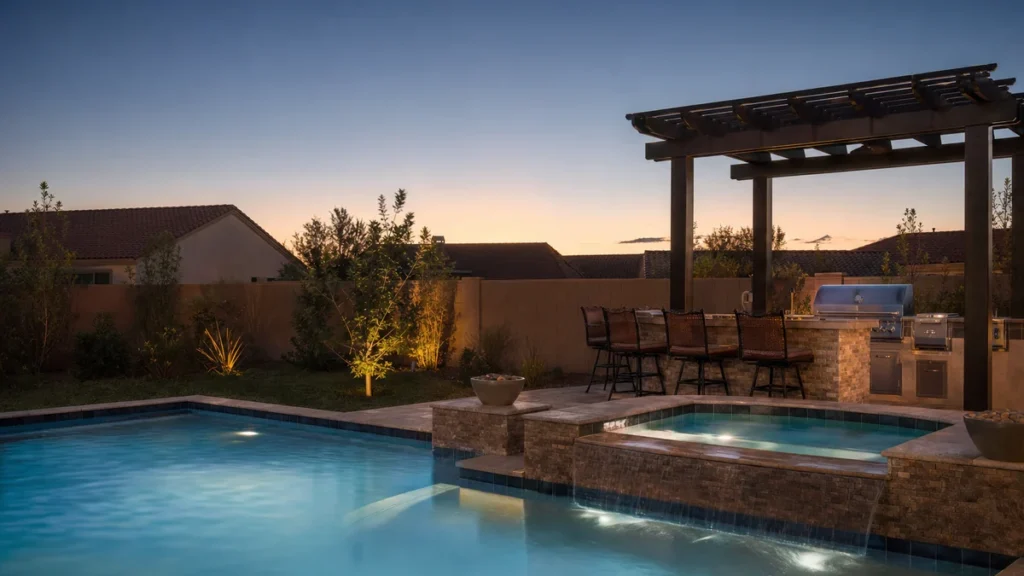
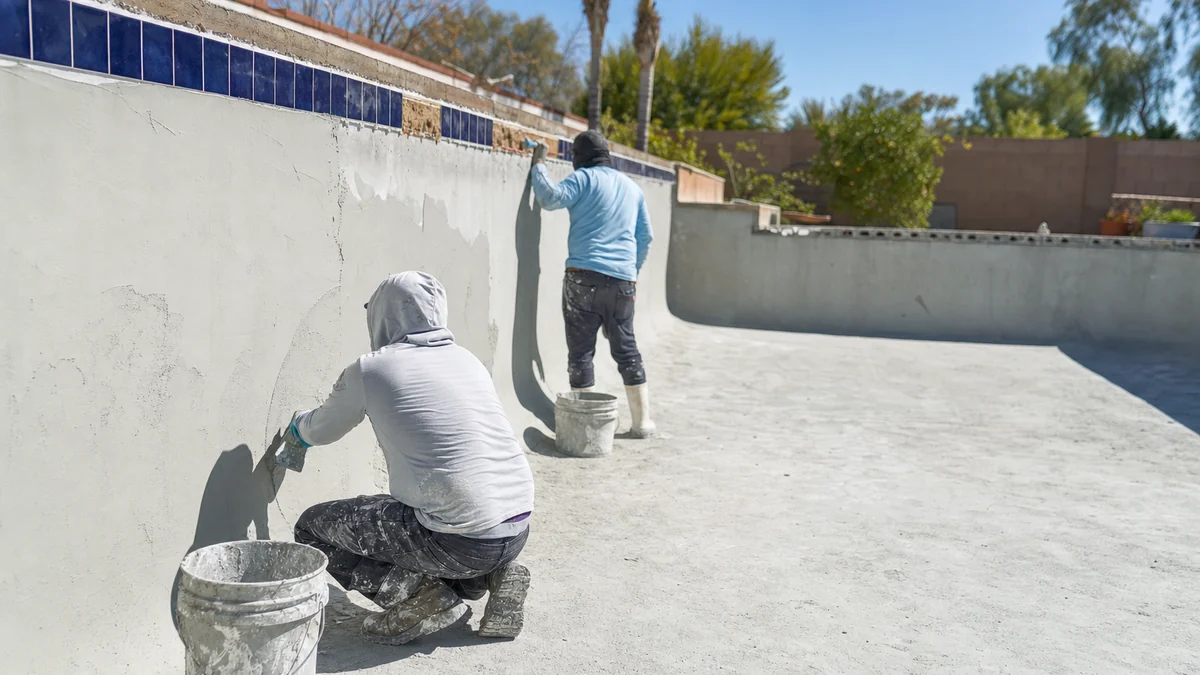
Shoot every wanted project from dig to startup. If you want more renovation work, before-and-after pairs from the same angle sell it better than anything you can write. If you want more luxury builds, show the details: tile, water features, lighting at dusk, the outdoor kitchen.
How a pool builder should use project photos and videos covers what to shoot at each stage.
Curious what your marketing is actually booking?
Get a free visibility audit — no obligation, no sales pitch.
Step 5: What should my Google Business Profile say?
Your profile is often the first place a homeowner sees you, so point it the same way. Edit your Business Profile so the business description names the projects you want, and use the services editor to list them clearly.
Photos matter as much here as on your site. Google’s photo tips suggest adding at least three photos that represent the services you offer, including the speciality services you deliver, and say photos should represent reality, without heavy filters or AI. Load up on the project types you want, and keep adding them as jobs finish.
When you ask for reviews, ask every customer, but make sure the customers from your wanted projects get asked at handover without fail. Reviews that mention a resurfacing job or a custom spa tell the next buyer you do that work.
Step 6: How do I point Google Ads at the projects I want?
Split your ads by project type. Google’s guide to organizing your account says to create a separate campaign when you need different settings, such as budget or location targeting, and to build each ad group around a narrow theme with keywords related to it. For a pool builder, that usually means a campaign for each project type you want, each with its own budget, towns and landing page.
That lets you put more money behind the work you want and less behind the rest. It also stops a cheap, high-volume project type from eating the whole budget.
Use negative keywords to exclude search terms for work you don’t want, such as above-ground pools, pool cleaning or small repairs. Whether to market renovations separately from new pools shows that split in detail.
Step 7: What about social media and ads on Facebook and Instagram?
Post the projects you want more of, more often than anything else. Stage-by-stage clips of a custom build, a time-lapse of a resurfacing job or a dusk shot of a spa spillover teach your followers what you’re known for.
If you run Meta ads, build the ad around the project you want: the photos, the words and the page the ad sends people to. Showing ads to people who already visited a specific project page on your site is a good way to stay in front of a buyer who’s weeks or months from deciding.
Step 8: How do referrals and partners fit in?
Tell them what you want. Past customers, landscapers, outdoor kitchen builders, home builders and realtors send you whatever they think you do. A simple message works: “We’re taking on more renovations and spa additions this year; if a neighbor mentions one, we’d love an intro.”
Match the partner to the project. Landscapers and outdoor living contractors see backyards that need a full makeover. Realtors meet buyers of homes with tired pools. Home builders meet owners planning a new backyard from scratch.
How do I stop attracting projects I don't want?
- Say what you do, and what you don’t. A short line like “We build inground gunite pools and remodel existing pools; we don’t install above-ground pools” saves everyone time.
- Ask on your form. A project-type question and a timeline question tell you what’s coming before the call.
- Signal the budget. A “projects typically start at” line or a financing example on wanted-project pages filters out mismatched buyers.
- Refer out. Send the jobs you don’t want to someone you trust. It earns goodwill and sometimes referrals back.
How to qualify leads before a design consultation covers the questions to ask.
How do I know it's working?
Tag every lead and every signed contract with its project type and its source. Then compare the mix month by month against the same months last year: are more of your consultations for the wanted project types, is the close rate on them holding, and what did each signed contract of that type cost?
Give it a season. Pool contracts often sign months after the first inquiry, and SEO for new pages takes time to build. If the leads for your wanted projects are coming in but not closing, the problem is in the consultation or the proposal, not the marketing.
Not sure which of these is costing you jobs?
A free visibility audit checks the Google profile, reviews, site and tracking, and shows what to fix first.
What's different about choosing your project mix as a pool builder
Project sizes vary enormously. A pool builder might sell a resurfacing job and a full custom build with a spa and outdoor kitchen in the same week, with very different contract sizes, crew time and margins. Few trades have that range, which is why choosing the mix matters so much.
Crew time is the scarce thing. In peak season you can’t add crews overnight, so the projects that earn the most per week of crew time are often worth more than the biggest contracts.
Seasons shape the mix. New builds pile up in spring; renovations and equipment work can fill the slower months. A planned mix can smooth the calendar.
Every finished project markets the next one. Neighbors see the build, the yard sign and the finished pool. Doing more of the work you want puts more of it on your street, in your gallery and in your reviews.
A worked example: comparing two project types
These numbers are made up to show the math, not a benchmark for your company. Say a builder compares two project types.
- Custom gunite new build: a $90,000 contract with $27,000 gross profit, tying up a crew for about 12 weeks. That’s $27,000 divided by 12, or $2,250 per crew-week.
- Full renovation (resurfacing, tile and new equipment): a $32,000 contract with $9,600 gross profit, tying up a crew for about 3 weeks. That’s $9,600 divided by 3, or $3,200 per crew-week.
The new build is the bigger job, but in this example each week of crew time earns more on renovations. That doesn’t mean the builder should drop new builds; they also bring referrals and show off the best work. It might mean adding a renovation page and gallery, a renovation ad campaign with its own budget for the slower months, and a note to landscaping partners that the company is taking more remodels.
Run the same math with your own numbers. The answer is often different from the one you’d guess.
Frequently asked questions
Should I take my unwanted project types off my website?
Usually not. Keep them listed if you still do them, just lower down and with less ad money behind them. Remove them only if you’ve truly stopped doing that work.
How long does it take to shift my project mix?
Ads aimed at a new project type can bring inquiries quickly, but SEO for new pages typically takes 3–6 months, and pool contracts sign long after the first call. Plan on a season before judging the mix.
Can I market luxury pools if I've only built a few?
Yes, if the ones you’ve built are strong. Show each in detail with the story behind it, and be honest about your experience; a few well-documented projects beat a gallery of stock photos.
Should add-ons like spas, fire features and outdoor kitchens get their own marketing?
Give them their own page if you want more of them and have finished examples to show. Otherwise feature them inside your pool pages and galleries, where buyers planning a full backyard will see them.
What if the project type I want has fewer searches in my area?
Lean more on proof and partners than on ads. A strong page and gallery still help the buyers who do search, and referral partners can send buyers who never type it into Google.
Key takeaways
- Choose the projects you want by profit per week of crew time, close rate and season fit.
- Give each wanted project type its own page and put it first in your gallery.
- Point your Google profile services, photos and review asks at the same projects.
- Run each wanted project type as its own ad campaign with its own budget, and exclude the work you don’t want.
- Track leads and signed contracts by project type and judge the shift over a season.
Want a second set of eyes on your setup?
We'll look at how you show up locally and where calls are leaking, then send you a plain-English breakdown.
More in this section
- How do I grow a pool construction business with marketing?
- How do I advertise a pool construction company?
- How should a pool builder prepare marketing before peak season?
- How should a pool builder split its marketing budget?
- Which marketing channels get pool builders jobs fastest?
Sources
- SEO Starter Guide: The Basics — Google Search Central
- Edit your Business Profile — Google Business Profile Help
- Tips for business-specific photos on your Business Profile — Google Business Profile Help
- Organize your account with ad groups — Google Ads Help
- About negative keywords — Google Ads Help