
What offers actually get homeowners to call an electrician?

- Which promotions and specials work best for an electrical contractor?
- Why do some offers bring in calls and others just bring in price shoppers?
- Which offers work best for residential electrical work?
- Can I advertise "free" inspections or estimates?
- How do I run a discount without getting into trouble?
- What do I need to know before advertising financing?
- How do I match an offer to the kind of job I want more of?
- Where should my offers appear?
- How do I know which offer is working?
- What's different about offers for electricians
- A worked example: a discount versus an inspection offer
- Frequently asked questions
- Key takeaways
- More in this section
- Sources
The short version
- Lower the risk of calling: set-price inspections and diagnostic visits beat deep discounts.
- Tie offers to a real reason now: storm season, a new EV, an older home.
- Any discount must be off a price you really charge, with conditions next to the offer.
- Financing ads that state a payment amount, a repayment period, a down payment or a finance charge trigger extra disclosures (not legal advice).
- Measure booked jobs and follow-on work, not just calls.
For electrical contractor owners designing offers for their website, ads and mailers: which kinds of offers give homeowners a real reason to call, where to put them, and the advertising rules that come with them.
Get a free visibility audit · Book a growth call
Which promotions and specials work best for an electrical contractor?
The offers that work best for electricians lower the homeowner’s risk of calling rather than slashing the price: a set-price safety inspection or diagnostic visit, a seasonal check tied to a real need like storm season or a new EV, a bundled add-on with a big job, or clear financing information for panel upgrades and generators. Every offer has to be real, with its conditions printed right next to it, because the FTC treats price and “free” claims as advertising claims you must be able to back up. Judge an offer by booked jobs and the work that follows, not by call volume.
That’s how we build offers into the ads we run for local trades: one offer per campaign, matched to a page about that service, with call tracking so you can see which offer books work. Our local ads management page explains how we run Google Ads and Local Services Ads, our electrical contractor marketing page shows the full plan, and the electrical marketing questions library covers the rest.
Why do some offers bring in calls and others just bring in price shoppers?
In our judgement, it comes down to what the offer is for. An offer that only cuts the price attracts the people who care most about price, and they’re the hardest to close on anything bigger. An offer that removes a reason not to call attracts homeowners who have a real problem and were hesitating.
The things that stop a homeowner from calling an electrician are usually uncertainty: “What will it cost just to have someone look?”, “Will they try to sell me a new panel?”, “Is this even serious?” Offers that answer those questions, such as a set price for a visit or a clear safety check, tend to bring in better calls than “20% off”. If price shoppers are already filling your estimate calendar, keeping price shoppers off your schedule covers the screening side.
Which offers work best for residential electrical work?
In our judgement, these offer types fit most electrical shops:
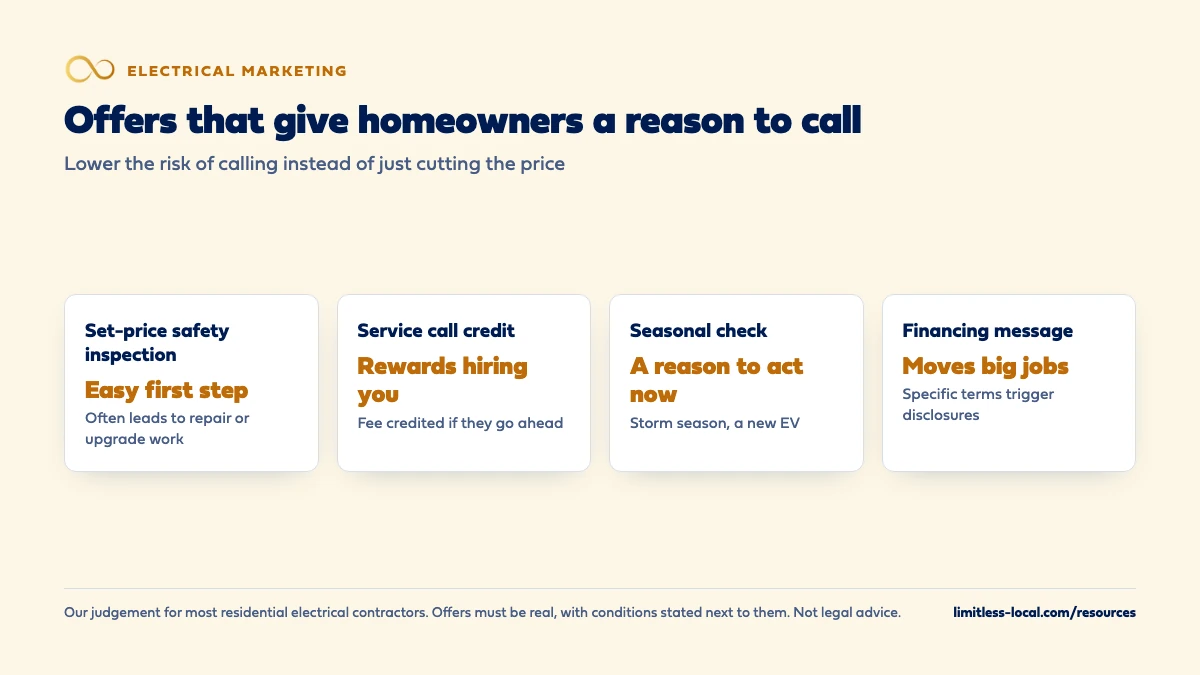
- Set-price safety inspection. A whole-home electrical check at a fixed, stated price. It gives a hesitant homeowner an easy first step and often leads to repair or upgrade work.
- Diagnostic or service call credit. Your normal service call fee, credited toward the repair if the customer goes ahead. It rewards the homeowner for hiring you, not for shopping.
- Seasonal checks. Generator checks before storm season, holiday lighting circuits, or a pre-summer AC circuit check, timed to when people are thinking about it.
- Bundles on big jobs. A whole-home surge protector added at a reduced price with a panel upgrade, or a dedicated circuit with an EV charger install.
- Financing information on high-ticket work. For panel upgrades, generators and rewires, knowing they can pay over time is often what moves a homeowner from “someday” to a call.
What all of these share: a real service at a real price, with an obvious next step.
Can I advertise "free" inspections or estimates?
Only if they really are free, with any conditions stated up front. The FTC’s Guides Against Deceptive Pricing say that whenever a “free”, “half price”, “50% off” or similar offer is made, all the terms and conditions should be made clear at the outset. They also say that if a seller raises the regular price of what must be bought to get the “free” item, or attaches other strings, the customer may be deceived (FTC Guides Against Deceptive Pricing).
For an electrician, in our practical reading, that means:
- “Free estimates” is fine for work you truly quote at no charge, such as a panel upgrade. If small jobs carry a service call fee, say so next to the offer.
- A “free surge protector with a panel upgrade” only works if your panel upgrade price didn’t quietly go up to pay for it.
- A “free inspection” that is really a sales visit for something else is the kind of bait the FTC warns about.
This is our reading of the FTC’s guides, not legal advice. State consumer protection laws apply too.
How do I run a discount without getting into trouble?
Make the comparison real. The FTC’s pricing guides say a reduction from your own former price is a legitimate basis for a price comparison only if that former price is the actual, bona fide price you offered to the public on a regular basis for a reasonably substantial period of time (16 CFR 233.1).
More broadly, the FTC’s small business advertising guide says ads must be truthful and not deceptive, that you need evidence to back up your claims before the ad runs, and that an ad can be deceptive because of what it leaves out (FTC).
In our judgement, the safe pattern for an electrician is simple: discount off a price you actually charge every week, put the end date and conditions right next to the offer, and honor it for everyone who meets the conditions. A “was $X, now $Y” on a price nobody ever paid is the pattern to avoid. Whether to show your regular prices at all is covered in whether electricians should show prices. Again, this is general guidance, not legal advice.
Curious what your marketing is actually booking?
Get a free visibility audit — no obligation, no sales pitch.
What do I need to know before advertising financing?
Financing messages can move high-ticket jobs, but they come with their own rules. The FTC’s guide notes that under the Truth in Lending Act and other federal and state laws, ads for consumer credit must include certain disclosures, and those disclosures must be clear and conspicuous (FTC).
The CFPB’s advertising rule under Regulation Z spells out the trigger. If an ad states the amount or percentage of any down payment, the number of payments or period of repayment, the amount of any payment, or the amount of any finance charge, the ad must also state, as applicable, the amount or percentage of the down payment, the terms of repayment, and the “annual percentage rate,” using that term, and, if the rate may be increased after consummation (once the credit deal is final), that fact (CFPB, Regulation Z). The CFPB’s commentary notes that general phrases like “monthly payments to suit your needs” don’t count as stating a payment amount.
In practice, in our judgement, most electricians are better off with a general message like “financing available for panel upgrades” in ads and on mailers, and leaving specific terms to the lender’s own materials. If you want to advertise a specific monthly payment or rate, get the wording from your financing provider and check it with your own advisor. This isn’t legal advice.
How do I match an offer to the kind of job I want more of?
Work backward from the job. In our judgement, a good pairing looks like this:
- Want more panel upgrades? Offer a safety inspection in older neighborhoods, and mention financing on the panel upgrade page. Getting more panel upgrade and EV charger jobs covers the rest of that plan.
- Want more EV charger installs? Offer a set-price home assessment that checks whether the panel has room, since that’s the homeowner’s biggest unknown.
- Want more generator work? Run a pre-storm-season offer early enough to schedule installs before demand peaks; getting more generator leads before storm season covers timing.
- Want to fill a slow month? A limited-time inspection or a bundle on small jobs can keep techs busy; more leads in the slow season has other options.
Where should my offers appear?
Everywhere the homeowner might see you, and the same offer in every place. In our judgement:
- Your website: on the page for that service, near the top and next to the phone number, with conditions right below it. One offer per page.
- Google Ads: in the ad text and on the landing page it sends people to, so the click lands on the offer they saw.
- Your Google Business Profile: as a post or offer while it’s running.
- Mailers and door hangers: for past customers and targeted neighborhoods; whether direct mail still works covers that channel.
- The phone: your office needs to know every live offer and its conditions. An offer the person answering doesn’t know about loses trust fast.
Take expired offers down everywhere on the end date. An old offer still on your site or profile is a promise you may be asked to keep.
How do I know which offer is working?
Give each offer its own trackable path: a separate tracking number or landing page, or an offer code your office records. Then look at more than call count:
- How many calls or forms came in from the offer.
- How many booked the offered service.
- How many went on to more work, such as repairs found on an inspection or an upgrade after a diagnostic.
- Revenue per booked job, compared with your normal jobs.
In our judgement, the best offers for an electrician often look average on calls and strong on follow-on revenue. An inspection offer that books fewer calls but turns a third of them into repair work can beat a discount that floods the phone with one-time callers.
What's different about offers for electricians
Safety gives you a real reason to call that isn’t a discount. Many homeowners have no idea what condition their wiring and panel are in. A set-price inspection speaks to that without inventing urgency. Keep the message factual: no scare tactics, and never claim a hazard you haven’t seen.
Your big jobs need financing more than discounts. A few hundred dollars off a panel upgrade or generator rarely changes the decision; knowing it can be paid over time often does. That’s why financing rules matter more to electricians than to trades selling small jobs.
Licensed work is part of the offer. Saying the offer includes licensed work and permits pulled where required separates you from handyman pricing.
Want to see where your company stands?
A free visibility audit shows where you show up on Google, Maps and AI answers, and what it's costing you in calls.
A worked example: a discount versus an inspection offer
These numbers are made up to show the math, not a benchmark for your market. Say you test two offers on the same ad budget for a month each.
Offer A, a percentage discount on any repair, brings in 40 calls. 14 book, mostly small one-time jobs, and none lead to further work that month.
Offer B, a set-price safety inspection at $79, off your regular inspection price of $149 that you charge every week, brings in 28 calls. 17 book an inspection, and 5 of those homeowners go on to repair or upgrade work averaging $1,900 each, which is $9,500 of follow-on work.
Offer B costs you $70 per inspection against your regular price, or $1,190 across 17 inspections. Fewer calls, but far more work behind them. On these made-up numbers, the inspection offer wins, and the only way to see that is to track follow-on jobs, not just calls.
Frequently asked questions
Should I offer a discount to first-time customers?
It can work, but in our judgement a set-price visit or a credited service call usually attracts better customers than a percentage off. If you do discount, it has to be off a price you really charge, with the conditions stated.
Do senior or military discounts work for electricians?
They can build goodwill, and they’re simple to explain. Apply them consistently, state any conditions, and track them like any other offer.
How long should an offer run?
Long enough to measure, usually a few weeks to a couple of months, with a real end date. In our judgement, an offer that never ends stops being an offer and becomes your price.
Can I use an offer in my Google Business Profile?
Yes, as a post while it’s running. Keep it identical to the offer on your website and in your ads, and remove it when it ends.
Is "no trip charge" a good offer?
It can be, if it’s true for everyone in your stated service area. If the waiver only applies when the customer books the repair, say that right next to the offer.
Key takeaways
- Offers that lower the risk of calling, like a set-price inspection, usually beat deep discounts.
- Match each offer to the job you want more of and the season homeowners think about it.
- “Free” and discount claims must be real, with all conditions clear up front, per the FTC’s pricing guides.
- Financing ads that state a payment, term, down payment or finance charge trigger extra disclosures; general messages don’t.
- Run the same offer everywhere, take it down when it ends, and judge it by booked and follow-on work.
Not sure what's working right now?
Start with a free visibility audit: rankings, Google profile, reviews and tracking, checked against your service area.
More in this section
- What should an electrician's website have to get more calls?
- Should my electrical company market smart home installs?
- Which marketing wins emergency electrical calls vs planned projects?
- How do I get more whole-home rewiring jobs in older neighborhoods?
- How do I get more referrals from past electrical customers?
Sources
- 16 CFR Part 233 — Guides Against Deceptive Pricing — eCFR (Federal Trade Commission rules)
- 16 CFR 233.1 — Former price comparisons — eCFR (Federal Trade Commission rules)
- Advertising FAQ's: A Guide for Small Business — Federal Trade Commission
- § 1026.24 Advertising. — Consumer Financial Protection Bureau