
Pay an in-house marketer year-round if restoration is seasonal?

- Is a full-time marketing salary worth carrying through a restoration company's slow months?
- Is restoration work really seasonal?
- What does a full-time marketer cost across a full year?
- What should an in-house marketer do in the slow months?
- Does pausing marketing in the slow season cost me later?
- When is a year-round salary hard to justify?
- What are the alternatives to a full-time, year-round hire?
- Can I hire a marketer just for storm season?
- How do I keep a full-time marketer busy all year?
- How should ad spend change through the year?
- How do I tell whether the year-round salary is paying off?
- What's different about this for restoration companies
- A worked example: what the slow months need to earn
- Frequently asked questions
- Key takeaways
- More in this section
- Sources
The short version
- Slow months are when SEO, pages, reviews and referral work get done.
- The base of water, sewage and leak calls runs all year; storms sit on top.
- Ad spend can flex with the season; a salary can't.
- If the quiet months don't hold a full-time job, don't pay for one.
For restoration owners whose work swings with freezes and storms, deciding whether a full-time marketer earns their pay in the quiet months.
Get a free visibility audit · Book a growth call
Is a full-time marketing salary worth carrying through a restoration company's slow months?
Usually yes, if the slow months are used for the work that makes the busy months pay: service pages, the Google profile, reviews, tracking, referral partners and a storm plan that’s ready before the weather turns. Restoration is rarely as seasonal as it feels, because burst pipes, appliance leaks and sewage backups come in all year. If your quiet months really don’t hold enough work for a full-time person, don’t carry a full salary for a part-time job; a part-time hire, a contracted specialist or an agency whose scope you can scale costs less.
If you’d rather pay for the work than for a seat, that’s the comparison our packages are built for: Essentials is $3,500 a month and Growth is $4,500 a month, ad spend is paid to Google separately, and you can raise or cut that spend with the season. Terms are month-to-month. We ask for three months in the contract, but if you want to leave, we won’t make you stay. See how it works for water, fire and mold companies on our restoration marketing page, read the restoration marketing guide for every channel, or browse more restoration marketing questions.
Is restoration work really seasonal?
Partly. Most restoration companies have peaks: the first hard freeze, when pipes burst across town in one night; spring rains and snowmelt; and, on the Gulf and Atlantic coasts, the hurricane season, which Ready.gov lists as June 1 to November 30 for the Atlantic. Fire jobs often cluster in the heating months.
Underneath the peaks sits a base that doesn’t care about the calendar. Washing machine hoses fail in July. Water heaters let go in April. Toilets overflow, sewer lines back up and dishwashers leak every week of the year. Mold work follows water damage wherever and whenever it happens.
For most owners, the picture is a steady base with storms stacked on top. Before you decide the slow months are dead, pull last year’s booked jobs by month from your job software. The quietest month is often busier than it feels, and that base is exactly what steady marketing protects.
What does a full-time marketer cost across a full year?
More than the salary on the offer letter. O*NET, the Labor Department’s job database, lists a 2025 median wage of $78,760 a year for market research analysts and marketing specialists, based on Bureau of Labor Statistics data. That’s a national median across every industry, not a restoration benchmark, but it’s a fair starting point.
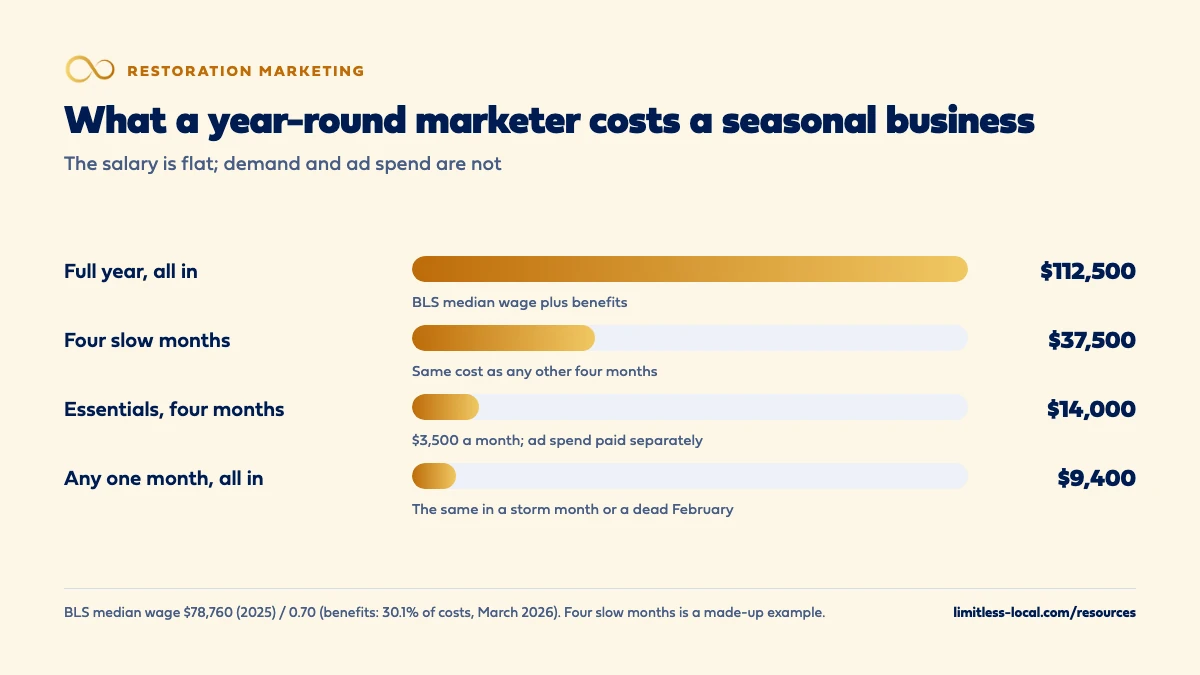
Benefits and payroll costs come on top. Wolters Kluwer’s VitalLaw coverage of the bureau’s employer costs report says benefits made up 30.1 percent of private employers’ compensation costs in March 2026, so wages and salaries were just under 70 percent. Divide that median wage by 0.70 and the total comes to roughly $112,500 a year, or about $9,400 a month, before software, training or ad spend.
The key point for a seasonal business: that cost is flat. You pay the same in a dead February as in a freeze week. Ad spend can drop when the phones are quiet; a salary can’t.
What should an in-house marketer do in the slow months?
The work that’s impossible during a storm week. When the phones are ringing, everyone is answering calls and dispatching crews, and nothing long-term gets done. The quiet months are when it should:
- Service pages. One clear page each for water extraction, burst pipes, sewage cleanup, mold and fire, written with what your crews actually do.
- Town pages that say something real. Only for towns you serve, with jobs you’ve done there.
- The Google profile. Fresh job photos, services, hours, and replies to every review.
- Review requests. A routine after every job, so the count keeps climbing between storms.
- Referral partners. Visits and follow-ups with plumbers, property managers and insurance agents, which take time a storm week never has.
- Tracking. Checking that every channel has its own number and every job has a source.
- The storm plan. Budget levels, ad copy, landing pages and call routing ready to switch on.
How to use SEO and ads in a restoration slow season goes deeper on which of these to do first.
Does pausing marketing in the slow season cost me later?
Often, yes, and the bill comes due at the worst time. SEO typically takes 3-6 months to show meaningful organic growth, so pages and profile work done in a quiet spring are what show up when the first freeze hits. Skip that work and you start each storm season from the same place as the last one.
Ads are different: they can generate leads within days of launch, so cutting ad spend in a slow month is a reasonable move. Trimming them to the year-round jobs is usually better than switching them off entirely, because you keep the account running and the base calls coming.
The U.S. Small Business Administration’s guide to getting the most from your marketing budget warns about the chicken-and-egg trap: sales drop, so you cut marketing, and sales decline further. A restoration company that lets its marketer go every autumn and rehires every winter is living in that trap.
Curious what your marketing is actually booking?
Get a free visibility audit — no obligation, no sales pitch.
When is a year-round salary hard to justify?
When most of these are true:
- You’re one or two trucks in one town, and the base of year-round calls is small.
- The slow months really are slow, which last year’s jobs by month confirm.
- The specialist work, like paid search, already sits with someone else.
- There’s no second job the person could do well in the quiet weeks.
- You’d have to cut crew pay or equipment to cover the salary in a bad quarter.
In that position, a full-time marketer spends part of the year looking for things to do, and you pay for it. A smaller, flexible setup usually gets you the same work for less. In-house marketer vs agency for a restoration company compares the full costs side by side.
What are the alternatives to a full-time, year-round hire?
- A part-time employee. Fewer hours all year, still in-house, still learning your business. Good for the Google profile, reviews, photos and referral follow-up.
- A combined role. Someone who runs marketing and also coordinates jobs, handles estimates or works the phones. The marketing hours rise in quiet months and fall in storm weeks, when the other half of the job takes over.
- A contracted specialist. Paid search or website work bought by the project or the month. The IRS’s guidance on independent contractors versus employees says it’s critical to classify the relationship correctly, and that the degree of control and independence decides it.
- An agency. A monthly fee for several skills, with ad spend paid to Google separately so it can follow the season.
- A split. A part-time or combined in-house role for the work that needs your people, plus outside help for the specialist work.
Can I hire a marketer just for storm season?
It rarely works. Storm-season marketing is mostly done before the storm: the pages, the reviews, the tracking, the budget plan and the call routing. During the surge itself, the marketing is a short daily list of budget changes, profile updates and pulling back once crews are full.
A seasonal hire arrives just as you’re busiest, has to learn your accounts, towns and services in the weeks when you have no time to teach, and leaves before any SEO work they started can pay off. You’d be paying peak attention for the least useful part of the work.
If storm weeks overwhelm you, the gap is usually call handling and dispatch, not marketing. Whether one in-house person can keep up with storm restoration marketing covers who should do what when the weather turns.

How do I keep a full-time marketer busy all year?
Give them a calendar, not a to-do list. A year for a restoration marketer might look like this:
- After the winter peak: review what booked, collect reviews from the season’s jobs, add job photos and stories to the site, and fix what broke under load.
- Spring: build or rewrite service and town pages, work the referral list, and clean up tracking.
- Early summer: for coastal markets, the storm plan is ready before hurricane season starts; elsewhere, push year-round services like leak and sewage work.
- Late summer and fall: freeze-season pages and ads ready, budgets agreed, phones and after-hours routing tested.
- Peak weeks: run the plan, adjust daily, then pull back.
If a full-time person can’t fill that calendar, it’s a sign the role is really part-time. Managing an in-house restoration marketer with no marketing experience covers how to check the work without learning the software yourself.
How should ad spend change through the year?
Separately from the salary. The salary pays for the person; ad spend pays for clicks and leads, and that should follow demand and what your crews can take. Raise it ahead of the peak, not after the phones are already ringing, and bring it back down when the board is full.
For short, sharp spikes, Google Ads has a tool built for this. Google’s page About seasonality adjustments says they’re ideal for short events of 1–7 days and may not work as well for periods of more than 14 days at a time, and that Smart Bidding already manages seasonal events, so use them only when you expect a major change in conversion rates. A hard freeze is the textbook case. A whole season isn’t.
Making these calls quickly and well is a big part of what an in-house marketer is for. It’s also why the salary is easier to justify when the person has the rest of the year’s groundwork to do.
How do I tell whether the year-round salary is paying off?
Look at a full year, not a month. Slow-month work pays off later, so a February report will never show it fairly. Once a year, compare:
- Booked jobs by month this year and last year, especially in the base months.
- Booked jobs from the Google profile, the website and referral partners, the channels slow-month work feeds.
- Cost per booked job across the year, with the full salary and benefits counted alongside ad spend and tools.
- How fast you got going when the first storm hit, compared with the year before.
If the base months grew and the peak started faster, the salary is earning its keep. If neither moved after a full year, change the setup.
Talk it through with someone who runs this every day
A 15-minute growth call: your market, your numbers, and what a realistic budget looks like. No pressure.
What's different about this for restoration companies
Your peaks are sudden, not scheduled. A landscaper knows spring is coming. A freeze or a storm gives you a day or two of warning. That favors someone who knows your accounts and has the plan ready, which is the strongest case for a year-round person.
Region changes the shape. A northern company may live on freeze season; a coastal one on hurricane season; a southwestern one on steady leaks and the odd monsoon. Use your own jobs by month, not someone else’s calendar.
Referral work never really stops. Property managers, plumbers and insurance agents send work all year, and keeping those relationships warm is slow, steady work that suits the quiet months. Building a referral network with plumbers and property managers covers how.
A worked example: what the slow months need to earn
These numbers are made up to show the math, not a benchmark. The salary uses the national figures above.
Say your marketer costs about $112,500 a year all in, and four months of your year are slow. The slow months cost $112,500 times 4 divided by 12, or $37,500.
Now ask what the slow-month work has to produce. Say a typical booked job leaves you about $1,500 in gross profit. To cover the slow months alone, the pages, reviews and referral work done in that time need to bring in $37,500 divided by $1,500, or about 25 extra booked jobs over the following year. Spread across a year of base calls and the next storm season, that’s a realistic test, and you can track it with lead sources.
Compare that with paying for the work instead of the seat. Four months of an Essentials package at $3,500 a month is $14,000, with ad spend separate in both cases. The answer depends on whether one person in your building would produce more than that over those months, which is exactly the question the booked-job count answers.
Frequently asked questions
Should I lay off my marketer in the slow season and rehire later?
It usually costs more than it saves. You lose the person who knows your accounts and plan, the slow-month groundwork doesn’t happen, and you hire and train again just before the busy season.
Can my marketer help with other jobs in the quiet months?
Yes, and a combined role is often the best fit for a smaller company. Just protect a set number of marketing hours each week so the long-term work doesn’t vanish.
Is a freelancer cheaper for a seasonal business?
Often, for specialist pieces like paid search or a website rebuild, because you pay only for the work. A freelancer is rarely the right fit for reviews, photos and referral visits, which need someone close to your jobs.
Should ad spend drop to zero in the slow months?
Usually not. Trim it to the jobs that happen all year, like leaks, burst pipes and sewage backups, and keep it running so base calls keep coming.
How many slow months make a full-time hire a bad idea?
There’s no set number. What matters is whether the quiet months hold enough useful work for one person. If your own calendar of pages, reviews, referral work and storm prep can’t fill them, the role is part-time.
Key takeaways
- A year-round marketer pays off when the slow months go into pages, reviews, tracking, referral partners and storm prep.
- Most restoration companies have a year-round base of leak, sewage and pipe work under the storm peaks.
- A salary is flat, so let ad spend do the flexing with the season.
- A seasonal hire arrives too late to prepare and leaves before SEO work pays off.
- If the quiet months can’t fill a full-time calendar, use a part-time, combined or outside setup instead.
Ready to compare options?
Book a short growth call and we'll walk through the math for your service area, including when we're not the right fit.
More in this section
- Should a restoration company hire an in-house marketer vs agency?
- How should a restoration company handle marketing during storm season?
- Can one in-house person keep up with storm restoration marketing?
- What monthly marketing budget does a restoration company need?
- Can I manage an in-house restoration marketer with no experience?
Sources
- 13-1161.00 – Market Research Analysts and Marketing Specialists — O*NET OnLine (U.S. Department of Labor)
- Employer compensation costs climb to $49.32 per hour, benefits remain significant share of labor expenses — VitalLaw (Wolters Kluwer), reporting U.S. Bureau of Labor Statistics data
- Hurricanes — Ready.gov
- How to Get the Most From Your Marketing Budget — U.S. Small Business Administration
- Independent contractor (self-employed) or employee? — Internal Revenue Service
- About seasonality adjustments — Google Ads Help