
What percent of revenue should an electrician spend on marketing?

- What share of yearly revenue should an electrical contractor put into marketing?
- Where does the percentage-of-revenue rule come from?
- Where does a residential or commercial electrician fit in that range?
- Should I base the percentage on last year's revenue or this year's goal?
- What should count inside the percentage?
- How does a growth goal change the percentage?
- Why does a new electrical business spend a bigger share?
- Does the percentage go down as the shop grows?
- Should I spend the same percentage every month?
- How do I know my percentage is buying jobs?
- What does an agency package look like as a share of revenue?
- What's different about the percentage for electricians
- A worked example: the same shop at three growth goals
- Frequently asked questions
- Key takeaways
- More in this section
- Sources
The short version
- The usual rule of thumb is 2% to 5% of revenue for business-to-business sellers and 5% to 10% for consumer-facing ones.
- Residential-heavy electricians tend to sit higher; commercial and builder-heavy shops lower.
- Growth costs more: every new job carries a marketing cost that repeat work doesn't.
- Set the share from jobs needed times cost per booked job, then check it against revenue.
For electrical contractors who want to size marketing as a share of revenue, and see how that share should move with the growth they’re after.
Get a free visibility audit · Book a growth call
What share of yearly revenue should an electrical contractor put into marketing?
There’s no fixed share, but a common small-business rule of thumb puts marketing at 2% to 5% of revenue for companies that sell mainly to other businesses and 5% to 10% for those that sell to consumers, so a mostly residential electrician usually sits higher than a mostly commercial one. The right share for you depends on your goal: holding steady takes less than growing, and a fast growth target can push you past the top of that range for a while. Work the percentage out from the extra jobs you need and what each booked job costs you, then check it against your revenue.
We build budgets the same way: from the jobs you need and what each booked job costs, not from a percentage picked out of the air. Every package includes call tracking and monthly reports with a cost-per-lead breakdown, so you can see what your share of revenue is buying. Our packages page lists what each tier covers and costs, our electrical contractor marketing page shows how it fits an electrical shop, and the electrical marketing questions library has the rest of the budget math.
Where does the percentage-of-revenue rule come from?
Mostly from general small-business advice, not from electrical contractors. BDC, Canada’s business development bank, sets out the common version in its guide to small-business marketing budgets: companies that sell to other businesses should spend between 2% and 5% of revenue on marketing, and companies that sell to consumers often spend more, between 5% and 10%, because they usually have to reach customers through more channels. The U.S. Small Business Administration’s advice on marketing budgets says there’s no hard and fast answer, that many businesses use a percentage of revenue as a guide, and that the range is wide.
Treat those numbers as a starting band, not a target. They weren’t measured on electrical shops and say nothing about what a booked job costs you. They work as a sanity check: if you’re well under the bottom of the band and the phone is quiet, or well over the top and you can’t say what the money bought, it’s time to look closer. For the whole budget picture, from job math to agency fees to when to raise or cut, see how much an electrical contractor should spend on marketing.
Where does a residential or commercial electrician fit in that range?
Homeowner work is the consumer side of the rule. Service calls, panel upgrades, EV chargers and generators are bought by people who search Google, check Maps, read reviews and call whoever answers. Winning that work takes a Google profile, reviews, a website and usually ads, and that’s why residential-heavy shops tend to land toward the upper band.
Commercial and builder work is the business side. It comes through bids, general contractors, property managers and relationships, so a marketing dollar buys less of it, and more of the cost shows up as your time on estimates and site walks instead of ad spend. A shop that’s mostly commercial can often sit lower.
Most shops are a mix. Lean toward the band that matches where most of your revenue comes from, and better yet, budget the two sides separately. The ins and outs of that split are in how to budget for residential versus commercial electrical jobs.
Should I base the percentage on last year's revenue or this year's goal?
For an established shop, start from the last twelve months of revenue. It’s a real number and already includes your slow and busy seasons. The growth you’re after then changes the percentage, not the base, which is how the worked example further down handles it.
For a new shop, there’s no history to use, so use projected revenue instead. That works if the projection is grounded in jobs you can actually staff, not in hope. Either way, set the number once a year, write it down, and review it every quarter against what each channel booked.
What should count inside the percentage?
Everything you spend to win new work, not just the ad bill. Count only the ad bill and you’ll think your share is lower than it is. Count:
- Ad spend paid to Google or Meta, and Local Services Ads lead charges.
- Management fees for ads, SEO and your Google Business Profile, whether you pay an agency or a freelancer.
- Website costs: hosting, updates, and a new site spread over the years you’ll keep it.
- Tools: call tracking, review requests and follow-up software.
- Offline marketing: truck wraps, yard signs, door hangers, mailers and sponsorships, spread over their useful life where it makes sense.
- Paid time: hours an office manager or marketing hire spends on it.
Leave out the field software you’d pay for anyway. If you’re not sure where a cost belongs, the line-by-line monthly marketing budget for electricians sorts each one.
Curious what your marketing is actually booking?
Get a free visibility audit — no obligation, no sales pitch.
How does a growth goal change the percentage?
It’s the biggest lever, and the reason a single number can’t fit every shop. Your marketing really pays for two things. The first is upkeep: the profile, reviews, website and baseline ads that keep your current flow of work coming in. The second is new jobs on top of that, and each one carries a marketing cost, while a repeat customer who calls you anyway costs next to nothing.
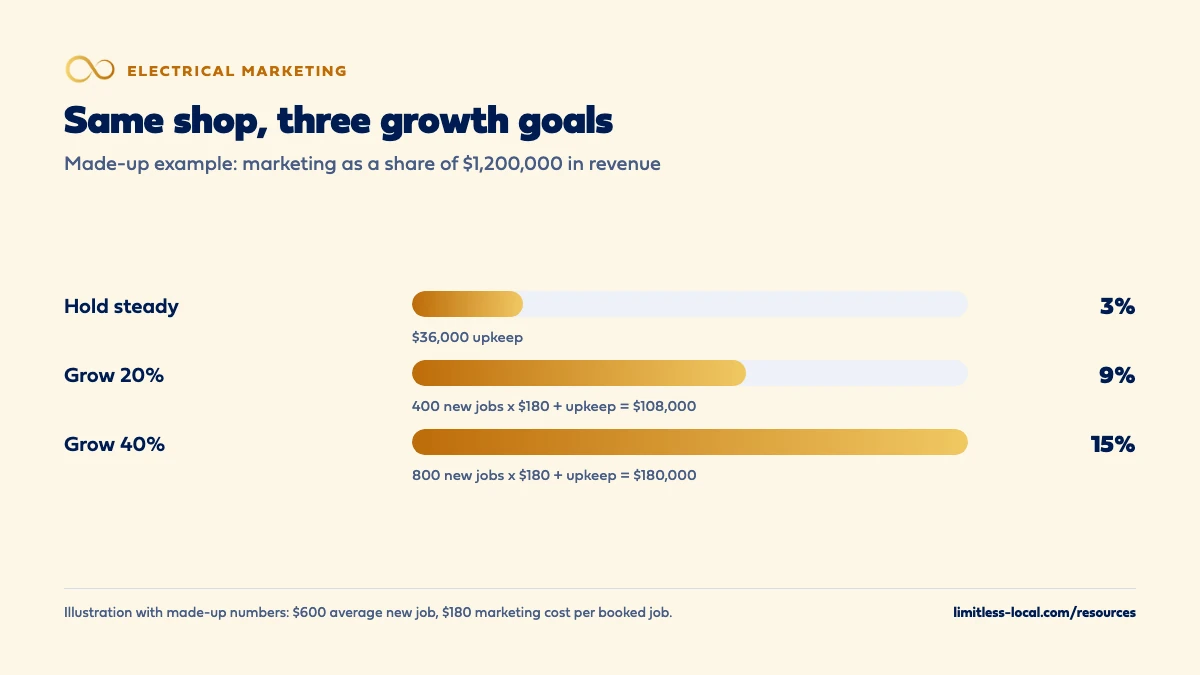
So the share rises with the goal. If a booked job costs you $180 in marketing and the average new job brings in $600, that’s 30% of that job’s revenue spent winning it. Add a lot of those jobs in one year and the overall percentage climbs fast. In the made-up example below, holding steady costs 3% of revenue, growing 20% takes about 9%, and growing 40% takes about 15%.
None of that is a problem if the jobs are profitable and your crews can handle them. It’s a problem when the plan assumes growth the schedule can’t staff, which is why the lead count your crew can actually run comes first. How many service call leads a month to aim for works that out from crew capacity.
Why does a new electrical business spend a bigger share?
Because it has no base to lean on. A new shop has few reviews, no repeat customers and no referral flow, so nearly every job has to be won through marketing while revenue is still small. A first-year electrician’s marketing can run well above the usual band as a share of revenue, and that’s fine for a set period if you treat it as building the base. Expect the share to fall as repeat work builds. Marketing a new electrical business from day one covers what to put money into first.
Does the percentage go down as the shop grows?
Often, yes, even while the dollar amount goes up. A lot of marketing cost doesn’t double when revenue doubles: the website, the Google profile work, the tracking and the management fee for one location stay roughly the same. Meanwhile repeat customers, referrals, maintenance agreements and builder relationships grow on their own and bring work that costs little to win.
Two things reset part of it. Opening a new town or a new service line, like generators or commercial work, means paying to build a base again in that area or job type. And losing your spot in Maps or a run of bad reviews can push the cost of each job back up. When the share jumps, check which of those happened before you assume marketing stopped working. Building up referrals and repeat work is one of the cheapest ways to bring the share back down.

Should I spend the same percentage every month?
No. Set the percentage for the year and spend it unevenly. Electrical demand moves with storms, heat, the holidays and your local building season, and the ads should move with it. Raise spend ahead of the busy stretch, trim it when the crews are booked out, and keep the upkeep work (profile, reviews, site) running all year because it pays off slowly.
Google Ads works on an average daily budget. Google’s help page on average daily budgets says spend can run over or under the daily figure on a given day, but your monthly spending limit for most campaigns is 30.4 times that average. So a planned monthly number divided by 30.4 is your daily setting, and a seasonal plan is mostly a matter of changing that setting a couple of weeks before demand turns.
How do I know my percentage is buying jobs?
Track cost per booked job for each channel, every month. Add up what you spent on a channel and divide by the jobs it booked. Then compare that with what a job of that type is worth to you after labor and materials. A channel that stays well under that line earns more budget; one that keeps going over gets fixed or cut.
For that you need the lead source on every job. Jobber’s lead source report, for example, shows leads, quotes, jobs and first-invoice value by source, and Housecall Pro and ServiceTitan have their own versions. What a good cost per booked job looks like for electricians shows how to set your ceiling.
What does an agency package look like as a share of revenue?
Our Essentials package is $3,500 a month and includes Google Ads management up to $2,500 a month in ad spend. Growth is $4,500 a month and adds Local Services Ads management, with Google Ads up to $5,000 a month in spend. Ad spend isn’t included in either; it’s paid straight to Google or Meta, and we recommend a budget after a quick audit.
As a share of revenue, the same package is a very different decision at different sizes. Say, for illustration, Growth plus $3,000 a month in ad spend: that’s $7,500 a month, or $90,000 a year. For a $1,200,000 shop that’s 7.5% of revenue, inside the consumer band. For a $2,000,000 shop it’s 4.5%. For a much smaller shop it can be more than the business should carry, and we’d rather say so than sell it. The test is the same as for any channel: does the cost per booked job come in under what the jobs are worth?
Talk it through with someone who runs this every day
A 15-minute growth call: your market, your numbers, and what a realistic budget looks like. No pressure.
What's different about the percentage for electricians
Small tickets and big ones in the same shop. A troubleshooting call and a service change can both start with one phone call, but they’re worth very different amounts. One blended percentage hides that, so run the job math separately for service work and for planned jobs like panel upgrades, EV chargers and generators.
Project revenue lands late. Permits, utility scheduling and inspections can push a sold panel or service upgrade weeks past the sale. Count it in the month you expect to invoice, or your percentage will look high one month and low the next.
Commercial work costs time, not ad spend. Bids, site walks and builder relationships are real marketing costs even when no invoice from Google shows up. If commercial is a big part of the shop, put a value on those estimating hours.
Licensed crews cap growth. When qualified electricians are hard to hire, the schedule, not the budget, often sets the ceiling. A higher percentage only pays if there’s someone to send.
A worked example: the same shop at three growth goals
These numbers are made up to show the math, not a benchmark for your market. Say your shop did $1,200,000 last year. Upkeep (profile, reviews, website, tracking and baseline ads) runs $36,000 a year, which is 3% of revenue and keeps your current work coming. A new job averages $600, and each one costs you $180 in marketing to book.
- Hold steady: $36,000, or 3% of revenue.
- Grow 20%: that’s $240,000 in new revenue, or 400 new jobs at $600. At $180 each, they cost $72,000. Add upkeep and the total is $108,000, about 9% of last year’s revenue.
- Grow 40%: $480,000 in new revenue is 800 new jobs, costing $144,000. With upkeep the total is $180,000, or 15%.
Two checks before you commit. First, 800 extra jobs a year is about 67 a month on top of what you already run, so make sure the crews exist. Second, look at the cost per booked job. Bring it down from $180 to $150 through better call answering or tighter targeting, and the 20% plan costs $60,000 plus upkeep, or $96,000, which is 8% instead of 9%. The percentage is the output; the job math is what you actually manage.
Frequently asked questions
Is the percentage based on gross revenue or profit?
The rule of thumb is stated as a share of revenue, so use total revenue for the band. Then check each channel against profit: a booked job should cost less in marketing than it leaves you after labor and materials.
Do truck wraps and uniforms count toward the percentage?
Count wraps, yard signs and anything else that exists to get you noticed. Spread a wrap over the years the truck will carry it. Plain work uniforms are closer to an operating cost; leave them out unless they’re doing marketing work.
Should my own time count?
Your own hours don’t show up on an invoice, but they’re real. At minimum, track them. If marketing is eating evenings you’d otherwise spend on estimates, that’s part of the cost of doing it yourself.
Is spending above the usual range a mistake?
Not if it’s buying profitable jobs your crews can handle. A shop growing fast or opening a new town can run above the band for a while. It’s a mistake when nobody can say what the extra spend booked.
How often should I revisit the percentage?
Set it once a year, check cost per booked job by channel every month, and shift money between channels every quarter based on what booked work.
Do referrals and repeat customers change the percentage?
Yes. Work that comes in without paid marketing lowers your overall share. Building that base is one of the cheapest ways to grow without the percentage climbing.
Key takeaways
- The common rule of thumb is 2% to 5% of revenue for business-to-business sellers and 5% to 10% for consumer-facing businesses; it wasn’t built for electricians.
- Residential-heavy shops tend to sit higher than commercial-heavy ones.
- Growth goals drive the share: holding steady is cheap, fast growth can push you past the usual band for a while.
- Count every cost of winning work, not just ad spend, and spend unevenly with the seasons.
- Judge the percentage by cost per booked job and whether your crews can handle the work.
Ready to compare options?
Book a short growth call and we'll walk through the math for your service area, including when we're not the right fit.
More in this section
- How much should an electrical contractor spend on marketing?
- What should electricians include in their monthly marketing budget?
- Is $500 a month too much for electrician marketing?
- Should an electrician change marketing budget by season?
- How much does a marketing agency cost for an electrician?
Sources
- What is an average marketing budget for a small business? — BDC
- How to Get the Most From Your Marketing Budget — U.S. Small Business Administration
- About average daily budgets — Google Ads Help
- Lead Source Report — Jobber Help Center