
Is $500 a month too much for electrician marketing?

- Is $500 a month too much to spend on marketing if I only want a few extra service calls a week?
- Is $500 a month a lot for an electrical shop?
- How many jobs does $500 a month have to book to pay for itself?
- Can $500 a month get me a few extra service calls a week?
- What can $500 a month actually buy?
- Where should an electrician put the first $500?
- Why not split $500 across a few channels?
- When is $500 a month too much?
- When is $500 a month too little?
- Should $500 a month go to ads or to someone to manage them?
- How long should I give $500 a month before deciding?
- What should I track each month at $500?
- What's different about a $500 budget for electricians
- A worked example: what $500 a month books
- Frequently asked questions
- Key takeaways
- More in this section
- Sources
The short version
- Break-even = $500 ÷ gross profit per job.
- At $200 profit a job, about three extra booked jobs a month covers it.
- It buys one tracked channel, one or two job types, your closest towns.
- It won't buy an agency, SEO and ads at once, or several towns.
- A few extra service calls a week may need more than $500.
For electricians thinking about a small, steady marketing budget and wondering whether $500 a month is money well spent or money down the drain.
Get a free visibility audit · Book a growth call
Is $500 a month too much to spend on marketing if I only want a few extra service calls a week?
No, $500 a month usually isn’t too much for an electrician; for most shops it’s on the small side, and it pays for itself if it books enough extra jobs to cover it. Divide $500 by the gross profit on a typical job to get your break-even, so at $200 profit a job you need about three extra booked jobs a month. It’s too much only when you can’t take more work, nobody answers the phone, or you can’t tell which calls it brought in. Spent well, it buys one focused, tracked channel for one or two job types in your closest towns, not an agency and not several channels at once.
When $500 a month is working and you want more calls than it can buy, that’s the point to compare running it yourself with paying someone to run it. Our packages start with Essentials at $3,500 a month for one location, which includes Google Ads management, Google Business Profile management, review generation and call tracking; ad spend is paid directly to Google. At $500 a month, you don’t need us yet. Our electrical contractor marketing page explains how we work with electrical shops, and the rest of the electrical marketing questions library goes question by question.
Is $500 a month a lot for an electrical shop?
For most electrical shops, no. The SBA’s article How to Get the Most From Your Marketing Budget says there’s no hard and fast answer to how much a small business should spend, and that many businesses use a percentage of revenue as a guide.
Set $500 against what you invoice. A shop billing $25,000 a month would spend 2% of it, which is modest by almost any measure. A brand-new one-truck shop billing far less will feel it more, and that shop needs to be strict about what the $500 buys.
But whether $500 fits your size isn’t the real question. The real question is whether it books enough work to pay for itself, and that’s easy to work out. How much an electrical contractor should spend on marketing covers the percentage method in more depth.
How many jobs does $500 a month have to book to pay for itself?
One line of math:
Break-even jobs per month = $500 ÷ gross profit per job
Gross profit is what’s left on an average invoice after materials and the labor to do the job. Pull it from your last few months of invoices, not from memory.
- If a typical job leaves $200, you need 2.5 jobs, so about three extra booked jobs a month to break even.
- If most of what the marketing brings in is small service calls, you’ll need more of them.
- If it books one panel upgrade, EV charger or generator in a month, that single job may cover the whole $500 on its own.
Count only jobs the marketing brought in, not referrals and repeat customers who’d have called anyway. That’s why tracking matters even at this budget.
Can $500 a month get me a few extra service calls a week?
Maybe, but run the numbers before you count on it. Three extra service calls a week is about 13 extra booked jobs a month. For $500 to buy that, each booked job would have to cost you about $38 in marketing. In a lot of markets, clicks on electrician searches cost enough that $38 per booked job is a stretch, especially once you account for calls that don’t book.
That doesn’t make $500 a bad idea. It means you should expect it to add a job or two a week in most towns, and plan to raise the budget once you can see what each booked job is costing. If a few extra calls a week is the real goal, how much an electrician should spend on Google Ads each month shows how to work the budget backward from the jobs you want.
To get a feel for your own towns before you spend, Google’s Keyword Planner gives search volume and forecasts for the keywords you enter. Treat them as estimates: Google says results depend on your bid, budget, ad quality, location targeting and more.
What can $500 a month actually buy?
At this level, nearly every dollar should reach homeowners. Here’s what it can cover:
- Google search ads. Google asks for an average daily budget, and its page on average daily budgets says to divide a monthly amount by 30.4, the average number of days in a month. $500 a month is about $16 a day.
- Local Services Ads. You pay per valid lead instead of per click. Google’s page on how leads work says lead prices vary with your location, the job type and the type of lead, and that every lead you receive counts toward your budget. A small budget runs out after a handful of leads.
- Call tracking, so each call shows which ad or listing it came from. Keep it to a basic plan.
What it can’t stretch to is ads, SEO, Local Services Ads and social media all at once, or an outside company managing them for you. Pick one channel and do it properly.
Where should an electrician put the first $500?
Do the free work first, then put the money in one place:
- Your Google Business Profile. Google says the Business Profile is free. List every service, add photos of real jobs and reply to every review.
- Reviews. Ask every customer after every job. That costs nothing and helps everything you spend on later.
- One tracked paid channel. Usually Google search ads for one or two job types you want more of, in the two or three towns closest to your shop, sent to a page about that job.
- Tracking. Tag every call by source, and ask new callers how they found you.
If you’re already verified for Local Services Ads with a healthy set of reviews, those can be the one channel instead. How to market a small electrical business on a tight budget goes step by step through the free work.
Curious what your marketing is actually booking?
Get a free visibility audit — no obligation, no sales pitch.
Why not split $500 across a few channels?
Because each piece gets too little to tell you anything. Split four ways across ads, social posts, a directory listing and a mailer, it gives you four channels that each bring in a call or two, and no way to know which one is worth keeping.
One channel at the full $500 gets enough calls, in time, to see a pattern: which searches bring calls, which calls book, and what each booked job cost. Once that one is clearly paying, you add the next. That’s slower in the first month and much faster over a year.
The same goes for job types and towns inside the one channel. Panel upgrades in your home town is a test you can read. Every electrical service in five towns isn’t.
When is $500 a month too much?
When it can’t pay off no matter how well it’s spent:
- You can’t take more work. If you’re booked out for weeks, new calls become lost jobs and frustrated customers. Raise prices or hire first.
- Nobody answers the phone. A paid call that goes to voicemail during a job is money spent on someone else’s booking.
- There’s no tracking. If you can’t tell which calls came from the $500, you can’t tell whether it worked.
- Cash is too tight. If one slow month of results would mean missing payroll, start with the free work and add spending later.
If any of those is true, fix it first. The $500 will go further afterward.
When is $500 a month too little?
When the goal is bigger than $500 can buy:
- Clicks are expensive in your towns, so $16 a day covers only a few visits.
- You want several job types in several towns. Spread that thin, nothing gets enough.
- You want to fill another truck. A crew’s worth of new jobs every month usually takes more than $500.
- Google keeps flagging the budget. Google marks a campaign “Limited by budget” when it’s underperforming because of its budget, and its page on fixing that status says it may suggest a recommended budget.
A budget that’s too small isn’t wasted if it’s tracked, because it tells you what a booked job costs. That number is what you need to decide how much more to spend, and whether $1,500 a month is too much for an electrician growing past referrals looks at the next step up.

Should $500 a month go to ads or to someone to manage them?
At this budget, almost always to the ads. If someone quotes you $500 a month to run your marketing, ask what’s included. If ad spend comes out of that $500, a management fee leaves very little to reach homeowners. If ad spend is on top, your real budget is bigger than $500.
A one-time setup can make sense: paying a freelancer once to build a clean campaign with the right keywords, negative keywords and call tracking, then running it yourself. A one-time cost is easier to carry than a monthly fee. Which electrical marketing costs are one-time and which are monthly sorts out the rest.
If you run it yourself, count your hours. Checking search terms and call logs takes time each week, and that time isn’t free if it comes off billable work.
How long should I give $500 a month before deciding?
Ads can generate leads within days of launch, so you’ll know within a couple of weeks whether the phone rings at all. Knowing whether $500 pays off takes longer, because a small budget brings fewer calls and you need enough booked jobs to judge.
Use the first month to fix the obvious: searches you don’t want, an ad pointing at the wrong page, calls arriving when nobody can answer. Then judge the next two or three months on booked jobs against your break-even. How much ad spend an electrician needs to judge Google Ads explains why small tests need longer.
If you’re tempted to put the $500 into SEO instead, know the ramp: SEO typically takes 3-6 months to show meaningful organic growth, and $500 doesn’t buy much of it.
What should I track each month at $500?
Two numbers on one sheet:
- What the marketing cost in total, ad spend plus any tools.
- How many booked jobs it brought in, and the gross profit on those jobs.
Divide the first by the number of jobs and you have your cost per booked job. Put it next to your break-even. Above it, fix something before you spend more. Below it, you’ve found money you can turn up.
Tracking can be as simple as asking every new caller how they found you and writing it in the job notes. Pair that with a tracking number on the ads and you’ll know within a few months what $500 is really doing.
Not sure which of these is costing you jobs?
A free visibility audit checks the Google profile, reviews, site and tracking, and shows what to fix first.
What's different about a $500 budget for electricians
Job values swing widely. A month can mix small service calls with panel upgrades, EV chargers and generators. Point the $500 at the bigger jobs and break-even comes fast; spend it on broad “electrician near me” searches and it fills with small calls.
Emergency calls need someone on the phone. If ads run at night and nobody answers, the budget pays for calls you’ll never book. Schedule ads for the hours you cover.
Builder and commercial work doesn’t need ads. If much of your work comes from general contractors and property managers, the $500 is for the homeowner jobs those partners don’t send.
Your license sets the map. Ads can reach any town, but only spend where your license and drive time let you serve well.
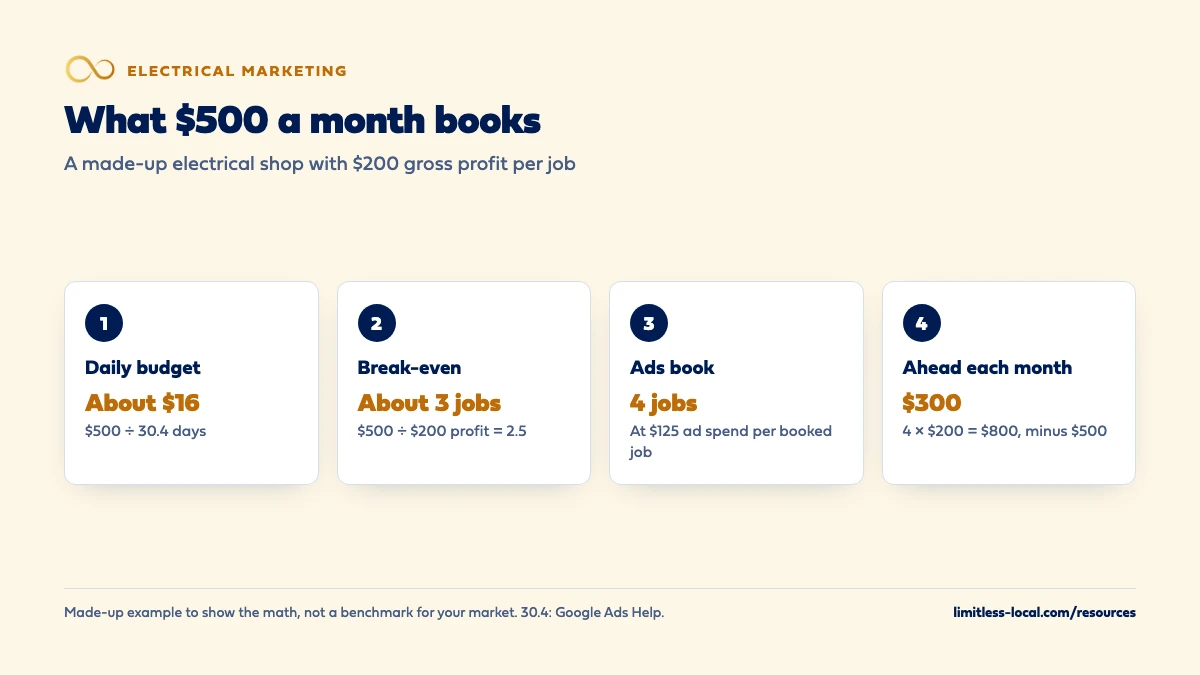
A worked example: what $500 a month books
These numbers are made up to show the math, not a benchmark for your market. Say an electrician’s typical job leaves $200 of gross profit, and the owner puts all $500 into Google search ads for panel upgrades and service calls in two nearby towns, with call tracking.
- Daily budget: $500 divided by 30.4 is about $16 a day.
- Break-even: $500 divided by $200 is 2.5, so about three booked jobs a month.
- What the ads book: say each booked job ends up costing $125 in ad spend. $500 divided by $125 is 4 booked jobs.
- Gross profit: 4 times $200 is $800, so the shop is $300 ahead for the month.
That’s a good result, and it’s about one extra job a week, not three. To book 13 extra jobs a month at $125 each, the owner would need about $1,625 a month. The $500 did its job: it proved what a booked job costs, which is exactly the number needed to decide whether to spend more.
Frequently asked questions
Does $500 a month include ad spend?
On this page, yes: $500 is the total, ad spend included. If someone quotes you $500 for management, ask whether ad spend is on top, because it’s usually paid to Google separately.
Is $500 a month enough for SEO for an electrician?
It buys very little SEO work, and SEO is slow to show results. At this budget, most shops do better doing the free Google profile and review work themselves and putting the money into ads.
Should I spend $500 on Facebook ads instead of Google?
For most service calls, people search on Google when something breaks, so search ads usually come first. Social ads can help with planned jobs like EV chargers or generators once search is working.
Can I spend $500 only in busy months?
You can, but slow months are when you need calls most, and starting over each time wastes the first weeks. Lower the budget in slow months rather than switching it off.
What if $500 is more than I can afford right now?
Start with the free work: your Google profile, reviews and past customers. Add a smaller ad budget on your single most profitable job type when you can, and raise it as booked jobs pay for it.
Key takeaways
- $500 a month breaks even at $500 divided by your gross profit per job; at $200 a job, that’s about three booked jobs.
- Put it into one tracked channel, one or two job types, and the towns closest to your shop.
- It’s too much if you can’t take more work, don’t answer the phone or can’t track what booked.
- A few extra service calls a week usually takes more than $500, so use the first months to learn what a booked job costs.
- At this budget, spend on ads and a one-time setup, not a monthly management fee.
Want a second set of eyes on your setup?
We'll look at how you show up locally and where calls are leaking, then send you a plain-English breakdown.
More in this section
- Is $1500 a month too much for electrician marketing past referrals?
- What should electricians include in their monthly marketing budget?
- How much should an electrical contractor spend on marketing?
- How much does a marketing agency cost for an electrician?
- Should an electrician change marketing budget by season?
Sources
- How to Get the Most From Your Marketing Budget — U.S. Small Business Administration
- About average daily budgets — Google Ads Help
- How leads work — Google Local Services Help
- Use Keyword Planner — Google Ads Help
- Get Listed on Google – Google Business Profile — Google
- Fix “Limited by budget” status — Google Ads Help