
How do I recover from bad reviews on my plumbing company?
- What should a plumbing company do after a run of bad Google reviews?
- What should I do first when bad reviews pile up?
- Did my reviews drop, or did they disappear?
- Which bad reviews will Google remove?
- How do I report a review, and what if Google says no?
- What if someone wants money to take the bad reviews down?
- How should a plumber reply to a bad review?
- Can I ask an unhappy customer to change their review?
- What usually causes bad plumbing reviews, and how do I fix it?
- How do I rebuild my rating without breaking Google's rules?
- How do I recover when I have no time, or ten trucks to manage?
- What's different about bad reviews for plumbing companies
- A worked example: how many good reviews it takes to recover
- Frequently asked questions
- Key takeaways
- More in this section
- Sources
The short version
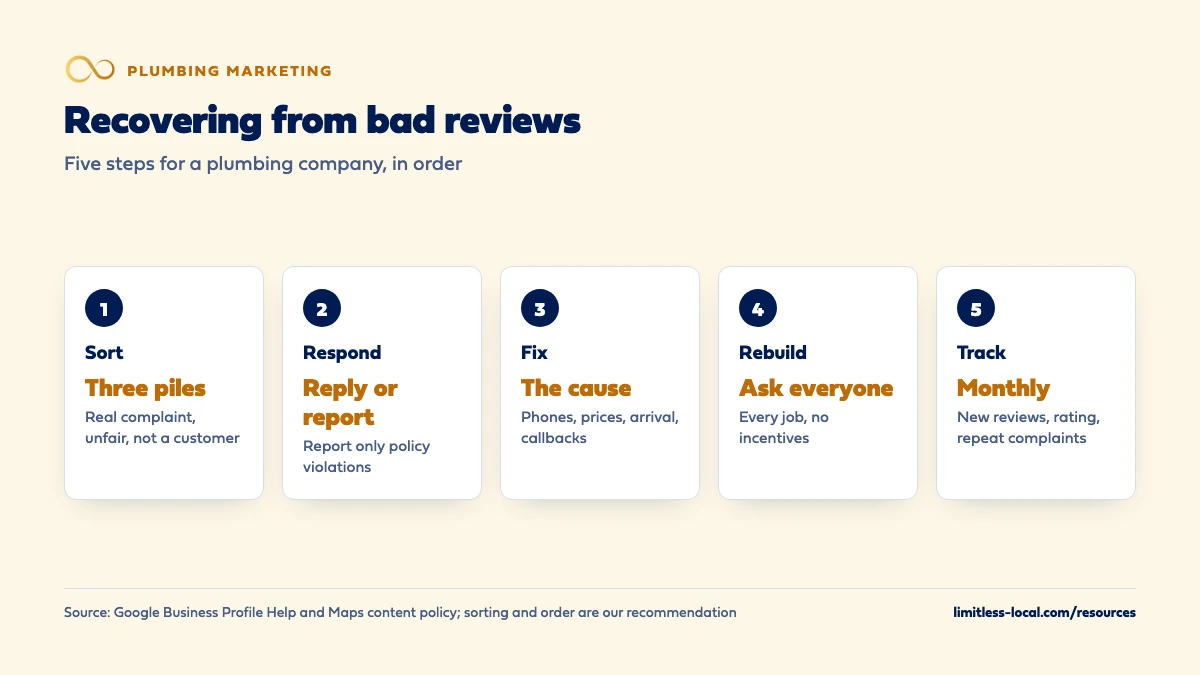
- Sort first: real complaint, unfair but real, or not a customer at all.
- Reply to the real ones and fix the cause; report only reviews that break Google's policies.
- Extortion demands go to Google's merchant extortion form; never pay.
- Rebuild with honest reviews from every job, never incentives or review gating.
For plumbing owners whose rating took a hit, or whose review count dropped, and who want a plan that fits around running the trucks.
Get a free visibility audit · Book a growth call
What should a plumbing company do after a run of bad Google reviews?
Sort the bad reviews first: real customers with a real complaint, real customers being unfair, and reviews that don’t come from customers at all. Reply calmly to the real ones and fix what caused them, report only reviews that break Google’s policies, and use Google’s extortion report if someone demands money to remove reviews. Then rebuild by sending every customer on every job a request for an honest review, because your score is the average of all your Google ratings and a steady flow of new ones is what moves it back up. Buying reviews, offering anything for them or asking only happy customers breaks Google’s rules and can leave you worse off.
Review response and review generation sit alongside Google Business Profile management in our local SEO work for plumbing companies, and when a profile takes a hit, the sorting and the rebuild below are the work. The rest of the plumbing marketing questions library covers asking for reviews, review targets and the profile itself.
What should I do first when bad reviews pile up?
Don’t reply to anything yet. Read every new review, then check each reviewer’s name and details against your job software, whether that’s ServiceTitan, Housecall Pro or Jobber. In our judgement, almost every bad run sorts into three piles, and each needs a different fix:
- Real customers with a real complaint. A no-show on an emergency call, a price that wasn’t what the office quoted, a drain that clogged again two days later. These need a reply and a fix in the business.
- Real customers being unfair. They’re angry about something outside your control, like a city sewer main or a part on backorder, or the story is one-sided. These need a calm, factual reply, not a removal request.
- Not customers at all. No matching job, no matching call, no details about any work. These are the only ones worth reporting, and only if they break a Google policy.
Write the piles down. The rest of the plan follows from which pile is biggest.
Did my reviews drop, or did they disappear?
Owners say “my reviews dropped” about two different problems: a falling rating, or a falling count. If the count went down, Google lists several possible reasons (About missing or delayed reviews):
- Reviews are checked against Google’s policies, which can delay a new review by a few days.
- After merging profiles, it can take a few days for reviews from both to show.
- Reviews removed for policy violations won’t be restored. Google says reviews are usually removed for violations like spam or inappropriate content.
- In certain situations, Google may temporarily disable reviews for some profiles or business categories.
If reviews you collected through a giveaway or a review service vanished, that’s most likely the policy filter, in our reading, and the rebuild has to come from honest asks. Google doesn’t explain individual removals. How to ask in a way Google allows is in getting more Google reviews.
Which bad reviews will Google remove?
Only reviews that break its policies. Google says you can report any review, but only those that violate its policies are eligible for removal. It asks you not to report a review just because you disagree with it or dislike it, and says it doesn’t get involved in conflicts between businesses and customers (Report inappropriate reviews on your Business Profile).
The policies that most often fit a bad run on a plumbing profile, from Google’s Maps content policy (Prohibited & restricted content):
- Fake engagement: content that doesn’t reflect a genuine experience.
- Conflict of interest: the policy names current or former employment and personal affiliations such as industry competitors. A one-star review from a former tech, or from a competing plumber, fits here.
- Off-topic, harassment or hate content, as defined in the same policy.
A one-star review from a real customer who thought your emergency rate was too high doesn’t break any of these. It stays, and the reply is your tool.
How do I report a review, and what if Google says no?
From your Business Profile, select Read reviews, choose the review, select the reason to flag it, such as Spam, and send the report. Google says evaluation typically takes several days, and you can follow the status in its Reviews Management Tool: Decision pending, Report reviewed – no policy violation, or Escalated once you appeal (Report inappropriate reviews on your Business Profile).
If a report comes back with no violation and you disagree, Google allows a one-time appeal through the same tool, and you can select up to 10 reviews in it. In our judgement, save the appeal for reviews where you have something specific to show, such as no record of the person in your job software and no call from their number, rather than resending everything that annoyed you.
Curious what your marketing is actually booking?
Get a free visibility audit — no obligation, no sales pitch.
What if someone wants money to take the bad reviews down?
That’s extortion, and Google calls it a serious policy violation. It says these scams may involve a sudden increase in 1-star and 2-star reviews, followed by someone demanding money, goods or services to remove them. Its instructions: don’t engage with or pay the people involved, because it can encourage more attempts and doesn’t guarantee removal; don’t try to resolve it yourself by offering money or services; gather evidence immediately; and report it through the merchant extortion report form (Report negative review extortion scams on your Business Profile).
The evidence Google asks for:
- Screenshots of every demand, showing date, time and sender details.
- Direct links to each suspicious review.
- Any names, usernames, emails, phone numbers or profiles tied to the people making demands.
- When you first noticed the jump in bad reviews, and when the first demand arrived.
Google says that form is only for cases where you’ve been directly targeted with a demand. Spam or off-topic reviews without a demand go through the normal report.
How should a plumber reply to a bad review?
One at a time, in your own words, after you’ve cooled off. Google’s tips for negative reviews: never share the reviewer’s private information or make personal attacks; acknowledge mistakes but don’t take responsibility for things outside your control; apologize when it fits; address the reviewer by name and their specific feedback; reply promptly; and if it’s complex, ask them to call or email so you can sort it out privately (Tips to get more reviews).
For plumbers, two situations need extra care, in our judgement:
- Emergency price complaints. Explain the after-hours rate plainly and when it was quoted, without arguing.
- Water damage blame. If a review claims your work caused damage, keep the public reply short, don’t debate the facts or fault, and take it offline. The claim itself is a matter for you, your insurer and, if needed, your attorney; this page isn’t legal advice.
U.S. federal rules set hard lines too, and this isn’t legal advice. The FTC says you can respond publicly, but its review rule prohibits knowingly or recklessly making a false accusation about the reviewer, using physical threats or intimidation to get a review changed or removed, and using an unfounded or groundless legal threat to get it removed (Consumer Reviews and Testimonials Rule: Questions and Answers).
Can I ask an unhappy customer to change their review?
You can contact them and fix the problem. The FTC says its review rule doesn’t prohibit contacting customers who post negative reviews to resolve the issues (Consumer Reviews and Testimonials Rule: Questions and Answers). Google says constructive replies and following up on concerns may even encourage the customer to update their review (Tips to get more reviews).
What you can’t do is attach anything to the change. Google strictly prohibits offering incentives, like free or discounted goods or services, for posting, changing or removing a review. The FTC adds that paying customers to change or remove truthful negative reviews may violate the FTC Act. So send someone back to clear the drain again, refund what’s fair, and let the customer decide on their own whether to update anything. Waiving the bill in exchange for a new rating is the one move that’s off the table.
What usually causes bad plumbing reviews, and how do I fix it?
Treat the real complaints as a report on your operations. Pull the jobs behind them and look for the common thread. In our judgement, plumbing complaints cluster around a short list:
- Calls nobody answered. “Called three times, never heard back” reviews often come from people who never became customers. They’re rarely removable, and the fix is the phone, which stopping lost after-hours calls covers.
- Price surprises. A trip or diagnostic fee not mentioned on the phone, an after-hours rate quoted vaguely, or a sewer or repipe price that landed far above the first number the office gave.
- Arrival windows. A missed window with no call, on a job where the customer took a day off work or has water on the floor.
- Callbacks. The same clog or leak back within days, and a slow return visit.
- The mess. Cut drywall, wet floors or a dug-up yard left without a clear word about who fixes what.
Fix the cause before you push for new reviews. Otherwise you’re asking more customers to write about the same problem.
How do I rebuild my rating without breaking Google's rules?
With volume of honest reviews. Google says your review score is the average of all ratings published on Google, and that a new review can take up to 2 weeks to show in the score (Understand review scores for local places & businesses). The only lasting way to move an average is more ratings from real customers. Google also says a mix of positive and negative feedback often feels more trustworthy, so a few honest complaints with good replies aren’t the end of the profile.
The rules matter most right after a bad stretch, because that’s when shortcuts look tempting. Google’s policy doesn’t allow discouraging negative reviews, selectively soliciting positive ones, pressuring customers to review on the spot, or asking for specific content (Prohibited & restricted content). Reviews from employees, family or competitors fall under its conflict-of-interest rule. And if Google finds fake engagement, it can remove the reviews and restrict the profile: no new reviews for a set period, existing reviews unpublished for a set period, or a warning to customers that fake reviews were removed (Business Profile restrictions for policy violations).
So ask every customer on every completed job, the same way. How many you’re aiming for is worked out in how many Google reviews a plumber needs.
How do I recover when I have no time, or ten trucks to manage?
The owner doesn’t need to do most of it. In our judgement, a recovery that survives a busy season looks like this:
- Automate the ask. Put your Google review link in the job-complete text and the invoice from your job software, so every customer gets it without anyone remembering.
- Half an hour a week for replies. Read and reply to new reviews in one sitting. If an office manager drafts the replies, the owner can approve the hard ones.
- One cause at a time. Pick the most common complaint and fix it this month: a scripted price explanation on the phone, a late-arrival text, a callback rule.
Once a month, not every morning, check four things: new Google reviews, your average rating, whether new bad reviews repeat an old complaint, and whether every completed job triggered the review text.
With a bigger fleet, the same plan needs tracking by tech or crew. Check that each tech’s jobs trigger the review text, and look at which crews the complaints name. Don’t set review quotas: Google’s policy doesn’t allow asking staff to collect a certain number of reviews. Getting your techs to ask on every job covers how to track the habit instead.
Not sure which of these is costing you jobs?
A free visibility audit checks the Google profile, reviews, site and tracking, and shows what to fix first.
What's different about bad reviews for plumbing companies
Emergencies raise the stakes on both sides. A customer with water on the floor is stressed and paying an after-hours rate, which makes price and arrival complaints more likely. In our judgement, the fix lives in the first phone call: say the rate, say the window, and call if it slips.
Big jobs carry long memories. A sewer replacement or repipe customer who felt surprised by the price can leave the most detailed bad review on your profile. Written estimates and a clear walkthrough of what’s included protect you more than any reply.
A worked example: how many good reviews it takes to recover
These numbers are made up to show the math, not a benchmark. Say your profile had 120 reviews averaging 4.7 stars, which is 564 stars in total. Then five one-star reviews land in a bad week. Now you have 125 reviews and 569 stars, an average a little over 4.5.
To get back to 4.6, you need about 15 new five-star reviews, or about 30 new reviews if they average 4.8. Getting all the way back to 4.7 takes about 62 straight five-star reviews. That’s why the recovery is a habit, not a sprint: the average moves slowly in both directions, and the profile with a steady flow of honest reviews recovers while the one waiting for a lucky week doesn’t.
If you complete a lot of residential jobs each month and send every customer the link, those numbers come within reach in months, not years. Review response and basic review generation are part of our Essentials package at $3,500 a month; a free visibility audit is a reasonable place to look at your own reviews and where they’re coming from.
Frequently asked questions
Can I delete a bad Google review myself?
No. You can reply to it, and report it if it breaks Google’s policies; only reviews that violate the policies are eligible for removal. Source: Report inappropriate reviews.
How long does Google take to look at a review I reported?
Google says evaluation typically takes several days, and you can check the status in the Reviews Management Tool.
Can I start a new Google profile to get rid of the bad reviews?
Google’s guidelines allow one profile per business. A second profile for the same business goes against them and puts both at risk, and it throws away the good reviews too.
Will a few bad reviews hurt my ranking in Maps?
Google says more reviews and positive ratings can help your local ranking, so the rating is one input. In our judgement, a few bad reviews among many good ones matter less than a steady stream of new reviews.
Should I reply to a review from someone who was never a customer?
Yes, briefly: say you can’t find a record of the job and invite them to call. Report it too if it breaks a policy. Don’t accuse them of lying, which the FTC warns against when you know the accusation is false.
Do bad reviews on Yelp or Facebook affect my Google rating?
No. Google says your review score is the average of ratings published on Google. Source: Understand review scores.
Key takeaways
- Sort bad reviews into real complaints, unfair-but-real, and not customers before you reply to any of them.
- Only reviews that break Google’s policies can be removed; report those, appeal once if you have evidence, and reply to the rest.
- Never pay or bargain with someone demanding money to remove reviews; use Google’s extortion report.
- Fix the operational cause, usually missed calls, price surprises, arrival windows or callbacks, before pushing for new reviews.
- Rebuild with honest reviews from every job; incentives, gating or staff reviews can get reviews removed and the profile restricted.
Want a second set of eyes on your setup?
We'll look at how you show up locally and where calls are leaking, then send you a plain-English breakdown.
More in this section
- How do I get more Google reviews for my plumbing company?
- How do I get my plumbing techs to ask for reviews on every job?
- How do I make my plumbing company look trustworthy online?
- How many Google reviews does a plumbing company need?
- How do I get more repeat customers and referrals for plumbing?
Sources
- Report inappropriate reviews on your Business Profile — Google Business Profile Help
- About missing or delayed reviews — Google Business Profile Help
- Report negative review extortion scams on your Business Profile — Google Business Profile Help
- Prohibited & restricted content — Maps User Contributed Content Policy Help
- Tips to get more reviews — Google Business Profile Help
- Understand review scores for local places & businesses — Google Business Profile Help
- Business Profile restrictions for policy violations — Google Business Profile Help
- Consumer Reviews and Testimonials Rule: Questions and Answers — U.S. Federal Trade Commission