
Why does NAP consistency matter for a restoration company?

- How do I keep my restoration company's details identical on every listing?
- What does "NAP consistency" actually mean for a restoration company?
- Why do Google and Bing care whether my details match across sites?
- What does a mismatch cost a restoration company in practice?
- What exactly has to match on every listing?
- Where do mismatched listings usually come from in restoration?
- How do I find the listings that are wrong?
- Which listings should a restoration company fix first?
- Can I use call tracking numbers without breaking consistency?
- What if we moved, changed our name or bought another company?
- How long until the corrections show up everywhere?
- What's different about listings for restoration companies
- A worked example: cleaning up after a warehouse move
- Frequently asked questions
- Key takeaways
- More in this section
- Sources
The short version
- Google and Bing compare what you say with what the rest of the web says.
- Mismatches can block your edits or send a homeowner to a dead number.
- Write down one official name, address and phone before you fix anything.
- Fix Google first, then Apple, Bing, Yelp and the directories.
- Keep old numbers ringing until the listings catch up.
For restoration owners whose company shows up under an old number, an old address or two different names, and who want every listing telling the same story.
Get a free visibility audit · Book a growth call
How do I keep my restoration company's details identical on every listing?
Search engines and map apps build your listing from many sources, not just from what you type in, so mismatched names, addresses or phone numbers can keep your corrections from publishing and can send an emergency caller to a dead line. Google says businesses with complete and accurate information are more likely to show up in local results, and Bing says changes to core details only apply if they match trusted outside data. Pick one official version of your name, address and phone, fix Google first, then the big directories and data sources, and keep old numbers forwarding until the web catches up.
We treat this as plumbing, not decoration: a restoration company that’s listed the same way everywhere is easier for Google to trust and easier for a homeowner to reach at night. Listing cleanup, with your name, address and phone synced across more than 50 directories, is part of our local SEO work, and our restoration marketing page shows where it fits for water, fire and mold companies. The restoration marketing guide shows where listings fit with ads, your website and follow-up, and the rest of the restoration marketing questions go one question at a time.
What does "NAP consistency" actually mean for a restoration company?
NAP is short for name, address and phone number. Every site that lists your company with those three details, from your Google profile to Yelp to a directory you’ve never heard of, is called a citation. Consistency means all of them say the same thing, written the same way.
For a restoration company, the list usually grows faster than for other trades. You may be on Google, Apple Maps, Bing, Yelp, Facebook, the Better Business Bureau, your trade association’s member list, a certification body’s locator, a few lead services, and in vendor lists at insurance-related programs and property management companies. Each one was set up by someone at some point, often with whatever number or address was current that week.
The goal isn’t to be on every site. It’s that every site that does list you agrees with your Google profile, your vans and your invoices. Which restoration citations and directories matter covers which sites are worth being on in the first place.
Why do Google and Bing care whether my details match across sites?
Because they don’t build your listing only from what you tell them. Google says the information in its business profiles is compiled from a variety of sources: publicly available information such as your own website, licensed data from third parties, and users who contribute facts like addresses and phone numbers. Source: Understand how Google sources & uses info in Business Profiles & local search results.
Google also says local results are mainly based on relevance, distance and popularity, and that businesses with complete and accurate information are more likely to show up in local search results. If your business info isn’t accurate, Google says your profile might not show up for relevant searches in your area. Source: Tips to improve your local ranking on Google.
Bing is even more direct. Its Bing Places help says your name, address, phone and similar basic details are controlled through automated validation, and that changes you submit “are only applied if they align with trusted external data.” If inconsistencies are detected, changes may not publish or may be overwritten. Source: Bing Places for Business: Manage your listing.
In our judgement, that’s the practical reason to care: when the rest of the web still shows your old number, your correction can lose the argument.
What does a mismatch cost a restoration company in practice?
Ranking theory aside, the cost is a missed emergency. A homeowner with water coming through the ceiling at midnight finds you in an app, taps an old number, gets a disconnected line or a former partner’s cell, and calls the next company. They rarely try a second listing to find the right number.
Mismatches also confuse the people who send you repeat work. A property manager or adjuster who looks you up after a referral and finds two names and three numbers may wonder whether they found the right company. That’s our judgement, not a measured effect, but it fits how restoration work comes in: fast, and often through someone checking you out on a phone.
If calls are already slipping through the cracks for other reasons, what missed calls cost a restoration company puts a number on it.
What exactly has to match on every listing?
- Business name. Google says your profile name should reflect your real-world name as used consistently on your storefront, website, stationery and as known to customers. Legal terms like LLC aren’t allowed unless your real-world signage and paperwork consistently show them, and extra words such as “24/7 Water Damage” can get a profile suspended.
- Address. One format, including any suite number, written the same way each time. If you’re a service-area business with your address hidden on Google, use the same real address on directories that insist on one.
- Phone. One main local number that you control. Google asks for a local number instead of a central call center helpline whenever possible, and says the number must be under your business’s direct control.
- Website and hours. Not strictly part of NAP, but fix them in the same pass.
Before you touch a listing, write the official version of each in one shared document. In our judgement, “Street” versus “St.” matters far less than a wrong phone number or an old address, so spend your time on the errors that would send a customer to the wrong place. Source: Guidelines for representing your business on Google.
Curious what your marketing is actually booking?
Get a free visibility audit — no obligation, no sales pitch.
Where do mismatched listings usually come from in restoration?
In our judgement, most restoration companies pick up mismatches in a few predictable ways:
- A move from a garage or a first small shop to a warehouse with room for equipment.
- A rename or rebrand, including dropping an old trade name or joining or leaving a franchise.
- Buying another company and inheriting its listings, numbers and duplicate profiles.
- Old tracking numbers from a past agency or a lead service that were pasted into directories.
- The owner’s cell used in the first year, before the company had a main line.
- A second brand for mold or rebuild work that shares the same address and phone.
Knowing which of these applies to you tells you what to search for in the audit below.
How do I find the listings that are wrong?
Search your company name, then search each of these on its own, in quotes:
- Every phone number the business has ever used, including old cells and tracking numbers.
- Every past address, including your house if you started there.
- Every past name, plus the names of any company you bought.
Put each listing you find in a spreadsheet with three columns: the site, what it shows, and whether you can log in. Then search Google Maps for your name and street. A second pin for your company is a duplicate. That spreadsheet is both your to-do list and your later check that the fixes held.
Which listings should a restoration company fix first?
- Google Business Profile. It feeds Search and Maps, and as Local Services Ads move into Google Ads during 2026, your business name, address and hours sync one way from the profile into Google Ads. Google’s Edit your Business Profile page covers each field. For the profile itself beyond NAP, see optimizing a restoration Google profile.
- Apple Business. It controls your place card in Apple Maps.
- Bing Places. It feeds Bing search and maps.
- Yelp, Facebook and the BBB. In our judgement, these are among the sites homeowners and property managers most often check when they look you up by name.
- Trade and vendor lists. Association member pages, certification locators and any program or property management vendor portal you’re in.
- Everything else on your spreadsheet, worst errors first.
Paid lead and directory sites are a separate decision. Whether directory listings help rankings covers that question.

Can I use call tracking numbers without breaking consistency?
Yes, if you’re deliberate about where they go. Google’s rule is that the number must be under your direct control and must reach your business; it also says not to use numbers that redirect callers to landing pages or numbers other than your actual business. Source: Guidelines for representing your business on Google.
Our view: keep your main local number on directories, Yelp, Facebook and vendor lists so those citations agree, and keep any tracking numbers to places you control, like your Google profile, your website and your ads. The full setup, including how to keep your main number visible on the profile, is on whether call tracking numbers hurt rankings.
What if we moved, changed our name or bought another company?
Each platform has its own rule, and they don’t agree:
- Google, after a move: update the existing profile with the new address rather than creating a new one. Google says you can have only one Business Profile for each business, and a profile it considers a duplicate won’t show on Search or Maps. Source: Resolve duplicate profiles & ownership issues.
- Bing, after a move or name change: Bing doesn’t recommend editing the old listing, because that “may lead to data conflicts over time.” Its help recommends a new listing and closing the old one instead.
- Yelp: routine edits go through Yelp for Business; its support page points bigger changes like moves and closures to a separate process. Source: How do I suggest changes to the general business info?
If you bought a company, decide which name survives before you touch anything, and keep its old numbers forwarding to your dispatch line for as long as calls keep arriving on them.
How long until the corrections show up everywhere?
No platform gives you a fixed date, and they move at different speeds:
- Google Business Profile: edits usually show in about 10 minutes, though some take up to 30 days, per Google’s Manage your business address page.
- Google Ads and Local Services Ads: hours, phone and minor name changes sync within 24 hours; significant changes to name, storefront address or primary category require verification that typically takes 24 to 48 hours, and your campaign may pause meanwhile. Source: Local Services Ads transition to Performance Max campaigns with pay-per-lead goals.
- Bing: a typical publish cycle is 7 to 12 days in North America, and editing again resets the clock.
- Apple: suggested changes can take up to five business days to review. Source: Maintain location information accuracy with Apple Business.
Smaller directories that copy data from elsewhere are slower and less predictable. In our judgement it takes weeks to months for most of the web to catch up, which is why we’d never make a big name or address change in the middle of storm season.
Want to see where your company stands?
A free visibility audit shows where you show up on Google, Maps and AI answers, and what it's costing you in calls.
What's different about listings for restoration companies
The caller won’t try twice. Emergency calls come from people who are stressed and in a hurry. A wrong number on one app is a lost job, not a delayed one.
More places list you. Beyond the usual directories, restoration companies tend to show up in certification locators, trade association lists and vendor lists kept by programs and property managers. Those lists are easy to forget during a cleanup.
Ads now depend on the profile. As Local Services Ads move into Google Ads, your profile’s name, address and hours flow into your ads, and a big change can pause a campaign. Plan changes for a quiet week. If you’re also getting verified for LSAs, make sure the details you submit match the profile.
Second brands need care. If you run mold or rebuild under a different name from the same shop, decide whether it’s really a separate business before giving it separate listings. Google allows one profile per business.
A worked example: cleaning up after a warehouse move
These numbers are made up to show the process, not a benchmark. Say your company moved from a rented garage to a warehouse two years ago and switched phone providers at the same time. Your audit spreadsheet turns up 38 listings. Of those, 22 show the current address and number, 11 still show the garage address, and 5 show the old phone number, including a trade association page and a property manager’s vendor list.
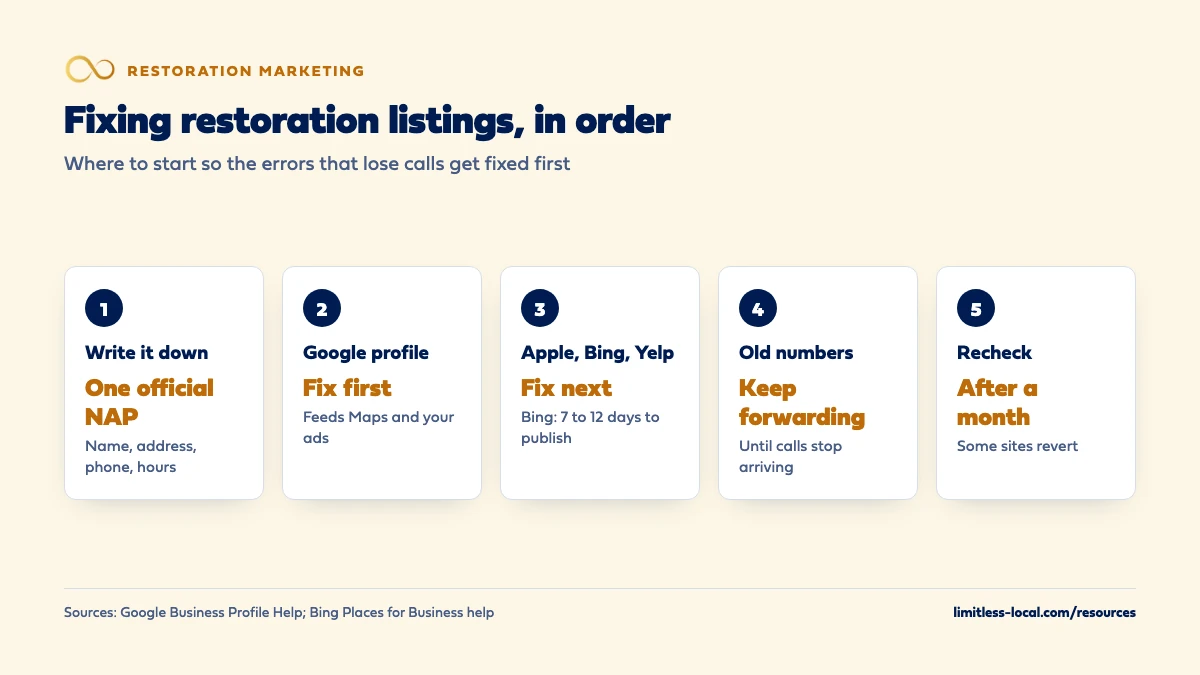
The order of work: update Google and confirm verification, then Apple, Bing, Yelp, Facebook and the BBB, then the 5 old-number listings, because those are the ones that lose calls today, then the remaining old-address listings. Keep the old number forwarding the whole time. Recheck the spreadsheet a month later and again after a quarter, because some sites will quietly revert to old data.
If you’d rather hand it off, our Essentials package, at $3,500 a month, includes business listing cleanup and buildout plus Google Business Profile management, and our listing work syncs your name, address and phone across 50+ directories.
Frequently asked questions
Does "Street" versus "St." on one directory hurt my rankings?
In our judgement, small formatting differences matter far less than a wrong phone number or an old address. Fix the errors that send customers to the wrong place first.
Can I add "24/7" or "Emergency" to my name on directories?
Not on Google unless it’s really part of your name on your vans and invoices. Google says unnecessary information in the name isn’t permitted and could get your profile suspended.
Should I delete my old Google profile after a move?
No. Google says to update the existing profile with the new address. Creating a second profile risks it being treated as a duplicate, which won’t show on Search or Maps.
Do I need to be listed on hundreds of directories?
No. Accuracy on the listings that exist matters more than count, in our judgement. Start with Google, Apple, Bing, Yelp, Facebook and the BBB.
Is this a one-time job?
Mostly, but recheck a few times a year. Directories copy each other, and old data can creep back after a fix.
Key takeaways
- Google and Bing build your listing from many sources, so mismatches can block or overwrite your edits.
- For restoration, the real cost of a wrong listing is a missed emergency call.
- Write down one official name, address and phone, then fix Google first.
- Keep tracking numbers on channels you control and your main number on directories.
- Keep old numbers forwarding and recheck listings after a month.
Not sure what's working right now?
Start with a free visibility audit: rankings, Google profile, reviews and tracking, checked against your service area.
More in this section
- What do property managers look for in a restoration vendor?
- What makes homeowners trust a restoration company they find online?
- How does a restoration company recover when its reviews drop?
- How hard is it for a restoration company to get verified for LSAs?
- How fast does a restoration company need to answer emergency calls?
Sources
- Understand how Google sources & uses info in Business Profiles & local search results — Google Business Profile Help
- Tips to improve your local ranking on Google — Google Business Profile Help
- Guidelines for representing your business on Google — Google Business Profile Help
- Resolve duplicate profiles & ownership issues — Google Business Profile Help
- Manage your business address — Google Business Profile Help
- Local Services Ads transition to Performance Max campaigns with pay-per-lead goals — Google Ads Help
- Bing Places for Business: Manage your listing — Bing Places for Business
- Maintain location information accuracy with Apple Business — Apple Business Help