
Restoration phone stopped ringing: is it Maps, ads or reviews?
- How do I tell whether Maps, ads or reviews caused my restoration calls to drop?
- Did the phone really stop ringing, or did the calls stop reaching you?
- Is it the season or the weather?
- Which source dropped?
- Step 1: Is your Google Business Profile still showing up in Maps?
- Step 2: Did your Local Services Ads stop running?
- Step 3: Are your Google search ads limited, paused or outbid?
- Step 4: Did your reviews or rating change?
- Step 5: Did your website lose search traffic or stop converting?
- What if every source dropped at the same time?
- What changes for a restoration company running 10 or more trucks?
- In what order should I fix things once I find the cause?
- What's different about diagnosing a call drop for restoration companies
- A worked example: finding the source of a drop
- Frequently asked questions
- Key takeaways
- More in this section
- Sources
The short version
- Test your own phone numbers first: broken routing looks exactly like a marketing problem.
- Compare with the same weeks last year, not last month. Weather moves restoration calls.
- Find which source dropped: Maps, Local Services Ads, search ads, website or referrals.
- One source down points to that channel; everything down points to phones, reviews or the season.
- Fix one cause at a time and change nothing else while you wait to see the result.
For restoration owners, including those running 10 or more trucks, whose calls fell off and who want to find the cause before changing anything.
Get a free visibility audit · Book a growth call
How do I tell whether Maps, ads or reviews caused my restoration calls to drop?
Start by checking that the drop is real: test every number you advertise, then compare calls by source with the same weeks last year, because weather drives restoration call volume. If only Maps calls fell, check your Google Business Profile for suspensions, edits and lost reviews; if only ad calls fell, check campaign status, budgets, billing and new competitors. If every source fell at once, look at your phones, your rating and the weather before blaming any single channel.
Finding where calls went is exactly what source-by-source tracking is for. Every package includes call tracking with recording, source tagging and a monthly report with a cost-per-lead breakdown, so a drop shows up by channel instead of as a vague slow month. See how the packages compare, how it all fits restoration companies, and the bigger picture in the restoration marketing guide. More answers live in the restoration marketing questions library.
Did the phone really stop ringing, or did the calls stop reaching you?
Before you touch Maps, ads or reviews, rule out the boring cause. A surprising number of “the phone stopped” problems are phone problems:
- A tracking number expired or was released, and the listing still shows it.
- Call forwarding broke after a phone system or carrier change.
- A new phone menu or voicemail greeting is losing callers before anyone answers.
- The phones ring, but nobody picks up at lunch, at night or on weekends.
Spend half an hour calling every number you advertise: the Google profile, Local Services Ads, the ad call button, the website, the trucks and the directory listings. Call from a phone your office doesn’t recognize, during the day and after hours. Then pull your call log and count missed calls, not just answered ones.
If the calls are arriving and going unanswered, the fix is staffing and routing, not marketing. Getting more live inbound calls walks through the routing side.
Is it the season or the weather?
Restoration calls follow the weather more than most trades. A winter without a hard freeze, a dry spring or a storm season that missed your area can cut calls without anything being wrong with your marketing.
So compare the right weeks. Lay this month’s calls next to the same weeks last year, not next to last month. If last January had a deep freeze and this January didn’t, a drop is expected. If the weather was similar and calls still fell, keep digging.
Two more checks help:
- Look at profile views, not just calls. Views count how many people saw your Google profile on Search and Maps. If views and calls fell together in a quiet-weather month, demand is the likely reason. If views held and calls fell, people are seeing you and choosing someone else.
- Ask your referral partners. Plumbers and property managers know whether it’s been quiet for everybody.
Which source dropped?
This is the question that decides everything else. If each channel has its own tracking number, line them up for the last few months:
- Google Business Profile (Maps)
- Local Services Ads
- Google search ads
- The website (organic visitors)
- Referral partners and repeat customers
Then read the pattern:
- One source fell, the rest held: the problem is inside that channel. Go to its step below.
- Every source fell together: look at things that touch all of them: phones, your rating, the weather, or a strong new competitor in your towns.
- Calls held, but booked jobs fell: it isn’t a marketing problem at all. Listen to call recordings and check who’s answering.
If you don’t have tracking numbers per source yet, you can still get partway there with each platform’s own reports, covered below. Then set the numbers up so the next drop takes ten minutes to diagnose, not two weeks. Tracking which marketing brings booked restoration jobs covers that setup.
Step 1: Is your Google Business Profile still showing up in Maps?
Open the performance report on your profile and compare the same months year over year. Three numbers tell the story:
- Views fell: you’re showing up less. Visibility is the problem.
- Views held but Calls fell: people still see you but pick someone else. Reviews, photos and hours are the usual reasons.
- Searches for terms like water damage fell: demand dropped, or you lost relevance for those searches.
If views fell sharply, check the profile itself before anything else:
- Is it suspended, or showing a warning?
- Did a recent edit get rejected, or did Google change your name, category, hours or phone number?
- Did someone add service words to the business name, or an address you don’t staff?
- Is there a duplicate profile splitting your calls?
A sudden fall usually has a cause you can find on the profile. A slow slide over months more often means competitors got stronger. Getting your restoration company back into the Map Pack covers each of these fixes, including appeals.
Step 2: Did your Local Services Ads stop running?
Local Services Ads can go quiet without anyone noticing. Google’s guide to why Local Services Ads aren’t running lists the usual causes, and they’re worth checking in this order:
- Status. Is the ad switched on, approved and not under review?
- Hours and ad schedule. Outside your listed business hours, or if the account shows you as not taking customers, your ad won’t show in searches with a badge. Check that a recent hours change didn’t shrink your window.
- Budget. Check whether you’ve reached your monthly budget. A budget that used to last 30 days might now run out in two weeks.
- Account and billing alerts. An expired card or account issue stops the ads until it’s fixed.
- Targeting. A service area or job type removed by accident can quietly shrink your leads.
If the ad is running but leads fell, look at responsiveness and reviews. Missed calls and a falling rating can push you down the listings, so the problem may really be in Step 4 or in your phones.
Curious what your marketing is actually booking?
Get a free visibility audit — no obligation, no sales pitch.
Step 3: Are your Google search ads limited, paused or outbid?
For regular search ads, start with the campaign list and look at each campaign’s status.
- Paused, ended or disapproved ads. A policy disapproval on your main ad can stop most of your calls overnight.
- “Limited by budget”. Google marks campaigns this way when a limited budget is holding them back; the page on fixing Limited by budget shows how to see the recommended budget.
- Who changed what. Change history lists changes to your account, campaigns and ad groups over the past 2 years, including who made them. A paused campaign, a cut budget or a removed call asset often explains a drop to the day.
- New competition. The auction insights report compares you with other advertisers in the same auctions, including how often they show when you do. A new name near the top, or your impression share sliding, means someone is bidding harder in your towns.
If competition is the cause, the answer isn’t always to outbid them. You can also narrow to the towns where you win, or lean harder on Maps and referrals.
Step 4: Did your reviews or rating change?
Reviews feed everything else: they count toward where you show up in Maps and Local Services Ads, and they decide whether a homeowner taps you or the next listing. Check three things:
- Did the rating drop? A few angry reviews in a row, especially recent ones, can cost calls even if your average still looks fine.
- Did reviews disappear? Google’s page on missing or delayed reviews says reviews are usually removed for policy violations like spam, and ones removed for violations won’t be restored.
- Is the profile restricted? If Google finds fake or incentivized reviews, the restrictions for policy violations can include blocking new reviews for a set period, unpublishing existing ones, or showing a warning that fake reviews were removed.
Then look sideways. If a competitor went from 40 reviews to 200 in a year while you added a handful, you didn’t get worse; they got better. How a restoration company recovers when its reviews drop covers the fixes without breaking Google’s rules.
Step 5: Did your website lose search traffic or stop converting?
Organic website calls usually fall slowly, so they’re rarely the cause of a sudden drop. But check two things.
Search visibility. In Search Console, the Performance report shows clicks and impressions from Google Search, and you can change the date range to compare periods. Look at your water damage pages and town pages. A sharp fall right after a site redesign, a move to a new host or a URL change points at the website work, not at Google.
The site itself. Redesigns break things that matter for calls: the tap-to-call link, the call tracking script, a form that now sends to nobody. Test them on your own phone. If visitors are steady and calls fell, the page stopped doing its job; why a restoration website gets clicks but no calls lists the usual reasons.
What if every source dropped at the same time?
When Maps, ads and the website all fall together, the cause is usually something they share:
- Phones. Back to the first check: a routing change hits every channel at once.
- Weather. A quiet season lowers every source together.
- Your rating. A run of bad reviews shows up on Maps, Local Services Ads and in what people see before they call.
- A new or bigger competitor. A franchise opening nearby, or a rival that suddenly spends more, can take share across every channel at once.
- A lost referral partner. If a property manager or plumbing company that sent steady work moved to someone else, it can feel like the phone died.
Talk to your crews and office staff too. They often know about the new truck wraps around town or the property manager who stopped calling before the numbers show it.
What changes for a restoration company running 10 or more trucks?
Bigger companies have more places for a drop to hide. A few extra checks:
- More than one profile. If you have several locations, compare each one. A drop at one location points to that profile; a drop everywhere points to something shared.
- More people with access. Office staff, a past marketer, an agency and an old freelancer may all have logins. Change history on ads and edit history on profiles show who changed what.
- Capacity. Sometimes calls didn’t fall, but crews were full, so the office turned work away or quoted slow arrival times and stopped logging those calls.
- Plateau, not drop. If calls are flat rather than falling, you may have outgrown your towns or your channels.
Growing a restoration company past a plateau covers that case: finding the constraint and adding the next lever.
In what order should I fix things once I find the cause?
Fix the cheapest, fastest causes first, and change one thing at a time so you can see what worked:
- Phones and routing. Every other fix is wasted if calls go unanswered.
- Anything switched off. Paused campaigns, an empty budget, billing alerts, a suspended profile.
- Anything changed by mistake. Hours, categories, phone numbers, service areas.
- Reviews. Start asking every finished customer again, and reply to every review.
- Competition. Decide whether to bid harder, narrow your towns or build up Maps and SEO.
- Website. Repair what a redesign broke, then improve the pages that bring calls.
Give each fix a couple of weeks before you judge it, and compare against the same weeks last year again. If the cause was demand, the right move may be to wait, keep your profile and reviews sharp, and be ready when the weather turns.
Not sure which of these is costing you jobs?
A free visibility audit checks the Google profile, reviews, site and tracking, and shows what to fix first.
What's different about diagnosing a call drop for restoration companies
Weather sets the baseline. A freeze, a storm or a dry spell can swing your calls a long way on its own. Always compare like with like.
Emergencies punish missed calls. A homeowner with water on the floor calls the next company within a minute, so a routing problem shows up as lost calls almost instantly.
Referrals are a big, quiet source. Plumbers, property managers and insurance agents can send a lot of work, and losing one doesn’t show up in Google’s reports at all.
Paid channels carry the peaks. When a storm hits, the companies with ads running and budgets ready get the extra calls. A budget that ran out mid-month can cost you the busiest week of the year.
A worked example: finding the source of a drop
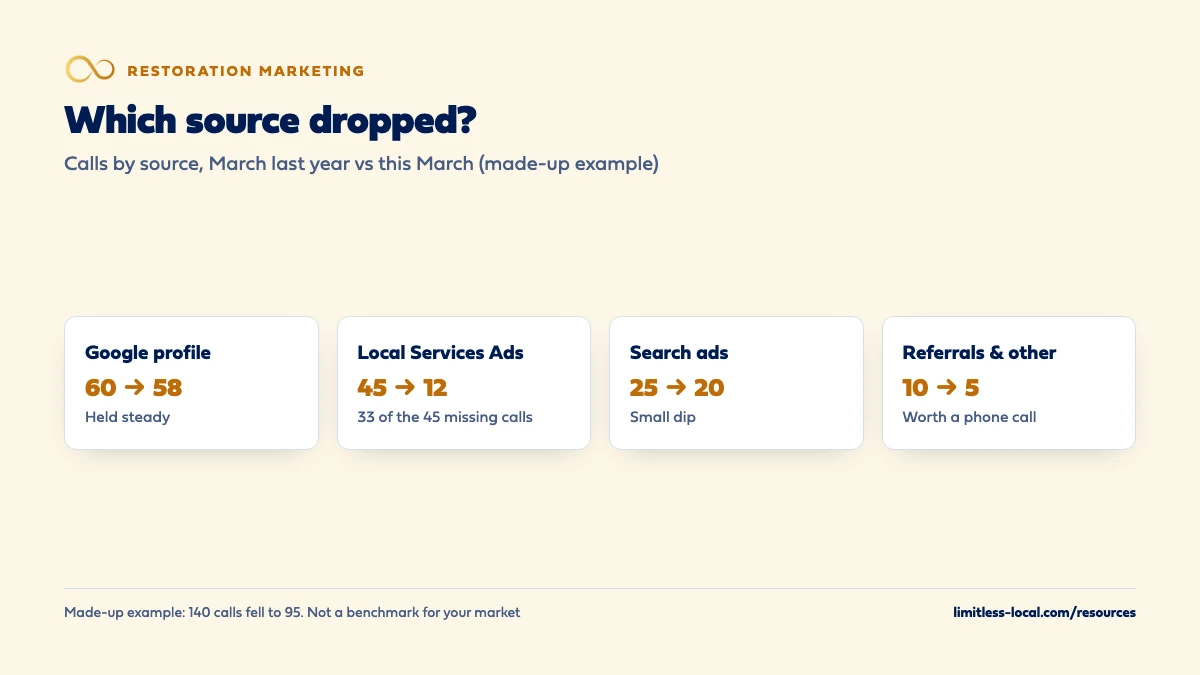
These numbers are made up to show the method, not a benchmark for your market. Say a restoration company got 140 calls in March last year and 95 this March, with similar weather. The owner lines up calls by source:
- Google profile: 60 last year, 58 this year.
- Local Services Ads: 45 last year, 12 this year.
- Search ads: 25 last year, 20 this year.
- Referrals and other: 10 last year, 5 this year.
Local Services Ads account for 33 of the 45 missing calls. Checking that account shows the monthly budget ran out halfway through the month after a busy February, and nobody noticed. Fixing the budget is a five-minute job. Without the source breakdown, the owner might have fired the SEO company or rebuilt the website instead.
Frequently asked questions
How long should I wait before deciding calls have really dropped?
A slow week tells you little. Look at at least a month against the same weeks last year, unless calls fell to almost nothing overnight, which points to something switched off or broken.
Can a Google algorithm update cause a sudden drop in calls?
It can shift organic rankings and Maps results, but a sharp drop on a single day is more often a suspension, a budget, a billing alert or a phone change. Rule those out first.
Should I raise my ad budget right away when calls drop?
Not before you know the cause. More budget won’t help if the phones aren’t answered, the profile is suspended or the weather is quiet.
Do I need call tracking to diagnose a drop?
It makes it far faster. Without a number per source, you’re guessing from separate platform reports that don’t line up neatly.
Could a competitor have reported my profile or left fake reviews?
It happens. Check for a sudden wave of reviews from people you never worked for, and report reviews that break Google’s policies. Never answer it with fake reviews of your own.
What if the drop is only in one town?
Check that town’s service area settings on your profile and ads, and look for a new competitor there. Maps results lean on distance, so a rival opening close to that town can take its calls.
Key takeaways
- Call every number you advertise before blaming any channel.
- Compare with the same weeks last year, because weather moves restoration calls.
- Line up calls by source: one source down points to that channel, everything down points to something shared.
- Check Maps profile status, ad status and budgets, and your reviews in that order.
- Fix one cause at a time and give it a couple of weeks before judging.
Want a second set of eyes on your setup?
We'll look at how you show up locally and where calls are leaking, then send you a plain-English breakdown.
More in this section
- Restoration website traffic vs phone calls: what is the difference?
- Why is my restoration website getting clicks but no calls?
- How does a restoration company recover when its reviews drop?
- Can a restoration company rely on SEO and Maps without ads?
- What elements turn restoration website visitors into calls?
Sources
- Understand your Business Profile performance & insights — Google Business Profile Help
- Why aren't my Local Services Ads running? — Google Local Services Help
- Fix "Limited by budget" status — Google Ads Help
- About change history — Google Ads Help
- Use auction insights to compare performance — Google Ads Help
- About missing or delayed reviews — Google Business Profile Help
- Business Profile restrictions for policy violations — Google Business Profile Help
- Performance report (Search results): Overview and basic setup — Search Console Help