
Can a restoration company rely on SEO and Maps without ads?

- Can a restoration company get enough calls from SEO and Google Maps alone?
- What does relying on SEO and Maps actually mean for a restoration company?
- Can organic results carry a restoration company's calls on their own?
- Why does distance limit what Maps can do for a restoration company?
- Who shows up on the page when I'm not running ads?
- How long before organic results can carry the load?
- What does an organic-only plan cost if there's no ad spend?
- When do ads still earn a place for a restoration company?
- Is it risky to depend on a single source of calls?
- How do I test cutting ads without losing jobs?
- What organic work keeps the calls coming once ads are off?
- What's different about going organic-only in restoration
- A worked example: what cutting ads would actually remove
- Frequently asked questions
- Key takeaways
- More in this section
- Sources
The short version
- Organic search and Maps can carry a steady base of calls once the profile, reviews and pages rank.
- Distance is a main Maps ranking factor, so towns far from your location are hard to win without ads.
- SEO typically takes 3-6 months to show meaningful growth, so going organic-only is a later move, not a starting point.
- Cut ads in steps, and only after you know what share of your signed jobs they produce.
For restoration owners tired of paying for every click who want to know whether organic search and Maps can carry the phones on their own.
Get a free visibility audit · Book a growth call
Can a restoration company get enough calls from SEO and Google Maps alone?
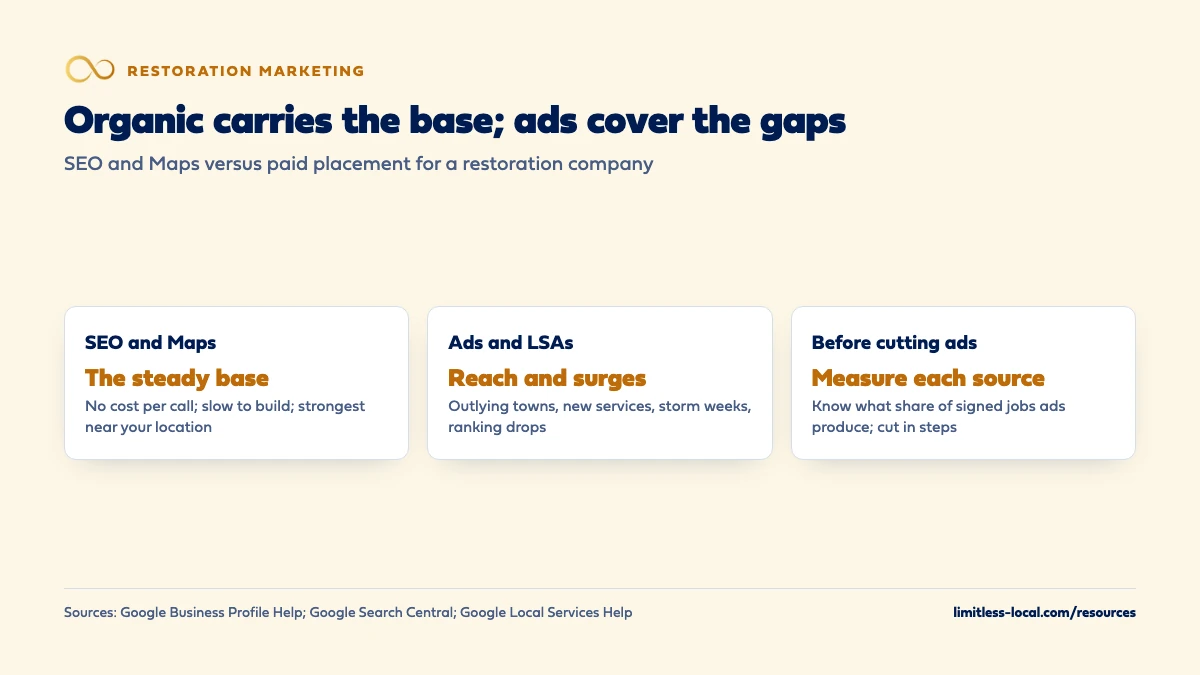
Some restoration companies can, once their Google profile, reviews and service pages rank well in the towns they serve, but most can’t count on organic results alone for every call they need. Organic and Maps listings cost nothing per call, and Google says nobody can pay for a better local ranking, but distance is one of the main local ranking factors, so a profile tends to be strongest near the business and weaker at the edges of a service area. Organic can carry a steady base of water damage work; ads still earn a place for the towns you don’t rank in, the services you’re not known for yet, and storm weeks when demand outruns your rankings.
The honest answer depends on your numbers: what share of your signed jobs comes from organic search, Maps, referrals and ads today. That’s what we look at first. Our local SEO work covers the Google profile, citations, reviews, service pages and content, and it’s included in every package, with Google Ads and, from the Growth tier, Local Services Ads alongside it for the gaps organic doesn’t cover. See how it applies to water, fire and mold companies on our restoration marketing page, read the restoration marketing guide for every channel side by side, or browse the restoration marketing questions library.
What does relying on SEO and Maps actually mean for a restoration company?
It means getting your calls from the two places on Google you can’t buy: the map results, which come from your Google Business Profile, and the regular organic results, which come from your website. Google is clear on both. Its guidance on hiring an SEO says Google never accepts money to include or rank sites in its search results and that it costs nothing to appear in organic results. Its local ranking help says there’s no way to request or pay for a better local ranking.
Free to appear in isn’t the same as free to earn. Ranking for “water damage restoration” in your towns takes a complete profile, steady reviews, real service pages and ongoing work, whether you do it yourself or pay someone. What changes when you drop ads is that you stop paying for each click or lead, and your call volume depends entirely on where you rank.
Can organic results carry a restoration company's calls on their own?
In our judgement, sometimes, and usually only after the company has been doing the organic work for a while. It’s most likely when most of these are true:
- You already show in the map results for water damage searches in the towns closest to you.
- Your profile has a steady flow of recent reviews, and you reply to them.
- Your website has a real page for each service you sell, and organic visits are already turning into calls.
- A good share of your work comes from referral partners, program work or repeat commercial accounts, so search isn’t carrying everything.
- Your service area is compact enough that most of it is close to where your business is.
It’s least likely for a new company, a company serving a wide area from one location, or one that wants to grow into fire, mold or commercial work it isn’t known for yet. Those are the situations where ads do work that organic results can’t do quickly.
Why does distance limit what Maps can do for a restoration company?
Google says local results are mainly based on relevance, distance and popularity, and it describes distance as how far each business is from the customer who’s searching. A restoration company is usually a service-area business, which Google defines as one that visits customers directly but doesn’t serve them at its address, and a service-area business can only have one profile for the whole area it serves, according to its service area guide.
In our judgement, that’s the practical ceiling on a Maps-only plan. You can list up to 20 service areas, but listing a town doesn’t make you close to it. The towns near your location are where the map results tend to work hardest for you; the towns half an hour or more away are where you’ll often see competitors who are closer to the searcher.
Organic web pages can reach further than the map results, because a strong page about water damage in a specific town can rank there. Ranking for water damage restoration in a city covers how to do that without thin, copied town pages.
Who shows up on the page when I'm not running ads?
Your competitors’ ads, if they’re running them. Google’s Local Services Ads guide says the Local Services unit is shown prominently in Google Search results when people search for the services an advertiser offers in the areas they’ve chosen. Search ads also show on the same results page as the organic listings.
That doesn’t mean organic results don’t get calls. People scroll past ads to the map results and to companies they recognize. In our judgement, though, a homeowner with water spreading across a floor tends to call one of the first companies that looks credible, and on a busy search, paid placements are part of what they see first.
The real question is whether your organic position in each town produces enough signed jobs on its own. Only your tracking can answer that.
Curious what your marketing is actually booking?
Get a free visibility audit — no obligation, no sales pitch.
How long before organic results can carry the load?
Longer than most owners hope. Ads can generate leads within days of launch, while SEO typically takes 3-6 months to show meaningful organic growth. Google’s SEO starter guide says some changes might take effect in a few hours and others could take several months, and that in general you likely want to wait a few weeks to assess whether your work had beneficial effects in Search.
That’s the time to start showing growth, not the time to replace paid calls. In our judgement, a restoration company should expect to run ads alongside the organic work for at least its first several months and decide about cutting back only once organic calls are visibly growing. How to tell restoration SEO is working before leads arrive lists the early signs to watch, and what to use for leads while SEO ramps up covers the bridge.
What does an organic-only plan cost if there's no ad spend?
Time, or money paid to someone else’s time. Google’s SEO guidance says that if you run a small local business, you can probably do much of the work yourself, and it recommends starting with its SEO starter guide. The work itself is ongoing:
- Keeping your Google profile complete and accurate, with current hours, categories and service areas.
- Asking for a review after every job and replying to them. Google says more reviews and positive ratings can help your business’s local ranking.
- Adding real photos of your crews, trucks and jobs.
- Writing and improving service pages for water, mold, fire and sewage work.
- Keeping your name, address and phone consistent across directories.
None of that has a per-click price, but it has a cost in hours every month. In our judgement, that’s the real trade: ads cost money per lead, organic costs steady effort, and dropping ads only saves money if the effort keeps happening.
When do ads still earn a place for a restoration company?
In our judgement, even a company with strong organic results usually has good reasons to keep some paid spend:
- Towns you don’t rank in. Ads let you show in the outer parts of your service area where your map listing is weaker.
- New services. If you want more fire, smoke or mold work and your pages don’t rank for it yet, search ads can bring those calls while the pages build.
- Storm and freeze weeks. Demand jumps faster than rankings can move.
- After a ranking drop. If your map listing slips, ads can keep calls coming while you fix the cause. Getting back into the map pack covers what to check.
- Local Services Ads specifically. They charge per lead rather than per click, which some owners find easier to judge against a signed job.
The point isn’t to run every channel forever. It’s to use paid spend where organic results are weakest, and to keep the amount tied to the cost per signed job.
Is it risky to depend on a single source of calls?
Yes, whichever source it is. Organic rankings can move when Google changes its systems, when a competitor improves its profile, or when something on yours goes wrong, such as a suspended listing or a changed phone number. Google doesn’t publish exactly how it ranks; its local ranking help says it keeps the search algorithm details confidential.
The Small Business Administration’s guide to marketing budgets makes the general point: it recommends including a mix of marketing methods and says not to put all your eggs in one marketing basket.
In our judgement, the safer version of “no ads” for a restoration company is a mix of organic search, Maps, referral partners and past customers, with a small paid budget you can turn up quickly when a ranking slips or a storm hits. That keeps one change at Google from emptying the schedule.
How do I test cutting ads without losing jobs?
- Measure first. For two or three months, tag every lead with its source and record which ones signed. You need to know what share of signed jobs ads produce before you cut them.
- Cut in steps. Lower the budget or narrow the towns rather than switching everything off, and watch whether total signed jobs hold.
- Cut where you rank best first. In our judgement, ads in the towns where your map listing is already strong are the most likely to be paying for calls you’d have had anyway.
- Keep the setup. Pausing a campaign keeps it ready to turn back on. For Local Services Ads, Google says that when your ad is paused, a free version of your listing may be displayed, per its page on ad scheduling.
What happens to your job flow when you stop ads covers the effect in more detail.
What organic work keeps the calls coming once ads are off?
The same work that got you there, done every month. Google’s local ranking help lists verifying the business, keeping your information complete and accurate, responding to reviews, and adding photos and videos as ways to improve your local ranking, and it notes that prominence is also based on things like how many websites link to your business and how many reviews you have.
For a restoration company, in our judgement, that means a review request after every job, replies to every review, fresh photos from real jobs, and service pages that stay current. It also means watching the early signs (impressions, map views, calls from organic visits) every month, so you see a slide before the phone goes quiet.
Want to see where your company stands?
A free visibility audit shows where you show up on Google, Maps and AI answers, and what it's costing you in calls.
What's different about going organic-only in restoration
Emergency searches favor whoever answers first. Water damage calls are urgent, and the homeowner often calls the first credible company that picks up. In our judgement, that makes the top of the results page, paid or not, worth more in restoration than in trades where people collect three quotes over a week.
Demand comes in spikes. A freeze or storm can bring a week’s worth of calls in a day. Organic positions don’t grow with demand; a paid budget can be raised for a few days and brought back down.
Referral and program work changes the math. A company that gets a large share of its jobs from plumbers, property managers or insurance programs needs less from search, which makes an organic-only plan more realistic.
Water, fire and mold rank separately. Strong water damage rankings don’t carry over to fire and smoke searches. Each service needs its own page and its own reviews mentioning that work.
A worked example: what cutting ads would actually remove
These numbers are made up to show the math, not a benchmark for your market. A restoration company tracks its signed jobs for three months and finds it signs about 30 jobs a month: 12 from Maps and organic search, 8 from referral partners and 10 from ads. Its ads cost $3,000 a month, so each ad-sourced job costs $3,000 divided by 10, or $300 in ad spend.
If it cuts ads completely, it’s betting that organic results will pick up those 10 jobs. In our judgement that’s unlikely at first, because most of the ad-sourced jobs came from outlying towns where its map listing is weak. Without ads, it should plan on closer to 20 signed jobs a month until organic results grow.
A safer test: cut ads only in its two strongest towns, where the map listing already ranks well. If total signed jobs stay near 30 for two months, those ads were mostly paying for calls it would have had anyway. If they fall, turn them back on.
Frequently asked questions
Does stopping Google Ads hurt my organic or Maps ranking?
Not directly. Google says advertising with Google won’t have any effect on your site’s presence in its search results, and that there’s no way to pay for a better local ranking. You lose the ad calls, not the organic position.
Can I rank in Maps for towns far from my location?
It’s harder. Distance is one of the main local ranking factors, and a service-area business can only have one profile for the whole area. Strong town-specific pages on your website and ads are the usual ways to reach further.
How many reviews do I need before I can drop ads?
There’s no number that makes ads unnecessary. Google says more reviews and positive ratings can help your local ranking. Decide based on what share of your signed jobs comes from organic results, not on a review count.
Is an organic-only plan realistic for a new restoration company?
Rarely in the first months. SEO typically takes 3-6 months to show meaningful organic growth, so a new company usually needs a paid channel or referral work to fill the gap.
Should I keep Local Services Ads even if I rank well in Maps?
Maybe. They charge per lead and show prominently in search results. If the cost per signed job from LSAs is one you can carry, they can sit alongside a strong map listing; if your tracking shows they mostly bring calls you’d get anyway, test lowering them.
Will a paused Local Services Ad still show anything?
Google says that when your ad is paused or outside your scheduled hours, a free version of your listing may be displayed.
Key takeaways
- Organic results and Maps cost nothing per call, and Google says no one can pay for a better local ranking.
- Distance is a main Maps ranking factor, so outlying towns are hard to win without ads or strong town pages.
- SEO typically takes 3-6 months to show meaningful growth, so organic-only is a later stage, not a starting point.
- Ads still earn a place for outlying towns, new services, storm weeks and ranking drops.
- Measure each source’s share of signed jobs, then cut ads in steps, starting where you rank best.
Not sure what's working right now?
Start with a free visibility audit: rankings, Google profile, reviews and tracking, checked against your service area.
More in this section
- Do Google Ads help a restoration company's SEO rankings?
- Can a restoration owner do their own SEO instead of hiring someone?
- Should a restoration company run Google Ads, LSAs or both?
- What can a restoration company use for leads while SEO ramps up?
- How should a restoration company run Google Ads for fire damage?
Sources
- Tips to improve your local ranking on Google — Google Business Profile Help
- Manage your service areas for service-area & hybrid businesses — Google Business Profile Help
- Do you need an SEO? — Google Search Central
- Search Engine Optimization (SEO) Starter Guide — Google Search Central
- Getting started with Local Services Ads (United States) — Google Local Services Help
- About ad scheduling — Google Local Services Help
- How to Get the Most From Your Marketing Budget — U.S. Small Business Administration