
Can a restoration owner do their own SEO instead of hiring someone?
- How much of my restoration company's SEO can I realistically handle myself?
- Is SEO something a restoration owner can actually learn?
- What SEO work can I handle myself without much risk?
- Can I write my own service pages?
- What SEO work usually needs outside help?
- Can I build city pages myself without getting in trouble?
- How do I know if my own SEO is working?
- How long before do-it-yourself SEO brings restoration calls?
- What does doing it myself really cost?
- If I hire someone later, what should I keep doing myself?
- When is it time to stop doing SEO myself?
- What's different about DIY SEO for restoration companies
- A worked example: counting the hours of do-it-yourself SEO
- Frequently asked questions
- Key takeaways
- More in this section
- Sources
The short version
- Google says a small local business can probably do much of its own SEO.
- Owners do the profile, photos, reviews and service details best, because they know the work.
- Help is most useful for technical fixes, links, steady page writing and tracking booked jobs.
- The real cost of DIY is your hours; count them before deciding it's free.
For restoration owners deciding whether to keep SEO in-house to save money, and which parts are worth handing off.
Get a free visibility audit · Book a growth call
How much of my restoration company's SEO can I realistically handle myself?
Yes, much of it. Google itself says a small local business can probably do much of its SEO work itself, and the core of local SEO for a restoration company is work the owner already knows best: an accurate Google Business Profile, real job photos, steady reviews, and one clear page per service and area. Where owners usually need help is time and consistency, technical site problems, link building, and tracking which work actually books water, mold and fire jobs. Whichever way you go, expect a ramp of months, not weeks.
Doing your own SEO is a fair choice, and a lot of this page is about how to do it well. If you’d rather hand it off, our local SEO covers the profile, listings, pages, links and reporting for a restoration company, and you still supply what only you know: your jobs, photos and service area. The restoration marketing page shows how SEO fits with ads, and the restoration marketing guide covers the do-it-yourself versus hire decision across all channels. More owner questions are in the restoration marketing questions library.
Is SEO something a restoration owner can actually learn?
Yes. Google’s own page on whether you need an SEO says that if you run a small local business, you can probably do much of the work yourself, and it recommends starting with Google’s SEO Starter Guide, which it describes as a practical guide that covers much of what an SEO would do for you.
The starter guide is blunt that there are no secrets that will automatically rank your site first. Most of local SEO is unglamorous and steady: complete information, useful pages, real reviews, and patience. None of that requires a marketing degree. It does require hours, and that’s where most owners get stuck.
What SEO work can I handle myself without much risk?
In our judgement, these are the jobs an owner does as well as or better than anyone else, because they depend on knowing the business:
- Your Google Business Profile. Categories, services, service area, hours and phone number, kept exactly true. Optimizing a restoration Google profile walks through each field.
- Job photos. Crews setting up drying equipment, a cleaned-out crawl space, a finished rebuild. You’re on the jobs; nobody else can take them.
- Reviews. Asking every satisfied customer and replying to each review. Google’s page on improving your local ranking says more reviews and positive ratings can help your local ranking, and that replying to reviews shows you value customer feedback. Replying to reviews covers the wording.
- Service facts. What you actually do for water, mold, fire, smoke and sewage work, how fast you get there and which towns you cover. Even if someone else writes your pages, these facts have to come from you.
Can I write my own service pages?
You can, and your knowledge is the hard part. The SEO Starter Guide says creating content that people find compelling and useful will likely influence your presence in search results more than any of its other suggestions, and it recommends writing content based on what you know about the topic rather than rehashing what others have published. A restoration owner who explains what happens in the first hours after a pipe bursts, what the drying process looks like and how the insurance paperwork usually goes is writing exactly that kind of page.
Where owners struggle is getting the pages written at all, then giving each one a clear title, linking them together sensibly and keeping them up to date. Ranking for water damage in your city covers what a strong service page needs, step by step.
What SEO work usually needs outside help?
In our judgement, these are the parts owners most often struggle to do alone:
- Technical problems. Pages Google can’t index, slow mobile pages, duplicate pages, broken redirects after a site change. Diagnosing them takes familiarity with Search Console and your website platform.
- Links and local mentions. Earning links from local organizations, suppliers and news sites takes time and outreach, and the shortcut is dangerous: Google’s spam policies list buying or selling links for ranking purposes as link spam.
- Listings across the web. Getting your name, address and phone consistent on dozens of directories is tedious rather than hard.
- A steady writing schedule. One good page a month for a year beats ten rushed pages in a week, and that steadiness is hard to keep during a busy storm season.
- Tracking what books. Knowing which pages and searches bring calls, and which of those calls become signed jobs, needs call tracking and some setup.
Curious what your marketing is actually booking?
Get a free visibility audit — no obligation, no sales pitch.
Can I build city pages myself without getting in trouble?
Yes, if each page is genuinely about that town. The risk is copying one page twenty times and swapping the town name. Google’s spam policies describe doorway abuse as pages created to rank for specific, similar search queries that lead people to intermediate pages that aren’t as useful as the final destination. A page for each town you really serve, saying something true about your work there, is a different thing.
In our judgement, this is the one area where owners doing their own SEO most often cause problems, usually by following a template that promises quick rankings. Building restoration city pages that rank explains how to make them worth having.
How do I know if my own SEO is working?
Set up Google Search Console for your website. Google’s Performance report page says it shows how your search traffic changes over time, which search queries bring traffic to your site, and clicks, which it defines as the number of times someone clicked your site from Google Search results. Your Business Profile has its own performance view for calls and direction requests.
Check once a month, not once a day. The SEO Starter Guide says some changes take effect in a few hours and others could take several months, and that in general you likely want to wait a few weeks to judge whether your work helped. For restoration, also note storm months, which raise calls from every source. Tracking visibility in Maps and AI search covers the full monthly check.
How long before do-it-yourself SEO brings restoration calls?
Plan for months. SEO typically takes 3-6 months to show meaningful organic growth, whether you or someone else is doing it. The ramp is the same; what changes is how steadily the work gets done during it.
That ramp is why many restoration companies don’t rely on SEO alone at first. Water damage calls are urgent and the work is out there today, so ads or Local Services Ads often carry the phone while the free visibility builds. In our judgement, that’s the bigger budget question for most owners, not whether to hire for SEO.

What does doing it myself really cost?
Your hours. DIY SEO isn’t free; it’s paid in time that could go to estimates, crews, adjusters and sales calls. The honest test is whether you’ll still be doing it in month five, after a storm season has eaten your evenings.
In our judgement, an owner who blocks out a few hours a month and sticks to it can keep the core going. An owner who means to do it “when things slow down” usually finds that restoration rarely slows down at the right time. If you’re weighing a hire, an in-house marketer or an agency compares the two paid options.
If I hire someone later, what should I keep doing myself?
The parts that depend on you. Google’s hiring page says you are responsible for the actions of any companies you hire, and suggests asking what results they expect, in what timeframe, and whether they will share all the changes they make. It also warns that no one can guarantee a #1 ranking on Google.
Even with help, in our judgement you should keep supplying job photos, approving what pages say about your services, asking for reviews at the end of every job and owning your Google profile and website logins. Those are the pieces that make your restoration company look like itself in search, and they’re the hardest for anyone else to fake.
When is it time to stop doing SEO myself?
In our judgement, a few signs:
- You’ve gone three months without touching the profile, a page or your reviews.
- Search Console shows indexing errors or a traffic drop you can’t explain.
- You want to expand into new towns or services faster than you can write for them.
- Your hours are worth more running jobs than writing pages.
Google’s hiring page notes that a great time to hire is when you’re considering a site redesign or planning a new site, so the site is built to be search-friendly from the start. If a rebuild is on your list, that’s a natural point to decide.
Not sure which of these is costing you jobs?
A free visibility audit checks the Google profile, reviews, site and tracking, and shows what to fix first.
What's different about DIY SEO for restoration companies
Your busiest weeks are unpredictable. A freeze or a storm can take every hour you have for weeks, so a DIY plan needs to survive those stretches, not assume a steady calendar.
You have more services to cover than most trades. Water, mold, fire, smoke, sewage and sometimes rebuild each deserve their own page, which is a lot of writing for one owner.
Your knowledge is the content. What you know about drying times, the first hours after a loss and working with adjusters is exactly what makes restoration pages useful. Keep insurance points general and never promise a claim outcome.
Photos need care. Use photos of your crews and equipment, and avoid anything that identifies a customer’s home or shows a family’s damaged belongings.
A worked example: counting the hours of do-it-yourself SEO
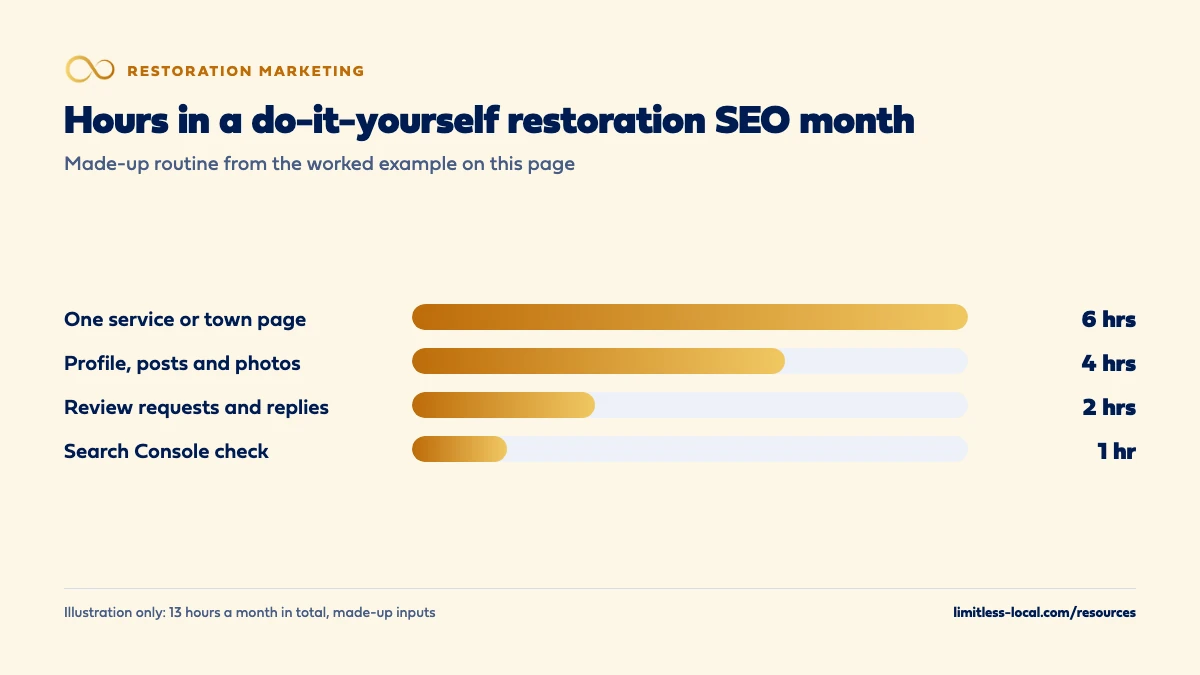
These numbers are made up to show the math, not a benchmark. Say an owner plans a monthly SEO routine:
- Google profile updates, posts and job photos: 4 hours a month
- Asking for reviews and replying to them: 2 hours a month
- Writing or improving one service or town page: 6 hours a month
- Checking Search Console and the profile’s performance: 1 hour a month
That’s 13 hours a month. If the owner values their time at $75 an hour, the routine costs $975 a month in time, before any tools, and it only works if those hours actually happen during storm season.
The comparison isn’t one-for-one. Our Essentials package is $3,500 a month and covers more than SEO, including Google Ads management, a content sprint of up to 10 pages and two blog posts a month, with ad spend paid directly to Google. Some owners are better off doing the SEO routine themselves and spending on ads; others would rather buy their hours back. The math above is how to decide, not a reason to pick one.
Frequently asked questions
Is Google's SEO Starter Guide enough to get started?
For the basics, yes. Google recommends it to small local businesses doing their own SEO, and it covers most of what an SEO would do on your site. Pair it with Google’s Business Profile help pages for the Maps side.
Do I need paid SEO tools to do it myself?
Not to start. Search Console and your Business Profile’s performance view are free, and in our judgement they cover what most single-location restoration companies need to check each month.
Can I pay for links to speed things up?
No. Google’s spam policies list buying or selling links for ranking purposes as link spam. A shortcut like that can hurt you more than it helps.
Should my office manager do the SEO instead of me?
They can handle the routine parts, like posting photos and asking for reviews. In our judgement, you should still approve what the pages say about your services and stay the owner of the profile and website accounts.
Can someone promise my DIY setup will rank if they fix it once?
No. Google says no one can guarantee a #1 ranking, and a one-time fix doesn’t replace steady work. Ask what they’ll change and how you’ll measure it instead.
Key takeaways
- Google says a small local business can probably do much of its own SEO.
- Owners are best at the profile, job photos, reviews and the facts on service pages.
- Technical fixes, links, listings, a steady writing schedule and tracking booked jobs are where help pays off.
- Never shortcut with bought links or copied town pages; both break Google’s spam policies.
- Count your hours honestly, and expect months, not weeks, before SEO shows meaningful growth.
Want a second set of eyes on your setup?
We'll look at how you show up locally and where calls are leaking, then send you a plain-English breakdown.
More in this section
- Do Google Ads help a restoration company's SEO rankings?
- Should a restoration company hire an in-house marketer vs agency?
- Should a restoration company run Google Ads, LSAs or both?
- How should a restoration company build city pages that rank?
- How should a restoration company run Google Ads for fire damage?
Sources
- Do You Need an SEO? Tips for Hiring an SEO — Google Search Central
- SEO Starter Guide: The Basics — Google Search Central
- Tips to improve your local ranking on Google — Google Business Profile Help
- Spam Policies for Google Web Search — Google Search Central
- Performance report (Search results): Overview and basic setup — Search Console Help