
How do I rank in Google for water damage restoration in my city?
- What does it take to rank a water damage restoration page in Google for my city in 2026?
- Where do I need to rank when someone searches for water damage in my city?
- Step 1: Do I need a dedicated water damage page?
- Step 2: What should the water damage page actually say?
- Step 3: How should I write the title and description?
- Step 4: How do I show Google which city I serve without spamming?
- Step 5: Does the page need to work on a phone?
- Step 6: How should the rest of my site point to it?
- Step 7: How do I get links and mentions from my city?
- Step 8: Does structured data help a water damage page rank?
- Step 9: How do I know if the water damage page is moving up?
- What if a competitor still outranks me?
- What's different about ranking for water damage restoration
- A worked example: reading Search Console for a water damage page
- Frequently asked questions
- Key takeaways
- More in this section
- Sources
The short version
- There are two places to rank: the map results, driven by your Google profile, and the regular results, driven by your page.
- One substantial water damage page beats a thin page per suburb.
- Title, phone experience, internal links and local mentions are the levers you control.
- Judge it in Search Console after a few weeks, and expect SEO to be a ramp of months.
For restoration owners who want their own website, not just ads, to show up when someone in town searches for water damage help.
Get a free visibility audit · Book a growth call
What does it take to rank a water damage restoration page in Google for my city in 2026?
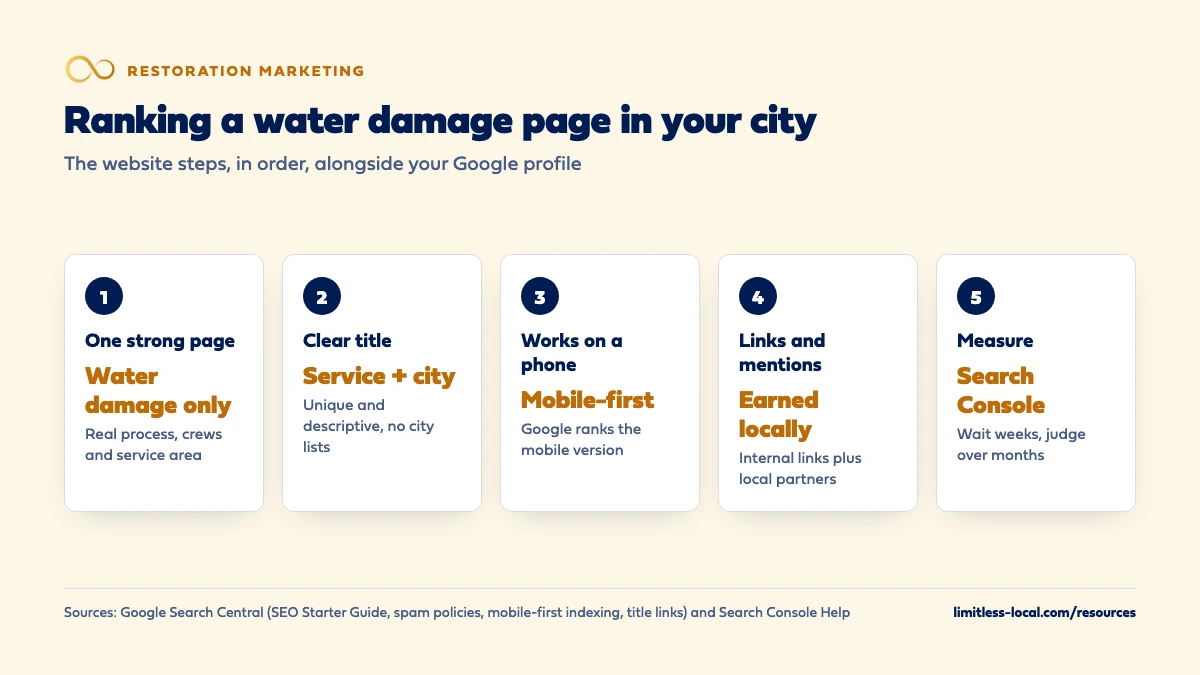
To rank for water damage restoration in your city, build one strong water damage page that answers what a homeowner needs in the first hours, names the places you really serve, shows your own crews and jobs, and loads and calls easily on a phone. Give it a clear title, link to it from the rest of your site, and earn genuine links and mentions from your area, while keeping your Google Business Profile complete and your reviews coming in for the map results. Avoid city-name lists and near-copy city pages, which Google’s spam policies call out, and measure progress in Search Console over months, not days.
This is the work our local SEO service does for restoration companies: service pages that earn their place, a cleaned-up Google profile, and links from the places you actually work. For the wider view of where water damage jobs come from, including ads and lead buying, see the water damage leads guide; the restoration marketing questions library goes one question at a time.
Where do I need to rank when someone searches for water damage in my city?
Two places, and they work differently. The local results on Google Maps and Search come from Business Profiles. Google says they’re mainly based on relevance, distance and popularity: how well your profile matches the search, how far you are from the person searching, and how well known your business is, which Google says is also based on how many websites link to you and how many reviews you have. Google also says there’s no way to request or pay for a better local ranking.
The regular web results below and around them come from web pages, and that’s where your water damage page competes. In our judgement, you need both: the map results are hard to win far from where your business is based, because distance is part of the formula, while a strong page gives you a second way into the same search. This page is about the website side; optimizing your restoration Google Business Profile covers the map side. Sources: Tips to improve your local ranking on Google.
Step 1: Do I need a dedicated water damage page?
Yes, in our judgement. If water damage is the work you want most, it shouldn’t live as one bullet on the homepage or a combined “services” page. Give it its own page with a descriptive address such as /water-damage-restoration/. Google says words in a URL can show as breadcrumbs and help people judge a result, though keywords in the URL alone have hardly any effect on ranking, so pick the address for people, not for the algorithm.
Then make the page worth ranking. Google’s starter guide says creating compelling, useful content will likely influence your presence in search more than any of its other suggestions, and its people-first questions ask whether content shows first-hand expertise and leaves a reader feeling they learned enough to reach their goal. For a homeowner with water on the floor, that goal is knowing whether you can come and what happens next. Sources: SEO Starter Guide and Creating helpful, reliable, people-first content.
Step 2: What should the water damage page actually say?
In our judgement, a water damage page earns its ranking by answering what a homeowner is worried about, in the order they worry about it:
- Can you come now? Your real response hours and the phone number, high on the page.
- Where do you go? The towns and neighborhoods your crews really cover, written as sentences, not a keyword block.
- What happens first? Your process: inspection, extraction, drying, monitoring, and when repairs start.
- Who will show up? Your crew, equipment and any certifications you hold, shown with your own photos.
- What about insurance? General guidance on how you work with a homeowner’s claim, without promising an outcome.
Write it in the words homeowners use. Google’s starter guide says to think about the different words people might search for, while noting its language matching can relate a page to many queries even without every exact term. “Burst pipe”, “flooded basement” and “water extraction” belong in honest sentences, not repeated in every paragraph. Other loss types deserve their own pages; what a sewage cleanup page should say covers one. Source: SEO Starter Guide.
Step 3: How should I write the title and description?
The title link is the headline Google shows in results, and Google says it’s drawn from your page’s title element and other headings. Google’s advice: a good title is unique to the page, clear and concise, and accurately describes the contents, and it can include your business name and the physical location of the business. Google also warns against keyword stuffing in titles and against boilerplate titles that vary by only a single piece of information, which copied city pages tend to produce.
The snippet under the title usually comes from the page’s own text, and occasionally from the meta description, which Google describes as a short, page-specific summary of the most relevant points. In our judgement, a plain title like “Water Damage Restoration in [Your City] | [Business Name]” and a description that says what you do, where and when does more than a clever one. Sources: Influencing your title links in search results and SEO Starter Guide.
Step 4: How do I show Google which city I serve without spamming?
Say it the way you’d say it to a customer: where you’re based, which towns you cover, and real jobs you’ve done there. Google’s spam policies list two things restoration sites often do to cover a metro:
- Keyword stuffing, which includes blocks of text that list cities and regions a page is trying to rank for.
- Doorway abuse, which includes pages targeted at specific regions or cities that funnel users to one page, and substantially similar pages that are closer to search results than a clear site structure.
That doesn’t rule out a page for a nearby city. In our judgement it rules out pages that only swap the city name. If you want separate pages for the towns you serve, each one needs something true and specific to that town; how to build city pages that rank walks through the structure. Source: Spam policies for Google web search.
Curious what your marketing is actually booking?
Get a free visibility audit — no obligation, no sales pitch.
Step 5: Does the page need to work on a phone?
Yes, for ranking as well as for calls. Google says it uses the mobile version of a site’s content for indexing and ranking, which it calls mobile-first indexing, and that keeping the same content on desktop and mobile lets both versions rank for the same keywords.
In our judgement, the phone version is also where most of the value is for restoration: someone standing in a wet basement wants a tap-to-call number and a reason to trust you within a screen or two. If your page already gets visits but the phone doesn’t ring, why a restoration website gets clicks but no calls covers the fixes. Source: Mobile site and mobile-first indexing best practices.
Step 6: How should the rest of my site point to it?
Link to the water damage page from your homepage, your main menu and the related pages (mold, sewage, storm) with link text that says what it is. Google’s starter guide says link text tells users and Google something about the page you’re linking to, and that the vast majority of new pages Google finds each day are found through links.
Keep one URL for one topic. Google says duplicate content isn’t a spam violation, but two pages with the same information can confuse people and waste crawling, and it suggests redirecting the weaker one to the page that best represents the information. In our judgement, an old “water damage” page and a newer “water mitigation” page that say the same thing should be merged. Source: SEO Starter Guide.
Step 7: How do I get links and mentions from my city?
Google says it finds pages mainly through links from other pages, that other sites linking to you happens naturally over time, and that you can encourage it by promoting your site: community engagement, advertising and word of mouth among them. For the map results, Google says how well known a business is, which feeds its local ranking, is also based on how many websites link to it.
In our judgement, the best restoration links come from real relationships: local chambers, community sponsorships, and the plumbers and property managers who send you work. Building a referral network with plumbers and property managers covers the relationship side.
Know where the line is. Google’s link spam policy includes buying or selling links for ranking, exchanging goods or services for links, excessive link exchanges, and partner pages made only to cross-link. A partner page that genuinely helps customers is fine; a swap made only for ranking is not. Sources: SEO Starter Guide, Spam policies for Google web search and Tips to improve your local ranking on Google.
Step 8: Does structured data help a water damage page rank?
Google describes LocalBusiness structured data as a way to tell it about details like your business hours, and says the name and physical address are required for the content to be eligible to show as a rich result. It can go on any page, though Google says it may make more sense on a page with information about your business. Google doesn’t say it raises a page’s ranking, so in our judgement treat it as tidy housekeeping on your contact or main location page, not as the step that wins the city.
The same goes for the things Google’s starter guide says not to focus on: the meta keywords tag (Google doesn’t use it), keywords in the domain name (hardly any effect beyond breadcrumbs), a target word count (length alone doesn’t matter for ranking) and treating E-E-A-T as a ranking factor (Google says it isn’t one). Sources: Local business structured data and SEO Starter Guide.
Step 9: How do I know if the water damage page is moving up?
Use the Performance report in Google Search Console. Google says it shows which queries bring traffic to your site, and gives clicks, impressions, click-through rate and average position, which you can group by query or by page. Filter to your water damage page and watch which searches it shows for and whether the position is improving.
Give it time. Google’s starter guide says some changes take effect in a few hours and others take several months, and that you’ll likely want to wait a few weeks before judging whether a change helped. In our experience SEO is a ramp: it typically takes three to six months to show meaningful organic growth, while ads can bring calls within days. Then connect the page to the phone: tracking which marketing brings in booked restoration jobs covers how to tell whether its calls became jobs. Sources: Performance report (Search results) and SEO Starter Guide.
What if a competitor still outranks me?
Look at what their page gives a homeowner that yours doesn’t, not at how many times they repeat the city. Google’s people-first questions make a fair checklist: does their page show more first-hand expertise, or describe the job more completely? Is their business better known locally, with more reviews and more sites mentioning it?
In our judgement, the usual gaps on restoration pages are thin process descriptions, stock photos, no clear service area, a slow mobile page and few local mentions. Fix the ones that are true for you, one at a time. Sources: Creating helpful, reliable, people-first content and Tips to improve your local ranking on Google.
Not sure which of these is costing you jobs?
A free visibility audit checks the Google profile, reviews, site and tracking, and shows what to fix first.
What's different about ranking for water damage restoration
Emergency searches. Many water damage searches happen with water still coming in. In our judgement, that means the page has to rank and convert at the same time: the phone number and response hours belong near the top, not below three paragraphs of history.
Loss types are separate searches. Water, sewage, mold and fire are different jobs and, in our judgement, different searches. A page per loss type you actually handle tends to match searches better than one page trying to cover all of them.
Insurance and health topics need care. Explain how you work with a homeowner’s insurance claim in general terms, without promising coverage or outcomes, and only make mold health claims that a source such as the EPA actually states.
Photos without voyeurism. In our judgement, show your crews and equipment, and leave out customers’ faces, addresses and identifiable damaged homes.
A worked example: reading Search Console for a water damage page
These numbers are made up to show the math, not a benchmark or a forecast for any market. Say the Performance report for your water damage page shows 1,200 impressions and 36 clicks over three months, a click-through rate of 3%, with most impressions coming from searches that include your city’s name.
You rewrite the title to name the service and city plainly and move the phone number and service area to the top of the mobile page. If, over the next three months, the same 1,200 impressions brought a 5% click-through rate, that would be 60 clicks. If 1 in 5 of those clicks called, that’s 12 calls, and your call tracking tells you how many became booked jobs. The ranking report alone can’t tell you that.
On our side, local SEO is part of every package. Essentials ($3,500 a month) includes a content sprint of up to 10 pages, two blog posts a month, link building and Google Business Profile management, with call and form tracking. We don’t guarantee rankings, and nobody honestly can, but you’ll see what we did and what it produced.
Frequently asked questions
Can I rank for a city where I don't have an office?
In the regular web results, a page about the work you genuinely do there can compete. In the map results it’s harder, because Google weighs how far a business is from the person searching.
Should every page on my site mention my city?
Only where it’s true and useful to the reader, in our judgement. Google’s spam policies name blocks of text listing cities a page is trying to rank for as keyword stuffing, so a footer full of town names doesn’t help.
Does Google prefer longer service pages?
No. Google’s starter guide says content length alone doesn’t matter for ranking. Write enough to answer the homeowner’s questions, then stop.
Will running Google Ads help my organic ranking?
Google says there’s no way to pay for a better local ranking. Ads can bring calls while the page ramps up, but they’re a separate channel.
How often should I update the water damage page?
When something real changes: services, coverage, certifications, process or photos. Google warns against changing dates or content just to look fresh when nothing substantial has changed.
Key takeaways
- Map results run on your Google profile (relevance, distance, popularity); regular results run on your water damage page.
- Build one substantial water damage page that answers what a homeowner needs first, in their words, with your own photos.
- Google’s spam policies name city-list blocks and near-copy city pages; say where you work in honest sentences instead.
- Make it work on a phone, link to it across your site, and earn real local links rather than swaps.
- Watch it in Search Console and give it months, not days.
Want a second set of eyes on your setup?
We'll look at how you show up locally and where calls are leaking, then send you a plain-English breakdown.
More in this section
- Which Google Ads keywords should a water damage company target?
- How do I get detailed Google reviews after a water damage job?
- Do job photos on Google help a restoration company rank?
- How should a restoration company build city pages that rank?
- How should a restoration company run Google Ads for fire damage?
Sources
- SEO Starter Guide — Google Search Central
- Creating helpful, reliable, people-first content — Google Search Central
- Spam policies for Google web search — Google Search Central
- Tips to improve your local ranking on Google — Google Business Profile Help
- Influencing your title links in search results — Google Search Central
- Mobile site and mobile-first indexing best practices — Google Search Central
- Performance report (Search results): Overview and basic setup — Search Console Help
- Local business (LocalBusiness) structured data — Google Search Central