
Do Google Ads help a restoration company’s SEO rankings?
- Will paying for Google Ads or LSAs move my restoration company up in Maps or organic results?
- Does spending more on Google Ads push my restoration website up in the free results?
- Do Local Services Ads help my Google Business Profile rank in the map pack?
- Why does my company seem to show up more after I start running ads?
- Can ads indirectly help my restoration SEO?
- How do I use my ad data to decide what pages to build?
- Do Google Ads help me show up in AI Overviews or AI answers?
- If ads don't help rankings, should I stop paying for them?
- Can pausing ads hurt my organic or Maps rankings?
- Do ads and organic results compete for the same clicks?
- What actually moves a restoration company up in the free results?
- What's different about ads and rankings for restoration companies
- A worked example: separating paid calls from organic calls
- Frequently asked questions
- Key takeaways
- More in this section
- Sources
The short version
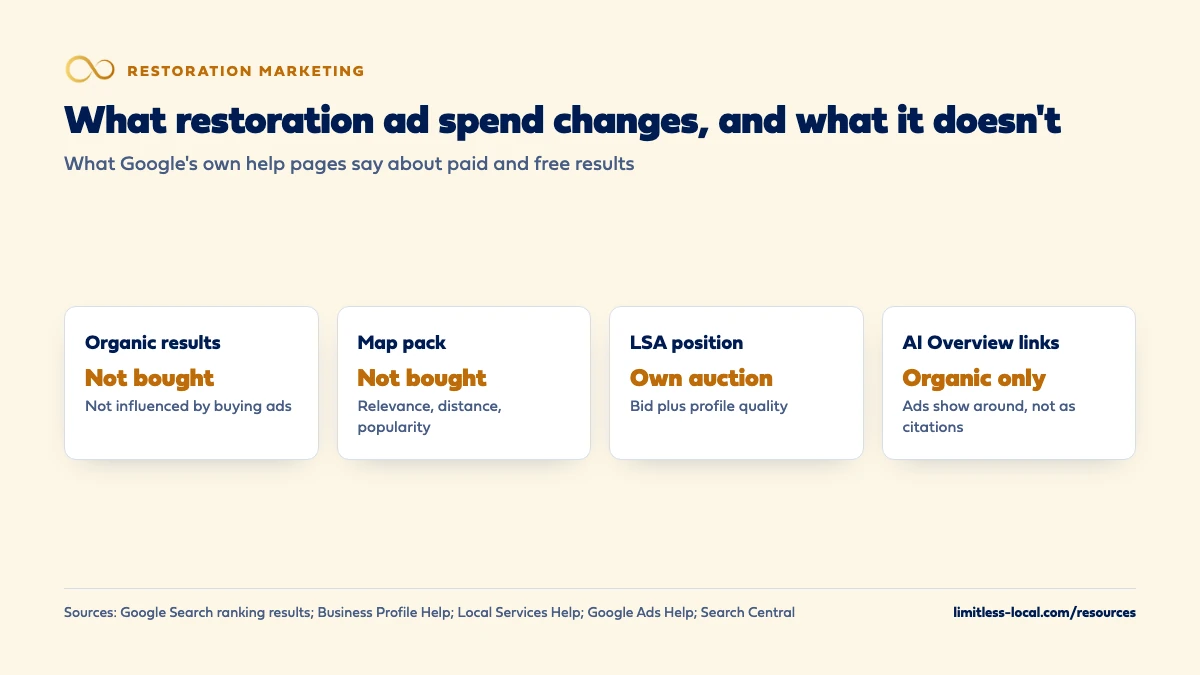
- Google says organic results aren't influenced by whether you buy ads, and nobody can pay for a better ranking.
- Local Services Ads rank in their own auction; that auction doesn't carry over to Maps or organic results.
- Ads show above, below and inside AI Overviews, but buying them doesn't make AI answers cite your site.
- The real link is data: ad search terms show which jobs to build pages and profile details for.
For restoration owners wondering whether the money going to Google Ads or Local Services Ads also buys them a better spot in the free results, the map pack or AI answers.
Get a free visibility audit · Book a growth call
Will paying for Google Ads or LSAs move my restoration company up in Maps or organic results?
No. Google says the results you see in Search are not influenced by whether a business buys ads, and that there’s no way to request or pay for a better local ranking, so Google Ads and Local Services Ads don’t move a restoration company up in organic search or the map pack. Ads buy a separate, labeled spot at the top while you pay for it. What ads can do is help indirectly: they show you which searches turn into booked water, mold and fire jobs, which tells you what pages and profile details to build for the free results.
Because ads and organic results are ranked separately, we run them as two jobs that feed each other: local ads bring restoration calls while you pay, and local SEO builds the free visibility that keeps working when you don’t. The search terms and booked-job data from the ads tell the SEO side which water, mold, fire and sewage pages to build first. Our restoration marketing page shows how the two fit together, and the restoration marketing guide covers how to split a budget between channels. More questions like this one are in the restoration marketing questions library.
Does spending more on Google Ads push my restoration website up in the free results?
No. Google’s page on how it ranks results says the results you see on Search are solely based on your query and are not influenced by whether a business, individual or organization buys ads. The same page says Google never gives advertisers special treatment in how its search algorithms rank their websites, and that nobody can pay Google to do so.
That holds no matter how big your budget is. A restoration company spending heavily on water damage keywords gets more ad impressions, not a higher organic position for its water damage page. If your organic ranking went up while your ads were running, something else changed: new pages, new reviews, new links, a competitor slipping, or ordinary movement in the results.
Do Local Services Ads help my Google Business Profile rank in the map pack?
Not according to Google. Its Business Profile page on improving your local ranking says plainly that there’s no way to request or pay for a better local ranking on Google. The same page says local results are mainly based on relevance, distance, and popularity: how well your profile matches the search, how far you are from the searcher, and how well known your business is, which includes how many websites link to you and how many reviews you have.
Local Services Ads are ranked in their own auction. Google’s page on Local Services ad rankings says that auction takes into account your bid and your overall profile quality, including how responsive you are to customers (missed calls may count against you), how relevant you are to the search, and your rating, number of reviews, response time, photos and verification checks. Spending more on LSAs raises your position in the LSA unit at the top of the page. Nothing on Google’s pages says it carries over to the map pack below it.
There’s an overlap worth noticing, though. Reviews, responsiveness and complete business details matter to both, so the work that makes you a strong LSA advertiser is close to the work that helps your profile. That’s our reading of two separate Google pages, not a statement that one feeds the other. Choosing between Google Ads and LSAs covers the LSA side in detail.
Why does my company seem to show up more after I start running ads?
Because you are showing up more, just in a different place. Google’s ranking page says ads are always labeled “Sponsored” or “Ad” and shown separately from search results. When your ads run, your company appears in those labeled slots on searches where it didn’t appear before. You see your name more often, your staff hear “I saw you on Google” more often, and it’s easy to read that as a ranking change.
To check, look at the organic numbers on their own. Search Console’s performance report shows clicks and average position for your website in the free results, and your Business Profile performance report shows profile views, calls and direction requests. Neither counts ad clicks. If those numbers didn’t move when the ads started, the ads didn’t change your free visibility; they added paid visibility on top of it.
Can ads indirectly help my restoration SEO?
Yes, in a few honest ways, and none of them involve Google rewarding you for paying.
- Search terms data. Google’s page on the search terms report says it shows the actual searches that triggered your ads and how they performed, and that it helps you discover new ideas for landing page content. For a restoration company, that’s a list of how homeowners and property managers really describe their problem: “basement flooded”, “ceiling leak”, “sewer backup”, “smoke smell after fire”. Those phrases make good page topics and headings.
- Proof of which jobs pay. If your call tracking ties ad calls to booked jobs, you learn which services and towns produce signed work. That tells you where to spend SEO effort first.
- More customers, more reviews. In our judgement, more booked jobs give you more chances to ask for reviews, and Google’s local ranking page says more reviews and positive ratings can help your local ranking. The ads don’t help directly here; the extra jobs and your review requests do.
- People who remember your name. Some people who saw your ad may later search for your company by name. That’s a branded search, and it isn’t evidence of a better ranking for “water damage restoration” in your city.
Curious what your marketing is actually booking?
Get a free visibility audit — no obligation, no sales pitch.
How do I use my ad data to decide what pages to build?
Pull the search terms report for the last few months, then sort the terms by the ones that turned into calls, and better still, booked jobs. Group them by service and by town. In our judgement, a pattern like this tells you a lot:
- Searches you pay for every month that your site has no page for, such as sewage cleanup or a specific nearby town
- Wording that converts that your pages don’t use, such as “burst pipe” when your page only says “water damage”
- Searches that produce clicks but never jobs, which may not deserve an SEO page either
Then build or improve one page per strong service, using the language people actually typed. Ranking for water damage in your city walks through what a strong water damage page needs, and building city pages that rank covers the town side without making thin copies.
Do Google Ads help me show up in AI Overviews or AI answers?
Ads can appear around AI answers, but buying them doesn’t get your website cited inside the answer. Google’s page on ads and AI Overviews says ads are eligible to show above, below or within AI Overviews, and that ads serve following the existing auction ranking system and signals. Those are ad placements, labeled as ads.
The supporting links in the AI Overview itself work differently. Google’s Search Central page on AI features and your website says you can apply the same foundational SEO best practices to AI features as to Search overall, and that to be eligible as a supporting link in AI Overviews or AI Mode, a page must be indexed and eligible to be shown in Google Search with a snippet. That’s an organic requirement, and ad spend doesn’t meet it. Tracking visibility in Maps and AI search covers how to check where you appear.
If ads don't help rankings, should I stop paying for them?
Not for that reason. Ads and SEO do different jobs. Ads can bring calls within days of launch, and SEO typically takes 3-6 months to show meaningful organic growth. For a restoration company, where a burst pipe or a sewer backup needs a crew today, a channel that can put you in front of tonight’s emergencies matters even while your free visibility is still building.
The question to ask of your ads is whether they book jobs at a cost you can live with, not whether they help your rankings. When ads are switched off, the calls they produced stop with them, which is why we think it’s wise to keep SEO work going alongside. What happens when you stop ads covers that in more detail.
Can pausing ads hurt my organic or Maps rankings?
Going by Google’s own statements, no: if buying ads doesn’t influence the free results, stopping them shouldn’t either. What you lose when you pause is the paid placement and the calls it produced. If your total calls drop when ads go off, that’s the ads’ share of your calls disappearing, not your organic ranking falling.
The one caution is indirect. If ads were bringing in most of your jobs, pausing them means fewer customers to ask for reviews, and over months that can slow the review growth Google’s local ranking page says can help. That’s our judgement about cause and effect, not a ranking rule.
Do ads and organic results compete for the same clicks?
They share a page, so they can. When your ad and your organic listing both show for the same search, some people who would have clicked the free result may click the ad instead, and you pay for a visit you might have had anyway. That’s most likely on searches for your own company name.
Our judgement: don’t assume either way. Compare your Search Console clicks on searches where you rank well organically, with and without ads running, and see whether total calls from those searches actually rise when ads are on. If they don’t, the ad budget may do more good on searches where you don’t rank yet, like towns or services your site barely covers.
What actually moves a restoration company up in the free results?
The things Google names, done steadily. For the map pack, that’s relevance, distance and popularity: complete and accurate business details, the right categories, reviews you earn and reply to, photos of your real crews and jobs, and links from local websites. For organic results, it’s useful pages for each service and area you really serve, a site that works on a phone, and links and mentions from your community.
None of that is bought from Google, which is the point. It’s work, and it takes months to show up. Getting back into the map pack covers what to check if you’ve dropped.
Want to see where your company stands?
A free visibility audit shows where you show up on Google, Maps and AI answers, and what it's costing you in calls.
What's different about ads and rankings for restoration companies
The urgency gap is wide. Water damage and sewage calls can’t wait for SEO to ramp, so restoration companies often lean on ads early, and it’s tempting to believe the ad money is building rankings at the same time. It isn’t, so plan both from the start.
LSAs sit at the top of many restoration searches. Strong LSA placement can look like a ranking win, but it’s an ad position in its own auction, and it ends when the budget does.
Restoration has many services with different wording. Water, mold, fire, smoke, sewage and storm work are searched in very different words, so the search terms report is unusually useful for deciding which pages to build.
Storm months distort the picture. Calls from every source jump after a freeze or a storm, so compare organic numbers with the same season, not the month before.
A worked example: separating paid calls from organic calls
These numbers are made up to show the math, not a benchmark for your market. Say a restoration company spends $2,400 a month on Google search ads. Last quarter, call tracking showed an average of 30 calls a month from ads and 18 a month from its Business Profile and organic website pages, 48 in total.
The owner pauses the ads for a slow month to test the belief that ads were holding up the rankings. Calls fall to 19: one more than the 18 organic and profile calls from before. Search Console shows the water damage page’s average position didn’t change, and the profile’s call count is about the same. The 29 missing calls are the ads’ share disappearing, not a ranking drop.
Next, the owner reads the search terms report and finds that “sewer backup cleanup” searches produced 6 booked jobs from ads over the quarter, while the site has no sewage page. That’s the page to build first. At $2,400 a month, ads stay switched on for the emergencies, and the sewage page starts its own slow climb in the free results.
If you work with an agency, the same split applies. Our Essentials package is $3,500 a month and includes Google Ads management up to $2,500 a month in ad spend, which is paid directly to Google, alongside the SEO work, and the monthly report shows calls by source so you can see which side produced what.
Frequently asked questions
Does Google give advertisers better organic rankings in return for spending?
No. Google says it never provides special treatment to advertisers in how its search algorithms rank their websites, and nobody can pay it to do so.
Will a bigger LSA budget get me more Google reviews?
Not by itself. More booked jobs give you more customers to ask, and in our judgement that’s where the extra reviews come from: the asking, not the ad budget.
Is it worth running ads on my own company name?
Sometimes, if competitors bid on your name or your listing sits low on branded searches. Check whether total calls from branded searches rise with the ads on before you keep paying for clicks you may have had for free.
Do Microsoft or Facebook ads help my Google rankings?
We have no source saying any other ad platform affects Google’s rankings, and Google says its results aren’t influenced by whether a business buys ads. Judge those ads on the jobs they book.
Can an agency promise that running ads with them will improve my rankings?
Not honestly. Google says ranking can’t be bought, and nobody can guarantee rankings. What an agency can show you is calls and booked jobs by source, so you can see what each side is producing.
Key takeaways
- Google says buying ads doesn’t influence organic results, and nobody can pay for a better local ranking.
- LSAs rank in their own auction on bid and profile quality; that position doesn’t carry over to the map pack.
- Ads can show around AI Overviews, but citations in them come from organic, indexed pages.
- The search terms report is the real bridge: it shows which restoration searches to build pages for.
- Judge ads on booked jobs, and judge rankings on Search Console and Business Profile numbers, separately.
Not sure what's working right now?
Start with a free visibility audit: rankings, Google profile, reviews and tracking, checked against your service area.
More in this section
- Do job photos on Google help a restoration company rank?
- Should a restoration company run Google Ads, LSAs or both?
- How should a restoration company run Google Ads for fire damage?
- Do Angi or HomeAdvisor listings help restoration companies rank?
- Can a restoration owner do their own SEO instead of hiring someone?
Sources
- How Does Google Determine Ranking Results — Google Search
- Tips to improve your local ranking on Google — Google Business Profile Help
- About ad rankings — Local Services Help
- About the search terms report — Google Ads Help
- About ads and AI Overviews — Google Ads Help
- AI Features and Your Website — Google Search Central