
What can a restoration company use for leads while SEO ramps up?
- Where should restoration leads come from during the months SEO takes to work?
- Why does a restoration company need a bridge while SEO builds?
- Which bridge brings restoration calls fastest?
- Can Local Services Ads be part of the bridge?
- Will my Google Business Profile bring calls before the website ranks?
- How do referral partners help during the ramp?
- Should I buy leads from lead sellers while SEO ramps up?
- Can insurance program work fill the gap?
- What about past customers and commercial accounts?
- How much should the bridge cost?
- When can I start easing off the bridge?
- What's different about bridging the SEO ramp in restoration
- A worked example: a bridge that shrinks as SEO grows
- Frequently asked questions
- Key takeaways
- More in this section
- Sources
The short version
- Google search ads are usually the fastest bridge; most ads are reviewed within one business day.
- Local Services Ads can follow once you pass Google's screening and verification.
- Referral partners and past customers cost time, not ad spend, and keep paying after the bridge ends.
- Shrink the bridge in steps as tracked organic jobs grow, not on a fixed date.
For restoration owners who’ve started on SEO and need water, mold and fire calls in the months before organic search pays off.
Get a free visibility audit · Book a growth call
Where should restoration leads come from during the months SEO takes to work?
Use sources that don’t depend on rankings: Google search ads, which can start running once they pass review (most within one business day), Local Services Ads once you clear Google’s screening, referral partners such as plumbers and property managers, and past customers. A verified Google Business Profile can also start bringing calls before your website ranks. SEO typically takes 3-6 months to show meaningful growth, so plan the bridge for at least that long, track which source signs each job, and shift money toward organic only as organic calls actually grow.
A bridge is only temporary if someone is watching when organic calls start to carry their weight, and that’s how we plan it: ads sized to the signed jobs you need now, SEO working in the background, and spend moved as the tracking shows organic jobs growing. Our local ads work covers Google Ads in every package and Local Services Ads from the Growth tier, with local SEO alongside. See how it fits water, fire and mold companies on our restoration marketing page, read the restoration marketing guide for every channel, or browse the restoration marketing questions library.
Why does a restoration company need a bridge while SEO builds?
Because SEO pays later and payroll doesn’t wait. Ads can generate leads within days of launch, while SEO typically takes 3-6 months to show meaningful organic growth. Google’s SEO starter guide says some changes might take effect in a few hours and others could take several months, and that you likely want to wait a few weeks to assess whether a change helped.
Paying for ads doesn’t shorten that wait. Google’s guidance on hiring an SEO says advertising with Google won’t have any effect on your site’s presence in its search results. So the bridge and the SEO work run side by side: one fills the schedule now, the other builds the calls you won’t have to pay for each time.
In our judgement, the worst version of this is the owner who starts SEO, sees nothing in month two, and cancels it to fund ads. The ramp only moves while the work continues.
Which bridge brings restoration calls fastest?
Usually Google search ads. Google’s ad review page says most ads are reviewed within one business day, though some take longer, and once an ad’s status is Eligible it starts to run. If you’re launching a new landing page with the ads, Google notes the page has to be complete for the ad to be reviewed.
For a restoration company, in our judgement, the bridge campaign should start narrow: water damage first, the towns your crews reach fastest, and only the hours someone can answer. Fire, smoke and mold campaigns can follow once the first one has a known cost per signed job.
The catch is that fast doesn’t mean cheap. Search ads charge per click, and emergency water damage searches can attract competition in many markets. How fast each restoration channel produces leads compares the timelines side by side.
Can Local Services Ads be part of the bridge?
Yes, once you’re through Google’s checks. Its screening and verification page says all businesses must pass screening, that the process varies by business category and location, and that it may include background, business registration, insurance and license checks and minimum review requirements. Some advertisers may be eligible for accelerated verification and then have 14 days to complete additional steps to keep their ad serving.
Google’s Local Services Ads guide also describes pre-badge ads, which let you receive leads after passing the preliminary checks while you finish the rest. Those listings appear below providers who’ve completed all onboarding and earned the badge.
In our judgement, start the LSA application the same week you start SEO, and run search ads while it’s in progress. Getting verified for Local Services Ads walks through the steps for a restoration company.
Will my Google Business Profile bring calls before the website ranks?
It can, and it’s free. The map results come from your Business Profile, which builds on a different track from your website’s organic rankings. Google’s local ranking help says verifying your business makes it more likely to show up in search results, that businesses with complete and accurate info are more likely to show up in local results, and that more reviews and positive ratings can help your local ranking.
So in the bridge months, in our judgement, the profile deserves weekly attention: correct categories and service areas, real photos of crews and drying setups, a review request after every job, and a reply to every review. It won’t replace ads overnight, especially in towns far from your location, but it’s often the first organic source to start producing calls.
Curious what your marketing is actually booking?
Get a free visibility audit — no obligation, no sales pitch.
How do referral partners help during the ramp?
They send work that never touches a search result. Plumbers often find the leak before anyone calls a restoration company. Property managers need a reliable call for every unit. HVAC companies, roofers and others see damage on their own jobs.
In our judgement, the bridge months are the right time to build these relationships, because they keep paying after the bridge ends. What earns referrals is response time, how you treat their customers and keeping them informed about the job. Never offer payment for referrals; build on the service.
Building a referral network with plumbers and property managers covers how to approach them and what to track.
Should I buy leads from lead sellers while SEO ramps up?
It’s an option, and in our judgement a careful one. Bought leads can fill a gap without any setup, but the terms vary a lot: some are sold to several companies at once, some are exclusive, and some are priced per call. Leads sold to several companies turn into a race to call first, and the cost per signed job can be far higher than the cost per lead suggests.
If you try them, treat them like any other channel: give them their own tracking, record which ones sign, and compare the cost per signed job with your search ads. Shared, exclusive and pay-per-call restoration leads breaks down the differences.
Bought leads also do nothing for your own name. Every dollar there is rented; the profile, reviews and pages you build during the same months are owned.
Can insurance program work fill the gap?
For some restoration companies, yes. Third-party administrator and preferred-vendor programs can send steady jobs, usually with their own pricing terms and requirements. Whether they’re worth it depends on those terms, your margins and how much of your capacity they take up.
In our judgement, program work can be a reasonable floor during the SEO months, as long as it doesn’t fill the schedule so completely that you can’t take the direct jobs your marketing is starting to bring in. Whether TPA program work is worth it versus generating your own leads covers the trade-offs. This is general business guidance, not insurance or legal advice.
What about past customers and commercial accounts?
Past customers are the cheapest bridge most companies ignore. They already know your work, they have neighbors, and some own rental properties. In our judgement, a short note after the job wraps, a request for a review, and an occasional check-in keep your name in front of them when a neighbor’s basement floods.
Commercial accounts (property managers, schools, churches, small office buildings) take longer to win, but one account can bring repeat work. The bridge months are a sensible time to start those conversations, since they won’t produce calls overnight either.
Neither replaces search for emergency water work. Both make the business less dependent on whatever Google does next.
How much should the bridge cost?
Work it backward from the signed jobs you need, not from a round number. Take the jobs you need each month, subtract what referrals, program work and organic search already produce, and size the ads to the rest. As organic results grow, that gap shrinks, and so does the ad budget.
Two Google rules shape the number. Search ad budgets are set per day; Google’s page on average daily budgets says you divide a monthly amount by 30.4 to get the daily budget, and that you won’t pay more than 30.4 times the daily average in a month for most campaigns. For Local Services Ads, Google’s bidding page recommends a minimum budget of 10 leads per week when you use Maximize leads.
Then add whoever runs it. In our judgement, an all-in cost per signed job, with management included, is the only fair way to compare the bridge with SEO.
When can I start easing off the bridge?
When your tracking shows organic jobs growing, not when the calendar says six months. The early signs come first: pages getting indexed, more impressions for water damage searches with your town names, better average positions, and more views on your Google profile. How to tell restoration SEO is working before leads arrive lists what to watch.
Once organic calls are signing jobs in a town, in our judgement, that town is the first place to lower ad spend. Cut in steps, keep the campaigns paused rather than deleted, and watch whether total signed jobs hold for a few weeks before the next step. If they fall, turn the spend back up. Most restoration companies keep some paid spend for outlying towns and storm weeks even after SEO is carrying the base.
Want to see where your company stands?
A free visibility audit shows where you show up on Google, Maps and AI answers, and what it's costing you in calls.
What's different about bridging the SEO ramp in restoration
Emergencies can’t wait for rankings. Someone with water on the floor calls today. In our judgement, a restoration company feels the gap between starting SEO and seeing organic calls more sharply than trades where customers plan the job weeks ahead.
Weather can swamp or starve the bridge. A freeze can bring more calls than the crews can handle; a dry month can leave the bridge as the only source of work. Keep the ad budget flexible so you can raise it for a few days and bring it back down.
Referral and program work are real channels here. Plumbers, property managers and insurance programs send restoration jobs in a way they don’t for many trades, which gives restoration owners more non-search bridge options than most.
Water, fire and mold ramp separately. Your water damage page might rank months before your fire or mold pages, so the bridge can shrink for one service while staying in place for another.
A worked example: a bridge that shrinks as SEO grows
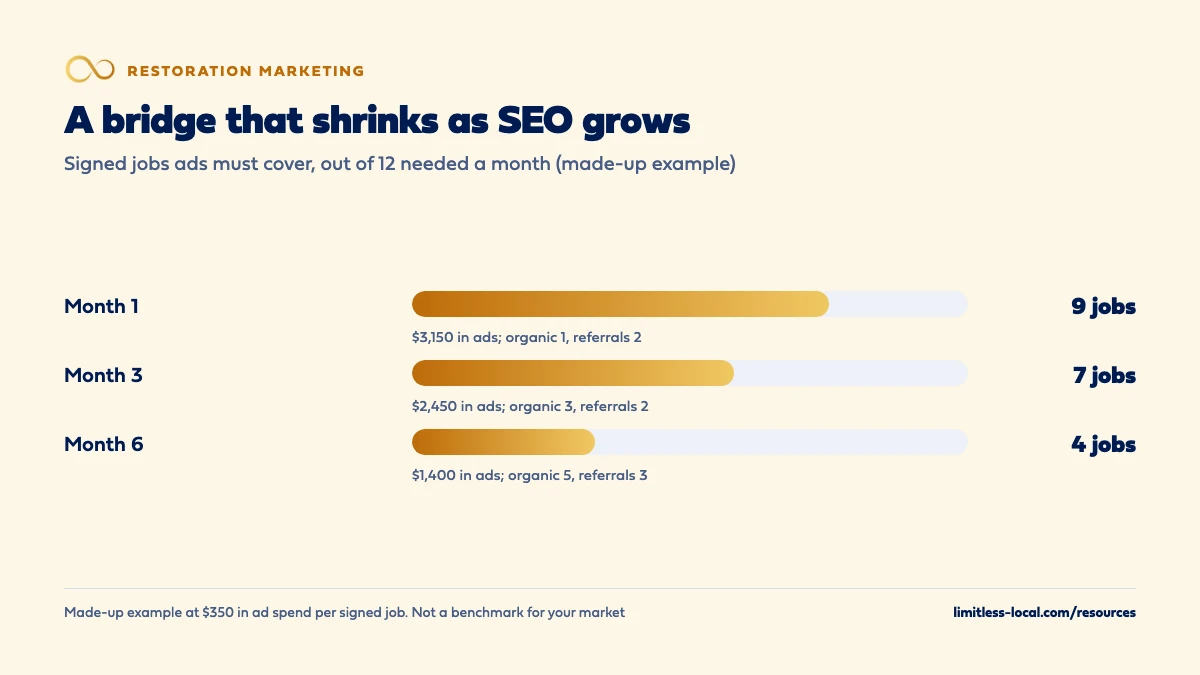
These numbers are made up to show the math, not a benchmark for your market. A restoration company needs 12 signed jobs a month. Its search ads and Local Services Ads together produce signed jobs at about $350 each in ad spend.
- Month 1: organic search brings 1 signed job and referrals bring 2, so ads need to cover 9. That’s 9 times $350, or $3,150 in ad spend.
- Month 3: organic is up to 3 and referrals hold at 2, so ads cover 7: $2,450.
- Month 6: organic brings 5 and referrals 3, so ads cover 4: $1,400.
The owner didn’t cut the bridge on a date. Each month, the tracking showed how many signed jobs organic and referrals produced, and the ad budget filled only the remaining gap. If organic had stalled at month three, the bridge would have stayed at $2,450, and that stall would be the signal to look hard at the SEO work.
Frequently asked questions
Does running ads make SEO work faster?
No. Google says advertising with Google won’t have any effect on your site’s presence in its search results. Ads fill the schedule while SEO builds; they don’t speed it up.
How long should I plan to run the bridge?
At least as long as SEO typically takes to show meaningful growth, which is 3-6 months, and longer if your market is competitive. Let your tracking, not the calendar, decide when to shrink it.
Can I use Facebook ads as a bridge?
In our judgement, they’re a weak bridge for emergency water work, because people with an active leak tend to search rather than scroll. They can help later for remarketing to people who already visited your site.
Should I pause SEO to afford more ads?
In our judgement, no. The organic ramp only moves while the work continues, so pausing it restarts the wait you’re paying the bridge to cover.
What if my Local Services Ads application stalls?
Keep search ads running and check which step is pending in your dashboard. Google says the screening process varies by category and location and may include background, license, insurance and review checks.
Is direct mail a good bridge for restoration?
In our judgement, it’s better for staying in front of past customers and property managers than for catching emergencies, since nobody keeps a mailer handy for the day a pipe bursts. If you use it, give it its own tracking number.
Key takeaways
- SEO typically takes 3-6 months to show meaningful growth, and ads don’t speed it up, so plan a bridge.
- Google search ads are usually the fastest bridge; start Local Services Ads screening at the same time.
- Work the Google profile, referral partners and past customers during the ramp; they cost time, not ad spend.
- Size the bridge to the gap between the jobs you need and what organic and referrals already produce.
- Shrink it town by town and in steps as tracked organic jobs grow.
Not sure what's working right now?
Start with a free visibility audit: rankings, Google profile, reviews and tracking, checked against your service area.
More in this section
- How can I tell if restoration SEO is working before leads arrive?
- Can a restoration owner do their own SEO instead of hiring someone?
- Can a restoration company rely on SEO and Maps without ads?
- How fast do restoration marketing channels produce leads?
- Should a restoration company run Google Ads, LSAs or both?
Sources
- Search Engine Optimization (SEO) Starter Guide — Google Search Central
- Do you need an SEO? — Google Search Central
- About the ad review process — Google Ads Help
- Understand the screening and verification process — Google Local Services Help
- Getting started with Local Services Ads (United States) — Google Local Services Help
- Tips to improve your local ranking on Google — Google Business Profile Help
- About average daily budgets — Google Ads Help
- How bidding works for Local Services Ads — Google Local Services Help