
How fast do restoration marketing channels produce leads?
- Which restoration marketing channel brings in leads soonest, and which takes longest?
- Which restoration marketing channel is fastest?
- How long do Local Services Ads take to start producing restoration leads?
- How long before a Google Business Profile brings in restoration calls?
- How long does restoration SEO take to bring in leads?
- How do the channels compare side by side?
- Is faster always better for a restoration company?
- How quickly can an agency produce results compared with building marketing in-house?
- What order should a restoration company turn channels on in?
- How do I know when a channel is actually working?
- What's different about channel speed for restoration companies
- A worked example: four channels started in the same week
- Frequently asked questions
- Key takeaways
- More in this section
- Sources
The short version
- Google Ads: calls can start within days of launch, once ads pass review.
- Local Services Ads: fast once live, but verification comes first.
- Google profile and Maps: visible after verification, then a slow climb.
- SEO: typically three to six months before meaningful organic growth.
- Speed isn't the same as cost per booked job; judge each on jobs.
For restoration owners deciding where to put money first, who want an honest side-by-side of how long Google Ads, Local Services Ads, Maps and SEO take to start producing calls.
Get a free visibility audit · Book a growth call
Which restoration marketing channel brings in leads soonest, and which takes longest?
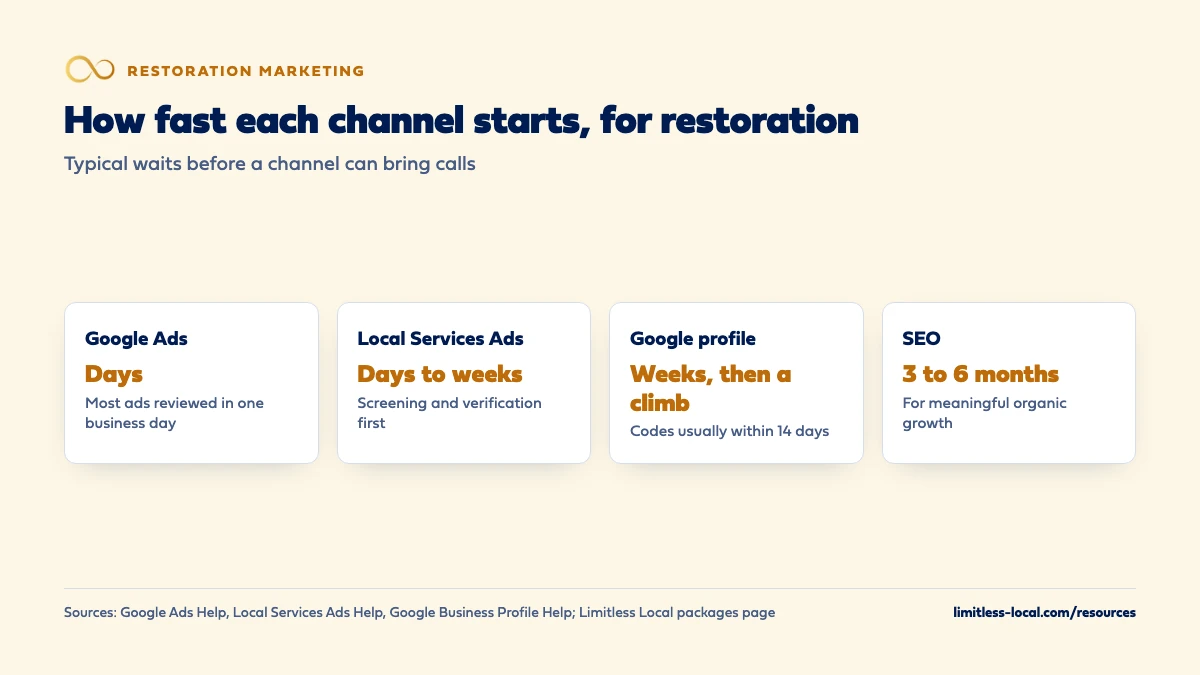
Google Ads is usually the fastest: once the account is built, Google says most ads are reviewed within one business day, and paid clicks can start right after. Local Services Ads can be close behind, but only after Google’s screening and verification, which can take days or weeks depending on what’s requested. A Google Business Profile can start showing in Maps once verified, but climbing the map pack takes steady reviews and accurate info, and SEO typically takes three to six months to show meaningful organic growth.
We plan restoration marketing around exactly this split: ads to bring calls in while the slower, cheaper-per-job channels build. Our packages combine both, and our restoration marketing page shows how that plays out for water, fire and mold work. The restoration marketing guide covers every channel and budget in depth, and the rest of the restoration marketing questions go one question at a time.
Which restoration marketing channel is fastest?
Google Ads, in most cases. A search campaign doesn’t need a reputation, a review count or months of content. It needs an account, a landing page, keywords, a budget and ads that pass Google’s review. Google says most ads are reviewed within one business day, though some take longer if they need a more complex review, and it suggests checking the ad’s status if a review runs past 2 full business days. Source: About the ad review process.
That’s why our own published timeline says ads can generate leads within days of launch, while SEO typically takes three to six months to show meaningful organic growth. Fast doesn’t mean cheap, though. Paid clicks for water damage searches stop the moment the budget does.
How long do Local Services Ads take to start producing restoration leads?
Local Services Ads can produce calls quickly once they’re running, because you’re paying per lead rather than waiting for rankings. The wait is upfront: Google screens and verifies businesses before the ads run.
Google’s screening help describes a risk-based process. Some advertisers qualify for accelerated verification and get the Google Verified badge quickly, then have 14 days to complete any additional verification steps to keep their ads serving. If you need a D-U-N-S number first, Google notes that applying through Dun & Bradstreet can take up to 30 days. A business that fails a background check has to wait an additional 30 days to reapply. Source: Understand the screening and verification process.
Local Services Ads are also moving into Google Ads as Performance Max campaigns with pay-per-lead goals during 2026, with service-area businesses without physical storefronts in a later phase. Source: Local Services Ads transition to Performance Max campaigns with pay-per-lead goals. The verification steps themselves are covered on getting verified for LSAs.
How long before a Google Business Profile brings in restoration calls?
Two clocks run here. The first is verification. Google says most verification codes arrive within 14 days, codes expire after 30 days, and verification reviews take up to 5 business days after you complete the steps. Source: Verify your business on Google.
The second clock is ranking, and it has no fixed date. Google says local results are mainly based on relevance, distance and popularity, and that more reviews and positive ratings can help your local ranking. Source: Tips to improve your local ranking on Google. Relevance you can fix in an afternoon with the right categories and services. Popularity builds one review at a time.
In our judgement, a verified, complete profile can start picking up calls from searchers close to you fairly early, while showing up across your whole service area takes months of reviews and activity. The profile setup itself is on optimizing a restoration Google profile.
How long does restoration SEO take to bring in leads?
Longer than ads, and Google says so itself. Its SEO Starter Guide notes that some changes take effect in a few hours while others could take several months, and suggests waiting a few weeks to judge whether a change helped. Source: SEO Starter Guide.
Our published expectation is that SEO typically takes three to six months to show meaningful organic growth. For a restoration company, the first wins often come from service pages and city pages that match how people search, like water damage, mold remediation or fire damage in a specific town. Ranking for water damage in your city covers what those pages need.
The trade-off: once organic pages rank, each extra call doesn’t carry a click cost the way an ad does. That’s why SEO is worth starting early even though it’s slow.
Curious what your marketing is actually booking?
Get a free visibility audit — no obligation, no sales pitch.
How do the channels compare side by side?
A rough comparison, using Google’s own help pages for the waits and our judgement for the rest:
- Google Ads. Wait: building the account plus ad review, which Google says is usually within one business day. Calls stop when spend stops. Best for: getting the phone ringing now.
- Local Services Ads. Wait: screening and verification, from quick to several weeks. Pay per lead. Best for: emergency calls once verified.
- Google profile and Maps. Wait: verification (codes within 14 days, review up to 5 business days), then a gradual climb. Free to run. Best for: steady calls from nearby searchers.
- SEO. Wait: typically three to six months for meaningful growth. Best for: lower cost per job over time.
- Referral relationships. Wait: depends on people, not platforms. Best for: repeat work from plumbers and property managers.
Is faster always better for a restoration company?
No. The number that matters is cost per booked job, not how soon the phone rings. A channel that starts fast but sends calls you can’t convert, or calls from outside your service area, can cost more per job than a slower one.
Speed also needs capacity. If ads switch on during a wet month and you only have one crew, you can end up paying for calls you can’t take. In our judgement, set daily budgets and ad schedules to match the crews you actually have.
And each channel needs the phone answered. A lead that rings out at 2 a.m. is lost no matter how fast the channel delivered it.
How quickly can an agency produce results compared with building marketing in-house?
The platform waits are the same either way. Google reviews ads, verifies LSAs and verifies profiles on its own schedule, no matter who submits them. What changes is the setup time on your side.
An agency that already runs these channels can usually launch faster than a new hire who is still learning your business and the platforms, in our judgement. Our own onboarding asks about 2 to 3 hours of your team’s time, with campaigns going live in weeks 1 to 2. An in-house hire has to be recruited first, then trained, before any of the platform clocks even start.
Neither route makes SEO faster. Google’s own advice on hiring an SEO is to interview them, check references and be wary of anyone who claims they can put you in first place. Source: Do you need an SEO? The full hire-versus-agency decision is on in-house marketer versus agency.
What order should a restoration company turn channels on in?
In our judgement, most restoration companies do best starting slow channels and fast channels at the same time:
- Verify and complete the Google profile. It’s free and it takes the longest to mature.
- Start reviews and service or city pages. They’re the slow build.
- Run Google Ads, LSAs or both to bring calls in while the slow channels grow. Google Ads, LSAs or both helps you choose.
- Set up call tracking first, so you know which channel booked which job.
As organic calls grow, many owners shift budget from paid to the work that keeps paying.
How do I know when a channel is actually working?
Count booked jobs by source, not clicks or impressions. Ads and LSAs show results within weeks, so give them about a month of clean data before big changes. Profile and SEO work need a quarter or more before you judge them, and Google’s own guidance suggests waiting a few weeks to assess any single change.
For restoration, also allow for lag: insurance-backed jobs may pay weeks after the call. Tracking which marketing brings booked jobs covers how to tie calls to jobs and revenue.
What's different about channel speed for restoration companies
Demand comes in waves. A freeze or a storm can fill a week, then a dry stretch follows. Fast channels like ads let you turn up when demand rises, while slow channels keep a floor under the quiet months.
The search is urgent. Someone with water on the floor calls one of the first few companies they see. That makes paid placement and the map pack the channels that matter most in the moment, in our judgement.
Verification has extra weight. Restoration crews go into people’s homes, and Google’s LSA screening can include background checks for select users before ads run. Start that paperwork early.
Not sure which of these is costing you jobs?
A free visibility audit checks the Google profile, reviews, site and tracking, and shows what to fix first.
A worked example: four channels started in the same week
These numbers are made up to show how the channels overlap, not a forecast. Say a restoration company starts everything in the same week. Google Ads launches after review and brings 6 booked jobs in the first month. LSAs take three weeks to clear verification and bring 3 booked jobs in month one, then 5 in month two. The Google profile was already verified but had few reviews; after 40 new reviews over three months it starts producing a handful of booked jobs a month. Service pages are published in month one and bring their first organic calls in month three.
By day 90 the owner can compare cost per booked job by source and decide where to add or trim. If you hand it off, our Essentials package is $3,500 a month and includes Google Ads management up to $2,500 a month in ad spend, profile management and content; Growth, at $4,500, adds Local Services Ads management. Ad spend is paid to Google separately.
Frequently asked questions
Can SEO bring restoration leads in the first month?
Occasionally, for a page that matches an easy search. But our published expectation is three to six months for meaningful organic growth, so don’t plan cash flow around it.
Do I need a Google profile before running Google Ads?
Not strictly, but in our judgement every restoration company should have a verified, complete profile anyway. Local Services Ads also pull core business details from it as they move into Google Ads.
Why are my ads approved but not getting calls?
Approval only means the ad can run. Budget, bids, keywords, location settings and the landing page decide whether it shows and whether people call.
Is it worth turning ads off once SEO starts working?
Often you can scale ads down rather than off. Many owners keep some paid budget for surges and for searches where they don’t rank yet.
Does an agency make Google verify my business faster?
No. Google’s verification and review timelines apply to everyone. An experienced team mainly saves setup time and avoids mistakes that restart the clock.
Key takeaways
- Google Ads is usually fastest; Google says most ads are reviewed within one business day.
- Local Services Ads can be quick once live, but screening and verification come first.
- A Google profile verifies in days to weeks; climbing the map pack takes months of reviews.
- SEO typically takes three to six months to show meaningful organic growth.
- Start the slow channels on day one and judge every channel by cost per booked job.
Want a second set of eyes on your setup?
We'll look at how you show up locally and where calls are leaking, then send you a plain-English breakdown.
More in this section
- How should a restoration company follow up on leads that don't book?
- Is my restoration marketing agency producing real jobs?
- How do I track which marketing brings in booked restoration jobs?
- How should a restoration company market to real estate agents?
- What does a restoration lead cost on Local Services Ads?
Sources
- About the ad review process — Google Ads Help
- Understand the screening and verification process — Local Services Ads Help
- Local Services Ads transition to Performance Max campaigns with pay-per-lead goals — Google Ads Help
- Verify your business on Google — Google Business Profile Help
- Tips to improve your local ranking on Google — Google Business Profile Help
- SEO Starter Guide — Google Search Central
- Do you need an SEO? — Google Search Central