
How should a restoration company follow up on leads that don’t book?
- What follow-up should a water, fire or mold company send after a voicemail, form or estimate that didn't book?
- Which restoration leads count as "didn't book"?
- How fast should I follow up on an emergency lead I missed?
- What should the follow-up schedule look like for estimates?
- What should a follow-up text or email actually say?
- Do texting and email rules apply to restoration follow-up?
- How do I follow up on Local Services Ads leads that didn't book?
- How do I follow up when the job is waiting on the insurance adjuster?
- How do I follow up with property managers and commercial leads?
- Where should unbooked leads live so nothing gets dropped?
- When should I stop following up?
- How do I know if my follow-up is working?
- What's different about follow-up for restoration companies
- A worked example: what a follow-up schedule can win back
- Frequently asked questions
- Key takeaways
- More in this section
- Sources
The short version
- Sort unbooked leads by urgency: emergency, estimate, or waiting on someone else.
- Emergency leads get a call back and a text within minutes, not tomorrow.
- Estimates get a call, then two short reminders spaced a few days and a week apart.
- Log every lead with a status and a next step, and stop the moment someone opts out.
For restoration owners whose phones get answered, but whose voicemails, web forms, mold inspections and rebuild estimates go quiet afterward.
Get a free visibility audit · Book a growth call
What follow-up should a water, fire or mold company send after a voicemail, form or estimate that didn't book?
Sort every unbooked restoration lead by how urgent it is, then follow up on a fixed schedule instead of when someone remembers. Active water, sewage or fresh fire damage gets a call back and a text within minutes, because that customer is calling other companies right now. Mold inspections, rebuild estimates and insurance-pending jobs get a call, then a short text or email a few days later and again about a week after that, and stop when the customer says no or stop.
Every one of our packages includes call, web and form tracking, so a lead that didn’t book still shows up with its source instead of disappearing into a voicemail box. Essentials includes a three-email welcome flow, Growth a five-email flow, and Scale custom follow-up sequences; automation add-ons such as unified messaging, calendar and reminders, after-hours answering and AI website chat plug into any tier, with pricing shared on the discovery call. See what each tier covers on our automation page and how it applies to water, fire and mold work on our restoration marketing page. For the bigger picture on channels and budget, read the restoration marketing guide, and the restoration marketing questions library takes the rest one question at a time.
Which restoration leads count as "didn't book"?
Anything that reached you and didn’t end in a signed work authorization or a scheduled visit. In a restoration company, that usually falls into five piles:
- Missed calls and voicemails, including calls that came in while the office was on another line.
- Web forms and chat messages that got a reply but no answer back.
- Local Services Ads messages sent by text or email from your ad.
- Inspections that ended with “let me think about it”, most often mold and small water jobs.
- Estimates waiting on someone else: a rebuild scope waiting on the adjuster, a property manager waiting on the owner, a homeowner comparing bids.
The first three are a speed problem. The last two are a follow-up problem. This page is mostly about the follow-up side; answering the phone in the first place is covered in who should answer after-hours calls.
How fast should I follow up on an emergency lead I missed?
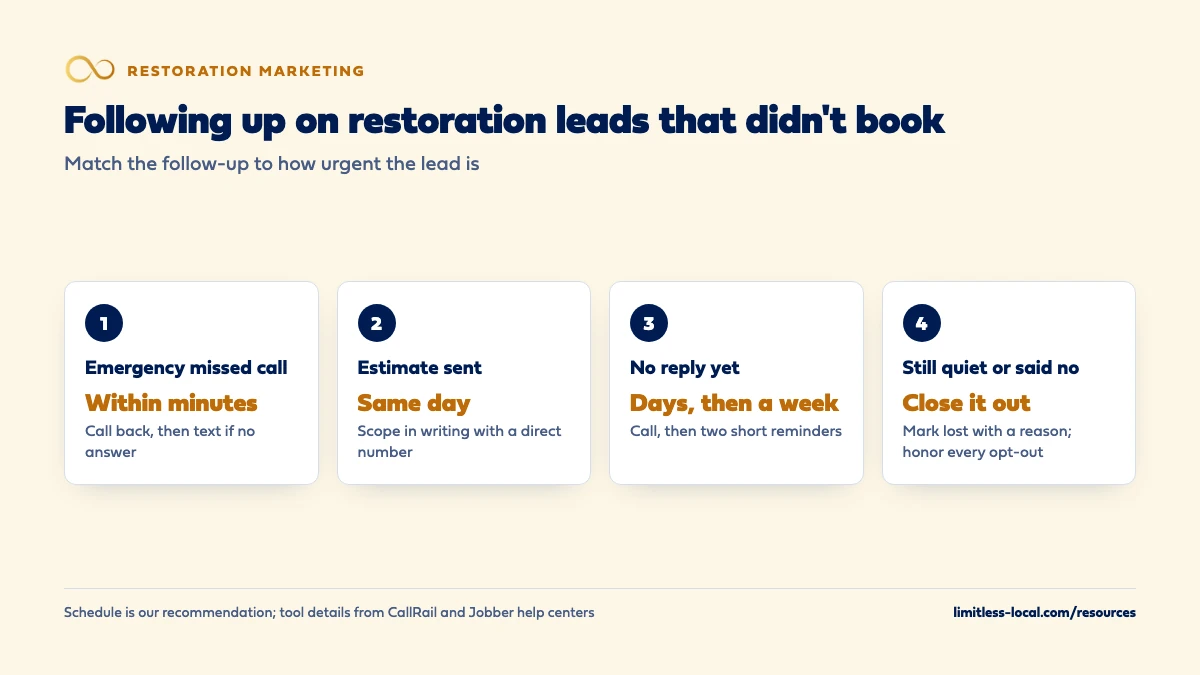
Within minutes, by phone first. A homeowner with water coming through the ceiling isn’t going to wait for a callback tomorrow morning; in our judgement, most of them dial the next company in the search results before your voicemail greeting finishes. So a missed emergency lead gets:
- A call back right away from whoever is on call, not the office the next morning.
- A short text if the call back doesn’t connect, saying who you are and that a crew can come out.
- One more call a little later if there’s still no answer.
If you use call tracking, it can send that first text for you. CallRail’s automated response for missed calls sends a text to a caller you missed, to let them know when they can expect to hear from you. CallRail notes that it doesn’t reach landlines, toll-free tracking numbers can’t send texts, a caller who hangs up before 15 seconds counts as abandoned and gets no text, and you have to register for text messaging compliance first. An automatic text buys a few minutes; it doesn’t replace the call. How fast to answer emergency calls covers the answering side in more detail.
What should the follow-up schedule look like for estimates?
For a mold inspection, a rebuild estimate or a smaller water job that didn’t sign on the spot, a fixed schedule beats good intentions. In our judgement, a simple one works for most restoration companies:
- Same day: send the estimate or scope in writing, with one sentence on what happens next and a direct number to reach the person who did the inspection.
- A few days later: a short call. If no answer, a text or email asking whether they have questions.
- About a week after the estimate: one more short reminder.
- After that: mark the lead as lost or waiting, with a reason, and stop chasing.
Field service software can send the reminders for you. Jobber’s automations include a quote follow-up that sends an automatic email or text to clients who haven’t responded to a quote, up to two reminders, each set to a number of days after the quote went out, with 90 days as the longest gap you can set. Jobber says the follow-up goes out the same way the quote did, so a quote sent by text gets a text reminder. Other tools work in a similar way; what matters is that the reminder goes out whether or not anyone remembers.
What should a follow-up text or email actually say?
Keep it short, specific and about their job. A homeowner who just had a burst pipe or a smoke-filled kitchen doesn’t want a sales pitch. In our judgement, good follow-ups do four things:
- Say who you are and which job it’s about: the address, the date of the inspection, the type of damage.
- Answer the most likely question before it’s asked: when you could start, what the next step is, whether they need anything from their insurer first.
- Give one clear next step, such as “reply YES and we’ll schedule” or “call this number to talk to the tech who came out.”
- Make it easy to say no. “If you’ve gone with someone else, just let us know and we’ll close this out” gets more replies than silence, and a no is useful too.
Skip the urgency tricks. The FTC’s advice on avoiding scams after weather emergencies lists “you’ll get a discount, but only if you sign a contract right away” as a sign of a scam, so a sign-today offer can make an honest company look like one.
Do texting and email rules apply to restoration follow-up?
Yes, and the details matter. This is general information, not legal advice; check with an attorney before you set up automated texting or email campaigns.
Texts. The FCC’s guide to unwanted robocalls and texts says its rules ban autodialed texts to a mobile phone unless the owner gave consent or the message is for emergency purposes, that commercial texts require written consent while informational texts can use oral consent, and that people can opt out of any robotext at any time and in any reasonable way. In practice, a customer who called you about their job and asked to be texted is very different from a list you text with promotions. When someone says stop, stop.
Email. The FTC’s CAN-SPAM compliance guide says the law covers commercial email, which must identify itself as an ad, include a valid physical postal address and an easy way to opt out, and that opt-outs must be honored within 10 business days, with the opt-out working for at least 30 days after you send. Emails that only facilitate a deal the person already agreed to, or update them on an ongoing transaction, count as transactional and are exempt from most of the law, but the FTC says those categories are read narrowly. A reminder about a quote they asked for, mixed with a promotion, can easily become commercial.
The FTC also says you can’t hand responsibility off: if a vendor sends email for you, both of you can be held responsible.
Curious what your marketing is actually booking?
Get a free visibility audit — no obligation, no sales pitch.
How do I follow up on Local Services Ads leads that didn't book?
Reply from the lead itself and do it quickly. Google’s How leads work page says you can reply to message leads directly from the Leads page in Google Ads or by responding to the notification, and that messages are routed through anonymized proxy numbers and email aliases, so reply through those rather than hunting for the customer’s own number.
The billing rules make follow-up cheaper than it looks. Google says that once a lead is charged, follow-up calls or messages with that customer aren’t charged again as long as there’s interaction within 15 days and the contact comes from the same phone number or email. If 15 days go by with no activity, a new call or message from that customer can be charged as a new lead. Google also says a call that goes to voicemail during business hours is treated as connected and charged if the caller stays on the line for more than 20 seconds, whether or not they leave a message. So a voicemail you paid for and never returned is money spent on a lead nobody worked. Google also notes that message lead pricing considers whether the customer has contacted other local advertisers, which is a reminder that the person who messaged you may well have messaged your competitors too. If you’re still setting LSAs up, getting verified for LSAs covers that first.
How do I follow up when the job is waiting on the insurance adjuster?
Follow up on the schedule, not the outcome. A rebuild or contents job that’s waiting on an adjuster isn’t a dead lead; it’s a lead with a date attached. In our judgement, the most useful thing you can do is ask the property owner when they expect to hear from their insurer, write that date on the lead, and check back right after it.
Keep your messages about your work and your schedule: when you could start, what you’d need to begin, how long your scope takes. Don’t predict what the insurer will pay or approve, and don’t coach the homeowner on their claim. That conversation is between them, their adjuster and their policy. If they ask insurance questions you can’t answer, point them back to their insurer or their state’s insurance department.
How do I follow up with property managers and commercial leads?
Differently from homeowners. A property manager who didn’t book often isn’t saying no; they’re waiting on an owner’s approval, a second bid or a budget cycle. In our judgement, the follow-up that works is to ask who else has to sign off and when, then follow up on that date with what they’ll need for the approval: your scope, your certificate of insurance, a timeline.
The same lead often comes back months later as a different job. A manager who didn’t book a small water job may call you for the next one if you stayed polite and stayed in touch. What property managers look for in a vendor goes further into that relationship.

Where should unbooked leads live so nothing gets dropped?
In one list with a status and a next step, not in a dispatcher’s head or a pile of sticky notes. Whatever you use, whether that’s a restoration platform, a field service app or a spreadsheet, every lead needs:
- Name, phone, email and property address
- Lead source, so you know which channel it came from
- Type of job and urgency
- Status: new, contacted, estimate sent, waiting on insurer, waiting on approval, booked, lost
- Next follow-up date and who owns it
- Reason lost, if it’s lost: price, went with someone else, insurer denied, no response, out of area
The lead source matters later. When you look back at which marketing produced real jobs, an estimate that booked after three follow-ups should still count for the channel that brought it in; tracking which marketing books jobs covers how to keep that link.
When should I stop following up?
When the person says no, says stop, or has gone quiet through your whole schedule. Honoring a no quickly is part of the rules for texts and email, and it’s also good manners in a business that depends on reviews and word of mouth.
In our judgement, after the last reminder an unbooked lead moves to “lost” with a reason, not to an endless drip. If the reason was timing, such as waiting on an insurer or a budget, it’s fair to put one more check-in on the calendar for the date they gave you. A lost lead that told you why is worth more than one that just stopped answering, because the reasons show you what to fix: price, speed, trust or service area.
How do I know if my follow-up is working?
Look at a few numbers every month:
- Time to first follow-up on missed calls and forms, split by business hours and after hours.
- Share of estimates that book, and how many of those booked only after a follow-up.
- Leads with no next step, which should be zero.
- Reasons lost, grouped, so you can see whether you’re losing on price, speed or something else.
If the share of estimates that book goes up after you start a follow-up schedule, that’s the payoff. If missed calls are the bigger leak, start with what missed calls cost you instead.
Not sure which of these is costing you jobs?
A free visibility audit checks the Google profile, reviews, site and tracking, and shows what to fix first.
What's different about follow-up for restoration companies
Two speeds of lead. Most trades have one sales cycle. Restoration has two: emergency mitigation that’s won or lost in minutes, and mold, rebuild and contents work that can take weeks. One follow-up schedule for both will either be too slow for the first or too pushy for the second.
Someone else often holds the decision. An adjuster, a property owner, a landlord or an HOA board may need to approve the work, so “no answer” often means “not yet.”
The customer is having a bad week. Follow-up that feels like a sales sequence lands badly with someone whose house is full of fans. Plain, helpful and short works better.
Storms change the math. During a weather event, every emergency lead gets a call back first and estimates wait a day. Write that rule down before the storm, not during it.
A worked example: what a follow-up schedule can win back
These numbers are made up to show the math, not a benchmark for your market. Say your company sends 20 mold and rebuild estimates in a month that don’t sign on the spot. Without a schedule, a few book anyway when the customer calls back on their own.
Now add two reminders to every one of those 20 estimates. If that brings in just three more signed jobs at an average of $6,000 each, follow-up added $18,000 in booked work that month, from leads you had already paid to get. Fewer wins would still likely cover the time spent sending reminders.
Compare that with what you spend to get new leads. If you pay for management on top of ad spend, such as our Essentials package at $3,500 a month with ad spend paid to Google separately, every lead you win back with a follow-up lowers your real cost per booked job without spending another dollar on ads.
Frequently asked questions
Should I text or call first when following up?
Call first for anything urgent, and text if the call doesn’t connect. For estimates, a text or email reminder is fine, as long as the customer gave you their number for this job and can easily say stop.
Can an answering service or AI receptionist handle follow-up?
It can take details and send a first reply, but in our judgement a person who knows the job should make the follow-up call on emergencies and estimates. Make sure whatever you use logs the lead with a next step.
Is it pushy to follow up on a mold inspection?
Not if it’s short and useful. One call and two reminders that answer real questions read as good service; daily messages with pressure don’t.
Should I offer a discount to get an estimate to book?
Usually not as a first move. Ask why they haven’t decided; the answer is more often timing, insurance or trust than price, and a discount doesn’t fix any of those.
How long should I keep a lost lead on file?
Keep the record, with its source and reason lost. It feeds your marketing reports, and it tells you who to call if the same property calls again.
Key takeaways
- Sort unbooked leads by urgency: emergencies need a call back within minutes, estimates need a schedule.
- Use a fixed estimate schedule: same-day written scope, a call a few days later, a reminder about a week out, then close it.
- Texts and email have rules on consent and opt-outs; get legal advice before automating, and stop when asked.
- LSA follow-ups with the same customer within 15 days aren’t charged again, so return every paid lead.
- Keep every lead in one list with a status, a next step, an owner and a reason lost.
Want a second set of eyes on your setup?
We'll look at how you show up locally and where calls are leaking, then send you a plain-English breakdown.
More in this section
- How do I track which marketing brings in booked restoration jobs?
- How should a restoration company market to real estate agents?
- How should a restoration company market to commercial properties?
- What lead-to-booked-job rate should a restoration company expect?
- How does a restoration company recover when its reviews drop?
Sources
- Automated responses for missed calls — CallRail Help Center
- Automations — Jobber Help Center
- CAN-SPAM Act: A Compliance Guide for Business — Federal Trade Commission
- Stop Unwanted Robocalls and Texts — Federal Communications Commission
- How leads work — Google Local Services Help
- How To Avoid Scams After Weather Emergencies and Natural Disasters — Federal Trade Commission