
Who should answer restoration calls after hours?
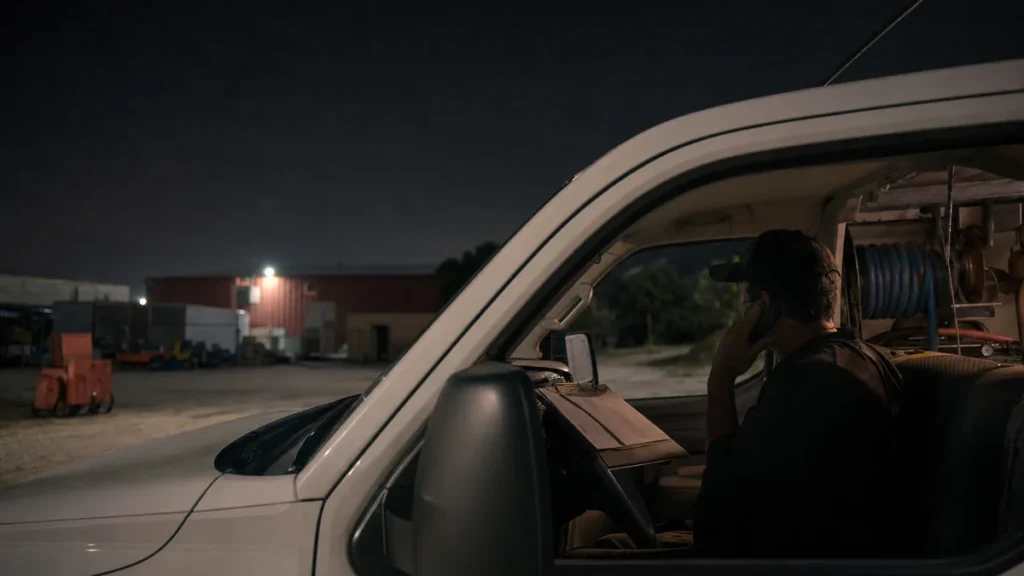
- Owner, on-call tech, answering service or AI receptionist: who should take restoration calls at night?
- What are the real choices for answering restoration calls after hours?
- Should the owner answer every night call?
- Does an on-call technician rotation work for a small restoration company?
- What does an answering service do well, and where does it fall short?
- Can an AI receptionist answer restoration emergencies?
- Which after-hours calls need a person tonight?
- What answer time is acceptable for after-hours restoration calls?
- Do my Google profile and Local Services Ads change who should answer?
- Should whoever answers text or call people back automatically?
- Which after-hours setup fits my size of company?
- How do I check that after-hours answering is working?
- What's different about after-hours calls for restoration companies
- A worked example: voicemail at night versus a first layer plus on-call tech
- Frequently asked questions
- Key takeaways
- More in this section
- Sources
The short version
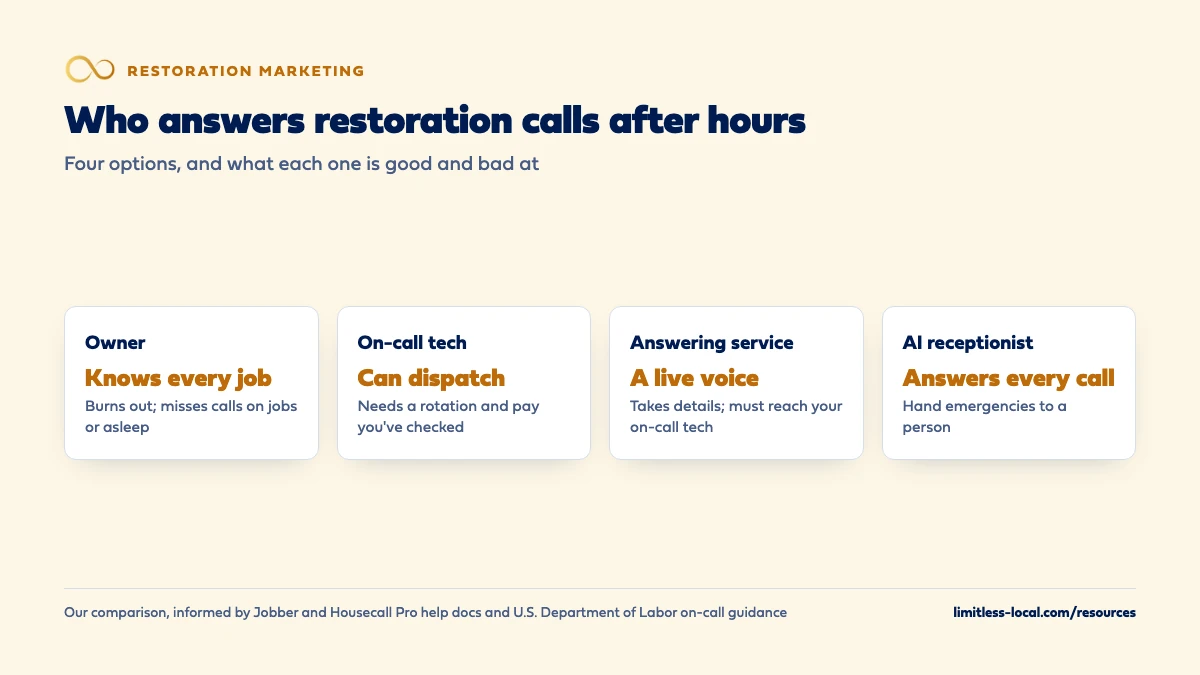
- Owner only: knows every job, but burns out and misses calls while on a job or asleep.
- On-call tech rotation: can dispatch, but needs a fair schedule and pay you've checked.
- Answering service: a live voice that takes details; it must reach your on-call tech, not just take messages.
- AI receptionist: answers every call and can book routine work; set it to hand emergencies to a person.
For restoration owners choosing who picks up the phone at night and on weekends, and how to make sure emergencies still reach someone who can send a crew.
Get a free visibility audit · Book a growth call
Owner, on-call tech, answering service or AI receptionist: who should take restoration calls at night?
After-hours restoration calls should be answered live by someone who can either send a crew or reach the person who can, within the first few rings. For most small and mid-size companies that means a first layer that answers every call (an answering service or an AI receptionist) handing emergencies straight to an on-call technician on a rotation, with the owner as the named backup rather than the only line. Let the first layer take details and book routine work like mold inspections and rebuild estimates, but don’t let it be the last stop for active water, sewage or fresh fire damage.
After-hours answering (AI that picks up when you can’t) is one of our automation add-ons, alongside AI website chat, automated follow-up on estimates and unclosed jobs, and lead tracking that puts calls, texts, chats and forms in one place; add-ons plug into any package of our restoration marketing, and their pricing is covered on the discovery call. The restoration marketing guide explains why speed-to-lead matters; this page is the staffing choice behind it. More answers sit in the restoration marketing library.
What are the real choices for answering restoration calls after hours?
There are four, and most companies end up combining two of them:
- The owner’s phone. Free, and the person answering knows every job and price. The weak point is one human being awake, sober and out of a crawlspace every night of the year.
- An on-call technician on a rotation. The person answering can decide to roll a truck and often is the one who goes.
- An answering service. A live voice that follows your script, takes the details and passes the call to whoever is on call.
- An AI receptionist. Software that answers every call, takes details, can book routine work and sends you a summary.
The question isn’t which one is best in general. It’s which one gets a homeowner with water on the floor talking to someone who can send a crew, at 2 a.m., every time. How fast restoration companies need to answer covers the speed standard; this page is about who carries the phone.
Should the owner answer every night call?
At a one-truck company, the owner often does, and that’s a reasonable place to start. The owner can quote, schedule and dispatch in one call, and nobody cares more about winning the job.
The problem is coverage, not skill. The owner is also the person on the 1 a.m. extraction and the person sleeping after it. In our experience, an owner-only night line works until the first busy week, and then calls start going to voicemail exactly when the jobs are biggest.
If the owner answers, make it deliberate: one forwarding setup that rings the owner’s phone out loud, a named backup for nights the owner is on a job, and a rule that a missed call gets a callback within minutes. Getting emergency calls with one truck covers the rest of the one-truck setup.
Does an on-call technician rotation work for a small restoration company?
Usually it’s the strongest option once you have two or more people who can run a water job. The tech who answers can decide whether the job needs a truck tonight and often be on the road within minutes.
Make it fair and clear:
- A posted rotation, weekly or by night, so everyone knows who has the phone.
- A backup for each shift, because the on-call tech may already be on a job.
- A clear decision rule for what gets a truck tonight and what gets a morning callback.
- Pay you’ve checked. The U.S. Department of Labor says an employee required to stay on call at the employer’s premises is working, while one who can stay at home or leave word where they can be reached is, in most cases, not working while on call, and that extra limits on their freedom could change that. Your state may have its own rules, so check with your accountant or an employment attorney before you set on-call pay; this isn’t legal advice.
The weakness: a tech on an extraction with wet hands can’t take a sales call well. Pair the rotation with a first layer that answers when the tech can’t. Source: Fact Sheet #22: Hours Worked Under the FLSA (U.S. Department of Labor).
What does an answering service do well, and where does it fall short?
A good answering service gives every caller a live, calm human voice and collects the same details every time. For restoration, that consistency matters: name, address, callback number, what’s wet or burned, whether the water is stopped, whether the power is safe, and whether there’s an insurance claim.
Where it falls short is the handoff. A service that takes a message and emails it to the office has turned an emergency into a morning callback, which in restoration is usually a lost job. When you set one up, ask for three things in writing:
- Dispatch, not messages. Emergencies get a live transfer or a phone call to the on-call tech, and the service keeps calling down your list until someone answers.
- Your script, word for word, including what operators must never say: no coverage opinions, no prices you haven’t approved, no promised arrival time they can’t know.
- Call recordings or detailed logs so you can check how calls were handled.
Then call it yourself late on a Sunday night, posing as a homeowner with a burst pipe, and see what happens.
Can an AI receptionist answer restoration emergencies?
It can answer them. Whether it should handle them is a different question. Field-service software now ships with AI phone answering, and the help docs show what it does:
- Jobber’s Receptionist answers calls and texts around the clock, can take requests and schedule jobs, and lets you set an escalation policy: when callers use terms you choose, such as “emergency” or “urgent”, it can text a team member a transcript snippet or transfer the call to them right away.
- Housecall Pro’s CSR AI answers calls, summarizes them and flags urgency. Its after-hours settings let it call you, text you or log the call, and it says emergency handling is always on, forwarding the call or sending a text alert to the number you pick.
For restoration, set it up so emergency words (water, flooding, leak, sewage, fire, smoke) transfer the call to the on-call tech, not just text them. A text the tech reads twenty minutes later is a slower answer than the homeowner will wait for. Let the AI take everything else: mold inspection requests, rebuild estimates, “are you in my area” questions and existing customers.
Watch what it says. In a case summarized by the American Bar Association, a Canadian tribunal held an airline responsible for wrong information its website chatbot gave a customer. Keep an AI receptionist away from insurance coverage, pricing you haven’t approved and arrival-time promises. Sources: Receptionist, powered by Jobber AI (Jobber Help Center), CSR AI Overview (Housecall Pro Help) and BC Tribunal Confirms Companies Remain Liable for Information Provided by AI Chatbot (American Bar Association).
Curious what your marketing is actually booking?
Get a free visibility audit — no obligation, no sales pitch.
Which after-hours calls need a person tonight?
Whoever answers first needs a short list, because the whole point of a first layer is sorting. Our working split:
- Hand to the on-call tech now: water still coming in or standing, sewage backups, a fire or smoke event in the last day, any commercial property, and any caller who sounds unsafe or asks for a person.
- Book or promise a morning callback: mold inspections, rebuild and repair estimates, insurance and paperwork questions, scheduling changes on open jobs, and vendors.
Tell the caller which bucket they’re in. “Our technician will call you in the next few minutes” and “Our office will call you at 8 a.m.” are both fine answers. Silence isn’t.
What answer time is acceptable for after-hours restoration calls?
The same as during the day; the speed standard itself is covered in the page on how fast restoration companies need to answer, linked above. What’s specific to nights is where the time goes: in our judgement, an emergency caller should hear from the on-call tech within minutes of the first layer picking up, not within the hour, because a homeowner with water on the floor doesn’t wait longer just because it’s dark.
The first layer buys you that live answer. It doesn’t buy you the job. The handoff to someone who can dispatch is the part to time and test. What missed calls cost a restoration company shows what a slow handoff costs in jobs.
Do my Google profile and Local Services Ads change who should answer?
They change what happens if nobody does. Google asks businesses to list their regular customer-facing hours on their profile. If yours says you’re open all night, homeowners will call expecting a person.
On Local Services Ads, Google charges for a missed call during your business hours when the caller stays on the line more than 20 seconds, and a call that goes to voicemail or an automated greeting during business hours is treated as a connected call and charged on the same rule, message or not. So a night line that rolls to voicemail can cost you the job and the lead fee. The help page we read doesn’t say how a call answered by an AI receptionist is judged, so treat that as untested and watch your lead charges.
Either cover the hours you list, or list the hours you cover. Setting up your restoration Google profile covers hours and phone numbers. Sources: Guidelines for representing your business on Google and How leads work (Local Services Help).
Should whoever answers text or call people back automatically?
An automatic text when a call is missed is a useful bridge, not a replacement for a person. CallRail, for example, notes that callers on landlines won’t receive the text, that callers who hang up within 15 seconds are classed as abandoned and don’t get one, and that you must register for text messaging compliance before automated texts go out.
Be more careful with automated callbacks. The FCC has ruled that calls made with AI-generated voices are “artificial” under the Telephone Consumer Protection Act, the law that governs robocalls. The FCC announcement doesn’t address a reply to someone who has just called you, so ask your provider and an attorney before you let software place calls in an AI voice. This isn’t legal advice. Sources: Automated responses for missed calls (CallRail) and FCC Makes AI-Generated Voices in Robocalls Illegal (FCC).
Which after-hours setup fits my size of company?
- One truck: an AI receptionist or answering service as the first layer, with emergencies transferred to the owner, and a missed-call text as the safety net. The owner gets to sleep through the routine calls.
- Two to four crews: a first layer that answers everything, emergencies transferred to an on-call tech on a weekly rotation, and the owner as backup.
- Larger or multi-market: a dispatcher on nights, or a dispatch-capable answering service, plus an on-call tech per area. Storm weeks need an overflow plan on top; handling a storm call surge covers that.
These are our recommendations, not rules. Whichever you pick, write it down, test it monthly with a real call, and review the night’s calls each morning.
How do I check that after-hours answering is working?
Once a week, pull every call that came in outside office hours and check four things: was it answered live, how long until someone who could dispatch spoke to the caller, what bucket it went into, and did it become a job. Listen to a few recordings to hear whether the script was followed and the emergencies were handed off.
Judge the setup by after-hours jobs booked, not by calls answered. A service that answers every call and books nothing isn’t solving the problem.
Not sure which of these is costing you jobs?
A free visibility audit checks the Google profile, reviews, site and tracking, and shows what to fix first.
What's different about after-hours calls for restoration companies
The night call is often the job. Burst pipes, failed water heaters and storm damage don’t keep office hours, and the homeowner calling at night is usually ready to say yes to whoever answers.
The person answering has to decide fast. In restoration, the difference between “send a truck tonight” and “call back at 8” is the whole call. That decision belongs with someone who knows the work, or a first layer with a very clear rule.
Insurance questions come up on the first call. Whoever answers should take the claim details and stay out of coverage opinions. That’s true for a tech, an operator or software.
A worked example: voicemail at night versus a first layer plus on-call tech
These numbers are made up to show the math, not a benchmark for your market. Say your company gets 18 calls a month outside office hours. Today they go to the owner’s cell, which rolls to voicemail when the owner is on a job or asleep. Morning callbacks book 2 jobs from those calls.
Now put an AI receptionist in front of an on-call rotation. Every call is answered; emergencies are transferred to the on-call tech; routine requests are booked for the morning. Say that books 6 jobs from the same 18 calls, or 4 more than before. At a made-up average job value of $4,000, that’s $16,000 more work a month from calls you were already getting.
Now the cost side. Jobber, as one example, lists its Receptionist as an add-on on select plans at $29 a month including 30 conversations, plus $0.79 for each conversation over that, so 18 calls a month stays inside the included amount. Other tools and answering services price differently, and on-call pay is its own line. Put your real quotes next to the extra jobs.
Frequently asked questions
Can I just forward night calls to my cell phone?
Yes, as a deliberate setup with a named backup for nights you’re on a job. On its own it tends to fail in the busiest weeks, which are the ones that matter most.
Will homeowners hang up on an AI receptionist?
Some will. That’s one reason to transfer emergencies to a person quickly and to send a missed-call text if a caller drops.
Should the after-hours line say we're open around the clock?
Only if a person who can dispatch is reachable around the clock. Otherwise say exactly when someone will call back, and keep your Google profile hours consistent with that.
What should an answering service never tell a caller?
What their insurance covers, a price you haven’t approved, or an arrival time they can’t know. Those belong to your team.
Do I need a separate phone number for nights?
Usually not. Keep one public number and change where it routes after hours, so your listings and your website stay consistent.
How often should I test the after-hours setup?
Monthly at least, and before every storm season: call your own number at night, play a homeowner with a burst pipe, and time how long it takes to reach someone who can send a truck.
Key takeaways
- Answer after-hours calls live, and get emergencies to someone who can dispatch within minutes.
- Most companies do best with a first layer (answering service or AI receptionist) plus an on-call tech rotation, and the owner as backup.
- Set AI tools to transfer emergency calls to a person, and keep them out of coverage and pricing talk.
- Check on-call pay rules before you start a rotation; the DOL’s on-call guidance depends on how restricted the tech is.
- Either cover the hours your Google profile lists or list only the hours you cover, especially if you run Local Services Ads.
Want a second set of eyes on your setup?
We'll look at how you show up locally and where calls are leaking, then send you a plain-English breakdown.
More in this section
- How fast does a restoration company need to answer emergency calls?
- How much do missed calls cost a restoration company?
- How should a restoration company handle marketing during storm season?
- How do restoration companies show up in AI search answers?
- How can a one-truck restoration company get emergency calls cheaply?
Sources
- Receptionist–powered by Jobber AI — Jobber Help Center
- CSR AI Overview — Housecall Pro Help Center
- Fact Sheet #22: Hours Worked Under the Fair Labor Standards Act (FLSA) — U.S. Department of Labor, Wage and Hour Division
- How leads work — Google Local Services Help
- Guidelines for representing your business on Google — Google Business Profile Help
- Automated responses for missed calls — CallRail Help Center
- FCC Makes AI-Generated Voices in Robocalls Illegal — Federal Communications Commission
- BC Tribunal Confirms Companies Remain Liable for Information Provided by AI Chatbot — American Bar Association, Business Law Today