
How do I grow a restoration company past a plateau?
- What's holding my restoration company's growth back, and how do I find it?
- Why do restoration companies hit a growth plateau?
- What numbers do I need before I can diagnose the plateau?
- Is my Google Maps visibility capping growth?
- Are my ads limited, or just aimed at the wrong searches?
- Is call handling the real bottleneck?
- What if my crews are already full?
- Which growth lever should I pull first?
- Should I add new services or new markets to break through?
- How do I know the plateau is actually breaking?
- What's different about a restoration company's plateau
- A worked example: finding the constraint in one company's numbers
- Frequently asked questions
- Key takeaways
- More in this section
- Sources
The short version
- A plateau is usually one constraint, not everything at once.
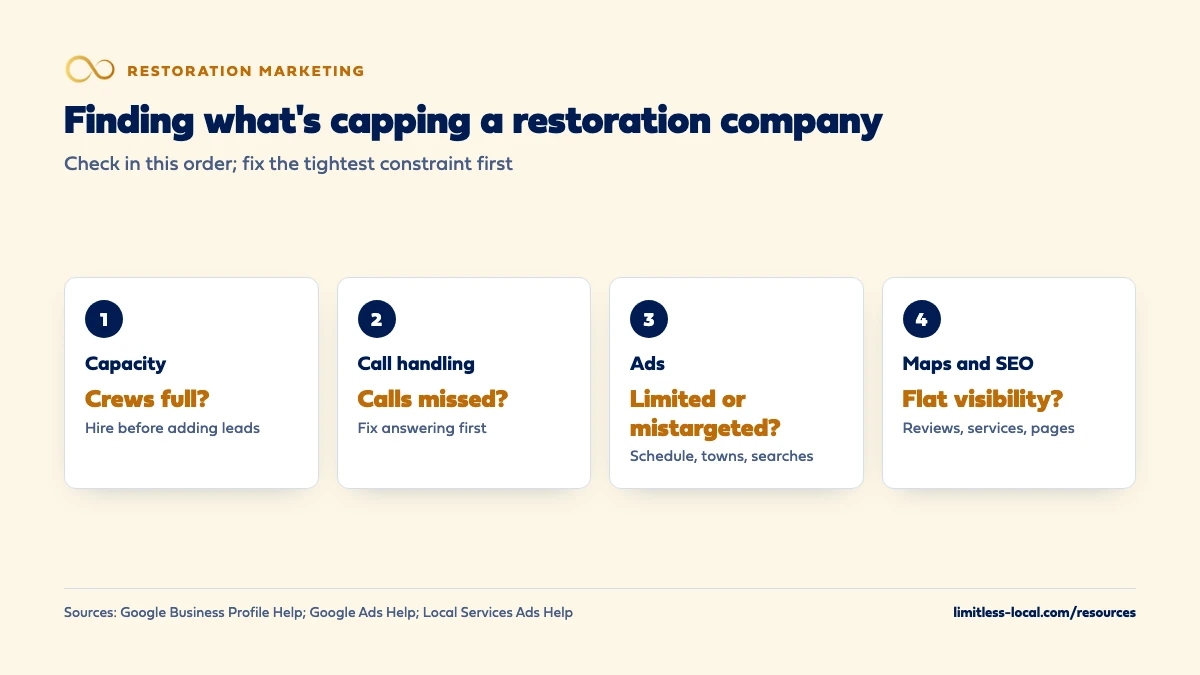
- Check crew capacity, call handling, ads and Maps visibility, in that order.
- Use your own numbers: crews busy, calls answered, jobs booked, calls by source.
- Fix the tightest constraint first, then recheck.
- More leads don't help if calls go unanswered or crews are full.
For restoration owners whose job count has flattened for months, who want to find which lever is actually capping growth before spending more.
Get a free visibility audit · Book a growth call
What's holding my restoration company's growth back, and how do I find it?
Find the bottleneck before you add spend, because a stalled restoration company is usually capped by one thing: crews that can’t take more work, calls that aren’t answered or booked, ads that are limited or poorly targeted, or not enough visibility in Maps. Check them in that order against your own numbers: crew utilization, answered calls, booked jobs and calls by source. Then fix the tightest constraint first, since more leads won’t help if every crew is already full or the phone isn’t answered.
This is how we start with any company that has stalled: tracking first, so the bottleneck shows up in numbers rather than guesses. Our packages include call, web and form tracking and a real-time dashboard for that reason, and our restoration marketing page covers the work itself. The restoration marketing guide is the broader playbook, and the rest of the restoration marketing questions go one question at a time.
Why do restoration companies hit a growth plateau?
In our judgement, most restoration companies stall when the thing that got them their first jobs stops scaling. Early growth often comes from the owner’s relationships, one strong channel or a few good storms. Then one of four limits shows up:
- Visibility: you’re not showing up in Maps or search beyond a few nearby towns.
- Paid reach: ads are capped by budget, schedule or location settings, or aimed at the wrong searches.
- Call handling: calls come in but too many are missed, slow or not booked.
- Capacity: crews and equipment are full, so more calls don’t become more jobs.
Each one has a different fix, and spending on the wrong one is how a plateau gets expensive.
What numbers do I need before I can diagnose the plateau?
Four, for each of the last few months:
- Calls and forms by source: Google profile, ads, LSAs, website, referrals.
- Answered calls: how many new-customer calls a person actually picked up.
- Booked jobs: how many of those became a job on the schedule.
- Crew utilization: how many days crews were fully booked or turning work away.
Your Google profile’s Performance report shows how many times people tapped the call button and which searches found you; Google notes those numbers include activity from both organic results and Google Ads. Source: Understand your Business Profile performance & insights. The rest comes from your phone system and job software. Tracking which marketing brings booked jobs covers the setup if you don’t have it yet.
Is my Google Maps visibility capping growth?
Signs that it is: profile calls have been flat for months, most come from a few towns near your shop, and competitors show up ahead of you in towns you serve.
Google says local results are mainly based on relevance, distance and popularity. Relevance improves with complete, detailed business info. Distance you can’t change. On popularity, Google says how well-known a business is depends partly on how many websites link to it and how many reviews it has, and that more reviews and positive ratings can help your local ranking. Source: Tips to improve your local ranking on Google.
For a stalled company, in our judgement, the usual gaps are a thin services list, reviews that slowed down after the first burst, and a website without pages for the jobs and towns you want. Holding your map pack spot against a new competitor covers the competitive side.
Are my ads limited, or just aimed at the wrong searches?
If ads bring a steady number of calls that never grows, check the settings before raising the budget:
- Schedule. Google Ads campaigns show ads all day by default, but you can limit them to certain hours or days. Source: About ad scheduling. Make sure the schedule matches when someone answers, then widen it if you add after-hours coverage.
- Locations. Check which towns you target and whether they match where you can send a crew.
- Searches. Read the search terms report for searches you’d never want, like DIY or job-seeker searches.
- Calls counted. With call reporting on, Google assigns a forwarding number to your ad so you can see call details, such as duration and whether the call connected. Source: About call reporting.
Local Services Ads charge per valid lead, and Google says lead prices can vary by location, job type, lead type and bidding mode. Source: How leads work. Judge any increase by cost per booked job, not by lead count.
Curious what your marketing is actually booking?
Get a free visibility audit — no obligation, no sales pitch.
Is call handling the real bottleneck?
Often, in our judgement, and it’s the cheapest one to fix. Compare calls received with calls answered and jobs booked. If a meaningful share of new-customer calls ring out, go to voicemail or get a callback hours later, more leads will mostly mean more missed jobs.
Look at when the misses happen. Restoration calls spike at night, on weekends and during storms, which is exactly when a small office is thinnest. How fast restoration calls need answering covers response time, and what missed calls cost puts a dollar figure on the gap.
Also check the booking step: who answers, what they ask, and whether they can schedule a crew on the call.
What if my crews are already full?
Then marketing isn’t the constraint, and more leads will raise your cost per job. Signs: crews booked out for days, jobs turned away or handed off during busy weeks, and equipment all in the field.
The fix is operational first: hiring and training techs, adding equipment, or raising your average job value with services you already do, like mold or rebuild work that follows a water job. In our judgement, marketing should keep a steady base running while you hire, rather than switching off and restarting. Keeping marketing steady while hiring techs covers that balance.
Which growth lever should I pull first?
The tightest one, and usually in this order of checking:
- Capacity: if crews are full, fix staffing before adding leads.
- Call handling: if calls are missed, fix answering before adding leads.
- Ads: if settings or targeting are limiting volume, fix those before raising budget.
- Maps and SEO: the slowest lever, but the one that lowers cost per job over time.
Change one thing at a time and give it a month of clean numbers. Paid changes show up within weeks; profile and SEO work needs a quarter or more. Our published expectation is that ads can generate leads within days of launch, while SEO typically takes three to six months to show meaningful organic growth.

Should I add new services or new markets to break through?
Sometimes, but only after the core is working. Expanding into commercial work, a new city or a new service line adds a new set of channels to build, and it won’t fix a missed-call or capacity problem at home.
When the core is healthy, the restoration-specific options are commercial property accounts, property management relationships and mold or rebuild work tied to your water jobs.
How do I know the plateau is actually breaking?
Compare booked jobs and revenue to the same month last year, not to last month. Restoration demand swings with weather, so a wet spring can look like progress and a dry summer like failure. If booked jobs are up year over year while cost per booked job holds steady or falls, the fix is working. If calls rose but bookings didn’t, the constraint has moved to call handling or capacity, and it’s time to check those again.
What's different about a restoration company's plateau
Weather hides the trend. Storm months and freezes inflate some months and flatten others, so year-over-year comparisons matter more than month-to-month ones.
Night calls are a hidden cap. Many restoration emergencies happen outside office hours. A company that only answers well during the day may be capped there without knowing it, in our judgement.
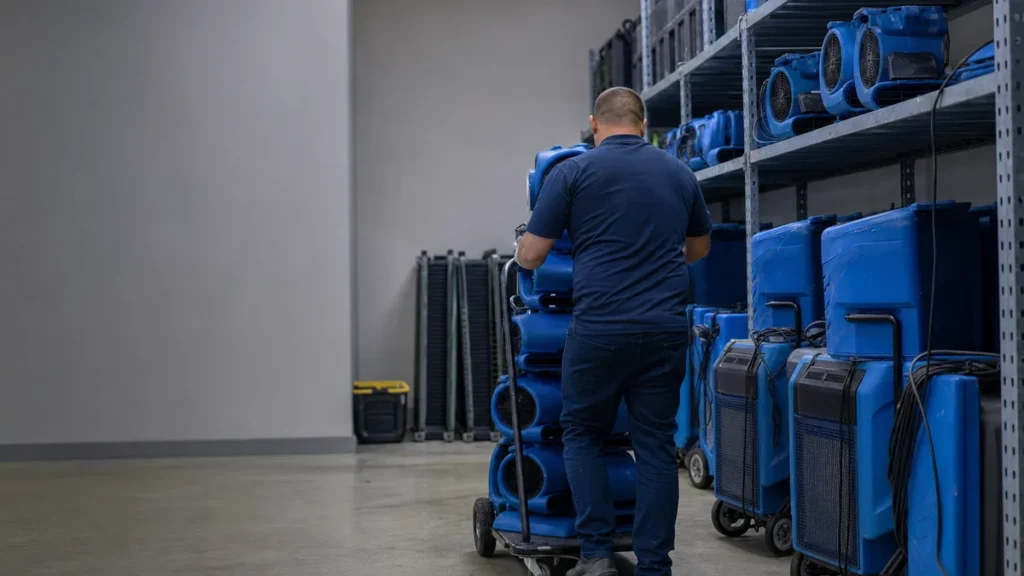
Capacity is equipment as well as people. Air movers and dehumidifiers tied up on long drying jobs limit new starts just like crew count does.
Jobs chain together. Water leads to mold and rebuild, so growing revenue per customer can be as useful as more first calls.
Not sure which of these is costing you jobs?
A free visibility audit checks the Google profile, reviews, site and tracking, and shows what to fix first.
A worked example: finding the constraint in one company's numbers
These numbers are made up to show the diagnosis, not a benchmark. A restoration company has booked about 30 jobs a month for a year. Its numbers for one month: 120 new-customer calls across all sources, 84 answered by a person, and 30 booked. Crews were fully booked on only a few days.
The constraint isn’t visibility; 120 calls is plenty for 30 jobs. It’s call handling: 36 calls (120 minus 84) were never answered by a person, and most of them came in after 6 p.m. Fixing after-hours answering is the first move. If even a third of those 36 calls had been answered and booked at the same rate as the rest (30 out of 84, about 36%), that’s roughly 4 more jobs a month before spending another dollar on ads.
If you’d rather have the tracking set up for you, every one of our packages includes call, web and form tracking, a real-time dashboard and a monthly report, starting with Essentials at $3,500 a month.
Frequently asked questions
Should I just raise my ad budget to get past a plateau?
Only if the numbers say ads are the constraint. If calls are already being missed or crews are full, a bigger budget mostly raises your cost per booked job.
How long should I give one fix before trying another?
About a month of clean data for ads and call handling changes. Profile and SEO work usually needs a quarter or more.
Can a plateau be seasonal rather than real?
Yes. Compare the same month year over year. Restoration demand moves with storms and freezes.
Do I need a new agency to break a plateau?
Not necessarily. Start with the numbers. If the constraint is call handling or capacity, changing agencies won’t fix it.
Does getting more reviews help a stalled company?
It can. Google says more reviews and positive ratings can help local ranking, and a review flow that slowed down is a common gap, in our judgement.
Key takeaways
- A plateau is usually one constraint: visibility, ads, call handling or capacity.
- Diagnose with calls by source, answered calls, booked jobs and crew utilization.
- Fix capacity and call handling before buying more leads.
- Change one thing at a time and compare year over year.
- Grow revenue per customer with mold and rebuild work tied to water jobs.
Want a second set of eyes on your setup?
We'll look at how you show up locally and where calls are leaking, then send you a plain-English breakdown.
More in this section
- How should a restoration company market a second location?
- How do I keep marketing steady while hiring restoration techs?
- How should a restoration company market to commercial properties?
- How does a restoration company recover when its reviews drop?
- What marketing does a brand-new restoration company need first?
Sources
- Understand your Business Profile performance & insights — Google Business Profile Help
- Tips to improve your local ranking on Google — Google Business Profile Help
- About ad scheduling — Google Ads Help
- About call reporting — Google Ads Help
- How leads work — Local Services Ads Help