
What marketing does a brand-new restoration company need first?
- In what order should a new restoration company set up its marketing?
- Why does the launch order matter for a new restoration company?
- What has to be settled before any marketing starts?
- How do I set up a Google Business Profile for a new restoration company?
- Does a new restoration company need a website right away?
- How does a brand-new restoration company get its first reviews?
- When should a new restoration company start Google Ads or Local Services Ads?
- What about referrals from plumbers and property managers?
- How do I know which marketing is producing jobs from day one?
- What can wait until the company is established?
- What's different about launching a restoration company's marketing
- A worked example: the first 12 weeks of a new restoration company
- Frequently asked questions
- Key takeaways
- More in this section
- Sources
The short version
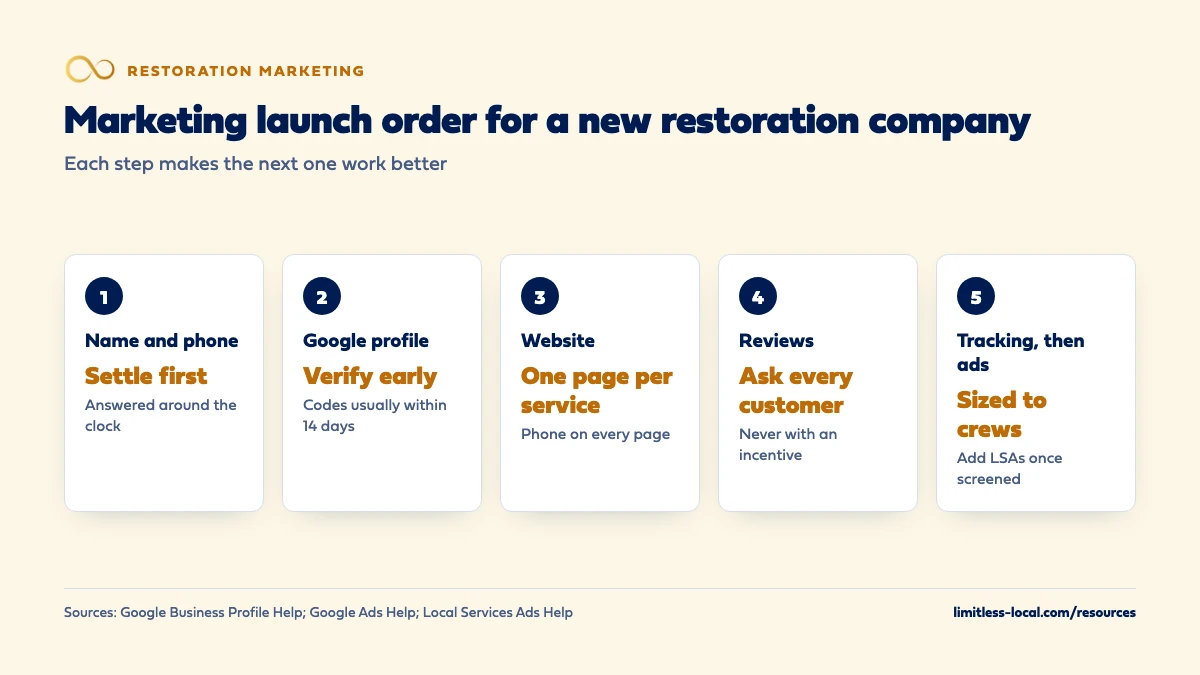
- Lock in your name and one answered phone number before anything else.
- Verify a Google profile as a service-area business.
- Build a simple site with one page per service.
- Ask every customer for a review, with no incentive.
- Add tracking, then ads sized to your crews.
For owners launching a restoration company with no Google profile, no reviews and no website yet, who want the launch order that gets the phone ringing without wasting money.
Get a free visibility audit · Book a growth call
In what order should a new restoration company set up its marketing?
Start with the things every later channel depends on: a settled business name and one local phone number someone answers around the clock, then a verified Google Business Profile set up as a service-area business. Next comes a simple website with a page for each service, a habit of asking every customer for a review, and call tracking so you know where jobs come from. Paid ads come after that foundation, sized to the crews you can actually send, because ads amplify whatever is already in place.
This is the same order our own process follows: build the foundation, turn on lead flow, then improve month by month. Our packages start with listing cleanup, profile setup and tracking for exactly that reason, and our restoration marketing page covers how the work fits water, fire and mold companies. Once you’re up and running, the restoration marketing guide covers channels and budget for an established company, and the rest of the restoration marketing questions go one question at a time.
Why does the launch order matter for a new restoration company?
Because every channel leans on the ones before it. Ads send people to your website and your phone. Google’s map results draw on your profile’s details and reviews. Directories copy your name and number from wherever they first find them. If the name changes in month three or the phone goes to voicemail at night, you pay to fix it everywhere later.
In our judgement, the most common launch mistake is buying ads before the basics exist: no reviews, a one-page site and a phone that isn’t answered after hours. The ads work, the calls come in, and too many of them are lost. Getting the order right is cheaper than getting the spend right.
What has to be settled before any marketing starts?
- Your name. Google says your profile name should reflect your real-world name as used consistently on your storefront, website, stationery and as known to customers. Pick the name that will go on vans and invoices and stick with it; adding words like “24/7 Water Damage” to the name isn’t permitted and could get a profile suspended. Source: Guidelines for representing your business on Google.
- One local phone number. Google asks for a local number instead of a call center helpline whenever possible, under your direct control. Use the business line from day one, not your personal cell, so you never have to change it on listings later.
- Who answers at night. Restoration calls arrive at all hours. Decide now whether it’s you, an on-call tech or an answering service. Who should answer after-hours calls walks through the options.
- Your real service area. The towns your crew can reach quickly, not every town on the map.
How do I set up a Google Business Profile for a new restoration company?
Most restoration companies go to the customer, so they’re service-area businesses in Google’s terms. Google’s guidelines say a business without a storefront customers visit should hide its address and show a service area, that a rented mailbox or virtual office isn’t eligible, and that the service area shouldn’t extend farther than about 2 hours of driving time from where you’re based. Source: Guidelines for representing your business on Google.
Verification comes next. Google says most verification codes arrive within 14 days, codes expire after 30 days, and verification reviews take up to 5 business days once you complete the steps. Source: Verify your business on Google. Start this in your first week; it’s the slowest piece to clear.
Once verified, fill in categories, services, hours and photos. Optimizing a restoration Google profile covers each field in detail.
Does a new restoration company need a website right away?
Yes, but a simple one. In our judgement, the first version needs:
- A home page that says what you do, where, and how fast you answer.
- One page for each service you actually sell: water damage, mold, fire and smoke, sewage, storm.
- Your phone number at the top of every page, tappable on a phone.
- Real photos of your crew and equipment, not stock images.
- Your service area, in plain words.
Separate service pages matter because people search for the job, not the company. Google’s SEO Starter Guide tells site owners to make their site interesting and useful to the people who visit it. Source: SEO Starter Guide. City pages can wait until the service pages are live.
Curious what your marketing is actually booking?
Get a free visibility audit — no obligation, no sales pitch.
How does a brand-new restoration company get its first reviews?
Ask every customer, every time. Google gives you a link or QR code you can send so customers can leave a review. Source: Tips to get more reviews.
The hard line: Google says offering incentives, like free or discounted goods or services, in exchange for reviews is considered fake and misleading content and is strictly prohibited. No discount on the deductible, no gift card.
Google also says reviews and positive ratings can help your local ranking, alongside relevance and distance. Source: Tips to improve your local ranking on Google. For a new company, in our judgement, the first handful of reviews matter more than almost anything else on the profile, because homeowners in a hurry compare stars. Ask at the final walk-through, then text the link the same day.
When should a new restoration company start Google Ads or Local Services Ads?
After the foundation is in place and you know how many jobs your crews can take. Google Ads can start quickly: Google says most ads are reviewed within one business day. Source: About the ad review process.
Local Services Ads need screening first. Google lists state-level business and owner licenses among the requirements, and background checks, business registration and insurance are required for select users. Source: Business screening and verification requirements (United States). Gather your paperwork early so it doesn’t hold you up later.
Start small. A one-crew company should cap spend at what it can actually run on. Getting emergency calls cheaply with one truck covers budget settings for that stage.
What about referrals from plumbers and property managers?
Start them early, because they take time. Plumbers, property managers and other trades see water damage before anyone else. In our judgement, a new company should introduce itself in person, explain how fast it responds, and follow up after every job they send.
A word of caution, and this isn’t legal or insurance advice: paying anyone for referrals can raise legal and industry-rule questions that vary by state and program. Don’t offer referral fees or kickbacks; if someone proposes a paid arrangement, check the rules with your own attorney before agreeing to anything. Building a referral network with plumbers and property managers covers how to do it without paying for leads.
How do I know which marketing is producing jobs from day one?
Set up tracking before you spend. At minimum, log every call and form with its source and whether it became a job. A spreadsheet works for the first few months; job software like Albi or Jobber can take over later.
Google’s profile has a performance report that counts how many times customers clicked the call button on your profile. Source: Understand your Business Profile performance & insights. But only your own records can tell you which calls turned into booked jobs and paid invoices. Tracking which marketing brings booked jobs covers the setup.
What can wait until the company is established?
In our judgement, a new restoration company can safely hold off on:
- Commercial and property management campaigns, until you have references to show.
- Program and vendor-panel work, which usually wants a track record.
- Social media advertising beyond a basic page.
- Dozens of city pages before the service pages are done.
- Paid directory and lead services, until you can measure cost per booked job.
None of these are bad. They just work better on top of a profile, a site and reviews that already convert.
What's different about launching a restoration company's marketing
Night calls decide everything. Water doesn’t wait for business hours. If no one answers at 2 a.m., marketing that works will still lose jobs.
Trust is checked fast. Homeowners and adjusters look you up in a hurry. Reviews, real photos and a consistent name and number carry more weight than polish, in our judgement.
Paperwork gates paid channels. Licensing, insurance and background checks can apply before Local Services Ads run, so the earlier you gather them the better.
One job leads to another. Water jobs turn into mold and rebuild work, so list every service you can actually perform from day one.
Not sure which of these is costing you jobs?
A free visibility audit checks the Google profile, reviews, site and tracking, and shows what to fix first.
A worked example: the first 12 weeks of a new restoration company
These steps and numbers are made up to show the order, not a forecast. Week 1: settle the name, set up the business line and after-hours answering, and request Google profile verification. Weeks 2 and 3: the code arrives, the profile is verified, and services, hours and photos go up. Weeks 3 to 6: a simple site with five service pages goes live, call tracking is in place, and every customer is asked for a review. By week 8 the company has 15 reviews. Weeks 8 to 12: a small Google Ads campaign starts, capped at what one crew can handle, with LSAs added once screening clears.
If you’d rather hand the setup off, our Essentials package is $3,500 a month and includes listing cleanup and buildout, profile management, a content sprint of up to 10 pages, Google Ads management up to $2,500 a month in ad spend, and call, web and form tracking. Ad spend is paid to Google separately.
Frequently asked questions
Can I use my personal cell as the business number at first?
You can, but in our judgement it’s better not to. Changing the number later means fixing it on every listing that copied it.
Should I show my home address on Google?
No. Google says a service-area business without a storefront customers visit should hide its address and show a service area instead.
How many reviews does a new restoration company need?
Google doesn’t publish a number. Aim for a steady flow from every job rather than a target, and never offer an incentive.
Can I run ads before my website is ready?
Technically yes, but in our judgement it wastes money. A clear service page with a tappable phone number turns far more clicks into calls.
Do I need social media at launch?
A basic, accurate page is enough at first. Put early effort into the Google profile, the site and reviews.
Key takeaways
- Settle your name, one local number and after-hours answering before any marketing.
- Verify a Google profile as a service-area business in week one; it’s the slowest step.
- Launch a simple site with one page per service and a tappable phone number.
- Ask every customer for a review, never with an incentive.
- Add tracking first, then ads sized to the crews you have.
Want a second set of eyes on your setup?
We'll look at how you show up locally and where calls are leaking, then send you a plain-English breakdown.
More in this section
- How should a restoration company market to commercial properties?
- How should a restoration company handle marketing during storm season?
- How should a restoration company market to real estate agents?
- How should a restoration company market a second location?
- Should a restoration company hire an in-house marketer vs agency?
Sources
- Guidelines for representing your business on Google — Google Business Profile Help
- Verify your business on Google — Google Business Profile Help
- Tips to get more reviews — Google Business Profile Help
- Tips to improve your local ranking on Google — Google Business Profile Help
- About the ad review process — Google Ads Help
- Business screening and verification requirements (United States) — Local Services Ads Help
- SEO Starter Guide — Google Search Central
- Understand your Business Profile performance & insights — Google Business Profile Help