
How do reviews and response time change my electrical ad results?

- Why do reviews and how fast I answer change what my electrical ads really cost?
- What do reviews and response time have to do with my ad results?
- How do reviews change who calls me from an ad?
- How do reviews change what Local Services Ads cost?
- How does response time change what I pay for leads?
- How fast do I need to answer?
- How do reviews and response time multiply each other?
- Which should I fix first, reviews or response time?
- How do I measure my response time and booking rate?
- Should I pause my ads until these are fixed?
- What's different for electrical contractors
- A worked example: same ad spend, different results
- Frequently asked questions
- Key takeaways
- More in this section
- Sources
The short version
- Booked jobs = leads × share you reach × share you book.
- Reviews raise the share who choose and book you.
- Fast answers raise the share you actually reach.
- In Local Services Ads, both feed ranking and cost per lead.
- Fix missed calls this week; build reviews every week.
For electrical contractors who judge ads by what each booked job costs, and want to know why the same ad spend books more work for one shop than another.
Get a free visibility audit · Book a growth call
Why do reviews and how fast I answer change what my electrical ads really cost?
Reviews and response time decide how many of the leads your ads buy turn into booked jobs, so they change your cost per booked job on every channel, not just one. Strong, recent reviews get more homeowners to pick you once they see you, and in Local Services Ads your rating, review count and average response time feed the ranking, where Google says higher quality profiles may rank higher and pay less per lead. Answering fast means you reach more of the people you paid for, while a missed Local Services Ads call during business hours can still be charged. Because the two multiply, small gains in each can cut what a booked job costs without adding a dollar to the ad budget.
We judge ads the same way: by what each booked job cost, not each click. Our local ads work covers Google Ads in every package and Local Services Ads management from the Growth tier at $4,500 a month, every package includes call tracking with recording and transcription, and review response and review generation come with every tier. Automation add-ons such as after-hours answering and unified messaging plug into any tier. Our electrical contractor marketing page explains how we work with electrical shops, and the rest of the electrical marketing questions library goes question by question.
What do reviews and response time have to do with my ad results?
Your ads buy a chance: a call, a form or a message from someone who needs an electrician. What happens next decides whether that chance becomes a job. Write the chain out and it’s easy to see:
Booked jobs = leads × share of leads you reach × share of those you book
Cost per booked job = ad spend ÷ booked jobs
The ad platform controls a piece of the first number. You control the other two. Response time decides how many leads you actually reach. Reviews, along with how you handle the call, decide how many of those people pick you over the next electrician on the list. That’s why two shops with the same budget, in the same town, can see very different costs per booked job.
How do reviews change who calls me from an ad?
Homeowners rarely book an electrician from an ad alone. They see you in an ad, on the map or in a Local Services Ads listing, and they look at your rating and how many reviews you have before they call. A thin or stale profile next to a competitor with plenty of recent, detailed reviews loses that comparison, even when your ad is on top.
Reviews also do work on the call itself. A homeowner who read about your crew pulling the permit and cleaning up after a panel upgrade calls already half-sold, and that shows up in how many quotes you close.
Google’s own tips to improve your local ranking say more reviews and positive ratings can help your business’s local ranking, and that positive reviews and helpful replies can help your business stand out. So the same reviews that help your ads also help your free listing in Maps. How to use your Google reviews in your electrical marketing covers putting them on your site and in quote follow-ups.
How do reviews change what Local Services Ads cost?
Here the link is direct. Local Services Ads are ordered by an auction that weighs your bid against how likely your ad is to bring a lead. Google’s page on how Local Services Ads rank lists profile quality as part of that, including your rating, number of reviews, average response time, high-quality images and the verification checks you’ve completed. It says higher quality profiles may rank higher and may also pay lower costs per lead.
There’s a floor too. Google’s page on improving Local Services Ads performance recommends 5 or more reviews and says that, depending on your business type, you may need 5 reviews for your ad to show.
So two electricians bidding the same amount don’t get the same results. The one with the stronger profile can show higher and pay less for each lead. How many Google reviews an electrician needs to compete helps you set a target for your towns.
How does response time change what I pay for leads?
In Local Services Ads, slow answering costs you twice.
- You can pay for calls you never answered. Google’s page on how leads work counts a missed call during your business hours as a valid lead when the caller stays on the line for more than 20 seconds.
- It can push you down the page. Missed calls may negatively affect your responsiveness, one of the things that decides how likely your ad is to bring a lead.
Turning on message and booking leads gives customers more ways to reach you and can raise your chances of getting a lead at night and on weekends, when you can’t answer the phone. But a message nobody answers for a day is still a lost job.
In regular search ads, you pay for the click whether or not anyone picks up. A call that rings out after a click is ad money spent on a homeowner who then calls the next shop.
Curious what your marketing is actually booking?
Get a free visibility audit — no obligation, no sales pitch.
How fast do I need to answer?
Faster than most shops think. A lead response study by James Oldroyd and InsideSales.com, from 2007, looked at three years of web-generated leads across six companies and found the odds of contacting a lead called within 5 minutes versus 30 minutes dropped 100 times. Those were sales leads from web forms, not homeowners calling an electrician, so treat it as a sign of how quickly interest fades, not a number for your shop.
For an electrical company, a working standard looks like this:
- Calls: answered live, every time someone is on duty.
- Missed calls: called back within minutes, not after the current job.
- Forms and messages: a reply within minutes during business hours, and first thing the next morning after hours, at the latest.
- Emergencies like a burning smell or a dead panel: straight to a person.
How fast your office should answer electrical calls goes through the targets in detail.
How do reviews and response time multiply each other?
Because each one works on a different part of the chain, gains stack. Raise the share of leads you reach and every review you have gets read by more callers. Strengthen your reviews and every call you answer is more likely to book.
Run it the other way and it hurts twice. A shop with a weak profile that also misses calls is paying for leads it never reaches, and losing many of the ones it does reach to better-reviewed competitors. More budget won’t fix that. It buys more of the same leak.
That’s also why judging ads by cost per lead alone misleads. Two shops can pay the same per lead and still see very different costs per booked job, and the difference is mostly what happens after the phone rings. The worked example below shows the math.
Which should I fix first, reviews or response time?
Usually response time, because it’s faster to fix. You can change who answers the phone, how missed calls get returned and how forms get answered this week. Reviews build over months.
- Stop the missed calls. Check your call tracking for unanswered calls by hour and day. Cover the gaps with office staff, a call schedule or an answering service. How to stop your electrical company from missing calls covers the options.
- Set reply rules for forms and messages, with one person responsible during business hours.
- Start asking every customer for a review the same week, so the profile improves while you fix the phones.
- Reply to every review. It shows homeowners you respond, before they’ve ever called you.
If your profile has very few reviews, Local Services Ads may not show at all yet, so that channel waits for the reviews either way.

How do I measure my response time and booking rate?
You can’t improve numbers you don’t see. Track these every month:
- Missed calls from each ad source, during business hours and after.
- Time to first reply on forms and messages. Your field software or inbox timestamps show it.
- Share of leads reached: leads you actually spoke with, divided by all leads.
- Booking rate: booked jobs divided by leads reached, split by job type, since a service call books differently from a generator quote.
- New reviews this month and your rating.
Call tracking with recordings lets you hear how calls are handled, not just whether they were answered. How to track which electrical marketing brings in real jobs covers tagging each lead by source in your field software.
Should I pause my ads until these are fixed?
Not always. Pause or cut back where the leak is worst:
- Missing a lot of calls at certain hours? Schedule ads only for the hours someone answers, rather than pausing everything.
- Missing calls all day? Fix coverage first. Paying for calls nobody answers is the most direct waste in any ad account.
- Few reviews, but you answer well? Keep search ads running for jobs you want, and build reviews in the background.
- Both weak? Pull back spend, fix the phones, start the review routine, then turn ads back up.
Then judge the result on cost per booked job, not cost per lead.
What's different for electrical contractors
Emergency calls can’t wait. A homeowner with a burning smell, a sparking outlet or no power will call the next electrician within minutes. Those are high-intent calls, and missing them costs the most.
Techs can’t answer from inside a panel. In a small shop, the person on the tools is often the person with the phone. Plan who answers when every tech is on a job, because that’s when ads keep ringing.
Big jobs are bought on trust. Panel upgrades, service changes, generators and EV chargers get quoted and compared. Reviews that mention those exact jobs, and a fast, clear quote, carry more weight than price.
Commercial buyers judge you on responsiveness. Property managers and builders remember who called back. The same habits that help your ads win repeat commercial work.
Want to see where your company stands?
A free visibility audit shows where you show up on Google, Maps and AI answers, and what it's costing you in calls.
A worked example: same ad spend, different results
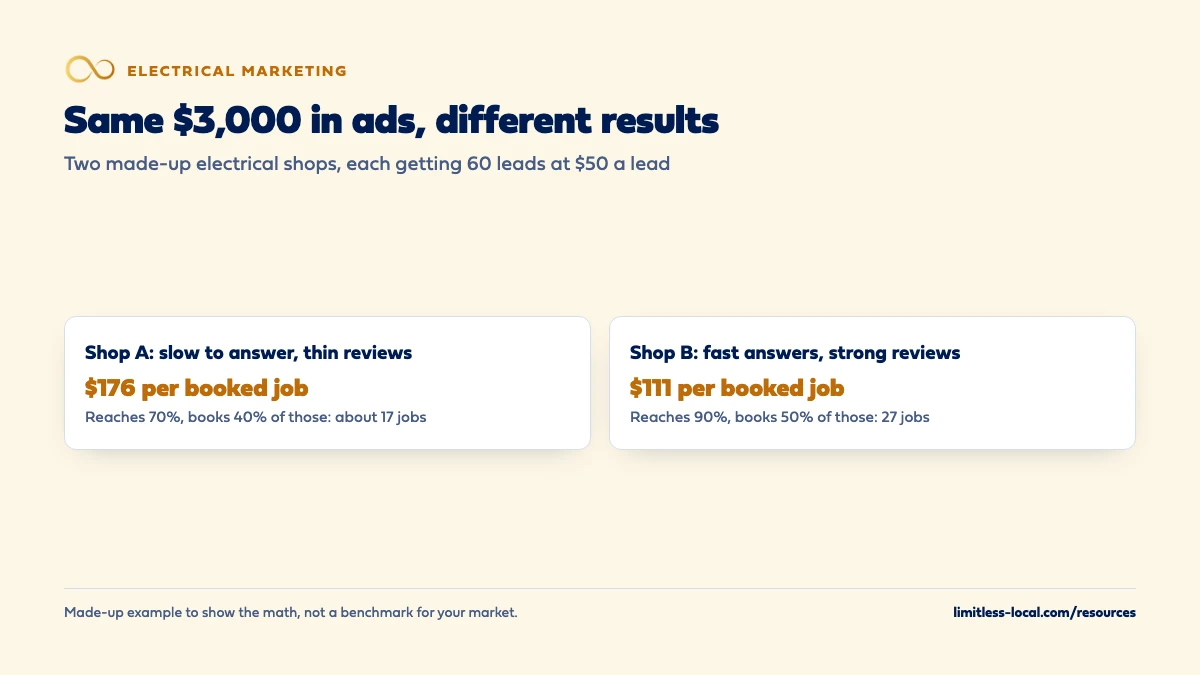
These numbers are made up to show the math, not a benchmark for your market. Two electrical shops each spend $3,000 a month on ads and each get 60 leads, so both pay $50 per lead.
- Shop A misses a lot of calls during jobs and has a thin, older set of reviews. It reaches 70% of its leads and books 40% of the ones it reaches: 60 × 0.7 × 0.4 is about 17 booked jobs, or about $176 per booked job.
- Shop B has someone answering and plenty of recent, detailed reviews. It reaches 90% of its leads and books 50% of those: 60 × 0.9 × 0.5 is 27 booked jobs, or about $111 per booked job.
Same budget, same cost per lead, and Shop B books 10 more jobs a month. In Local Services Ads, Shop B’s stronger profile could also show higher or pay less per lead, which would widen the gap further.
Frequently asked questions
Does replying to reviews count as response time for Local Services Ads?
Average response time is listed as part of profile quality, alongside your reviews, without being tied to review replies. Reply to reviews anyway, because homeowners read the replies before they call.
Will more reviews lower my Google Ads cost per click?
Don’t count on it. In regular search ads, reviews mostly work on the homeowner: more of the people who see your ad and check your profile choose to call. Judge that by booked jobs, not cost per click.
Am I charged for a Local Services Ads call I answer after 20 seconds of ringing?
The 20-second rule applies only to missed calls. If someone answers, the call is judged as an answered call based on the conversation.
Is an answering service worth it for ad calls?
If your call tracking shows many missed calls while techs are on jobs, coverage of some kind usually pays for itself before more ad spend does. Make sure whoever answers can book the job, not just take a message.
How many reviews do I need before Local Services Ads will show?
5 or more is recommended, and some business types need 5 before the ad shows.
Key takeaways
- Cost per booked job depends on leads, the share you reach and the share you book; reviews and response time drive the last two.
- In Local Services Ads, rating, review count and average response time are part of profile quality, which can raise your rank and lower cost per lead.
- A missed Local Services Ads call during business hours is charged once the caller stays on the line past 20 seconds.
- Fix missed calls first, because it’s fast; build reviews every week, because it’s slow.
- Judge ads on cost per booked job, not cost per lead.
Not sure what's working right now?
Start with a free visibility audit: rankings, Google profile, reviews and tracking, checked against your service area.
More in this section
- How do I use my Google reviews in my electrical marketing?
- How do I know if my electrical marketing agency is getting results?
- Does review velocity matter for electrician Google rankings?
- How competitive is my market for electrical SEO and Google Ads?
- How do I get more Google reviews for my electrical business?
Sources
- About ad rankings — Google Local Services Help
- How leads work — Google Local Services Help
- Improve your Local Services Ads performance — Google Local Services Help
- Lead Response Management Study — James Oldroyd and InsideSales.com
- Tips to improve your local ranking on Google — Google Business Profile Help