
Which is riskier for restoration marketing: a bad agency or bad hire?

- Which mistake costs a restoration company more: the wrong agency or the wrong marketer?
- What does a bad marketing hire actually cost?
- What does a bad agency actually cost?
- Which mistake is slower to spot?
- Which mistake is harder to undo?
- Where does a bad agency do the most damage?
- Where does a bad hire do the most damage?
- What early warning signs should I watch for with each?
- How do I limit the damage whichever way I go?
- Does the size of my restoration company change the answer?
- Is splitting the work between in-house and an agency less risky?
- What if I've already made the wrong call?
- What's different about this choice for restoration companies
- A worked example: what each mistake might cost before you catch it
- Frequently asked questions
- Key takeaways
- More in this section
- Sources
The short version
- A bad hire usually costs more per month and takes longer to undo.
- A bad agency is most dangerous when it owns your accounts or locks you in.
- Ad money is wasted the same way by either one, so the difference is the fee, the time and the exit.
- Owning your accounts and tracking booked jobs limits the damage from both.
For restoration owners weighing an agency against an in-house marketer who want to know which wrong choice does more damage, and how to limit it either way.
Get a free visibility audit · Book a growth call
Which mistake costs a restoration company more: the wrong agency or the wrong marketer?
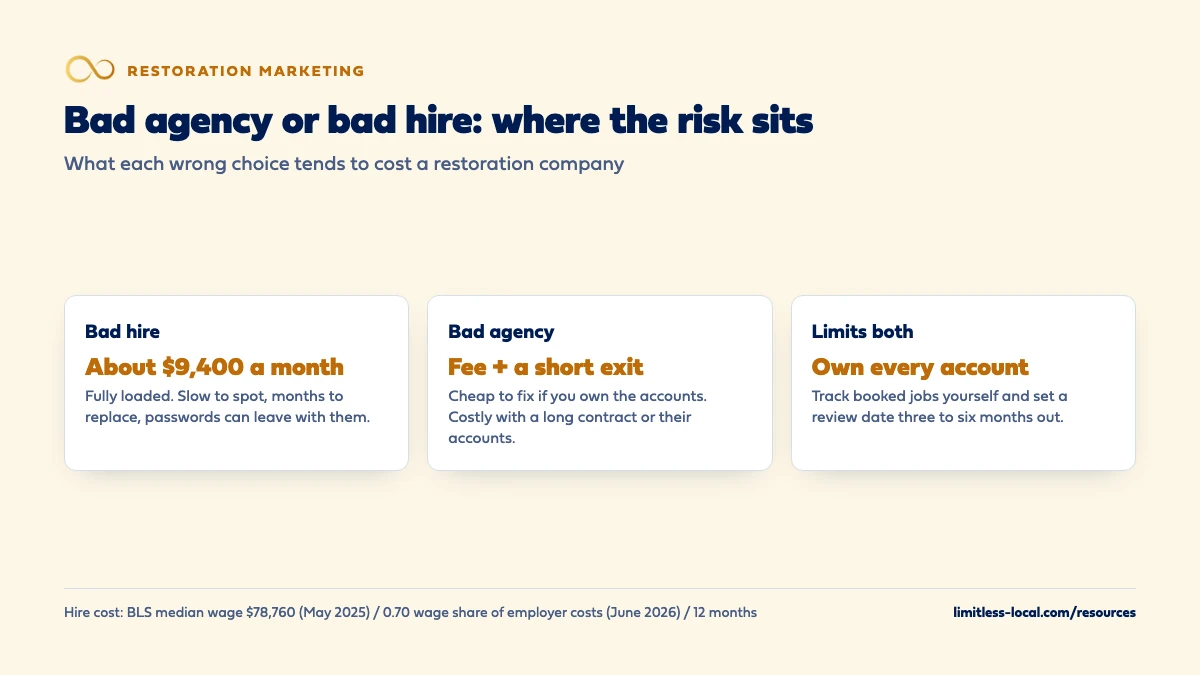
For most restoration companies, a bad hire is the riskier mistake: a full-time marketer costs more each month once benefits are counted, takes longer to spot as the wrong fit, and is slower and harder to replace than an agency on short terms. A bad agency becomes the bigger risk when it controls your Google Ads account, Google Business Profile, website or tracking numbers, or holds you to a long contract. Keep every account in the company’s name and judge either one by booked jobs, and the damage from either mistake stays small.
We’d rather you pick the right setup than pick us. Our terms are month-to-month: we ask for three months in the contract, but if you want to leave, we won’t make you stay. You own your website, your ad accounts and your data, even if you leave, and every package includes call tracking and a monthly report with a cost-per-lead breakdown, so you can tell within a few months whether the work is booking jobs. See how we approach restoration marketing, compare the packages, read the restoration marketing guide, or browse more restoration marketing questions.
What does a bad marketing hire actually cost?
More than the salary. The Bureau of Labor Statistics puts the median annual wage for market research analysts, the federal job category that includes marketing specialists, at $78,760 in May 2025. That’s a national median across every industry, not a restoration benchmark, but it’s a fair starting point.
On top of wages come benefits and payroll costs. The same agency’s employer costs report found wages and salaries made up 70.0 percent of private employers’ compensation costs in June 2026, with benefits making up the other 30.0 percent. Applied to that median wage, the total comes to roughly $112,500 a year, or about $9,400 a month, before software, ad spend or training.
A bad hire costs all of that plus the things that don’t show on payroll: the weeks you spent recruiting, the months before you’re sure it isn’t working, and the gap while you find someone else. During all of it, the phones aren’t ringing any more than they were.
What does a bad agency actually cost?
The monthly fee, the months it takes you to notice, and whatever it takes to get out. Agency fees for restoration work vary widely, and you’ll usually pay ad spend to Google on top. The fee is often lower than a fully loaded salary, and it usually comes with more than one set of skills.
The hidden costs are where a bad agency hurts:
- A long contract. Twelve months locked in turns a three-month mistake into a year-long one.
- Accounts in the agency’s name. If they own the Google Ads account, the website or the call tracking numbers, leaving can mean starting over.
- Reports that hide the truth. Clicks and impressions dressed up as results can keep a bad agency on the books for months.
- Work that hurts you. Spammy links, fake reviews or copied city pages can leave damage after they’re gone.
Remove those four and a bad agency is a cheap lesson: a few months of fees and a switch. How to vet a restoration marketing agency before signing covers how to check for each one up front.
Which mistake is slower to spot?
Usually the hire. An agency produces a report every month and you can compare it with what your phones and job software say. A single in-house marketer often reports to you on their own work, and if you aren’t a marketer yourself, it’s hard to tell whether slow results mean a slow market or the wrong person.
New hires also get a learning curve, and that’s fair. But it means a wrong hire can look like a slow start for months, and it can take six months or more to be confident it isn’t working.
Either way, the fix is the same: decide before day one what success looks like in booked jobs, and track it outside the marketer’s own reports. How to tell whether your restoration marketing is producing real jobs shows what to check.
Which mistake is harder to undo?
A hire, in most cases. Letting an employee go takes paperwork, a hard conversation and sometimes severance, and then you’re back to recruiting. In a small restoration company, that person may also have picked up other jobs along the way, like answering phones or taking job photos, so their leaving pulls on more than marketing.
An agency is usually easier to replace, as long as two things are true: the contract lets you leave on short notice, and you own your accounts. If either is missing, an agency can be harder to leave than an employee. Google’s own advice on hiring an SEO makes a point worth remembering here: you are responsible for the actions of any companies you hire, and if one creates deceptive or misleading content on your behalf, your site could be removed entirely from Google’s index. Bad work can outlast the people who did it.
Where does a bad agency do the most damage?
In the accounts. A restoration company’s marketing lives in a handful of places: the Google Ads account, the Google Business Profile, the website and domain, Search Console, and the call tracking numbers printed on trucks and yard signs. Whoever controls those controls your ability to switch.
- Google Ads. Google’s page about access levels lists Admin as the level that can give account access, change access levels and cancel other users’ invitations. Your company should hold Admin.
- Google Business Profile. Google’s page on profile owners and managers says a profile can have several owners but only one primary owner, and managers can’t add or remove users. Make sure the primary owner is you.
- Website and domain. The domain should be registered to your company, with the login in your hands.
- Tracking numbers. Ask who owns them and whether they can be moved to you if you leave.
Who should own the website and ad accounts goes through each one.
Curious what your marketing is actually booking?
Get a free visibility audit — no obligation, no sales pitch.
Where does a bad hire do the most damage?
In the gaps. Restoration marketing takes several different skills: Google Ads, Maps and reviews, the website and SEO, tracking, and keeping up with storm weeks. One person rarely does all of them well, and a weak hire tends to drift toward the parts they like and leave the rest.
Common damage from a bad hire looks like this:
- An ad account nobody checks at night, spending into junk searches during a freeze.
- A Google profile that sits untouched while competitors collect reviews.
- Passwords that live on one person’s laptop and leave with them.
- Months of activity reports with no link to booked jobs.
A one-person team is also a single point of failure. When they’re sick, on vacation or gone, the marketing stops. That risk is worth weighing as much as the salary.
What early warning signs should I watch for with each?
With an agency, walk away or ask hard questions if you see any of these:
- A promise of a #1 ranking. No one can guarantee one.
- Vague answers about what they’ll change and why.
- Reluctance to give you admin access to your own accounts.
- Reports full of clicks and impressions with nothing about calls or jobs.
With a hire, watch for these in the first few months:
- No call tracking or booked-job tracking set up, even after you asked.
- Busywork you can see (social posts, logo tweaks) and no change you can measure.
- Accounts created in their personal name.
- Trouble explaining what they did last week and what it was meant to do.
None of these proves the choice was wrong on its own. Two or three together usually do.
How do I limit the damage whichever way I go?
- Own every account. Ads, Google profile, website, domain, Search Console and tracking numbers in the company’s name, with you as admin or primary owner.
- Give limited access first. When an SEO offers an audit, grant only read access to Search Console at that stage, not write access. The same idea works for a new hire or agency: widen access as trust builds.
- Write down the scope. What they handle, what they don’t, and what you expect to see each month.
- Track booked jobs yourself. Mark which calls became jobs in your own job software, so you aren’t relying on the marketer’s report alone.
- Set a review point. Decide on a date, usually three to six months out, when you’ll judge the results against booked jobs.
- Keep the exit short. Month-to-month or short terms for an agency; a clear probation period for a hire.

Does the size of my restoration company change the answer?
Yes. For a one- or two-truck company, a full-time hire is a big fixed cost against uneven, storm-driven revenue, so a bad hire hurts more. An agency or a part-time arrangement keeps the downside smaller.
For a company with several locations and steady commercial work, there’s often enough to keep a marketer busy full time, and the cost of a bad agency (spread across more markets and more ad spend) grows. At that size, the safest setup often has someone in-house who owns the accounts and the reporting, with outside help for the specialist work. Whether to hire an in-house marketer or an agency compares the two on cost and skills.
Is splitting the work between in-house and an agency less risky?
Often, yes. When one person in-house owns the accounts, answers calls, gathers job photos and tracks booked jobs, a bad agency is easy to spot and easy to replace. When an agency handles the specialist work, a weak in-house person does less damage because the most technical jobs aren’t resting on them.
The risk in a split is tasks falling between the two. Write down who owns each task. Whether to split marketing between in-house and an agency lays out a typical division.
What if I've already made the wrong call?
Get your accounts in order before you make any change. Confirm you have admin or owner access to everything, download your reports, and line up whoever takes over so ads and phone numbers never go dark. The real risk in a switch is a gap in emergency calls, not losing everything overnight. How to switch your restoration marketing agency or go in-house walks through it step by step.
Not sure which of these is costing you jobs?
A free visibility audit checks the Google profile, reviews, site and tracking, and shows what to fix first.
What's different about this choice for restoration companies
Storm weeks test everyone. A freeze or a flood can triple the workload in a day. An agency usually has more than one person who can step in; a single hire may be the only one watching the ads while also helping in the office.
Revenue is lumpy. A slow month followed by a storm month makes a fixed salary feel heavier than a fee you can scale back.
Insurance slows the cash. Many jobs are paid through a claim weeks later, so a bad marketing bill hits before the jobs it should have produced are paid.
Several services, several skills. Water, mold, fire and sewage each have their own searches and pages, which is more for one person to cover well.
A worked example: what each mistake might cost before you catch it
These numbers are made up to show the math, not a benchmark. The hire’s cost uses the national figures above.
The bad hire. You hire a marketer at about $9,400 a month all in. It takes 6 months to be sure it isn’t working, so you’ve spent about $56,400 before you act, then another few months recruiting. Your ad spend ran the whole time too.
The bad agency. You sign with an agency at a made-up $2,000 a month on month-to-month terms, and you own your accounts. It takes 3 months to see it isn’t booking jobs, so you’ve spent $6,000 in fees, and you switch within a few weeks. Ad spend ran the whole time here too.
In this example, the hire costs more than nine times as much in fees before you catch it. Change one thing, though, and the picture flips: if that agency had a twelve-month contract and owned your website and tracking numbers, you’d pay $24,000 in fees for the year and lose the site and numbers on the way out.
Frequently asked questions
Is a freelancer less risky than an agency or a hire?
It can be cheaper, but a freelancer is often one person with one or two skills, so you get some of the single-point-of-failure risk of a hire. The same rules apply: own the accounts and track booked jobs.
Can a bad agency hurt my Google rankings after I leave?
It can if it used spammy tactics, like paid links or copied city pages, because that work stays on your site and profile until someone cleans it up. That’s why it pays to ask exactly what they’ll change before you start.
How long should I give a new marketer before deciding?
Set a review point three to six months out and judge it on booked jobs you can trace. Ads can show results within weeks, while SEO usually takes longer to build.
Should my office manager handle marketing instead of a new hire?
Only for the parts that depend on knowing the business, like review requests, job photos and marking booked jobs. Ads and SEO need specialist time an office manager rarely has, especially in storm season.
What's the single biggest protection against either mistake?
Owning your accounts. If the Google Ads account, Google profile, website, domain and tracking numbers are in your company’s name, you can replace anyone without starting over.
Key takeaways
- A bad marketing hire usually costs more per month than a bad agency and takes longer to catch and replace.
- A bad agency turns risky when it owns your accounts, locks you into a long contract or uses tactics that leave damage.
- Ad spend is wasted the same way by either, so compare the fee, the time to spot it and the exit.
- Keep every account in your company’s name, with you as admin or primary owner.
- Track booked jobs yourself and set a review date before anyone starts.
Want a second set of eyes on your setup?
We'll look at how you show up locally and where calls are leaking, then send you a plain-English breakdown.
More in this section
- Should a restoration company hire an in-house marketer vs agency?
- What should a restoration company look for in a marketing agency?
- How do I vet a restoration marketing agency before signing?
- How to manage a restoration marketing agency without losing control?
- Should a restoration company split marketing in-house and agency?
Sources
- Market Research Analysts: Occupational Outlook Handbook — U.S. Bureau of Labor Statistics
- Employer Costs for Employee Compensation Summary — U.S. Bureau of Labor Statistics
- Do you need an SEO? — Google Search Central
- About access levels in your Google Ads account — Google Ads Help
- Manage your Business Profile owners & managers — Google Business Profile Help