
Should a restoration company split marketing in-house and agency?

- What should a restoration company keep in-house and what should it hand to an agency?
- What does a split between in-house and an agency look like?
- Which marketing work should stay in-house?
- Which marketing work is worth handing to an agency?
- Who should handle the Google Business Profile?
- Who should own the accounts when the work is split?
- How do I stop the two sides from doubling up or dropping tasks?
- What should the in-house person do each week?
- How should I split the budget between staff time and the agency?
- When doesn't a split make sense?
- How do I tell whether the split is working?
- What's different about splitting marketing at a restoration company
- A worked example: what one month of a split costs per booked job
- Frequently asked questions
- Key takeaways
- More in this section
- Sources
The short version
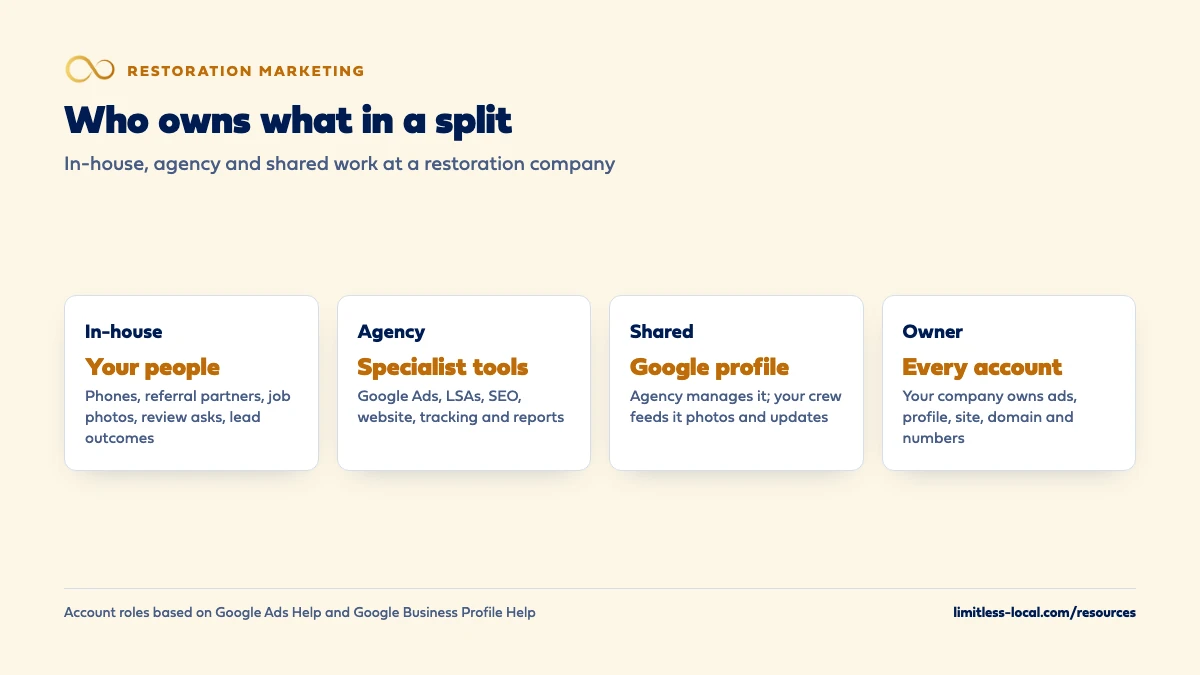
- In-house: the phones, referral partners, job photos, review requests and lead outcomes.
- Agency: Google Ads and Local Services Ads, SEO, the website, tracking and reporting.
- Shared: the Google Business Profile, with your crew feeding it real photos and job details.
- Your company owns every account, and each side gets only the access it needs.
For restoration owners with someone in the office who could take on part of the marketing, deciding what to keep and what to hand off.
Get a free visibility audit · Book a growth call
What should a restoration company keep in-house and what should it hand to an agency?
For most restoration companies past the one-truck stage, a split works better than doing it all in-house or handing it all to an agency. Keep the work that depends on your people in-house: answering and qualifying calls, referral partners like plumbers and property managers, job photos, review requests and marking which leads became jobs. Hand the specialist, tool-heavy work to an agency: Google Ads and Local Services Ads, SEO and the website, and call tracking. Then write down who owns each task, and keep every account in your company’s name.
That split is how our restoration marketing is built to run: our team handles the ads, SEO, Google profile and tracking, and your team keeps the phones, the relationships and the job details only it has. Onboarding takes your team about 2-3 hours, and every package includes call tracking and a monthly report with a cost-per-lead breakdown, so your in-house person and our team look at the same numbers. The packages page shows what each tier covers, the restoration marketing guide covers every channel, and the restoration marketing questions library takes the rest one question at a time.
What does a split between in-house and an agency look like?
A split means someone on your payroll owns part of the marketing and an agency owns the rest. That someone is rarely a full-time marketer. It’s usually an office manager, a dispatcher or a project coordinator who spends part of the week on marketing, working next to an agency that runs the paid and technical side.
It sits between the two options most owners compare. All in-house means hiring for every skill, and paid search, SEO, the website and tracking rarely live in one person. All agency means the agency has to chase you for photos, job details and which leads booked, and those are exactly the things that make the work good. A split puts each task with whoever is closest to it.
If you’re still choosing between a full-time hire and an agency, whether to hire an in-house marketer or an agency covers that decision. This page is about running both at once.
Which marketing work should stay in-house?
Keep anything that depends on being inside your company, on your job sites or in your relationships:
- Answering and qualifying calls. The first call decides whether a lead becomes a job, and it happens on your phones at all hours. No ad can fix a call that rings out.
- Referral partners. Plumbers, property managers, insurance agents and facility managers send work to people they know and trust. Lunches, follow-ups and thank-you calls are a person’s job.
- Job photos and job notes. Your crew is on site. Before, during and after photos of real drying setups, plus two lines on what happened, are the raw material for your Google profile, your website and your ads.
- Review requests. The best moment to ask is at the end of the job, when the homeowner is relieved, and the person to ask is the tech or project manager they’ve been dealing with.
- Lead outcomes. Booked, not booked, out of area, wrong service, spam. Only your team knows what happened after the phone rang.
None of these needs a marketing degree. They need someone who’s around every day and has a few hours a week set aside, which is why the in-house side usually fits inside a job someone already has.
Which marketing work is worth handing to an agency?
Hand off the work that needs specialist tools, practice and attention every week:
- Google Ads and Local Services Ads. Search terms, negative keywords, bids, budgets, location settings and the move of Local Services Ads into Google Ads. Mistakes here are billed by the click or the lead, so learning on the job is expensive.
- SEO and the website. Service pages for water, fire, mold and sewage work, pages for the towns you really serve, technical fixes, local links and consistent business listings.
- Tracking and reporting. Call tracking numbers, form tracking, and a report that ties calls to booked jobs instead of clicks.
Google’s own advice on hiring SEO help says a small local business can probably do much of the work itself, and that you’re responsible for the actions of anyone you hire. Both are worth keeping in mind. A coordinator can learn the basics, but learning them between storm calls is a different thing, and whoever you hire should explain every change they make.
Who should handle the Google Business Profile?
Both, with clear lanes. The profile mixes technical work with things only your team can supply.
- Agency: categories, services, the business description, posts, service areas and keeping details consistent with your website and listings.
- In-house: fresh job photos, review requests, and telling the agency the day something changes, like new hours, a new service or a new town.
- Owner: the final word on replies to angry reviews, especially anything touching an insurance dispute.
Set up access properly. You can invite users as owners or managers. Managers have mostly the same access as owners, except they can’t add or remove users or remove the profile, so the agency should be a manager and your company should keep primary ownership. Each person needs their own Google Account, so nobody ever shares a password.
Optimizing a restoration company’s Google Business Profile covers what the profile itself should say.
Curious what your marketing is actually booking?
Get a free visibility audit — no obligation, no sales pitch.
Who should own the accounts when the work is split?
Your company, every time. The ad accounts, the Google profile, the website and domain, Search Console and the call tracking numbers should be in your name, with the agency and your in-house person added as users.
Google Ads makes this easy to set up. When you grant access, you choose an access level: read-only users can view campaigns and reports, standard users can edit campaigns, and only admins can give access to others and unlink manager accounts. Google also notes that an account with only one administrator may lose access to its tags if that person becomes unavailable, so add a second admin. A good setup is you as admin, the agency with the access it needs to run campaigns, and your in-house person on read-only unless they’re actually running something.
If the agency links its own manager account, the client account still owns its data and can remove the manager by unlinking. Google recommends making a manager the owner of your account only if it really needs those privileges. Who should own the website and ad accounts goes through every account one by one.
How do I stop the two sides from doubling up or dropping tasks?
Give every recurring task exactly one owner and one handoff. The handoffs fail far more often than the tasks themselves. A short list covers most of it:
- Photos: the crew shoots them, the in-house person drops the best ones in a shared folder each week, and the agency uses them on the profile, the site and the ads.
- Lead outcomes: the in-house person tags every lead in your job software, whether that’s ServiceTitan, Housecall Pro, Jobber or a shared sheet, and the agency reads them for the monthly report.
- New services or towns: the owner decides, the in-house person tells the agency, and the agency updates pages, the profile and the ads together.
- Crew capacity: the owner says when crews are full or have room, and the agency raises or caps the ad budget to match.
Then hold a short check-in each week and one longer review each month. If the same question comes up twice, add a line to the list.
What should the in-house person do each week?
- Tag last week’s leads with their outcome, and flag any that look like junk so the agency can block those searches.
- Send the agency new job photos and a line about each job.
- Ask for reviews on finished jobs, using the same link or QR code every time.
- Check in with two or three referral partners.
- Pass on anything that changed: hours, services, towns, crew capacity, a big commercial account won or lost.
- Read the agency’s notes and ask about anything that doesn’t make sense.
That’s a few hours a week, not a full-time job. How much of your time managing a marketer takes breaks down the owner’s share, which shrinks once someone in-house owns this list.

How should I split the budget between staff time and the agency?
There’s no standard split. The Small Business Administration says there’s no hard and fast answer to how much a business should spend on marketing. There’s no standard way to divide it either. What helps is counting every line honestly:
- Staff time: the share of your coordinator’s pay that goes to marketing. It’s a real cost even though it doesn’t show up on an invoice.
- The agency fee: what you pay for management, SEO and reporting.
- Ad spend: paid to Google directly, on top of any agency fee.
As a reference point, our Essentials package is $3,500 a month and includes Google Ads management for up to $2,500 a month in spend, SEO for one location and Google Business Profile management. Growth is $4,500 a month and adds Local Services Ads management. Ad spend isn’t included in either. Splitting ad spend and agency fees goes deeper on the paid side of the budget.
When doesn't a split make sense?
- You’re a one-truck operation and you’re the office. There’s nobody to own the in-house side. Do the basics yourself, or hand most of it to an agency and commit to sending photos and lead outcomes.
- Nobody has time set aside. A split with an empty in-house seat is just an agency with gaps. If marketing is something your office manager does when it’s quiet, it won’t happen during storm season, which is when it matters.
- The agency won’t work with your staff. If an agency won’t share access, won’t explain its changes or treats your coordinator as a nuisance, the split will fail. Ask about it before you sign.
- You’ve grown to several locations with a big budget. More of the work can move in-house, sometimes a full marketing hire with an agency for paid search only.
How do I tell whether the split is working?
Look at one number each month: what each booked job cost, across all the marketing. Add up the agency fee, the ad spend and the share of staff time, then divide by the jobs that came from tracked marketing.
Tracking doesn’t have to be fancy to start. It can be as simple as asking every new customer where they heard about you. Pair that with call tracking numbers and your lead tags and you’ll know which channels book work.
Then look at the handoffs. Are photos arriving every week? Are leads tagged within a day or two? Does the agency explain what it changed and why? When the handoffs are healthy and cost per booked job holds steady or falls, the split is doing its job. When it rises, find the dropped task before you blame the channel.
Not sure which of these is costing you jobs?
A free visibility audit checks the Google profile, reviews, site and tracking, and shows what to fix first.
What's different about splitting marketing at a restoration company
The phone never closes. Water damage doesn’t wait for business hours, so the in-house side has to include a plan for nights and weekends. An agency can bring in the call; only your team can answer it.
A lot of work comes through people. Plumbers, property managers, insurance agents and facility managers send jobs to companies they know. That relationship work belongs in-house, and it should be tracked like any other channel. Building a referral network with plumbers and property managers covers how.
Storms change everything in a day. An agency can raise ad budgets within hours, but only you know whether crews can take more work. Agree up front on who makes that call and how fast.
Job photos need care. Get the homeowner’s OK before using photos from inside their home, and keep faces, house numbers and personal belongings out of frame.
A worked example: what one month of a split costs per booked job
These numbers are made up to show the math, not a benchmark for your market. A restoration company’s office manager spends about a day a week on the in-house list, and the owner counts that share of her pay as $1,200 a month. The agency side is our Essentials package at $3,500 a month, with $2,500 a month in Google Ads spend paid to Google.
- Total monthly marketing cost: $1,200 + $3,500 + $2,500 = $7,200.
- Jobs booked from tracked marketing that month: 18.
- Cost per booked job: $7,200 ÷ 18 = $400.
If a typical job leaves well over $400 after labor, equipment and materials, the split is paying its way. If the office manager stops tagging leads, that $400 becomes a guess, which is why the in-house list matters as much as the agency’s work.
Frequently asked questions
Can my office manager run the in-house side?
Usually, yes, if the time is protected. The in-house job is coordination: photos, lead tags, review requests and passing on changes. It doesn’t need someone who can run Google Ads.
Should my in-house person have edit access to Google Ads?
Usually not. Read-only access lets them see campaigns and reports. If both your coordinator and the agency edit campaigns, changes collide and nobody knows who changed what.
Will an agency work alongside my staff?
A good one should welcome it, because your staff supply the photos, job details and lead outcomes that make the work better. Ask how they’d split the tasks before you sign.
Who should write the website pages in a split?
The agency writes them, and your in-house person or a project manager checks the facts: the services you really offer, the towns you really serve and how a job really runs.
How soon can I judge whether the split is working?
Ads can bring calls within days, so judge them month by month. SEO typically takes 3-6 months to show meaningful growth, so give the organic side that long before deciding.
Key takeaways
- Keep the phones, referral partners, job photos, review requests and lead outcomes in-house.
- Hand Google Ads, Local Services Ads, SEO, the website and tracking to specialists.
- Share the Google Business Profile, with the agency as a manager and your company as primary owner.
- Give every recurring task one owner and one handoff; dropped handoffs sink most splits.
- Judge the whole setup on cost per booked job, counting staff time, the agency fee and ad spend.
Want a second set of eyes on your setup?
We'll look at how you show up locally and where calls are leaking, then send you a plain-English breakdown.
More in this section
- Should a restoration company hire an in-house marketer vs agency?
- Can I switch my restoration marketing agency or go in-house?
- How should a restoration company split ad spend and agency fees?
- What should a restoration company look for in a marketing agency?
- How should a restoration company market to real estate agents?
Sources
- Do You Need an SEO? Tips for Hiring an SEO — Google Search Central
- About access levels in your Google Ads account — Google Ads Help
- Manager Accounts (MCC): About ownership of client accounts — Google Ads Help
- Manage your Business Profile owners & managers — Google Business Profile Help
- How to Get the Most From Your Marketing Budget — U.S. Small Business Administration