
How much of my time does managing a restoration marketer take?

- How many hours a month will I spend managing an agency or in-house marketer?
- Where does an owner's time actually go with a marketer?
- How much time does the first month take?
- How do I give a marketer access without handing over control?
- Which parts can't I hand off?
- How long should a weekly check-in take?
- How do I tell my marketer which leads became jobs without it eating my week?
- What should the monthly review cover, and how long should it take?
- Does an in-house marketer take more of my time than an agency?
- What happens to my time during storm season?
- What are the signs it's taking too much of my time?
- What's different for restoration companies
- A worked example: what a steady month costs in owner time
- Frequently asked questions
- Key takeaways
- More in this section
- Sources
The short version
- The first month is the heaviest: access, decisions about jobs and towns, photos and details.
- After that, a short weekly check-in, a few minutes marking booked leads, and one monthly review.
- An in-house hire adds hiring, training and day-to-day management on top.
- Some jobs only you can do: answering calls, judging leads, and asking for reviews on site.
For restoration owners deciding whether they have the hours to work with an agency or a marketing hire, on top of running crews and jobs.
Get a free visibility audit · Book a growth call
How many hours a month will I spend managing an agency or in-house marketer?
Expect the first month to take the most time, mostly handing over account access, choosing which jobs and towns you want, and supplying photos and details only you have. After that, a well-run arrangement with an agency usually needs a short weekly check-in, a few minutes a week marking which leads became signed jobs, and one monthly review of cost per signed job: a few hours a month in total. An in-house marketer generally takes more of your time, because you’re also hiring, training and managing a person. If it takes much more than that, the setup or the reporting is usually the problem, not the marketing.
For comparison, here’s what our own process asks of an owner. Onboarding takes the owner’s team about 2-3 hours, campaigns go live in weeks 1-2, and after that it’s monthly reviews and optimization; Essentials includes quarterly strategy calls, and Growth adds monthly strategy calls with a dedicated account manager. Every package includes reporting with a cost-per-lead breakdown, call tracking with recording and a real-time dashboard, so you’re not chasing anyone for numbers. Our restoration marketing page covers how we work with water, fire and mold companies, and the packages page lists what each tier includes. For the wider picture, the restoration marketing guide covers every channel, and the restoration marketing questions library takes the narrower questions one at a time.
Where does an owner's time actually go with a marketer?
Into three kinds of work, and only the first is heavy:
- Setup. Giving access to your accounts, deciding which services and towns you want work in, supplying photos and the details that make your company different. This happens mostly in the first few weeks.
- Feedback. Telling your marketer which leads were real and which became signed jobs. This is small, but it’s weekly, and it’s the part owners most often let slide.
- Decisions. Reviewing results once a month and deciding what to change: budget, services, towns, or what to stop.
What shouldn’t take your time is chasing reports, re-explaining your business every month, or approving every post and keyword. In our judgement, if those start eating your week, the arrangement needs fixing. Google’s guide Do you need an SEO? suggests asking a provider before you hire how you can expect to communicate with them, and whether they’ll share all the changes they make and explain the reasoning. Asking that up front saves hours later.
How much time does the first month take?
More than any month after it, and most of it is front-loaded into the first week or two. Typical setup tasks for a restoration company:
- Access. Adding your marketer to your Google Business Profile, Google Ads account, website and call tracking, without giving away ownership.
- Services and areas. Which services you want more of (water, mold, fire, sewage, rebuild), which towns your crews can reach fast, and which you don’t want calls from.
- Hours and call routing. Who answers at night, on weekends and during a storm surge, so the marketing matches what the phones can handle.
- Proof. Job photos, certifications, the insurance and billing language you’re comfortable with, and anything you never want said about your company.
In our judgement, a few focused hours in that first fortnight saves weeks of back-and-forth later. If you’re still choosing who to hire, vetting a restoration marketing agency covers what to ask before any of this starts.
How do I give a marketer access without handing over control?
Keep ownership of every account in your company’s name and give your marketer a lower level of access. Google’s page on Business Profile owners and managers says managers have mostly the same access as owners, except they can’t add or remove users or remove the profile, and that each user needs their own Google Account so you don’t have to share a password.
Google Ads works the same way. Its page on access levels lists Email-only, Billing, Read-only, Standard and Admin access; Standard users can edit campaigns, while only Admins can grant account access and change access levels. Google also notes that an account with only one administrator may lose access to its tags if that user becomes unavailable, so adding a second administrator can help.
Setting this up correctly takes an hour once, and it’s the hour that protects you most if you ever change marketers. Who owns your website and ad accounts if you leave covers the rest.
Which parts can't I hand off?
A few jobs sit with you or your office no matter who runs the marketing:
- Answering the phone. A marketer can make it ring. Someone at your company has to pick up, at night too.
- Judging leads. Whether a call was a real job in your area or a price shopper from three counties away is something your team knows and your marketer doesn’t, until you tell them.
- Asking for reviews on site. The best moment is when the crew finishes and the homeowner is relieved. That ask happens at the job, not in an office.
- Approving what’s said about insurance, mold and certifications. In our judgement, claims in these areas carry the most risk if they’re wrong, and the owner should sign off on them once, in writing.
The rest (ads, the Google profile, website updates, review replies, reports) can be handed off. Google’s owners and managers page notes that additional owners and managers can edit info, respond to reviews and manage posts.
Curious what your marketing is actually booking?
Get a free visibility audit — no obligation, no sales pitch.
How long should a weekly check-in take?
In our judgement, 15 to 30 minutes, and some weeks a short message is enough. A good weekly check-in covers three things:
- Anything urgent: a storm coming, a crew out sick, a service you need to pause.
- Lead quality: which calls were junk, out of area or the wrong service, so they can be filtered out.
- What’s changing this week, in one or two sentences.
If you’re running Local Services Ads, the lead inbox is part of this. Google’s page on managing leads and jobs says you can review booked jobs and phone calls your ad generated from the inbox. As Local Services Ads move into Google Ads, Google’s transition page says leads appear on a Leads page there, with the same features as the old inbox, including charged status, lead type, a lead feedback form and the option to download leads into your own CRM.
How do I tell my marketer which leads became jobs without it eating my week?
Make it part of the job file, not a separate task. When the office books a job, the lead source goes on it; at the end of each week, your marketer pulls the list. In our judgement, that’s ten minutes of someone’s week, and it can be your office manager’s, not yours.
Google Ads can take this further. Google’s offline conversion imports FAQ describes importing leads that were qualified, or that converted, in your CRM or lead system back into Google Ads, and lists qualified lead or converted lead as the best-practice goal. Once that’s connected, booked jobs flow back without anyone typing them in.
Without this feedback, your marketer is judging success on leads, and in restoration a lead count is easy to pad with out-of-area calls and price shoppers. Tracking which marketing brings booked jobs covers the setup.
What should the monthly review cover, and how long should it take?
In our judgement, under an hour, and it should cover decisions, not a tour of charts:
- Signed jobs and cost per signed job by channel, against the ceiling you’ve set.
- What changed since last month, and what it produced.
- What’s next: one or two changes, with a reason for each.
- Anything to stop, because cutting a channel that isn’t working is a decision too.
Ask for the report a day before so you can read it first; the meeting then goes to questions. If every review is mostly clicks, impressions and rankings, ask for signed jobs instead. Whether your agency is producing real jobs lists what a useful monthly report includes.

Does an in-house marketer take more of my time than an agency?
Usually, yes, in our judgement. With an agency, you’re managing a result. With an employee, you’re also managing a person: hiring, onboarding, weekly one-to-ones, reviews, time off, and covering the gaps when they’re out. A single marketer also rarely covers ads, the Google profile, SEO, content and tracking equally well, so you may end up managing a freelancer or two as well.
An in-house hire can save time in other ways. They’re in the building, they hear the calls, and they learn your business faster. For a company with several locations or a large commercial program, that can be worth the management time. In-house marketer versus agency compares the cost of each.
What happens to my time during storm season?
It spikes, but it should spike in decisions, not tasks. When a storm or freeze hits, your marketer needs quick answers: raise the budget or pause it, which towns to cover, which services to push or turn off, and how many more jobs the crews can take. In our judgement, agree on those rules before the season starts, so a storm-day message takes two minutes instead of an hour.
The mechanics allow quick changes. Google’s transition page says you can pause a campaign with pay-per-lead goals and enable it again when you want leads, and Google’s page on average daily budgets says you can set and edit a campaign’s average daily budget at any time. The constraint is your crews and equipment, which only you know.
What are the signs it's taking too much of my time?
Watch for these, in our judgement:
- You chase reports instead of receiving them on a set day.
- You re-explain your services, towns or pricing every month.
- You’re asked to approve small things (single posts, minor keywords) that should be covered by rules you agreed once.
- Nobody can tell you what changed last month and why.
- You’re doing work you hired them for, such as replying to every review yourself or building ads.
Google’s hiring guide warns to be careful if a company is secretive or won’t clearly explain what it intends to do, and says you’re ultimately responsible for the actions of any companies you hire. A marketer who explains clearly, on a schedule, tends to cost you less time, not more.
Talk it through with someone who runs this every day
A 15-minute growth call: your market, your numbers, and what a realistic budget looks like. No pressure.
What's different for restoration companies
The phones are the bottleneck, not the marketing. In our judgement, most of the time an owner spends on restoration marketing is really call handling: who answers at 2 a.m., who calls back a missed lead. That time doesn’t go away with a better marketer, so plan it separately.
Insurance and mold language needs one sign-off. In our judgement, decide once what your marketing may say about insurance billing, mold and certifications, and put it in writing. That avoids re-approving the same wording on every page and ad.
Program and referral work muddies the feedback. If you take program jobs and referrals, tag them clearly so they don’t get credited to marketing, or blamed on it. That tagging is a few seconds a job and saves long arguments in the monthly review.
Storms compress decisions. A week of surge calls needs fast answers on budget and areas. Rules agreed ahead of time keep your time free for the crews.
A worked example: what a steady month costs in owner time
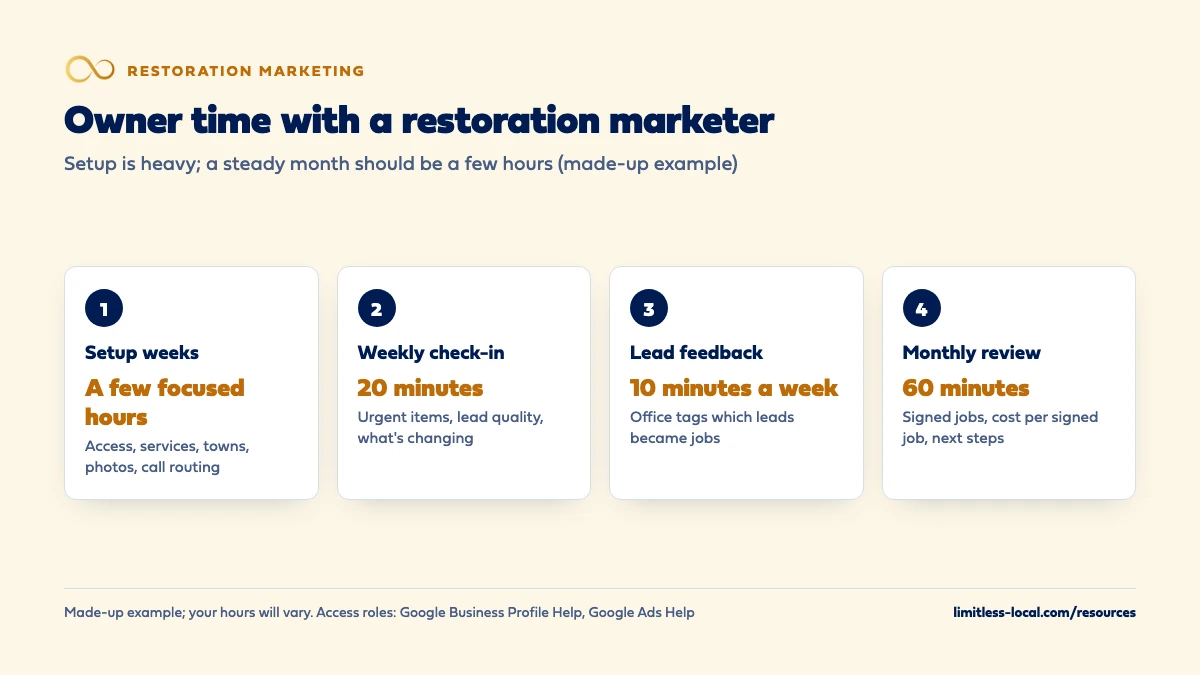
These numbers are made up to show the math, not a forecast for your company. Say the setup weeks are behind you and you work with an agency. Each week you spend 20 minutes on a check-in and your office manager spends 10 minutes tagging which leads became jobs. Once a month you spend an hour on the review.
Your own time: 20 minutes a week for four weeks is 80 minutes, plus the 60-minute review, for 140 minutes, or about 2 hours 20 minutes a month. Your office manager adds 40 minutes (10 minutes a week for four weeks), so the company total is 180 minutes, or 3 hours.
If you value your own time at $150 an hour, your 140 minutes cost about $350 a month. That’s the number to compare with doing it all yourself, which, in our judgement, takes many times longer once you count ads, the Google profile, reviews, website updates and tracking. It’s also the number to watch: if your share creeps well past a few hours a month, something in the setup or the reporting needs to change.
Frequently asked questions
Should I give my marketer my Google password?
No. Google’s Business Profile help says each user should have their own Google Account so you don’t need to share a password. Add your marketer as a manager on the profile and a Standard user in Google Ads, and keep ownership yourself.
Can my office manager handle the marketer instead of me?
For weekly check-ins and lead feedback, yes, in our judgement. Keep the monthly review and decisions about budget, services and towns with the owner.
How much time does doing my own marketing take compared with hiring it out?
Far more, in our judgement, because you’d be doing the work as well as deciding on it. Google says a small local business can probably do much of its own SEO, but ads, reviews, tracking and the website all add hours on top.
Do I need to approve every ad and post?
No. Agree on rules once: services, towns, the claims you’re comfortable with and words to avoid. Then review results monthly instead of approving each piece.
What if I don't have time for a monthly review?
Then ask for a one-page summary with signed jobs, cost per signed job and the one decision needed. In our judgement, skipping the review entirely is how marketing drifts toward lead counts instead of jobs.
Key takeaways
- The first few weeks take the most owner time: access, services, towns, photos and call routing.
- After setup, plan on a short weekly check-in, a few minutes of lead feedback and an hour-long monthly review.
- Keep ownership of your Google profile and ad accounts, and give your marketer manager or Standard access.
- Answering calls, judging leads and approving insurance and mold language stay with your company.
- An in-house marketer usually takes more owner time than an agency, because you manage a person as well as results.
Ready to compare options?
Book a short growth call and we'll walk through the math for your service area, including when we're not the right fit.
More in this section
- What monthly marketing budget does a restoration company need?
- Should a restoration company hire an in-house marketer vs agency?
- How do I keep marketing steady while hiring restoration techs?
- How should a restoration company handle marketing during storm season?
- How fast do restoration marketing channels produce leads?
Sources
- Do you need an SEO? — Google Search Central
- Manage your Business Profile owners & managers — Google Business Profile Help
- About access levels in your Google Ads account — Google Ads Help
- Manage leads and jobs — Google Local Services Help
- Local Services Ads transition to Performance Max campaigns with pay-per-lead goals — Google Ads Help
- Offline conversion imports FAQs — Google Ads Help
- About average daily budgets — Google Ads Help