
How does a roofing company get links from local websites?
- Where can a roofer earn links from real local sites without buying them?
- Do links from local websites help a roofing company show up on Google?
- What's the difference between a link and a citation for a roofer?
- Will my roofing suppliers and manufacturers link to my company?
- Do local sponsorships get a roofing company links?
- Which local associations and groups should a roofer join?
- How does a roofer get covered by local news?
- Can my customers and business partners link to my roofing company?
- What should a local site link to on my roofing website?
- Which link-building tactics should a roofer stay away from?
- How many local links does a roofing company need?
- How do I see which websites already link to my roofing company?
- What's different about local links for roofing companies
- A worked example: one quarter of asking for local links
- Frequently asked questions
- Key takeaways
- More in this section
- Sources
The short version
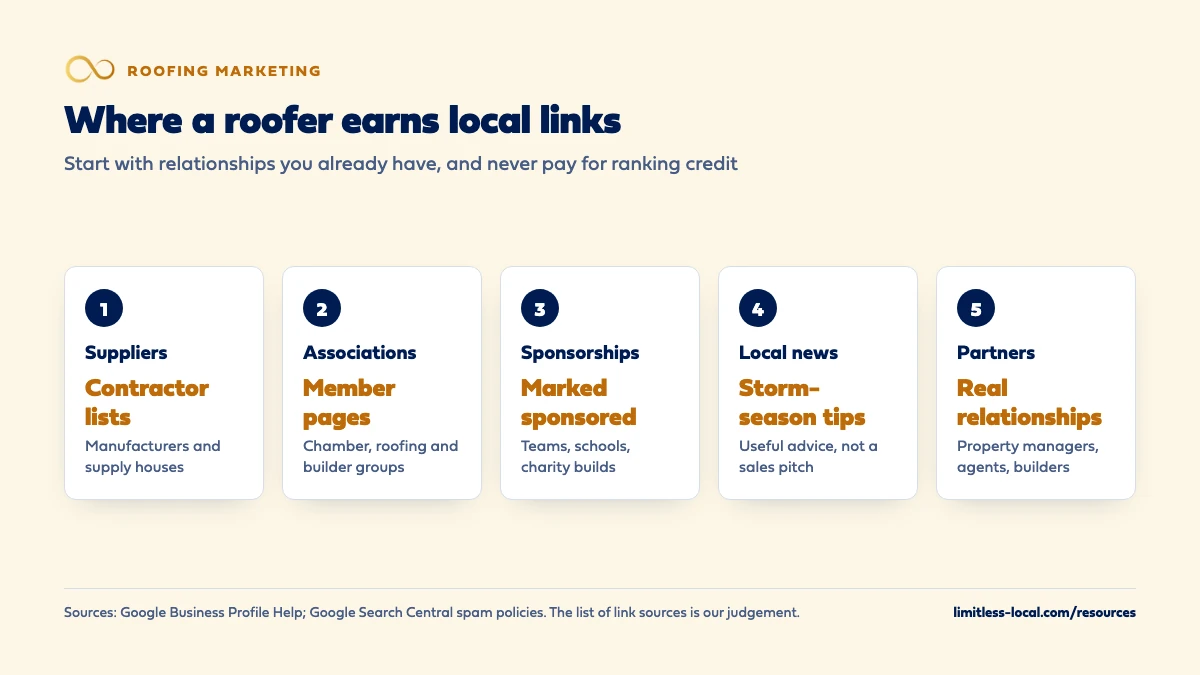
- Start with relationships you already have: suppliers, associations, sponsorships, customers and partners.
- Local news covers roofers who have something useful to say, especially before and after storm season.
- Paying or trading for a link that passes ranking credit is link spam under Google's rules.
- A sponsorship link is fine when it's marked as sponsored; sponsor for the community, not the link.
For roofing owners who keep hearing that links help them rank and want to know which local sites will actually link to them, and which tactics Google treats as spam.
Get a free visibility audit · Book a growth call
Where can a roofer earn links from real local sites without buying them?
A roofing company gets links from local websites mostly by asking the people it already works with: suppliers and manufacturers that list contractors, the chamber and trade associations it belongs to, the teams and charities it sponsors, local news outlets, and commercial customers and partners. Google says how many websites link to a business is part of how prominent it looks in local results, but it treats buying links, or trading goods or services for them, as spam. Earn each link through a real relationship or a story worth covering, and let any paid sponsorship link be marked as sponsored.
Links are one piece of being the roofer Google and homeowners trust in your towns, next to a clean Google profile, reviews and consistent business details. That’s the work our local SEO covers as part of roofing marketing. If you’re still deciding whether SEO is worth paying for at all, read is SEO worth it for roofers first, and the roofing marketing questions library takes the rest one question at a time.
Do links from local websites help a roofing company show up on Google?
They’re one of the signals, not the only one. Google’s Business Profile help lists three things behind local ranking: relevance, distance and prominence. On prominence, Google says it’s based partly on information like how many websites link to your business and how many reviews you have (Google Business Profile Help). For regular search results, Google explains that one of the ways it judges quality is whether other prominent websites link or refer to the content (How Search Works). Bing’s guidelines list external links from relevant websites as one way it discovers pages, and say links should be earned through useful content (Bing Webmaster Guidelines).
In our judgement, a link from a real local site also does something a ranking factor can’t: it sends you homeowners who already trust the site they came from. A link from the supply house’s contractor list or the chamber’s member directory is a referral, not just a signal.
What's the difference between a link and a citation for a roofer?
A citation is any listing of your business name, address and phone number, on a directory, a map app or a review site. A link (Google’s Search Console calls it a backlink) is a link on a page of another site that points to a page on your site (Search Console Help). Many listings are both. Some citations carry no link at all, and many good links, like a news story or a sponsor page, aren’t directory listings.
Citations matter mostly because your details need to match everywhere, which is its own job. Whether your roofing info needs to match on every listing covers that. This page is about the other half: real local sites choosing to point at yours. One warning applies to both: Google lists low-quality directory or bookmark site links as an example of link spam (Google Search Central), so more listings on junk directories isn’t the goal.
Will my roofing suppliers and manufacturers link to my company?
Often, if you ask. Start with the businesses you already spend money with:
- Shingle and metal roofing manufacturers. If you hold a manufacturer certification, check whether they list certified contractors on their site and whether your listing links to your website and shows your current details.
- Your supply house or distributor. Some keep a contractor directory or feature customers in a newsletter or on social media. Ask.
- Gutter, skylight, solar or insulation partners you install for, if they list installers by area.
These are worth checking once a year, because programs change and listings go stale. In our judgement, it’s the easiest place to start: the relationship exists, you’re already a customer, and the listing is a reason for a homeowner to trust you, not a favor.
Do local sponsorships get a roofing company links?
They can, and this is where roofers most often get the rules wrong. Google treats buying or selling links for ranking purposes as link spam, including exchanging money, goods or services for links, and requiring a link as part of a contract without letting the other site qualify it. Google also says paid links for advertising and sponsorship are a normal part of the web and don’t break its rules, as long as they’re marked with a nofollow or sponsored attribute (Google Search Central).
So sponsor the youth league, the school fundraiser or the charity build because it puts your name in front of families in your towns. If the sponsor page links to you, good, and if it’s marked sponsored, that’s fine. Don’t make a followed link a condition of the check, and don’t sponsor events nobody in your service area attends just to get a link. The banner at the field and the trucks in the parking lot often do more than the link, which is the same logic as whether yard signs and truck wraps are worth it.
Which local associations and groups should a roofer join?
Join the ones you’d join anyway for the business, then make sure their member listing is complete. In our judgement, the usual candidates for a roofer are:
- Your local chamber of commerce, which usually keeps an online member directory.
- A state or regional roofing contractors association.
- The local home builders association, if you do new construction or work with builders.
- Property manager, apartment or HOA groups, if you want commercial and multi-family work.
Membership dues aren’t the same as buying a link: you’re paying to belong, and the listing comes with it. Still, judge each group by the business it brings, not the link. A directory page nobody in your town ever visits is exactly the kind of low-value listing Google’s spam policies warn about.
Curious what your marketing is actually booking?
Get a free visibility audit — no obligation, no sales pitch.
How does a roofer get covered by local news?
Local reporters need sources, and roofers have useful things to say at predictable times. In our judgement, the stories that tend to get picked up are:
- Storm season. How homeowners can check a roof safely from the ground after hail or high winds, and how to spot out-of-town crews who show up after a storm and leave before the warranty matters.
- Community work. A free roof for a veteran or a family in need, done with a local charity.
- Hiring and training. Apprenticeships, local jobs, a crew expanding.
Send a short email to the reporter who covers weather or local business, offer one clear tip and your availability, and include your website. Keep it about the homeowner, not a sales pitch, and don’t comment on anyone’s insurance claim. If you write a press release, put it on your own site; Google lists press releases distributed on other sites with keyword-stuffed links as link spam (Google Search Central).
Can my customers and business partners link to my roofing company?
Yes, and they’re often the most relevant links you’ll get. Think about who already sends you work or works next to you:
- Commercial customers and property managers who list their vendors or wrote a testimonial you can point to. How a roofing company should market commercial roofing covers that side of the business.
- Real estate agents and home inspectors who keep a list of trusted local contractors for their clients.
- Builders and remodelers you subcontract for.
Be careful with swaps. Google lists excessive link exchanges (“link to me and I’ll link to you”) and partner pages made only for cross-linking as link spam (Google Search Central). A short list of partners you really work with is normal; a page of fifty swapped links is not.
What should a local site link to on my roofing website?
The page that fits the reason they’re linking. A chamber or supplier listing can point to your home page. A news story about a storm should point to your storm damage page. A sponsor page can point to your page about the community work, with photos. A property manager’s vendor list should point to your commercial roofing page.
Let them describe you in their own words. Google explains that anchor text, the visible words of a link, tells people and Google something about the page being linked to (Google Search Central). Your business name is the natural anchor. Asking everyone to use “best roofer in [town]” as the link text is the kind of optimized anchor text Google calls out in its link spam examples.
Make sure the page you’re sending people to is worth landing on. A slow, thin page wastes a good link, which is why getting recommended by ChatGPT and other AI tools starts with pages that say clearly what you do and where.
Which link-building tactics should a roofer stay away from?
Google’s spam policies list them plainly (Google Search Central). For a roofer, the ones that show up in sales pitches are:
- Packages of links for a monthly fee, or paying a site to add a link that passes ranking credit.
- Automated programs or services that create links to your site.
- Low-quality directory and bookmark sites.
- Guest posts and press releases on other sites stuffed with keyword links.
- Links hidden in widgets or spread across the footers of many unrelated sites.
Bing says the same thing in its own words: link buying, link spamming and private networks of sites violate its guidelines, and links should be earned (Bing Webmaster Guidelines). If someone offers you a set number of links for a set price, in our judgement that’s a reason to walk away.
How many local links does a roofing company need?
There’s no honest number. Neither Google nor Bing publishes one, and anyone who quotes a target is guessing. Google’s own description of local prominence mixes links with reviews and other information about your business (Google Business Profile Help), so links alone won’t fix a profile with a wrong category or a handful of reviews. If you aren’t showing up on Maps at all, why a roofing company isn’t showing up on Google Maps is the better first step.
In our judgement, the better question is whether the sites that should know about you do: the suppliers you buy from, the groups you belong to, the towns you work in. A handful of real local links that homeowners might click is worth more than a long list of sites nobody reads.
How do I see which websites already link to my roofing company?
Google Search Console has a free Links report. It shows which of your pages other sites link to most, and which sites link to you most, so you can confirm you recognize them and see whether the sites that matter to you point to your site (Search Console Help). Google notes the report is a sample, not a complete list, and doesn’t show whether a link is marked nofollow.
Keep a simple list next to it: every supplier, group, sponsor, partner and reporter you’ve asked, the date, and whether the link went live. Check it twice a year, because sponsor pages get replaced each season and directory listings go out of date. If you see unknown, spammy sites in the report, Google’s advice is to ask for removal first. Its disavow tool is an advanced feature, and Google says most sites will never need it (Search Console Help).
Not sure which of these is costing you jobs?
A free visibility audit checks the Google profile, reviews, site and tracking, and shows what to fix first.
What's different about local links for roofing companies
Proving you’re local. In our judgement, homeowners are wary of out-of-town crews after a big storm, and links from your chamber, your town’s news site and local organizations are public proof that you’ve been here a while, which a storm crew can’t fake quickly.
Storm timing. Reporters want roofing sources right before and right after severe weather. Build the relationship in the quiet months, so you’re the roofer they call when hail hits, and have a storm damage page ready to link to.
Insurance work. Keep any news comment or partner page general. Don’t comment on what a claim will pay, and never set up a link or referral arrangement that involves paying adjusters, agents or anyone else for sending you jobs.
A worked example: one quarter of asking for local links
These numbers are made up to show the approach, not a benchmark. Say you write down every local relationship you already have: 3 suppliers and manufacturers, 2 associations, 4 commercial customers and property managers, 2 sponsorships and 1 reporter who called you after last spring’s hail. That’s 12 places to ask.
- Your office manager sends each one a short, specific request, with the exact page you’d like them to point to.
- If half say yes over the quarter, you have 6 new links from real local sites, and no money spent buying links.
For context, link building is included in our Essentials package at $3,500 a month, along with business listing cleanup, and we sync your name, address and phone across 50+ directories. One roofing client got 3x map pack visibility in its target towns; better presence and consistent info across the web increased inbound calls. That’s one client’s past result, not a forecast for your business. Whether links are what’s holding you back, or something more basic, is one of the questions a free visibility audit answers.
Frequently asked questions
Is a Better Business Bureau listing a good link for a roofer?
It’s a listing homeowners often check, which is the main reason to keep it accurate. In our judgement, treat it like any membership: worth it for the trust it builds with customers, not as a link-building tactic.
Should I pay an agency for a monthly link package?
Not if the package pays sites to add links that pass ranking credit. Google lists buying links for ranking purposes as link spam, and Bing says the same.
Do social media profiles count as links?
Your own profiles linking to your site help people find it, and Google lists social media and community engagement among ways to promote a site. In our judgement they aren’t a substitute for other local sites choosing to link to you.
Can I get in trouble for links I didn't build?
Google says that in most cases it can assess which links to trust on its own, so most sites never need its disavow tool. It’s meant for sites dealing with paid links or other link schemes.
Do links help on Google Maps or only in regular results?
Google mentions links in both places: as part of prominence for local results, and as one quality signal in regular search. Reviews, relevance and distance still matter for Maps.
Key takeaways
- Start with relationships you already have: suppliers, associations, sponsors, partners and customers.
- Google counts how many websites link to a business as part of local prominence, alongside reviews.
- Buying links, or trading goods or services for them, is link spam; sponsorship links are fine when marked sponsored.
- Point each link to the page that fits it, and let partners use your business name as the link text.
- Use the free Search Console Links report and a simple list to track what’s live.
Want a second set of eyes on your setup?
We'll look at how you show up locally and where calls are leaking, then send you a plain-English breakdown.
More in this section
- How can my roofing company stand out from other roofers online?
- What should a roofing website include to get more estimate requests?
- How should a roofing company market commercial roofing?
- Do Local Services Ads help a roofer rank on Google Maps?
- How does a roofing company get recommended by ChatGPT?
Sources
- Tips to improve your local ranking on Google — Google Business Profile Help
- Spam policies for Google web search — Google Search Central
- SEO Link Best Practices for Google — Google Search Central
- Search Engine Optimization (SEO) Starter Guide — Google Search Central
- How Search Works: Ranking results — Google
- Links report — Search Console Help
- Webmaster Guidelines — Bing Webmaster Tools
- Disavow links to your site — Search Console Help