
How do I stop attracting price shoppers to my plumbing company?
- What mistakes bring price shoppers to a plumbing company, and how do I fix them?
- Who counts as a price shopper for a plumbing company?
- Mistake 1: Paying for "cheap" and DIY searches
- Mistake 2: Leading your ads with a coupon or the lowest price
- Mistake 3: Letting Local Services Ads take every job type and town
- Mistake 4: Hiding how you price
- Mistake 5: Dodging price questions on the phone
- Mistake 6: Giving homeowners nothing to compare except price
- Mistake 7: Running an old website that makes price the only difference
- Mistake 8: Judging marketing by how many calls came in
- What should a 10+ truck plumbing company do about price shoppers?
- Should I ever take price-shopper work?
- What's different about price shoppers for plumbing companies
- A worked example: fewer calls, more revenue
- Frequently asked questions
- Key takeaways
- More in this section
- Sources
The short version
- Exclude price-first and DIY searches from your Google Ads.
- Set Local Services Ads to the job types and towns you want.
- Lead ads with speed, proof and how you price, not the lowest number.
- Measure revenue per booked job, not how many calls came in.
For plumbing owners whose phones ring but whose schedules fill with callers who only want the lowest number.
Get a free visibility audit · Book a growth call
What mistakes bring price shoppers to a plumbing company, and how do I fix them?
Stop paying to attract them: exclude “cheap”, “free” and DIY searches from your Google Ads, set your Local Services Ads job types and service areas to the work you actually want, and stop leading your ads with a coupon or the lowest price. Then give value-minded homeowners something else to choose you on, such as how you price, who shows up, reviews that mention real jobs, and a straight answer when they ask what it costs. Judge the change by revenue per booked job rather than lead count, because fewer calls that are worth more is the goal.
That last point is how we judge any plumbing campaign: what each booked job cost and what it was worth, not how many calls came in. Every one of our packages includes call, web and form tracking and a monthly report with a cost-per-lead breakdown, so you can see which searches and ads bring the jobs you want. See how we approach plumbing marketing, or browse the rest of the plumbing marketing questions library.
Who counts as a price shopper for a plumbing company?
Not everyone who asks “how much?” Almost every homeowner wants a rough idea of cost before a truck shows up, and that’s reasonable. In our judgement, the price shopper you want fewer of is the caller whose only decision rule is the lowest number: they call four plumbers for a water heater quote, ignore what’s included, and book whoever is cheapest, or they want a price over the phone so they can decide whether to try it themselves.
Before changing anything, look at your own call log and jobs for the pattern. Common signs in plumbing are coupon-only drain cleanings that never turn into repeat work, water heater and repipe estimates that end with “we went with someone cheaper”, and callers who hang up when they hear your service fee. Once you can name the pattern, the mistakes below tell you where it’s coming from.
Mistake 1: Paying for "cheap" and DIY searches
Searches with words like “cheap”, “cheapest”, “free” or “how to” tell you what the person cares about before they see your ad. If your Google Ads show for them, you’re paying to attract price shoppers and do-it-yourselfers.
Negative keywords stop that. Google says negative keywords let you exclude search terms so your ads don’t show for them, and that you can build one account-level list that applies across your search campaigns. One detail catches people out: negative keywords don’t match close variants, so you have to add synonyms and singular and plural versions yourself. For a plumbing company, words like “cheap”, “DIY”, “how to”, “jobs”, “salary” and “school” are common starting points, but they’re our examples, so test them against your own searches.
To find the searches actually costing you, open the search terms report, which Google says shows the actual searches that triggered your ads and how they performed. The full routine is in using negative keywords to stop wasted spend.
Mistake 2: Leading your ads with a coupon or the lowest price
If the headline is a dollar figure, you’re selecting for people who respond to dollar figures. “Drain cleaning from [low price]” brings calls, but in our judgement it also brings a lot of callers who will leave the moment someone else’s number is lower.
Lead with what a value-minded homeowner is worried about instead:
- Speed. Same-day service, or a real person answering at night, if that’s true.
- Who shows up. Licensed plumbers, background-checked, in a marked truck, if that’s true.
- How you price. Upfront pricing approved before work starts, written options, no surprise charges.
- Proof. Your rating and review count, or a line from a real review.
You can still mention price as one fact among several. A clearly stated service fee removes a fear rather than inviting a bidding war. Whether a specific discount helps or hurts is a separate question, covered in whether coupons attract good plumbing customers.
Mistake 3: Letting Local Services Ads take every job type and town
Local Services Ads charge per lead, and what you get depends on the job types and areas you select. Google’s lead-credit page says that if you’re receiving unwanted leads, you should revisit your service areas, job types and categories, and warns that tightening them could reduce the number of leads you receive. It also says Google no longer supports credits for leads about job types you don’t service or areas you don’t serve, so those leads are on you.
For plumbing, that means choosing on purpose. If small faucet repairs across three counties fill your schedule with low tickets and long drives, turn off the job types you don’t want and pull the service area in to where your trucks make money. Whether LSAs fit your company at all is covered in whether Local Services Ads are worth it for plumbers.
Mistake 4: Hiding how you price
When homeowners can’t tell how you price, the only thing left to compare is the number. Explaining your method gives them something else to judge.
- Say how pricing works. If you price by the job and approve the price before work starts, say so on your website and in your ads.
- Explain the service fee. What it covers, and whether it goes toward the repair if that’s your policy.
- Show options on bigger jobs. A water heater or repipe estimate with more than one level, in writing, lets the homeowner choose on value instead of hunting for a lower quote.
You can add prices to your Google Business Profile services too. Google lets you add details such as a price and description to each service, but says to keep prices out of custom service names, and custom services that break its policy are rejected automatically. In our judgement, the prices worth posting are the ones that don’t change much job to job, such as a service fee or a membership, with a plain description of what’s included.
Curious what your marketing is actually booking?
Get a free visibility audit — no obligation, no sales pitch.
Mistake 5: Dodging price questions on the phone
A caller who asks “how much?” and gets “we’d have to come out and see” with nothing else often hangs up and calls the next plumber. That’s not a price shopper problem; it’s a call-handling problem.
In our judgement, a good answer has three parts: the service fee and what it covers, a straight sentence on how you price the job itself (“the plumber gives you a written price before any work starts”), and an offer of a time. For water heaters and repipes, add that the homeowner will get written options. What attracts the wrong customers is the opposite mistake: quoting a firm number for a job nobody has seen, which sets up a fight on site.
How quickly the call gets answered matters as much as what’s said, which how fast your office should answer a new call covers.
Mistake 6: Giving homeowners nothing to compare except price
A homeowner who isn’t choosing on price needs another way to choose, and reviews are the most common one. Research from Northwestern’s Medill Spiegel Research Center, first published in 2017, found that reviews have a greater impact on purchase likelihood for higher-priced items than cheaper ones, and it recommends prioritizing reviews for higher-price and higher-consideration products, where buyers face the risk of buying something expensive or unfamiliar. That research covered products sold online, not plumbing, but in our judgement a repipe or a sewer line replacement from a plumber the homeowner has never used fits that description.
The reviews that help most mention specifics: the plumber who explained the options, the cleanup, the price matching the estimate. Add real photos of your crew and your work, your license information where your state requires it, and how long you’ve been in business. Making your plumbing company look trustworthy online covers the rest.
Mistake 7: Running an old website that makes price the only difference
If your website looks the same as it did years ago, with no photos of your work, no reviews and no explanation of how you price, a homeowner comparing three plumbers has very little to go on except the quote. In our judgement, an outdated site doesn’t attract price shoppers by itself, but it leaves value-minded homeowners without a reason to pay more, so they fall back on price.
You don’t always need a new site to fix that. The pages that matter most for this problem are the service pages for your biggest jobs (water heaters, repipes, sewer lines) and a page on how you price. Each should say what’s included, show real work and include a few reviews about that kind of job. If the site is slow, broken on phones or impossible to edit, that’s when a rebuild starts to make sense.

Mistake 8: Judging marketing by how many calls came in
Price shoppers make lead counts look good. A campaign that brings 80 calls can look better than one that brings 50 until you see what each one booked and what those jobs were worth. If you only watch cost per lead, cutting price-first searches will look like a mistake for the first few weeks, because you’ll get fewer calls.
Track three things by source: booked jobs, average ticket and the share of estimates that turn into work. Most field software can do this. Jobber’s quotes report, for example, shows a quote conversion rate and the value of quotes sent and converted each month. Then compare sources by revenue per booked job. How much you can afford to pay for a plumbing lead shows how to set the ceiling.
What should a 10+ truck plumbing company do about price shoppers?
The same things, with more structure. In our judgement, a larger company’s price-shopper problem usually lives in three places:
- Call handling. With several CSRs, the price answer varies by who picks up. Write the script once and listen to a sample of calls each week.
- Campaign sprawl. More campaigns and more service areas mean more places for price-first searches to slip in. One shared negative keyword list across the account keeps that in check.
- Capacity. A big crew can fill a slow Tuesday with lower-ticket work, so the goal isn’t zero price shoppers. It’s keeping them off the days and the trucks you need for bigger jobs.
Track close rate and average ticket by CSR and by lead source. That shows whether the problem is the marketing, the phone or the estimate.
Should I ever take price-shopper work?
Sometimes. A low-ticket drain call on a slow day still covers a truck and a tech, and some first-time bargain hunters become good customers once they see your work. In our judgement, the mistake isn’t taking that work; it’s paying to attract it on days you’d rather be doing a water heater install, or letting it crowd out bigger jobs.
Decide when you’ll accept it, not whether. Many owners let price-first calls in during slow stretches and tighten up in busy ones, and judge both by what the work was worth.
Not sure which of these is costing you jobs?
A free visibility audit checks the Google profile, reviews, site and tracking, and shows what to fix first.
What's different about price shoppers for plumbing companies
Emergencies and planned work behave differently. In our judgement, a homeowner with water on the floor is choosing on speed, while a homeowner planning a water heater replacement or repipe has time to collect quotes. That’s where price shopping concentrates, so that’s where your proof and written options matter most.
DIY is always the other option. Plenty of homeowners try a drain snake or a video before they call. Some callers want a price only to decide whether to do it themselves. Excluding “how to” and DIY searches keeps you from paying for that.
Drain cleaning is easy to compare. It’s a common job with a simple name, which makes it the easiest service to shop on price. Bigger jobs that need a camera, a diagnosis or a written estimate are much harder to compare line by line.
Landlords and property managers. They shop on price more than most homeowners, in our view, but they also call again and again. Price them as accounts, not one-off jobs.
A worked example: fewer calls, more revenue
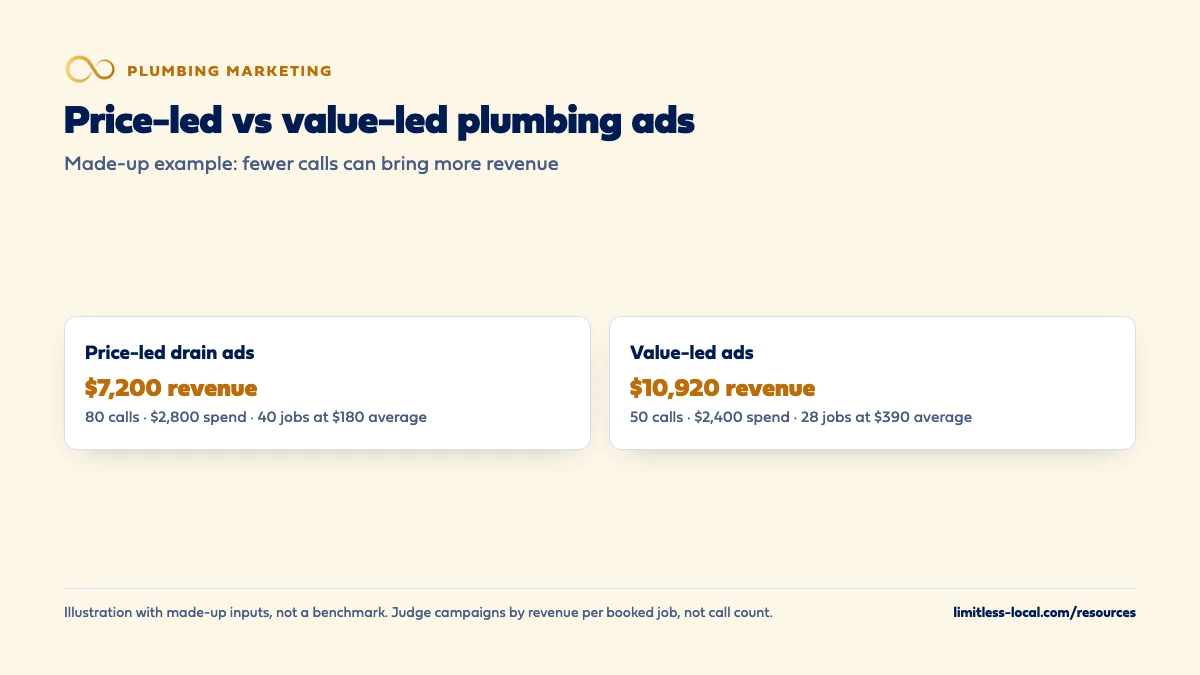
These numbers are made up to show the math, not a benchmark for your market. Say a price-led drain cleaning campaign brings 80 calls in a month at $35 each, or $2,800. Half of them book, so 40 jobs, at an average ticket of $180: $7,200 in revenue, and $70 per booked job.
Now say you cut the price-first searches and change the ads to lead with speed, reviews and upfront pricing. You get 50 calls at $48 each, or $2,400. Twenty-eight book, at an average ticket of $390: $10,920 in revenue, and about $86 per booked job.
The second campaign costs more per booked job and brings fewer calls, and it’s still better: less ad spend, more revenue and fewer trucks tied up on low tickets. That’s why revenue per booked job is the number to watch.
Frequently asked questions
Will cutting price-first searches lower my call volume?
Probably, at first. Google warns that tightening Local Services Ads settings can reduce your leads, and the same logic applies to negative keywords. Judge the change by booked revenue over a few weeks, not by the first week’s call count.
Should I post my prices online?
Post the ones that don’t change much, such as a service fee or a membership price, with what’s included. For bigger jobs, explain how you price and that the homeowner gets written options before work starts.
Is "free estimate" a bad thing to advertise?
Not always. For water heaters and repipes it can be fair to offer, but in our judgement it also draws quote collectors. If it’s filling your schedule with estimates that don’t close, try a credited service fee instead and compare close rates.
Do shared leads attract more price shoppers?
In our judgement, yes. When the same homeowner is sent to several plumbers at once, comparing quotes is built into the setup, so expect more price shopping and judge those leads by booked revenue.
Can I ask happy customers to mention price in their reviews?
No. Ask every customer for a review the same way and never suggest what they should write. Let the reviews say what they say.
Key takeaways
- Most price shoppers come from what you bid on and what your ads lead with.
- Use negative keywords and the search terms report to stop paying for “cheap” and DIY searches.
- Set Local Services Ads job types and service areas to the work you want; Google no longer credits leads outside them.
- Explain how you price and answer price questions straight, so the number isn’t the only thing to compare.
- Judge every change by revenue per booked job, not call count.
Want a second set of eyes on your setup?
We'll look at how you show up locally and where calls are leaking, then send you a plain-English breakdown.
More in this section
- How should a plumbing company market to commercial customers?
- How do I make my plumbing company look trustworthy online?
- How do I market water softeners and filtration as a plumber?
- How do I build city pages for my plumbing company without spam?
- How do I get more plumbing leads?
Sources
- About negative keywords — Google Ads Help
- About the search terms report — Google Ads Help
- About Automated Local Services Ads lead credits — Google Local Services Help
- Manage your services on your Business Profile — Google Business Profile Help
- How Online Reviews Influence Sales — Northwestern Medill Spiegel Research Center
- Quotes Report — Jobber Help Center