
Can I use AI to write electrical website content without hurting SEO?

- How can an electrician use ChatGPT or other AI tools for website pages without thin, generic copy?
- What does Google actually say about AI-written content?
- What kind of AI content gets a site in trouble?
- Where does AI genuinely help an electrician write web content?
- How do I make an AI draft sound like my shop and not a template?
- Can I trust AI on electrical codes, permits and safety?
- Do I need to say a page was written with AI?
- Will AI-written pages help me show up in AI search answers?
- What's a safe workflow for writing service pages with AI?
- What's different about AI content for electricians
- A worked example: where the time goes
- Frequently asked questions
- Key takeaways
- More in this section
- Sources
The short version
- Google judges the quality of a page, not whether AI helped write it.
- Mass-producing pages with AI that add nothing for readers is against Google's spam policies.
- Use AI for outlines and first drafts; add your own job details, area knowledge and photos.
- Check every code, permit, safety and pricing claim yourself; AI tools can be confidently wrong.
For electrical contractor owners who want to use AI tools to draft service pages and posts, and need to know what Google actually says about AI content and how to keep the pages useful, accurate and their own.
Get a free visibility audit · Book a growth call
How can an electrician use ChatGPT or other AI tools for website pages without thin, generic copy?
Yes. Google says appropriate use of AI is not against its guidelines, and that it rewards helpful, original content however it’s produced. What hurts is using AI to churn out many pages that add nothing, which Google’s spam policies call scaled content abuse. Use AI as a drafting aid, then add what only your shop knows: your service area, the work you actually do, real job details and photos, and fact-check every code, permit or safety claim before you publish.
That’s how we approach a website for any local trade: a page for each kind of work, written around how that shop actually does it, with real photos and details a template can’t supply, and call and form tracking so you can see which pages bring in work. Our website design page shows how a build works and what it costs, our electrical contractor marketing page shows how the site fits with search, ads and reviews, and the electrical marketing questions library covers the rest.
What does Google actually say about AI-written content?
Google’s position is clearer than most owners expect. In a 2023 post on AI-generated content, which its current helpful-content guidance still links to, Google says its ranking systems aim to reward original, high-quality content that shows expertise, experience, authoritativeness and trustworthiness, and that it focuses on the quality of content rather than how it’s produced. It says appropriate use of AI or automation is not against its guidelines, and that AI can serve as a critical tool to help people create great content (Google Search Central Blog).
The same post draws the line: using automation, including AI, to generate content with the primary purpose of manipulating search rankings violates its spam policies. And it says plainly that using AI doesn’t give content any special gains. So AI is neither a penalty nor a shortcut. The page still has to be worth reading.
What kind of AI content gets a site in trouble?
Google’s spam policies describe scaled content abuse: many pages generated mainly to manipulate rankings rather than help people, typically large amounts of unoriginal content that provides little to no value, no matter how it’s created. Its examples include using generative AI tools to generate many pages without adding value for users, and stitching together content from different pages without adding value (Google Search Central).
For an electrician, in our judgement, the risky patterns look like this:
- Dozens of city pages that are the same AI text with the town name swapped.
- A blog with a new AI post every day on general topics like “how electricity works” that has nothing to do with your services.
- Service pages rewritten from a competitor’s site by an AI tool.
The city page trap is the most common. How many location pages make sense, and what makes each one worth having, is covered in how many city pages an electrician’s website should have.
Where does AI genuinely help an electrician write web content?
In our judgement, AI tools save the most time on the parts of writing that slow owners down, not on the parts that make a page valuable:
- Outlines. Ask for the questions a homeowner has about an EV charger install or a panel upgrade, then pick the ones your customers actually ask.
- First drafts from your notes. Talk through how you handle a job, paste your rough notes in, and ask for a draft in plain language.
- Tightening. Shortening a long paragraph, fixing grammar, or making a technical explanation readable for a homeowner.
- FAQ wording from real questions your office hears on the phone.
- Meta descriptions and headings, which you then check against what the page really says.
What AI can’t supply is what makes your page different from every other electrician’s: your process, your service area, your photos, and your judgement about the houses you work in.
How do I make an AI draft sound like my shop and not a template?
Add what only you know. Google’s helpful content guidance asks whether content provides original information, whether it offers substantial value compared with other pages in search results, and whether it clearly shows first-hand expertise, such as from having actually used a product or service (Google Search Central). For an electrician, first-hand expertise looks like:
- How you actually do the job: what happens on the first visit, how you quote, how long a typical install takes, what you check before you start.
- Local detail: the age and type of homes you see most, common problems in your area, how permits and inspections usually go with the towns you serve, in general terms.
- Real examples: a short description of a recent job (with the customer’s permission and no address), and your own photos.
- Your voice: the way you’d explain it to a homeowner standing in their garage.
In our judgement, if you could swap your company name for a competitor’s and the page would still be true, it needs more of you in it. The structure each service page should follow is in which service pages an electrical contractor’s website needs.
Curious what your marketing is actually booking?
Get a free visibility audit — no obligation, no sales pitch.
Can I trust AI on electrical codes, permits and safety?
Not without checking. OpenAI’s own help center says ChatGPT can produce incorrect or misleading outputs, sometimes sounding confident even when it’s wrong, and that it can fabricate quotes, studies and references to sources that don’t exist. It encourages users to verify important information from reliable sources (OpenAI Help Center).
That matters more on an electrician’s site than most. Code requirements, permit rules and licensing vary by state and town, and change over time. An AI tool may state a rule from the wrong jurisdiction, an outdated code cycle, or one it simply made up. In our judgement:
- Don’t let AI state code sections, permit requirements or licensing rules on your site unless you’ve checked them against your local authority yourself.
- Keep safety advice for homeowners general and conservative: when to call a licensed electrician, not how to do it themselves.
- Never publish a price, rebate, tax credit or utility program an AI tool mentions without confirming it from the official source.
Google also notes that on topics where information quality is critically important, such as health and financial information, its systems place an even greater emphasis on signals of reliability (Google Search Central Blog). Safety content deserves the same care.
Do I need to say a page was written with AI?
Google’s helpful content guidance suggests asking “Who, How, and Why” about your content. On the How, it says that if automation is used to substantially generate content, it’s worth asking whether that’s self-evident to visitors through disclosures or other ways, and that AI disclosures are useful for content where someone might reasonably wonder how it was made. It also warns against using AI-generated headshots, made-up names or false credentials to make content seem written by someone it wasn’t (Google Search Central).
In our judgement, a service page you used AI to draft, then rewrote with your own process and checked yourself, is your page. What you must never do is invent an author, a license, a review or a credential to make AI text look more trustworthy. If a page lists an author, it should be a real person at your company.
Will AI-written pages help me show up in AI search answers?
Not by themselves. Google says using AI doesn’t give content any special gains, and the same applies in reverse: AI tools that summarize the web draw on pages that are clear, accurate and specific, however they were written. A generic page reads like hundreds of others and gives an AI answer nothing distinctive to cite.
In our judgement, the pages most likely to help are the ones built from real detail: what you do, where, how, and for whom. Being cited in AI answers is its own topic, covered in showing up in AI search answers.
What's a safe workflow for writing service pages with AI?
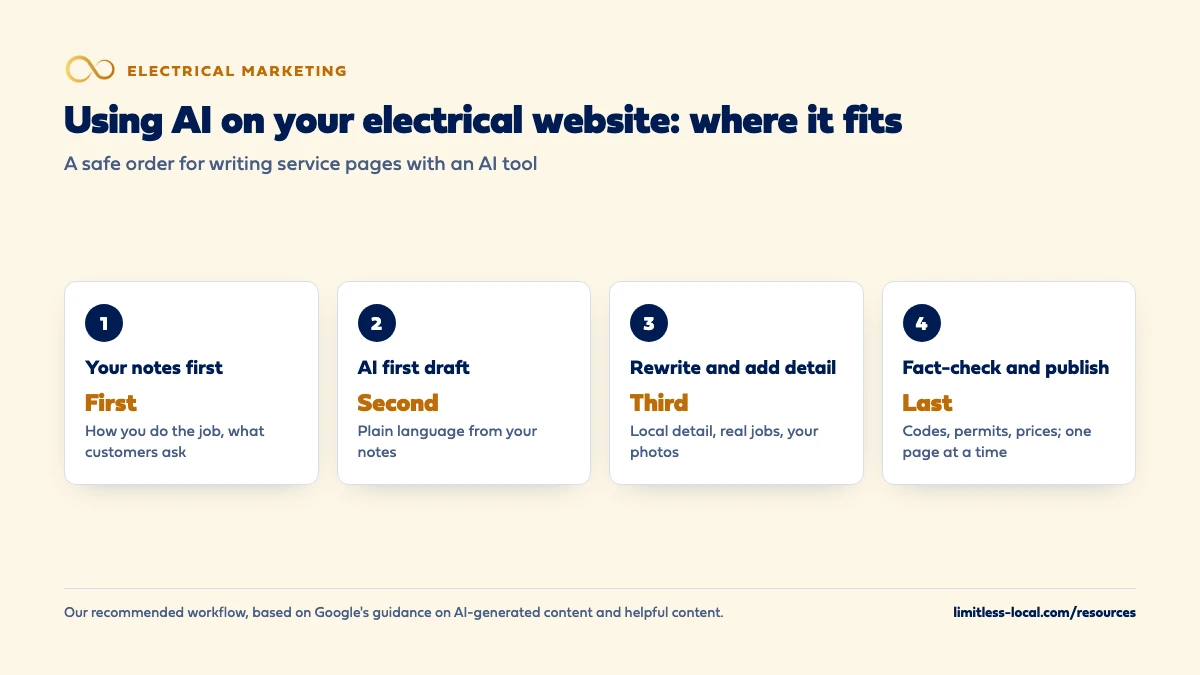
In our judgement, this order keeps the speed of AI without the risks:
- Start with your notes, not a blank prompt. Spend ten minutes writing or dictating how you handle the job and what customers ask.
- Ask AI for a draft from those notes, in plain language for a homeowner.
- Rewrite it in your words, adding local detail, real examples and anything the draft got generic.
- Fact-check every specific claim: codes, permits, prices, rebates, timelines.
- Add your own photos of real work.
- Have someone who knows the work read it, ideally a licensed electrician on your team.
- Publish one page at a time, not fifty at once.
If your site has bigger problems, such as slow pages, no clear phone number or missing service pages, fix those first; what to fix on your website before investing in SEO covers the order.
What's different about AI content for electricians
Mistakes can be safety problems, not just embarrassing. A wrong claim about what a homeowner can safely do, or which work needs a permit, reflects on your license. That raises the bar for fact-checking above most trades.
Your work is local and specific. The same EV charger install can differ in panel capacity, distance, permits and utility requirements from one house and one town to the next. Generic AI copy flattens exactly the details that make a homeowner trust you knows their kind of house.
Licensing is part of your content. Homeowners compare licensed electricians with handymen. Your license, the work you’re licensed for, and how you handle permits and inspections are details AI can’t invent and shouldn’t try to.
Not sure which of these is costing you jobs?
A free visibility audit checks the Google profile, reviews, site and tracking, and shows what to fix first.
A worked example: where the time goes
These numbers are made up to show the math, not a benchmark. Say you need 12 service pages for a new site. Written from scratch, each takes you about 4 hours, or 48 hours in all.
With an AI draft built from your notes, each page takes about 30 minutes of notes and drafting plus 90 minutes of rewriting, fact-checking and adding photos: 2 hours a page, or 24 hours in all. You save roughly half the time, and every page still carries your process, your area and your photos.
The shortcut that doesn’t work: generating all 12 pages in an afternoon and publishing them unedited. That saves more time on paper, but the pages read like everyone else’s, and any wrong code or permit claim is now on your site under your name. If you’d rather have it built for you, our themed website is $3,750, or $3,000 with any of our marketing packages, with up to 25 pages.
Frequently asked questions
Can Google tell if my content was written by AI?
Google says it focuses on the quality of content rather than how it’s produced, and that its spam systems look for spam however it’s made. The question to worry about is whether the page is useful, not whether it can be detected.
Is it OK to use AI for my blog posts?
Yes, on the same terms as service pages: start from your own knowledge, add real detail, and check facts. In our judgement, a few useful posts on questions your customers ask beat a daily stream of generic ones.
Can I use AI to rewrite a competitor's page?
No. Google’s spam policies list stitching or transforming other sites’ content without adding value as scaled content abuse, and it’s their work, not yours.
Should I use AI-generated images on my site?
In our judgement, real photos of your own work build more trust than generated images. Never use AI-generated headshots or invented team members; Google’s guidance warns against that kind of misleading content.
Which AI tool is best for writing electrical content?
The tool matters less than the process. Any mainstream assistant can draft from your notes; the value comes from your rewriting and fact-checking.
Key takeaways
- Google rewards helpful, original content however it’s produced, and says appropriate AI use isn’t against its guidelines.
- Mass-producing pages with AI that add nothing is scaled content abuse under Google’s spam policies.
- Use AI for outlines, drafts and tightening; add your own process, local detail and photos.
- Fact-check every code, permit, safety, price and rebate claim; AI tools can be confidently wrong.
- Never invent authors, credentials or reviews to make AI text look trustworthy.
Want a second set of eyes on your setup?
We'll look at how you show up locally and where calls are leaking, then send you a plain-English breakdown.
More in this section
- What should I fix on my electrical website before investing in SEO?
- Which keywords should my electrical website target to rank on Google?
- How do I show up in AI search answers for my electrical business?
- Should my electrical company start with LSAs, Google Ads or SEO?
- Should my electrical company run Google Ads and LSAs at the same time?
Sources
- Google Search's guidance about AI-generated content — Google Search Central Blog
- Spam Policies for Google Web Search — Google Search Central
- Creating Helpful, Reliable, People-First Content — Google Search Central
- Does ChatGPT tell the truth? — OpenAI Help Center