
What should a roofer do about an unfair Google review?
- How should a roofing company handle a Google review it thinks is unfair?
- What counts as an unfair Google review for a roofer?
- Which unfair reviews can Google actually remove?
- What if the reviewer only got an estimate and never hired me?
- What if the review is really about an insurance claim?
- What about neighbors and door-knocking complaints?
- How do I report a review that breaks Google's rules?
- How should a roofer reply to an unfair review?
- Can I ask the homeowner to change or remove the review?
- What if someone demands money to take bad reviews down?
- How much does one unfair review hurt a roofing company?
- What should a roofer never do about an unfair review?
- What's different about unfair reviews for roofers
- A worked example: one unfair review on a small and a large profile
- Frequently asked questions
- Key takeaways
- More in this section
- Sources
The short version
- Google removes reviews that break its policies, not reviews you disagree with.
- Report fake, competitor, ex-employee, off-topic and personal-information reviews; reply to the rest.
- Keep replies short, factual and private about the job and any insurance claim.
- Never offer money, discounts or free work to get a review changed or removed.
For roofing company owners staring at a one-star review they think is wrong, and deciding whether to report it, reply to it or both.
Get a free visibility audit · Book a growth call
How should a roofing company handle a Google review it thinks is unfair?
First decide whether the review is unfair or actually against Google’s rules, because Google only removes reviews that break its policies, such as fake reviews, reviews from competitors or former employees, off-topic rants and posts with someone’s personal information. If it breaks a policy, report it from your Business Profile and reply briefly while Google reviews it. If it’s a real homeowner describing a real experience you see differently, it will stay, so write a short, calm reply that states the facts without arguing or sharing private details. Never offer anything in exchange for changing or removing it.
Replying to reviews and asking every customer for one are part of the Google profile work in our local SEO service, and review response comes with every roofing marketing package. For where reviews fit among the channels that book roofing jobs, see the roofing marketing guide; the rest of the roofing marketing questions library goes question by question.
What counts as an unfair Google review for a roofer?
Two different things get called unfair, and they need different handling:
- Unfair but allowed. A real homeowner, or someone who really dealt with your company, describing that experience in a way you think is wrong, one-sided or harsh. Google says negative reviews aren’t always a sign of poor service, and it doesn’t get involved in conflicts between businesses and customers (Google Business Profile Help). These stay up, and your reply is where you deal with them.
- Against Google’s rules. Reviews that aren’t based on a real experience, come from someone with a conflict of interest, or contain content Google prohibits. These are the only ones Google will take down, and only after you report them.
Sorting it first keeps you from arguing in public with a real customer, or waiting on a report Google was never going to act on.
Which unfair reviews can Google actually remove?
Google’s Maps content policy says a review or rating should reflect an actual experience with a business and be genuine and unbiased, and it lists the kinds of content it removes. The categories that most often fit a roofing profile:
- Not a real experience. Content that isn’t based on a real experience or doesn’t accurately represent the business, or that was posted from several accounts by one person. A review that is plainly about a different roofer, such as an out-of-town crew with a similar name, may fit here.
- Conflict of interest. Google’s policy says this can include current or former employment, a contractual relationship, or industry competitors. A review from a crew member you let go, a sub you stopped using or a competing roofer qualifies.
- Unsupported accusations. Google’s offensive-content policy covers unsubstantiated allegations of unethical behavior or criminal wrongdoing, while allowing negative experiences described in a respectful manner. “Scam artist who stole my money” with nothing behind it is a candidate; “the crew left nails in my driveway” is not.
- Personal information and harassment. Threats, or someone’s personal details posted without consent. Google does allow the name of a contractor doing business under that name, so the owner’s name in a review isn’t a violation by itself.
All of this comes from Google’s prohibited and restricted content policy. Google makes the call, not you, and a review that just says your price was too high or your crew was slow is describing an experience. That one stays.
What if the reviewer only got an estimate and never hired me?
That’s still a real experience with your business, so in our judgement it’s very unlikely to come down. A homeowner who had you on the roof for an inspection, didn’t like the price or the diagnosis, and went with someone else is allowed to say so.
Treat it as a reply opportunity. Thank them for having you out, state plainly what the inspection found, and invite them to call. Other homeowners reading it are deciding whether to trust your inspections.
If the complaint is that nobody called them back or the estimate took too long, it may be fair even if it stings. That’s a process problem worth fixing; how fast to call back a new lead and following up on unsigned estimates cover both ends.
What if the review is really about an insurance claim?
Some of the harshest roofing reviews come from homeowners upset about their claim: it was denied, it paid less than they expected, or the job stalled waiting on approval. To the homeowner, the roofer is the face of the whole process.
Google’s tips for replying to negative reviews fit this case closely. Be honest and explain limitations: acknowledge any mistakes that were yours, but don’t take responsibility for things outside your control, and explain what you can and cannot do. Protect privacy: never share a reviewer’s private information, and if the situation is complex, ask them to call or email so you can sort it out privately (Google Business Profile Help).
For a roofer that means no claim numbers, no policy details, no dollar amounts and nothing about what the adjuster said in your reply. A line such as “Coverage decisions are made by the insurance company, not by us; we’re glad to walk you through what we documented on your roof” states the limit without blaming anyone. That wording is our suggestion, and how a claim is handled is between the homeowner and their insurer.
What about neighbors and door-knocking complaints?
Roofing jobs are loud and messy for a few days, and neighbors notice. Canvassing after a storm can also draw reviews from homeowners who didn’t want the knock.
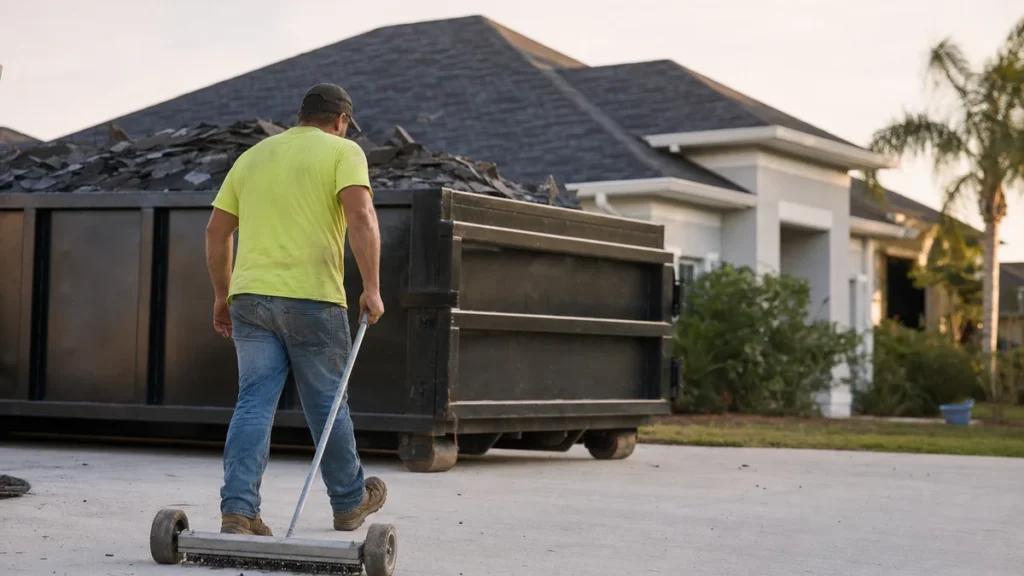
In our judgement, most of these describe something that really happened, so they’re likely to stay. The useful response is a short reply that acknowledges the problem and says what you changed, such as running a magnet sweep along the street as well as the customer’s yard. If the same complaint keeps coming up, it’s a job-site or canvassing practice to fix. How canvassing compares with online lead sources is covered in door knocking versus online marketing.
Curious what your marketing is actually booking?
Get a free visibility audit — no obligation, no sales pitch.
How do I report a review that breaks Google's rules?
- Go to your Business Profile and select Read reviews.
- Next to the review, select Report, pick the reason that fits (Google’s examples are “Spam” and “Profanity”) and send the report.
- Check the status in Google’s Reviews Management Tool. It will show Decision pending, Report reviewed – no policy violation, or Escalated once you appeal.
- If Google finds no violation and you disagree, you can submit a one-time appeal through the same tool.
Google says evaluation typically takes several days, and asks owners not to report a review just because they disagree with it or dislike it (Google Business Profile Help). Save the appeal for a case where you have something new, such as no record of the reviewer as a customer or proof that the reviewer works for a competitor.
How should a roofer reply to an unfair review?
Once, briefly and after you’ve cooled off. Google’s reply tips are to be professional and polite, keep it short and simple, apologize when it’s appropriate, and personalize the reply to the reviewer’s specific feedback (Google Business Profile Help). Google also checks replies against its content policies before they’re posted, and the reviewer is notified when you reply (Google Business Profile Help).
The FTC adds hard lines. You can respond publicly to a negative review, but you shouldn’t make an accusation about the reviewer that you know is false (or make it with reckless disregard for whether it’s true), use threats or intimidation to get the review changed or removed, or make a legal threat with no legitimate basis (FTC). This is a summary of the FTC’s guidance, not legal advice; for a specific dispute, talk to a lawyer.
In practice, a reply to a review you believe is fake can be as simple as “We can’t find a record of a job at this address. Please call our office so we can look into it.” A reply to a real but unfair review can thank them, state one or two facts about the job, and offer a phone call. Both are our suggested wording.
Can I ask the homeowner to change or remove the review?
You can contact them and try to fix the problem. The FTC says its review rule doesn’t stop a business from contacting customers who post negative reviews to resolve the issue (FTC), and Google says constructive replies and following up on concerns may even encourage a customer to update their review (Google Business Profile Help).
What you can’t do is attach anything to the change. Google doesn’t allow offering incentives, such as payment, discounts or free goods or services, in exchange for revising or removing a negative review (Google Maps content policy), and the FTC says paying customers to change or remove truthful negative reviews may violate the FTC Act. For a roofer, in our judgement, that also means never making a repair, a warranty document or anything else the homeowner is owed depend on the review. Fix the leak because it’s yours to fix, and let the homeowner decide on their own whether to update what they wrote.

What if someone demands money to take bad reviews down?
That’s extortion, and Google treats it as a serious policy violation. It says these scams may involve a sudden increase in 1-star and 2-star reviews followed by someone demanding money, goods or services to remove them. Google’s instructions: don’t engage with or pay the people involved, don’t try to resolve it yourself by offering money or services, gather evidence immediately, and report it through Google’s merchant extortion report form (Google Business Profile Help).
Google asks for screenshots of every demand showing the date, time and sender, plus links to each suspicious review. That channel is only for an actual demand; a single unfair review goes through the normal report.
How much does one unfair review hurt a roofing company?
Less than it feels like, and more on a small profile. Your Google review score is the average of all ratings published on Google, and after a new review it may take up to 2 weeks for the score to update (Google Business Profile Help). One low rating among many good ones barely moves the average; the same rating on a thin profile moves it a lot, as the worked example below shows.
Reviews also matter for where you show up. Google says more reviews and positive ratings can help your local ranking (Google Business Profile Help), though it doesn’t publish how much any single review matters. If your profile isn’t showing up at all, the cause is usually bigger than one review; why a roofing company isn’t showing up on Maps walks through the usual reasons. The lasting fix for one unfair review is a steady flow of honest ones, which is what getting more reviews after a roof replacement covers.
What should a roofer never do about an unfair review?
- Buy reviews or pay a service that promises five-stars to bury it. Paid reviews are fake engagement under Google’s policy.
- Have the crew, family or friends post reviews. Google’s policy treats employment and family relationships as a conflict of interest.
- Send the review link only to happy customers. Google doesn’t allow businesses to selectively ask for positive reviews or discourage negative ones.
- Pay or offer free work for a deletion. It breaks Google’s incentive rule and, per the FTC, may violate federal law.
- Return fire on a competitor’s profile. Google’s policy specifically prohibits posting on a competitor’s business to undermine its reputation.
- Argue, accuse or threaten in the reply. It reads badly to the next homeowner and runs into the FTC’s lines on false accusations and intimidation.
Want to see where your company stands?
A free visibility audit shows where you show up on Google, Maps and AI answers, and what it's costing you in calls.
What's different about unfair reviews for roofers
Thin profiles. A roofer selling replacements finishes far fewer jobs in a year than a plumber or HVAC shop running service calls, so there are fewer customers to review you, and each rating weighs more. That’s why one unfair review hurts a roofer more than it would a busy service company, and why asking every customer matters more.
More people meet you than hire you. Inspections, estimates and door knocks put you in front of many homeowners who never sign, and each of them can leave a review based on that real experience. In our judgement, the way you run inspections and estimates shows up in your reviews as much as the roofs you install.
Storm crews and name confusion. After a big storm, out-of-town crews work the same neighborhoods. A homeowner burned by one of them may leave the review on the wrong local company. That’s one of the clearer cases for a report, plus a short reply saying you have no record of the job.
A worked example: one unfair review on a small and a large profile
These numbers are made up to show the math, not a benchmark. Two roofing companies each have a 4.8 average, and each gets one unfair 1-star review.
- Company A has 12 reviews. Add the 1-star and the new average is (12 × 4.8 + 1) ÷ 13, about 4.5.
- Company B has 60 reviews. Add the 1-star and the new average is (60 × 4.8 + 1) ÷ 61, about 4.7.
Same review, very different damage. To get back to 4.8, Company B needs about 19 new five-star reviews. If Google removes the review because it breaks a policy, the problem goes away; if it doesn’t, new honest reviews are the only lasting fix.
Review response and basic review generation are part of our Essentials package at $3,500 a month, alongside Google Business Profile management. Whether that’s the right spend for you depends on what your profile is costing you in calls today, which is what a free visibility audit is for.

Frequently asked questions
Can I delete an unfair Google review myself?
No. You can reply to it and report it, but Google decides what comes down, and only reviews that violate its policies are eligible for removal. The reviewer can still change their review after reading your reply.
How long does Google take to decide on a reported review?
Google says review evaluation typically takes several days. You can check the status of each report in the Reviews Management Tool.
Should I reply to a review I've already reported?
In our judgement, yes: a short, neutral reply means homeowners reading it in the meantime see your side. You can edit or delete your reply later from your Business Profile.
Does the reviewer find out when I reply?
Yes. Google notifies them, and if they then change their review, its date updates to show the edit.
Can I take legal action over a false review?
That’s a question for a lawyer, not a marketing page. The FTC says a business can threaten legal action only with a legitimate basis, and can’t use unfounded or groundless legal threats to get a review removed.
Key takeaways
- Google removes reviews that break its policies, not ones you think are unfair.
- Fake, wrong-company, competitor, ex-employee, unsupported-accusation and personal-information reviews are worth reporting.
- Reviews from estimate-only homeowners, neighbors and unhappy claimants usually stay, so reply calmly and keep claim details private.
- Never trade money, discounts, free work or warranty items for a changed or removed review.
- One review weighs more on a small profile, so a steady flow of honest reviews is the lasting fix.
Not sure what's working right now?
Start with a free visibility audit: rankings, Google profile, reviews and tracking, checked against your service area.
More in this section
- How do I get more Google reviews after a roof replacement?
- Why isn't my roofing company showing up on Google Maps?
- How should a roofing company follow up on unsigned estimates?
- How does a roofing company get recommended by ChatGPT?
- Are Google Local Services Ads worth it for a roofing company?
Sources
- Report inappropriate reviews on your Business Profile — Google Business Profile Help
- Prohibited & restricted content — Maps User Generated Content Policy Help
- Tips to improve your local ranking on Google — Google Business Profile Help
- Tips to get more reviews — Google Business Profile Help
- Manage customer reviews — Google Business Profile Help
- Report negative review extortion scams on your Business Profile — Google Business Profile Help
- The Consumer Reviews and Testimonials Rule: Questions and Answers — Federal Trade Commission
- Understand review scores for local places & businesses — Google Business Profile Help