
When can a roofer stop relying on door knocking and referrals?
- How do I know my online leads are steady enough to cut back on canvassing?
- What's the problem with relying on door knocking and referrals?
- What signs say online leads can start carrying the load?
- How do I track where my signed roofs actually come from?
- How many jobs should come from online before I cut back on canvassing?
- Why shouldn't I judge this during storm season?
- How should a roofer cut back on door knocking without a gap?
- Should a roofer ever stop door knocking completely?
- What happens to referrals once online leads are steady?
- What has to be in place online before you pull back?
- How long does it usually take to get there?
- What's different about this decision for roofers
- A worked example: checking the threshold
- Frequently asked questions
- Key takeaways
- More in this section
- Sources
The short version
- Tag every lead by source first; without that, you're guessing.
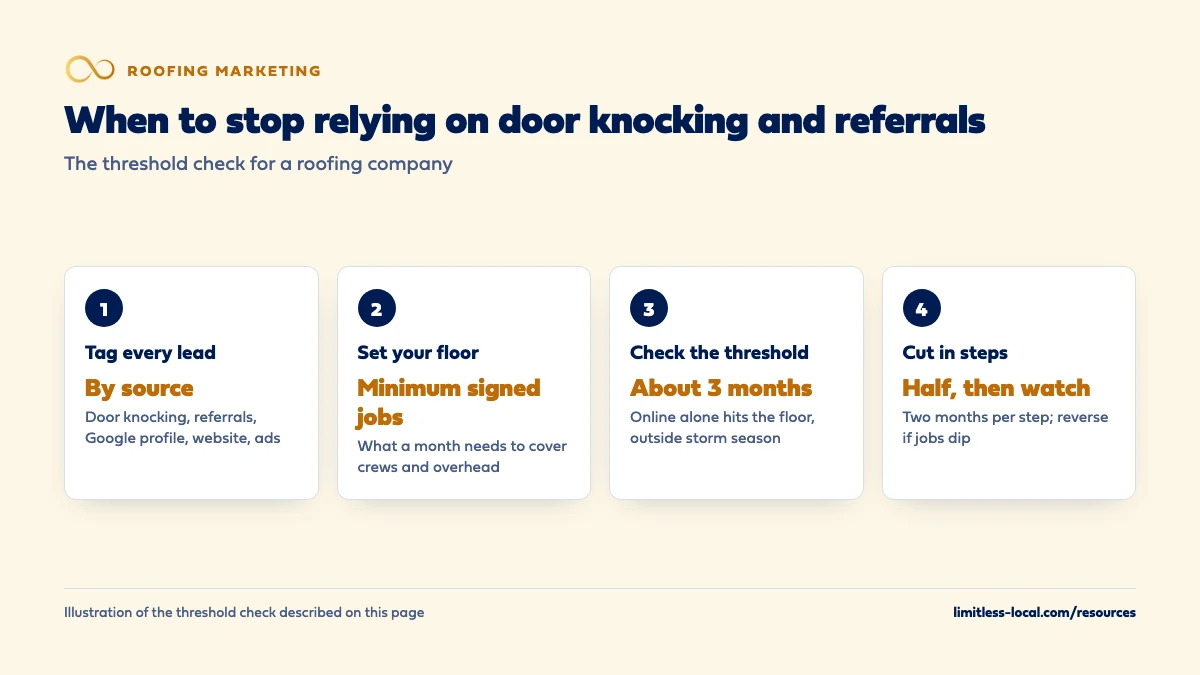
- The threshold: online sources alone cover your minimum signed jobs for about three straight non-storm months.
- Cut canvassing in steps and watch two months before cutting again.
- Keep asking for referrals; just stop depending on them.
For roofing owners whose crews are still fed by canvassing and word of mouth, and who want to know when online leads can take over.
Get a free visibility audit · Book a growth call
How do I know my online leads are steady enough to cut back on canvassing?
A roofer can stop relying on door knocking and referrals once online leads alone would have hit your minimum signed-job goal for about three months in a row outside storm season, at a cost per signed job you’re comfortable with, and you can prove it because every lead is tagged by source. Until then, keep canvassing and step it down gradually instead of all at once. Keep asking for referrals for good; the aim is for them to be a bonus on top of steady online leads, not the only thing keeping crews busy.
Building the online side to the point where it can carry the schedule is what our Limitless Engine packages are for: first the foundation (tracking, follow-up and a clean online presence), then lead flow from local SEO and ads aimed at the towns and jobs you want, then monthly improvement based on calls, leads and revenue. See how that works for roofers on our roofing marketing page. The guide to getting roofing leads compares every source side by side, and the roofing marketing questions library goes one question at a time.
What's the problem with relying on door knocking and referrals?
Nothing, as long as they keep coming. Canvassing can turn one job into a street full of inspections, and referred homeowners arrive already trusting you. Plenty of roofing companies were built on exactly those two.
The trouble is that both depend on things you don’t control:
- Door knocking stops when the knocking stops. A rep quits, the weather turns, or you pull people onto crews, and the pipeline dries up within weeks.
- Referrals come when they come. You can’t turn them up in a slow month.
- Neither scales cleanly. More canvassing means hiring and managing more reps. More referrals means more past customers, which takes years.
- Both miss the homeowner who’s already searching. Someone with a leak tonight isn’t waiting for a knock.
That’s why the question isn’t whether door knocking or referrals are good. It’s whether your business would survive a quiet month without them. Whether door knocking or online marketing is better for a roofing company covers the trade-offs, and the rules some states put on door-to-door roofers.
What signs say online leads can start carrying the load?
Look for all of these before you pull back:
- You’ve tagged every lead by source for at least a few months. If you can’t say which signed jobs came from Google, ads, canvassing and referrals, you can’t make this call yet.
- Online sources alone would have covered your minimum. Take the fewest signed jobs a month you need to cover payroll and overhead. Online leads should have hit that on their own, for about three straight months.
- Those months weren’t storm months. A hailstorm makes every channel look great.
- Cost per signed job is steady. Not swinging wildly from month to month.
- Calls from your Google profile are trending up, not just holding.
- Someone answers the phone. Online leads only turn into jobs if they’re called back fast.
If most of these hold, you’re close. If two or three don’t, the online side needs more time or a fix first. The signs your roofing marketing is about to get consistent goes deeper on what steady looks like in the numbers.
How do I track where my signed roofs actually come from?
The whole decision rests on this, so set it up before anything else:
- Ask on every first call how the homeowner found you, and record it.
- Give door knocking and referrals their own sources, and split online into Google profile, website, Google Ads and Local Services Ads if you can.
- Record it in your job software, not on paper. Housecall Pro’s lead source field lets you track where customers found you on customers, jobs and estimates. Jobber’s lead source report shows, for each source, how many leads got a quote, a job and an invoice, and the value of the first invoice.
- Follow each lead to the end: inspection, estimate, signed contract.
After a few months you’ll have the only numbers that matter here: signed jobs and revenue by source. How to track which roofing leads turn into signed jobs walks through the setup in more detail.
How many jobs should come from online before I cut back on canvassing?
There’s no industry percentage that fits every roofer, so use your own floor instead. Work out the minimum number of signed jobs a month that keeps your crews working and your bills paid. That’s your floor.
The threshold is simple: when online sources alone hit your floor for about three straight months outside storm season, you can start cutting back. Canvassing and referrals then become growth on top of a base, not the base itself.
Below that, think in terms of the gap. If online covers half your floor, you still need canvassing and referrals to fill the other half, and the move is to keep both while you build the online side. If you’re not sure what your floor translates to in leads, how many roofing leads a month you need to hit your job goal works backward from signed jobs to leads.
Curious what your marketing is actually booking?
Get a free visibility audit — no obligation, no sales pitch.
Why shouldn't I judge this during storm season?
Because storms lift everything at once. After hail or high wind, searches jump, profile calls jump, canvassers find damage on every street, and referrals pick up. Online leads can look strong enough to replace canvassing for a few weeks, then fall back when the storm work is done.
Judge on ordinary months. Where you have history, compare each month with the same month last year, so seasonal swings don’t fool you. Your Google Business Profile performance report shows calls and website clicks over any date range you pick, and Search Console’s performance report shows how often your site appeared and was clicked in search over time. Both make it easy to see whether the trend holds once the storm calls fade.
How should a roofer cut back on door knocking without a gap?
In steps, with a way back:
- Cut by about half first. If reps knock four days a week, drop to two. Keep the best areas and the best people.
- Keep the knocking that works best. Neighbors around jobs you’re working on right now, and streets hit by a recent storm.
- Watch two full months. Did signed jobs from all sources stay above your floor?
- Cut again, or reverse. If signed jobs held, cut further. If they dipped, put the days back and give the online side more time.
Move people, not just hours. A good canvasser often makes a good inspector or a strong follow-up caller for online leads, and keeping them means you keep their skill if you need to ramp canvassing back up.
Should a roofer ever stop door knocking completely?
Not necessarily. A small, targeted version is worth keeping for good, because some of it is cheap and effective:
- Job-site canvassing. A crew on a roof is the best ad on the street. Knocking on the neighbors’ doors while you’re there costs little.
- After local storms, where your state and town rules allow it.
- New neighborhoods you want to break into, as a short push.
What changes is the role. Door knocking goes from the thing the business depends on to a tool you pull out when it makes sense. That’s the real goal of this whole question.

What happens to referrals once online leads are steady?
Keep them, and make them more reliable. Referrals usually close well because the homeowner already trusts you, so they’re worth keeping even when you don’t need them to survive.
Make it a habit instead of luck:
- Ask at the end of every job, when the homeowner is happiest.
- Ask for a Google review in the same conversation. A review keeps working for you online long after the referral.
- Check in with past customers once a year. They know neighbors with older roofs.
- Stay in touch with realtors, home inspectors and other trades who see roofs every week.
The change is in how you think about them: a welcome bonus each month, not a number the schedule depends on.
What has to be in place online before you pull back?
The online side has to be built, not just started:
- A complete, verified Google Business Profile with real photos and the right services and service area.
- A steady flow of new reviews, every month, not a burst.
- A website with a clear page for each service and the towns you want, and an easy way to call or request an estimate.
- Ads running in your target towns, if you use them, with conversion tracking on.
- Fast follow-up. Calls answered, forms called back within minutes.
- Source tracking on every lead.
Fast follow-up is where many roofers lose the online leads they already have. A homeowner who fills out a form may be contacting other roofers too. How fast a roofing company should call back a new lead covers what to aim for.
How long does it usually take to get there?
Longer than most owners hope. Ads can generate leads within days of launch. SEO typically takes 3 to 6 months to show meaningful organic growth. Add a few months of tracked results to confirm the trend, and building an online side that can carry the floor is often a project of most of a year, not a month.
That’s exactly why canvassing and referrals shouldn’t stop while you build. Run them alongside the online work, track all of it, and let the numbers tell you when the balance has shifted.
If online leads are coming in but not signing the way canvassed ones did, that’s a different problem from lead volume. Inbound homeowners often compare several quotes. Whether it’s your marketing or your sales process when roofing leads don’t close helps sort out which one to fix.
Not sure which of these is costing you jobs?
A free visibility audit checks the Google profile, reviews, site and tracking, and shows what to fix first.
What's different about this decision for roofers
Storm work distorts every channel. Roofing demand comes in waves after weather, and door knocking is strongest right after a storm. Make the call on ordinary months, and expect to lean on canvassing again when a storm hits your area.
Replacements are bought on trust. A homeowner spending a large sum on a new roof checks reviews and photos before signing, whether they found you at the door or on Google. Every job your canvassers win is a chance for a review that helps the online side grow.
The job site is your best ad. Unlike most trades, roofers work in full view of the street for days. That’s why targeted job-site canvassing often survives even after online leads take over.
A worked example: checking the threshold
These numbers are made up to show the math, not a benchmark for your market. Say your floor is 6 signed roofs a month. You tag every lead by source, and over three ordinary months online sources sign 4, 5 and then 6 roofs. You’ve hit the floor once, not three times in a row. Keep canvassing at full strength for now.
Three months later, online signs 6, 7 and 7 in non-storm months. That clears the threshold. Now compare cost per signed job: canvassing costs $6,000 a month in rep pay and signs 3 roofs, or $2,000 per signed job; online costs $5,400 a month and signs 7, or about $771 per signed job.
You cut canvassing in half, keep the job-site knocks, and watch two months. If signed jobs stay above 6, you cut again. Our packages start at $3,500 a month for Essentials, and ad spend is paid to Google separately, so run the same math with your own numbers before you decide where the money goes.
Frequently asked questions
Should I stop door knocking as soon as I start online marketing?
No. Ads can bring leads within days, but SEO typically takes 3 to 6 months to show meaningful growth. Keep canvassing while the online side builds, and cut back only once the numbers show online can cover your floor.
Do online leads close as well as referrals?
Often not. A referred homeowner already trusts you, while someone who found you on Google is often comparing several roofers. Track close rates by source so you compare like with like.
Can door knocking and online marketing help each other?
Yes. Homeowners often look a roofer up on Google after a knock, so a strong profile helps canvassers close. And every canvassed job is a chance for a review that helps you online.
What if my canvassers still bring most of my jobs?
Then you’re not at the threshold yet. Keep them going, tag every lead and put more into the online side until it can cover your floor on its own.
Does this apply to commercial roofing work?
The same test works, but commercial jobs come in fewer and larger, so judge over a longer stretch and count signed contracts and revenue rather than lead volume.
Key takeaways
- You can’t make this call without tagging every lead by source first.
- The threshold: online sources alone hit your minimum signed jobs for about three straight months outside storm season.
- Judge on ordinary months; storms make every channel look strong.
- Cut door knocking in steps, watch two months each time, and reverse if signed jobs dip.
- Keep asking for referrals and keep targeted job-site canvassing; just stop depending on them.
Want a second set of eyes on your setup?
We'll look at how you show up locally and where calls are leaking, then send you a plain-English breakdown.
More in this section
- What can a roofer do this month to get more leads without waste?
- Is door knocking or online marketing better for a roofing company?
- What should a roofer expect in the first 90 days of marketing?
- How does a roofer keep up with leads coming in fast?
- How does a roofer get high-intent customers in their local area?
Sources
- Lead Source Report — Jobber Help Center
- How to Use Lead Sources — Housecall Pro Help Center
- Understand your Business Profile performance & insights — Google Business Profile Help
- Performance report (Search results): Overview and basic setup — Search Console Help