
When should a plumber stop doing their own marketing?

- How should a plumbing owner hand off the marketing without losing what works?
- How do I know it's actually time to stop?
- What does stopping my own marketing really mean?
- Which part of my marketing should I hand off first?
- What should stay with me and my office?
- Who should take over my plumbing marketing?
- What should I put together before anyone takes over?
- How do I give access without giving away my accounts?
- What happens to the campaigns I set up myself?
- When is the right time of year to hand off?
- What does my week look like after the hand-off?
- How long until I can tell the hand-off is working?
- What's different about the hand-off for plumbing owners
- A worked example: a staged hand-off
- Frequently asked questions
- Key takeaways
- More in this section
- Sources
The short version
- Step back from the doing, not from the owning.
- Hand off paid ads and tracking first, then SEO and the website.
- Write down today's numbers and gather every login before anyone starts.
- Your job after: a weekly look at booked jobs and the big decisions.
For plumbing owners who’ve decided their own marketing hours are better spent elsewhere, and want to step back without the calls dropping off.
Get a free visibility audit · Book a growth call
How should a plumbing owner hand off the marketing without losing what works?
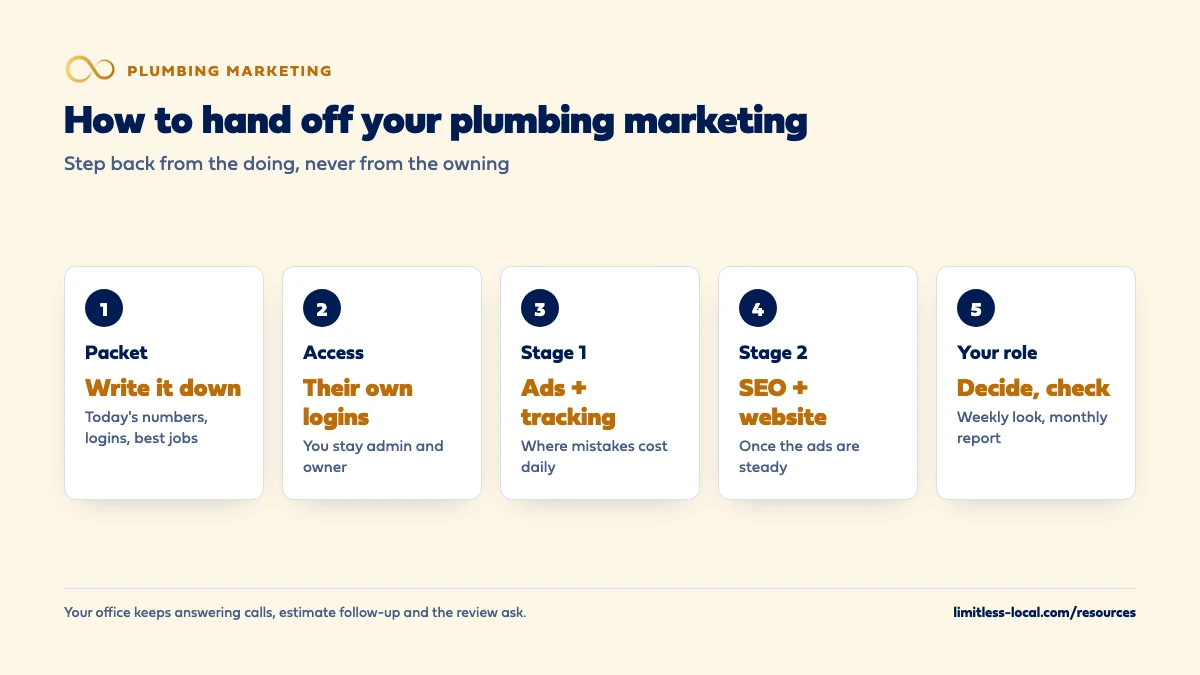
Stop doing the day-to-day work once it keeps slipping or costing you jobs, but never stop owning it. Hand it off in stages: paid ads and call tracking first, because mistakes there cost money every day, then SEO and the website, while your office keeps answering calls, following up on estimates and asking for reviews. Before anyone takes over, write down today’s numbers, gather every login under your company’s name and say what’s already working, then give access without giving away ownership.
When it’s time, our delivery is built so it takes little of your week: onboarding takes your team about 2-3 hours, campaigns go live in weeks 1-2, and after that you get a real-time dashboard and a monthly report with cost per lead by channel. Essentials is $3,500 a month and Growth is $4,500 a month, with ad spend paid directly to Google. We ask for three months and put it in the contract, but if you want out, we won’t make you stay. See the packages and what’s included, how it fits marketing for plumbing companies, or the rest of the plumbing marketing questions library.
How do I know it's actually time to stop?
If marketing keeps getting pushed to Sunday night, if you’re paying for ads without knowing what a booked job costs, or if a new truck needs calls by a set date, you’re there. When hiring a plumbing marketing agency makes sense walks through each of those signs and when it’s still too early, and how many hours a week a plumber should spend on marketing helps you put a number on your own time.
Once you’ve decided, the harder part is stepping back without the phone going quiet while someone new learns your business.
What does stopping my own marketing really mean?
It means you stop being the person who does the work. It doesn’t mean you stop being the person who decides. Those are two different jobs, and most owners who struggle with a hand-off tried to give away both.
After the hand-off, you still own four things:
- Direction: which jobs you want more of (water heaters, repipes, sewer lines, drains) and which towns are worth the drive.
- Budget: how much goes to ads each month, and when it goes up or down.
- Capacity: telling whoever runs the marketing when a tech is out, a truck is added or the schedule is already full.
- The accounts: every login stays in your company’s name.
Everything else, from building campaigns to writing pages to reading the first draft of the report, is the part you’re handing over.
Which part of my marketing should I hand off first?
Hand off in stages, starting with the work where a mistake costs the most money the fastest:
- Google Ads and Local Services Ads. Paid ads spend money every hour they run. Wrong keywords, ads running when nobody’s answering, or a budget that maxes out by noon cost you daily.
- Call tracking and reporting, at the same time. Whoever runs the ads needs to see which calls became booked jobs, or they’re working blind too.
- SEO and website pages, once the ads are steady. This work is slower, so it doesn’t suffer from waiting a month.
- Google Business Profile posts and setup, last, or split, with your office keeping hours and job photos current.
Handing it over one piece at a time also gives you a clean read. If calls change after the ads move, you know why. What plumbing marketing to keep in-house and what to outsource goes task by task if you want the full list.
What should stay with me and my office?
Keep the work that happens on the phone or at the job, because nobody outside your shop can do it for you:
- Answering calls and booking the job.
- Following up on water heater, repipe and sewer estimates.
- Asking for a review on every job, and taking job photos.
- Marking where each new customer heard about you.
These keep working the same way whoever runs the ads. If any of them is shaky today, fix it alongside the hand-off, not after. Sending more calls to a phone that goes to voicemail just costs more per voicemail.
Who should take over my plumbing marketing?
Match the hand-off to the size of the shop:
- Your office manager or a family member can take the Google profile, review replies and lead-source checks, if they get a few protected hours a week, not whatever’s left after dispatch.
- A marketing hire fits once there’s enough work for a full-time job and you can cover their tools on top of the salary.
- An agency or specialist fits when you need ads, SEO, tracking and the website handled at once without hiring for each skill.
Plenty of shops mix them: the office keeps the profile and reviews, and outside help takes ads and SEO. Whether to hire an agency or do it yourself compares the options side by side.
Curious what your marketing is actually booking?
Get a free visibility audit — no obligation, no sales pitch.
What should I put together before anyone takes over?
Spend an evening on a hand-off packet. It saves the new person weeks of guessing, and it’s the thing you’ll judge them against later.
- Today’s numbers: calls a month by source, booked jobs, ad spend and review count. Even rough numbers beat none.
- Every login, listed in one place you control: Google profile, Google Ads, website, domain, hosting, call tracking and your job software.
- Your best jobs and towns: the work you want more of, the work you’d rather not take, and the towns that are too far to make money.
- What’s already working, like one ad group that brings water heater calls or a referral partner who sends steady work.
- What you’ve tried that didn’t work, so nobody pays to learn it twice.
- Your busy calendar: when freezes hit, when it’s slow, and when you can’t take more work.
- Photos and your logo, in one shared folder.
If you’re not tracking lead sources yet, start now. The SBA’s guide to getting the most from your marketing budget notes that tracking can be as simple as reminding employees to ask new customers where they learned about your business.
How do I give access without giving away my accounts?
Whoever does the work gets their own login inside your accounts, and the company keeps ownership. Never hand over your own password, and never let a new account get created in someone else’s name. Two Google details are worth knowing:
- Google Ads: Google’s page on access levels notes that if an account has only one administrator, you may lose access to your tags if that user becomes unavailable. Keep at least two admins, and make sure one is you.
- Google Business Profile: add the new person as a manager, not an owner. Google’s page on owners and managers says managers can do most of the work but can’t add or remove users or remove the profile.
Who should own a plumbing company’s website and ad accounts has the full checklist, including the domain, hosting and call tracking numbers.
What happens to the campaigns I set up myself?
They shouldn’t vanish on day one. A good hand-off starts with a look at what you built, not a wipe:
- Audit before changing. Ask for a short write-up of what they found and what they plan to change first, before anything is switched off.
- Pause rather than delete. A paused campaign keeps its history, so you can compare against it or turn it back on.
- Protect what’s working. If one campaign or one keyword brings your best jobs, say so in writing. It’s easy for a cleanup to catch the thing that was quietly paying the bills.
- Keep the old reports. Last year’s numbers are what make next year’s comparison fair.
Some of what you built will probably change, and that’s normal. You just want each change explained in plain words.

When is the right time of year to hand off?
Hand off in a quieter stretch, a few weeks before your busy season, not in the middle of it. The new person needs a little calm time to learn your account, fix tracking and set budgets before the calls spike.
For most plumbing shops that means not starting the week of a hard freeze, when burst pipes flood the phones and nobody has time to answer setup questions. If you’re adding a truck, start the hand-off before the new plumber’s first day so the calls are building when they arrive.
Tell your office and techs it’s happening, too. If the lead form, call tracking numbers or review-request text changes, they should hear it from you first, not from a confused customer.
What does my week look like after the hand-off?
Lighter, but not empty. A healthy rhythm looks like this:
- Weekly, briefly: look at calls and booked jobs, and tell the team about anything that affects capacity, like a tech on vacation or a full schedule.
- Monthly: read the report and ask about booked jobs and cost per booked job, not just clicks and rankings.
- Before it goes live: approve anything that makes a promise to customers, such as a coupon, a price or a special offer.
- Quarterly: revisit the jobs and towns you’re going after, and the budget.
If you find yourself rebuilding ads at night again, something in the hand-off didn’t stick. Fix the hand-off rather than taking the work back.
How long until I can tell the hand-off is working?
Check against the numbers in your hand-off packet, and give each channel its normal ramp. Ads can generate leads within days of launch, so paid calls should show up early. SEO typically takes 3-6 months to show meaningful organic growth, so don’t judge the website pages in month one.
Compare like with like: a freeze month against a freeze month, a slow month against a slow month. What the first 30, 60 and 90 days of plumbing marketing look like sets out what to expect at each checkpoint.
If tracked booked jobs aren’t moving after a fair stretch, ask why in plain terms and expect a plain answer.
Not sure which of these is costing you jobs?
A free visibility audit checks the Google profile, reviews, site and tracking, and shows what to fix first.
What's different about the hand-off for plumbing owners
The phone matters more than the posts. Plumbing is emergency-heavy. Whoever takes over has to plan around how your phones are answered, including after hours, or the best campaign in the world sends burst-pipe calls to voicemail.
Your big tickets need naming. A water heater replacement, a repipe or a sewer line job is worth far more than a small drain call. Put those jobs at the top of your hand-off packet so the new person aims the budget at them from the start.
You’re on call, so plan for it. The Bureau of Labor Statistics’ Occupational Outlook Handbook notes that plumbers are often on call for emergencies, so evening and weekend work is common. Agree on how questions reach you in a busy week, like a set time or a text to your office, so the marketing doesn’t stall waiting on you.
A worked example: a staged hand-off
This example is made up to show the order, not a schedule for your shop. Say a three-truck plumbing company has been run by an owner doing the ads, the Google profile and the website himself.
- Month one: he writes the hand-off packet, adds an outside team as admins on Google Ads and as managers on the Google profile, and hands off the ads and call tracking. His office keeps answering, estimate follow-up and the review ask.
- Month two: the first report shows which ads booked water heater jobs and which only brought price-shoppers. He moves budget toward the water heater ads and keeps his weekly look short.
- Month three: with the ads steady, he hands off the website pages and SEO, and keeps his office on Google profile photos and hours.
At no point did he give away an account or stop setting the budget. He just stopped being the one at the keyboard.
Frequently asked questions
Should I tell my techs and office about the hand-off?
Yes. If call tracking numbers, the lead form or the review-request text changes, they need to know before customers notice. Tell them who to contact with questions.
What if the nephew or freelancer who helped me wants to keep a piece?
That can work if the piece is clear, like Google profile photos, and they report to the same numbers. Make sure their login is their own and the account stays in your company’s name.
What if I hand it off and it doesn't work?
Compare against the numbers you wrote down, allowing for the normal ramp: ads within days, SEO typically 3-6 months. If tracked booked jobs aren’t improving after that, ask why and be ready to change course. With the accounts in your name, changing course is simple.
Can I still post on my Google profile after handing it off?
Yes. Just agree who does what, so you’re not both replying to the same review or changing hours twice. A shared note of who owns each task is enough.
Is it a bad sign that I'm tired of doing marketing?
No. Being tired of it is often the first sign it’s slipping. Check your numbers before deciding, so the call rests on booked jobs and costs, not just a long week.
Do I need to hand over my old reports and data?
Share them, but keep the originals. Past call counts and ad history are what make a fair comparison possible, and they belong to your company.
Key takeaways
- Stop doing the marketing work, but keep owning the decisions and the accounts.
- Hand off paid ads and call tracking first, then SEO and the website.
- Write a hand-off packet: today’s numbers, every login, best jobs and what’s working.
- Give everyone their own login; you stay admin on Ads and owner on your Google profile.
- Hand off before the busy season, and judge each channel on its normal ramp.
Want a second set of eyes on your setup?
We'll look at how you show up locally and where calls are leaking, then send you a plain-English breakdown.
More in this section
- How many hours a week should a plumber spend on marketing?
- When does hiring a plumbing marketing agency make sense?
- What percentage of revenue should a plumber spend on marketing?
- Should I market harder before or after hiring another plumber?
- When should a plumbing company raise or cut its marketing budget?
Sources
- Plumbers, Pipefitters, and Steamfitters: Occupational Outlook Handbook — U.S. Bureau of Labor Statistics
- How to Get the Most From Your Marketing Budget — U.S. Small Business Administration
- About access levels in your Google Ads account — Google Ads Help
- Manage your Business Profile owners & managers — Google Business Profile Help