
What are the 5 Cs of marketing for an electrical business?

- How does an electrical contractor use the 5 Cs of marketing to plan the year?
- What are the 5 Cs of marketing?
- How are the 5 Cs different from the Ps of marketing?
- Company: what can your shop actually take on?
- Customers: who calls you, and what are they buying?
- Competitors: who shows up when homeowners search?
- Collaborators: who sends you work, or affects it?
- Climate: what's changing around you?
- How do I run a 5 Cs check in an afternoon?
- What should I do with the answers?
- How often should an electrician redo the 5 Cs?
- What mistakes make a 5 Cs check useless?
- What's different about the 5 Cs for electricians
- A worked example: one page of 5 Cs for a three-truck shop
- Frequently asked questions
- Key takeaways
- More in this section
- Sources
The short version
- Company, customers, competitors, collaborators, climate.
- The Cs describe your situation; the Ps are the decisions you make about it.
- For an electrician, capacity and service area belong in the company C.
- Redo the check yearly, and whenever something big changes in your market.
For electrical contractors who want a clear look at their market before deciding where the next marketing dollar goes.
Get a free visibility audit · Book a growth call
How does an electrical contractor use the 5 Cs of marketing to plan the year?
The 5 Cs of marketing are company, customers, competitors, collaborators and climate, a checklist for sizing up your situation before you decide how to market. For an electrical business that means what your shop can take on, who calls you and for which jobs, who else shows up when homeowners search in your towns, which builders, trades and suppliers affect your work, and what’s changing around you, like local building activity, seasons and demand for things like EV chargers and solar tie-ins. Run through them once or twice a year, then let the answers decide which jobs, towns and channels get your budget.
The competitors line is the one most owners guess at, and it’s the one a free visibility audit fills in: it shows where you show up on Google, Maps and AI answers in your service area. From there, our electrical contractor marketing work covers local SEO, your Google Business Profile, Google Ads and Local Services Ads, call tracking and review generation, and our packages page lists what each tier includes. The rest of the electrical marketing questions library goes question by question.
What are the 5 Cs of marketing?
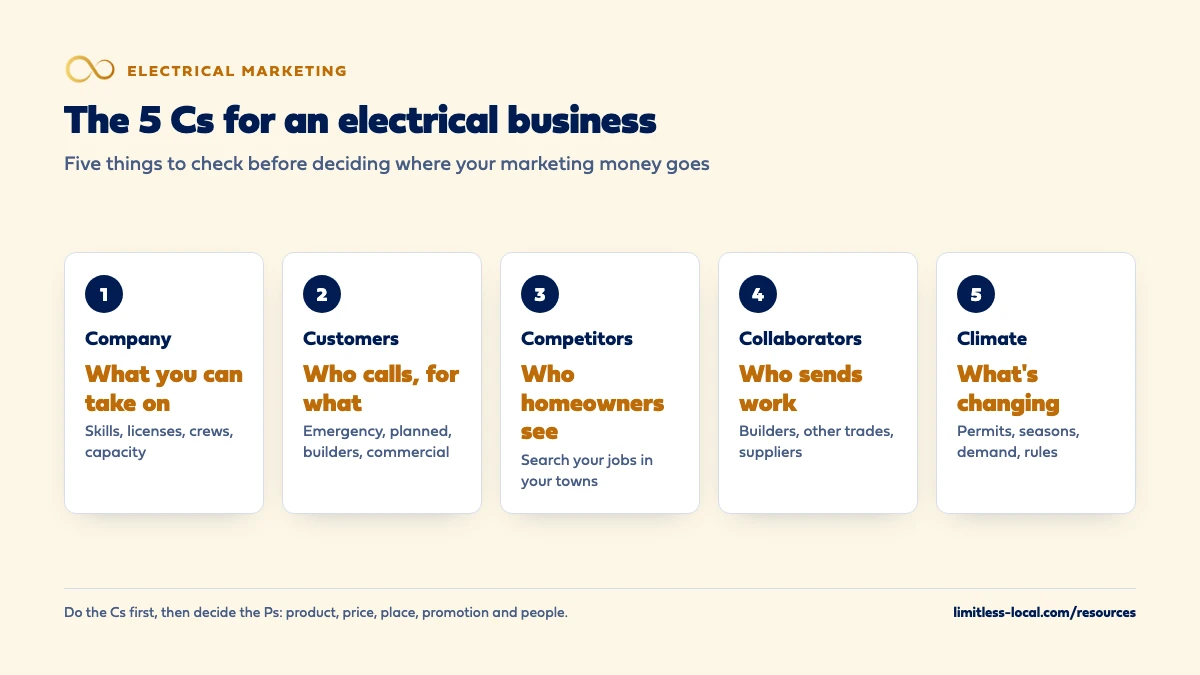
The 5 Cs are five things to look at before you make marketing decisions:
- Company: your own shop, what it’s good at and what it can handle.
- Customers: who buys from you, what they need and how they decide.
- Competitors: who else they could call, and why they’d pick them.
- Collaborators: the businesses that help you get or do work, such as builders, suppliers and other trades.
- Climate: the outside conditions you don’t control, such as the local economy, building activity, seasons and rules.
It’s a situation check, not a plan. Its job is to stop you from planning in a vacuum, like spending on ads for work your crews can’t take, or chasing a town where three established shops already own the map results.
How are the 5 Cs different from the Ps of marketing?
The Cs describe where you stand. The Ps are what you decide to do about it: which jobs you sell (product), how you charge (price), where you work and how people reach you (place), how you get found (promotion) and who they deal with (people).
Do the Cs first. If the climate check shows new subdivisions going up north of town, and the competitor check shows nobody there with many reviews, that shapes your place and promotion decisions. Skip the Cs and the Ps tend to be copied from whatever the shop down the road is doing.
If you haven’t worked through the Ps yet, the 4 or 5 Ps of marketing for an electrical business covers them, with a one-page plan you can fill in after this check.
Company: what can your shop actually take on?
Start with yourself, and be blunt. Write down:
- What you’re good at. The jobs your crews do well, get good reviews for and make money on.
- Capacity. How many trucks and licensed electricians you have, how full the schedule is, and how many more jobs a week you could take without slipping.
- Licenses and limits. The kinds of work your licenses and insurance cover, and anything you won’t do.
- Who answers. Whether calls get picked up when everyone’s on a job.
- Money and time. What you can spend on marketing each month, and how many hours you can give it.
Capacity is the line electricians skip most. Marketing that brings in more calls than your crews can run just burns money and reviews. If hiring is the real limit, whether to pause marketing while you’re hiring is worth reading before you raise any budget.
Customers: who calls you, and what are they buying?
Most electrical shops have more than one kind of customer, and each one buys differently:
- Homeowners with a problem now: no power, a burning smell, breakers tripping. They want whoever’s close and answers.
- Homeowners planning a project: a panel upgrade, an EV charger, a generator, a remodel. They compare a few shops, read reviews and want a clear quote.
- Builders, remodelers and general contractors: they care about bids, schedules and passing inspection.
- Commercial and property managers: repeat service, maintenance and tenant work.
The SBA’s guide to market research and competitive analysis lists questions worth answering about any market, including demand, market size, where customers live and where your business can reach, how many similar options they already have, and what they pay for those alternatives. For an electrician, add one more: which of these customer types do you want more of? Your job records already answer much of this. Sort last year’s jobs by type, town and ticket, and the picture usually gets clear fast.
Competitors: who shows up when homeowners search?
Your real competitors are the shops homeowners see when they search for the jobs you want, in the towns you want. That list can be different from the shops you think of as rivals.
To build it, search your main jobs plus each town, like panel upgrade plus the town name, and note who shows up in the ads, the map results and the regular results. Do it from a phone, and from different parts of your area, because Google’s local ranking help page says local results are mainly based on relevance, distance and popularity, so what you see at the shop isn’t what a homeowner across town sees.
For each competitor, note their review count and rating, the services they list, whether they show prices, and what they say makes them different. Then look for gaps: a town where nobody has many reviews, a job nobody has a real page for, an evening slot nobody covers. How a small electrical company competes with bigger ones covers what to do with those gaps.
Curious what your marketing is actually booking?
Get a free visibility audit — no obligation, no sales pitch.
Collaborators: who sends you work, or affects it?
Collaborators are the businesses whose decisions change how much work you get or how well you can do it:
- General contractors, builders and remodelers who invite you to bid.
- Other trades whose jobs need an electrician, like HVAC, solar, pool and generator installers.
- Property managers, home inspectors and real estate agents who get asked for a recommendation.
- Your supply house, for pricing, stock and lead times on equipment like panels and chargers.
Write down who sends you work now, who used to, and who you’d like to hear from. A builder who sends steady work is worth more to some shops than any ad. If that’s the kind of work you want, getting general contractors to send you steady work goes step by step.
Climate: what's changing around you?
Climate is everything outside your shop that changes demand. The Idaho Small Business Development Center puts it plainly: market research should track trends such as population shifts, legal developments and the local economic situation, and keep up with competitors’ strategies. For an electrician, look at:
- Building activity. The Census Bureau’s Building Permits Survey publishes statistics on new privately owned residential construction, monthly and annually, down to the county and place level. Rising permits in a town mean builder work, and later, service work in new homes.
- Long-term demand for the trade. The Bureau of Labor Statistics’ outlook for electricians says electricians will continue to be needed to link power generation systems, including solar and wind, to homes, businesses and power grids, and projects about 72,700 openings for electricians each year, on average, over the decade from 2025 to 2035. The solar line points to steady work for the trade. The openings figure is mostly about hiring: BLS expects many of those openings to come from replacing workers who retire or change jobs, so read it as competition for the electricians you’d want to hire.
- Seasons and weather. Storm season, summer load, holiday lighting.
- Rules. Licensing and permit requirements vary by state and city, and changes can open or close kinds of work.
How do I run a 5 Cs check in an afternoon?
- Pull last year’s jobs from ServiceTitan, Housecall Pro, Jobber or whatever you use, and sort them by job type, town and revenue. That’s most of your company and customers lines.
- Count your capacity: trucks, licensed techs, open slots on a normal week.
- Search your top jobs in your top towns from a phone and write down who shows up and how many reviews they have.
- List who referred work in the past year, and who stopped.
- Look up permits for your county and the towns you serve, and note anything changing in your area.
- Write one line per C on a single page. If a line says something any electrician anywhere could write, it’s too vague. Make it about your shop and your towns.

What should I do with the answers?
Turn each C into a decision:
- Company sets your limits: how many more jobs you can take, which ones, and how much you can spend.
- Customers picks the jobs and customer types you’ll go after first.
- Competitors shows where you can win: the towns and jobs with the weakest competition, and what you need to match, like review count.
- Collaborators tells you which relationships to put time into.
- Climate tells you when to push and when to hold, like raising budget before storm season or leaning into a fast-growing town.
Then write the Ps and a budget from there. Track booked jobs by source, so next year’s check starts with real numbers instead of guesses.
How often should an electrician redo the 5 Cs?
Once a year as a planning habit, ideally before your busy season. Then redo the part that changed whenever something big happens:
- A new shop opens nearby, or a competitor starts outspending you. What to do when a new electrical competitor opens nearby covers that one.
- You lose your spot in the map results.
- You add a truck, lose a tech or hire a dispatcher.
- A builder relationship starts or ends.
- A big local change, like a new subdivision or a permit rule change.
Each of those changes at least one C, and usually one of your Ps should change with it.
What mistakes make a 5 Cs check useless?
- Writing it from memory. Owners tend to remember their best jobs and worst customers. Use your job records.
- Listing the competitors you know instead of the ones homeowners see. Search like a homeowner, from a phone, in different towns.
- Ignoring capacity. A plan that needs a third truck you don’t have isn’t a plan.
- Treating climate as news. A national headline about EV sales matters only if it shows up in your area.
- Stopping at the analysis. If nothing about your jobs, towns or budget changes after the check, it was a writing exercise.
Want to see where your company stands?
A free visibility audit shows where you show up on Google, Maps and AI answers, and what it's costing you in calls.
What's different about the 5 Cs for electricians
Your company C includes licensing. What you can sell depends on the licenses your electricians hold and the rules where you work, which vary by state. That’s a real limit on your plan, not paperwork.
Customers split between emergency and planned work. The same shop can be competing on distance and answering speed for one job and on reviews and quotes for another. Look at them separately.
Collaborators matter more than in most trades. Builders, remodelers, solar and generator installers and other trades all need electricians, so relationships can be a whole channel.
Climate moves with technology. EV chargers, battery backup, solar tie-ins and generator demand change with what homeowners buy and with local storms, so this line deserves a fresh look every year.
A worked example: one page of 5 Cs for a three-truck shop
This shop and its numbers are made up to show what a finished page looks like, not a benchmark for your market.
- Company: three trucks, four licensed electricians, booked about a week out. Strong on service calls and panel upgrades. Room for roughly 6 more jobs a week.
- Customers: last year’s records show 60% of revenue came from planned jobs, though service calls were most of the job count. Most revenue came from two towns.
- Competitors: searching panel upgrade in the home town shows two shops with about 150 reviews each. In the growing town next door, nobody in the map results has more than 40.
- Collaborators: one remodeler sends work a few times a month; two builders stopped calling last year.
- Climate: permits in the next town over are climbing, and more homeowners are asking about EV chargers.
What it points to: push panel upgrades and EV chargers in the growing town, build reviews there from every job, reconnect with the two builders, and keep budget inside what about 6 extra jobs a week can absorb.
Frequently asked questions
Is it 3 Cs, 5 Cs or 7 Cs?
Different teachers use different counts. The five here (company, customers, competitors, collaborators, climate) cover what a local trade business needs, so there’s no reason to hunt for a longer list.
Do I need the 5 Cs if I already have a business plan?
A business plan usually covers some of the same ground. The 5 Cs check is shorter and meant to be redone often, so it’s useful even if your plan is a few years old.
Where do I find data on my local market for free?
Start with your own job records. Then use free public sources such as Census building permit data for your county and town, and your own searches on Google from a phone in each town you serve.
Should I include big franchise electricians as competitors?
Include anyone who shows up when homeowners search for your jobs in your towns. If a franchise outranks you there, it’s a competitor whether or not you think of it as one.
Is a SWOT analysis the same as the 5 Cs?
They overlap. A SWOT sorts things into strengths, weaknesses, opportunities and threats; the 5 Cs sort them by where they come from. Either works if it ends in a decision about jobs, towns and budget.
Can my office manager do the 5 Cs check?
They can gather most of it, like job records, reviews and permit numbers. The owner should make the calls on capacity and which work to chase.
Key takeaways
- The 5 Cs are company, customers, competitors, collaborators and climate.
- They describe your situation; the Ps are what you decide to do about it.
- Capacity is the company line electricians skip most, and it caps every plan.
- Find competitors by searching your jobs in your towns from a phone, not from memory.
- Redo the check yearly and whenever a competitor, crew change or local shift hits.
Not sure what's working right now?
Start with a free visibility audit: rankings, Google profile, reviews and tracking, checked against your service area.
More in this section
- Is it the 4 or 5 Ps of marketing for an electrical business?
- How do I grow a small electrical business with marketing?
- How do I market a new electrical business from day one?
- How should an electrical contractor market to commercial customers?
- Is five service areas too many for an electrician to market?
Sources
- Market research and competitive analysis — U.S. Small Business Administration
- Tips to improve your local ranking on Google — Google Business Profile Help
- Building Permits Survey (BPS) — U.S. Census Bureau
- Electricians: Occupational Outlook Handbook — U.S. Bureau of Labor Statistics
- Marketing — Idaho Small Business Development Center