
Which Google Business Profile categories should a pool builder use?

- What primary and additional categories should a pool construction company pick on Google?
- What does a Google category actually do for a pool company?
- What should a pool builder's primary category be?
- Which additional categories make sense for a pool builder?
- Which categories should a pool builder avoid?
- Should my service division or retail store have its own profile?
- If categories are limited, where do pool types and renovations go?
- Which attributes should a pool builder turn on?
- Will changing my category hurt my profile?
- Can Google change my category without asking me?
- How do I tell if my category is why I'm not showing up?
- What's different about categories for pool builders
- A worked example: categories for a builder that also services pools
- Frequently asked questions
- Key takeaways
- More in this section
- Sources
The short version
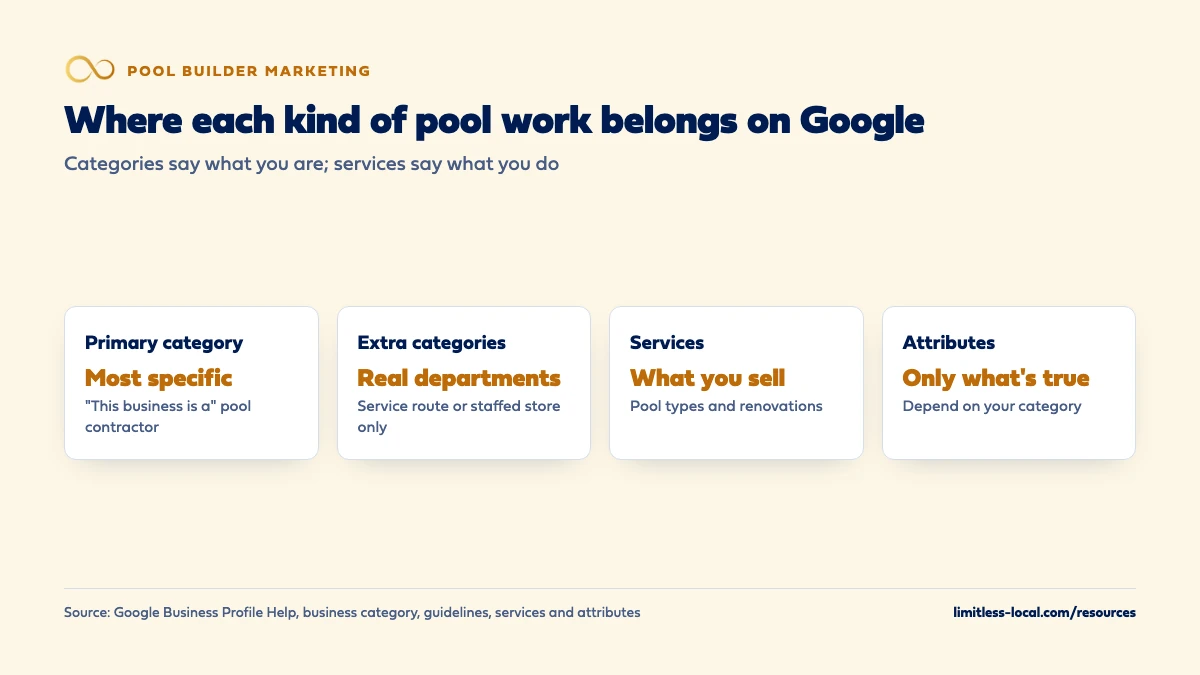
- Primary category: the most specific one that completes the sentence "this business is a".
- Additional categories: only for real departments, such as a service route or a staffed retail store.
- Pool types, renovations and add-ons go in the services list, not in extra categories.
- Change categories once and on purpose; an edit can trigger a new verification.
For pool builders choosing or fixing the categories on their Google Business Profile: the primary category, when extra categories are earned, and what belongs in services and attributes instead.
Get a free visibility audit · Book a growth call
What primary and additional categories should a pool construction company pick on Google?
Use the single most specific category that describes what your business is, which for a company whose main work is building pools is the pool contractor category in Google’s list, and make it your primary category. Add an additional category only for a real, separate part of the business that customers come to you for, such as a pool service route or a retail store, and keep the total as small as you can. Everything else you do, from fiberglass installs to resurfacing, belongs in your services list, not in more categories.
Getting categories, services and the rest of the profile right is part of the Google Business Profile management in every package of our local SEO work, and it’s where we start with the pool builders on our pool builder marketing page. For the rest of the profile and for Maps rankings, browse the pool builder marketing questions library.
What does a Google category actually do for a pool company?
Your category tells Google, and the homeowner looking at your profile, what kind of business you are. Google says categories help connect you with customers searching for your products or services, and that the categories you select affect your local ranking. Google adds that your categories might also be used to assign a label to your business, and that some categories come with category-specific features on the profile. Source: Manage your business category.
For a pool builder, the category is the first answer to “is this the kind of company I’m looking for?” Google also says that businesses in certain categories, such as service businesses, might have the option to show their services directly on the profile, so the wrong category could even change which tools you get. Source: Manage your services on your Business Profile.
What should a pool builder's primary category be?
Google’s rules for the primary category are short:
- Pick the category that best describes your business, from the list that appears as you type. You can’t create your own.
- Choose the most specific option. Google’s example is “Nail salon” instead of “Salon”.
- If the specific category you want isn’t there, pick a more general one that still describes you.
Sources: Manage your business category and Guidelines for representing your business on Google. Whatever sits in the first category field is your primary category, according to Edit your Business Profile.
Type “pool” into the category box and read every option before you choose. In our experience, the list includes a pool contractor category, usually shown as “Swimming pool contractor”, along with separate options for pool repair, pool cleaning and pool supply stores. Google doesn’t publish its category list in its help pages, and the names can change, so trust what the box shows you on the day. For a company whose main work is designing and building pools, the contractor category is our pick for primary. Don’t choose plain “Swimming pool”: in Google’s own examples, that’s the wrong category for a motel or a health club that has a pool, and in our reading it’s a category for a place people go to swim, not for the company that builds one.
Which additional categories make sense for a pool builder?
Google allows additional categories to describe special departments or services, and warns against adding a category for every product or service. Its example is a grocery store with a bakery and a deli, which uses “Grocery store” as primary and adds “Bakery” and “Deli”. Google’s guidelines add that you should use as few categories as possible to describe your core business. Sources: Manage your business category and Guidelines for representing your business on Google.
In our judgement, a pool builder has earned an additional category only when a separate part of the business is something customers come to you for on its own:
- A real service division. If you run weekly cleaning routes, openings and closings, or repair calls for customers whose pools you didn’t build, a pool cleaning or pool repair category describes that department.
- A staffed retail store. If homeowners walk in to buy chemicals, parts or equipment during posted hours, a pool supply store category fits.
- A hot tub or spa showroom that sells spas on their own, not just spas attached to your pool builds.
If you only do repairs on pools you built, under warranty, that’s part of building pools, not a department. If you’re thinking about turning service into its own line of work, the trade-offs are in adding a pool service business.
Which categories should a pool builder avoid?
Google’s guidelines rule out a few habits that tempt pool builders. Source: Guidelines for representing your business on Google.
- Categories used as keywords. Google says not to use categories only as keywords or to describe attributes of your business. Adding a landscaping or concrete category because your pool builds include a patio is exactly that.
- Categories for nearby or related businesses. Google says not to use categories that belong to a business contained within yours or related to it. The landscaper you partner with, the fence company you refer, or a separately owned store at your location keep their own categories.
- “Has a” categories. Google asks for categories that complete “This business is a”, not “This business has a”. A pool builder that has a design studio isn’t a design studio.
- Redundant categories. Google says that when you choose a specific category it includes more general categories behind the scenes, so you can skip anything that only repeats your primary category in broader words.
Curious what your marketing is actually booking?
Get a free visibility audit — no obligation, no sales pitch.
Should my service division or retail store have its own profile?
Usually not. Google’s guidelines say there should be one profile per business, and its departments rules apply to public-facing departments that operate as distinct entities: they typically have a separate customer entrance, a name that’s different from the main business and their own distinct category. If a department within your location is independently owned and operated, Google says it should have its own profile and you shouldn’t add its category to yours. Sources: Guidelines for representing your business on Google and Manage your business category.
For most pool companies, that means a service route run by the same company from the same office is an additional category and a group of services on the one profile, not a second profile. A retail store with its own entrance, its own name on the sign and its own staff during posted hours may qualify as a department with its own profile. If you’re unsure, our view is to keep one profile. How the extra profile question plays out in rankings is covered in ranking a pool company in Maps.
If categories are limited, where do pool types and renovations go?
Into the services list. Google says that when a local customer searches for a service you list, that service may be highlighted on your profile, and in the Maps app customers can see your full list under Services. You can choose suggested services, add custom services, group services into categories and add descriptions. Custom service names that contain profanity, gibberish, personal information, prices or phone numbers are rejected automatically. Source: Manage your services on your Business Profile.
So the split for a pool builder looks like this: your categories say what kind of company you are, and your services say what you build and fix. Gunite, fiberglass and vinyl liner pools, spas, resurfacing, tile and coping, decking, safety covers and equipment upgrades are all services. A homeowner searching for a fiberglass pool installer can see that work on your profile without you adding a fiberglass category that may not exist. The field-by-field version of the services list is in optimizing a pool builder profile.
Which attributes should a pool builder turn on?
Attributes are yes-or-no details that show on your profile on Search and Maps. Google says that if you add certain attributes, your business might show up in searches for places with those attributes. Some attributes can only be changed in certain locations, countries or business categories, and some are filled in from what customers who visit tell Google. You’ll find them under Edit profile, then More. Source: Manage your business attributes.
Because the attributes you’re offered depend on your category, set your categories first, then answer yes only to what is true for your business. If you have a showroom or design center that customers visit, the accessibility attributes on Google’s page, such as a wheelchair-accessible entrance or parking, are worth answering honestly, because they tell a visitor what to expect before they drive over.
Will changing my category hurt my profile?
It can slow things down. Google says that if you add or edit a category, you might be asked to verify your business again. Source: Manage your business category. Google’s attributes help page adds that a review of your edits usually takes about 10 minutes but can sometimes take up to 30 days. Source: Manage your business attributes.
In our judgement, that makes category changes something to plan rather than to test. Decide the primary and additional categories once, make all the changes in one sitting, and then leave them alone long enough to judge the result. Swapping categories every few weeks can leave you stuck in review or re-verification in spring, the worst time to be missing from Maps.
Can Google change my category without asking me?
Yes. Google says it gathers information from different sources, such as user reports and licensed content, and may update your profile if those sources say your info is wrong or out of date. In the profile editor, information Google changed shows in blue. When a suggested edit needs your review, you get 4 days to accept or reject it; if you don’t respond, Google may publish it if it’s supported by public information such as your website. Source: Understand Google updates on your Business Profile.
Google also says it can detect category information from your website and from mentions of your business across the web. Source: Guidelines for representing your business on Google. Our reading: make your website describe you the same way your profile does, and check the editor for blue text every month or two. Which searches your site pages should aim at is covered in keywords a pool builder should target.
How do I tell if my category is why I'm not showing up?
Google says local results are mainly based on relevance, distance and popularity, and it explains that last factor under the heading prominence. Relevance is how well a profile matches a search, and Google ties it to complete and detailed business information, which includes your category. Distance is how far you are from the searcher. Prominence comes from how well known you are, including links to your business and your reviews. Source: Tips to improve your local ranking on Google.
In our experience, a category problem means you don’t show up for a plain search like pool builder plus your town, even near your office. If you show up nearby but fade a few towns away, that’s more likely distance or prominence. Check the Searches numbers in your Performance report, which show the search terms people used to find your profile. Source: Understand your Business Profile performance & insights. If those terms are mostly about pool cleaning or chemicals when you want new builds, your category and services may be pulling the wrong crowd. For the other causes, see why a competitor outranks you.
Want to see where your company stands?
A free visibility audit shows where you show up on Google, Maps and AI answers, and what it's costing you in calls.
What's different about categories for pool builders
Several businesses under one roof. Many pool companies build, renovate, service and sell supplies. Only the parts customers come to you for on their own earn a category; the rest are services.
Renovation versus new construction. In our experience there’s no separate Google category for pool renovation, so renovation work is carried by your services list, your photos and your website, not a category.
Outdoor living is tempting. Pool builds often include patios, kitchens and fire features. Unless you sell those on their own, they’re services or project photos, not landscaping or patio categories.
Seasonal pressure. Category changes can trigger review or re-verification, so make them in the slow months, not when spring calls are coming in.
A worked example: categories for a builder that also services pools
These numbers are made up to show the reasoning, not a benchmark. Picture a pool company with one office and one profile. Last year, about 70% of its revenue came from new inground pools, 20% from renovations and resurfacing, and 10% from a weekly cleaning route with 40 customers, most of whom it didn’t build pools for. There’s also a small counter in the office where route customers sometimes pick up chemicals, but nobody staffs it during set hours.
- Primary: the pool contractor category, because new builds are what the business is.
- Additional: a pool cleaning category, because the route is a real department that customers hire on its own.
- Not added: a supply store category, because the counter isn’t a staffed store; a landscaping category, because patios are part of pool builds; a renovation category, because renovation work lives in services.
- Services: new builds grouped by pool type, a renovation group, and a service group for the route.
If the Performance report later shows mostly cleaning searches, the fix is more build photos and pages about new pools, not dropping the category the route depends on.
Frequently asked questions
Can I create a "pool builder" category if I can't find one?
No. Google says you can’t create your own category. If the specific one you want isn’t in the list, choose a more general category that still describes your business. Source: Manage your business category.
How many categories should a pool builder have?
As few as it takes to describe your core business, in Google’s words. For most pool builders that means one primary category, plus one more only if a separate department, such as a service route, exists.
Should I copy the categories my top competitor uses?
Only if they’re true for your business. A competitor’s categories may describe a store or service route you don’t have, and borrowing them breaks Google’s rule against using categories as keywords.
Do I need a separate category for fiberglass or vinyl liner pools?
No. Pool types are services. List them in the services editor, grouped under new construction, where Google may highlight them when someone searches for that kind of pool.
Does my category show on my profile?
Google says your categories might be used to assign a label to your business, based on your business type. Homeowners often see that label before anything else, which is one more reason to pick the specific one.
Will a hot tub category help me show up for hot tub searches?
Only add it if you sell hot tubs or spas on their own. If spas only come attached to your pool builds, list them as a service instead.
Key takeaways
- Make the most specific category that describes what your business is your primary category.
- Add extra categories only for real departments, such as a service route or a staffed retail store.
- Put pool types, renovations and add-ons in the services list instead of in more categories.
- Change categories once, in the slow season; an edit can trigger review or re-verification.
- Check for Google’s blue-text updates and keep your website describing you the same way.
Not sure what's working right now?
Start with a free visibility audit: rankings, Google profile, reviews and tracking, checked against your service area.
More in this section
- How do I optimize a pool builder Google Business Profile?
- How should a pool builder set up its Google service area?
- How should a pool builder structure Google Ads campaigns?
- Are Google Ads worth it for pool builders?
- What keywords should a pool builder target?
Sources
- Manage your business category — Google Business Profile Help
- Guidelines for representing your business on Google — Google Business Profile Help
- Manage your services on your Business Profile — Google Business Profile Help
- Manage your business attributes — Google Business Profile Help
- Understand Google updates on your Business Profile — Google Business Profile Help
- Tips to improve your local ranking on Google — Google Business Profile Help
- Edit your Business Profile — Google Business Profile Help
- Understand your Business Profile performance & insights — Google Business Profile Help