
How should an electrician respond to a negative Google review?

- What's the right way for an electrical contractor to answer a bad Google review?
- What should I do before I reply to a bad review?
- How do I tell a real complaint from a review that shouldn't be there?
- What should my reply to a negative review say?
- What should I never put in a reply?
- How do I reply when the complaint is about my price?
- How do I reply when a review raises a safety concern?
- When should I report a review instead of just replying?
- What if someone wants money to take bad reviews down?
- Can I ask the customer to change or remove the review?
- How long will one bad review affect my rating?
- What's different about bad reviews for electricians
- A worked example: what one 1-star review does to your average
- Frequently asked questions
- Key takeaways
- More in this section
- Sources
The short version
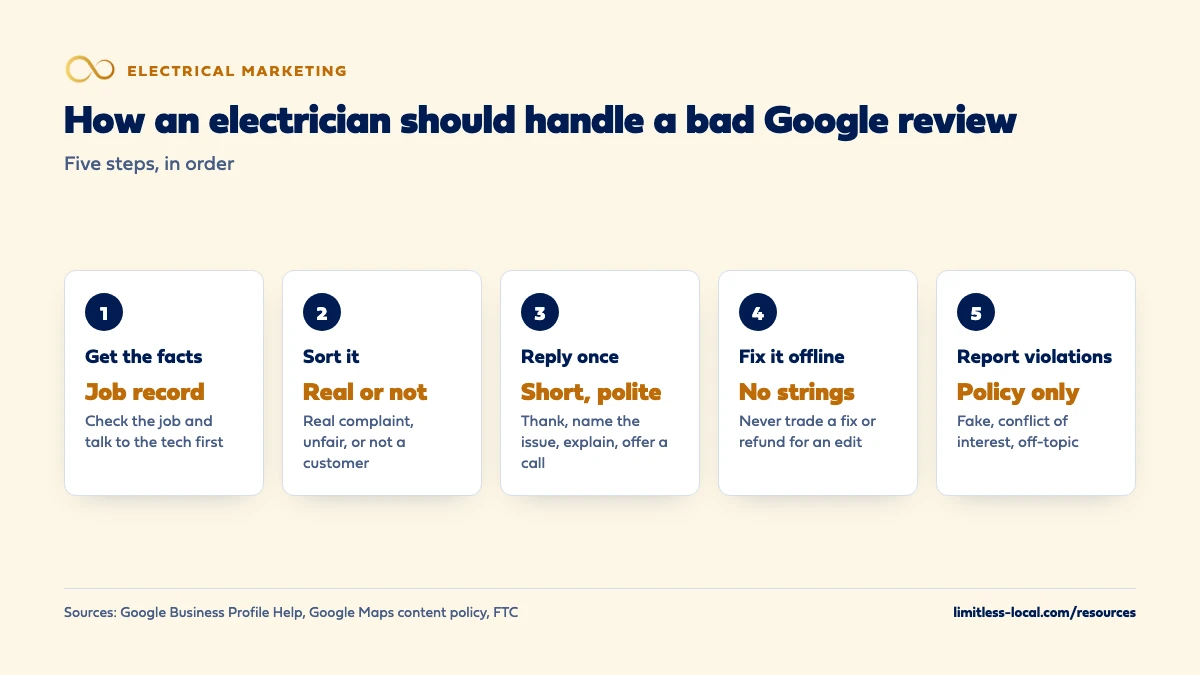
- Cool off, pull up the job record and talk to the tech before you write anything.
- Reply once, short and polite: thank them, name the issue, explain what you can and can't do, offer a call.
- Never share the customer's details, argue, threaten or offer anything in exchange for an edit.
- Report only reviews that break Google's policies; disagreeing with a review isn't a reason Google will remove it.
For electrical contractors who just got a 1-star review and want to answer it in a way that protects the business, not just their pride.
Get a free visibility audit · Book a growth call
What's the right way for an electrical contractor to answer a bad Google review?
Reply once, publicly and promptly: thank the customer, name the specific concern, say plainly what you can and can’t do about it, and ask them to call or email so you can sort it out offline. Keep the reply short and polite, leave out the customer’s private details, and never argue, accuse a real customer of lying, or offer a discount or refund in exchange for changing the review. If the review breaks Google’s policies, for example it comes from someone who never hired you, a competitor or a former employee, report it for removal as well; a review you simply disagree with stays up.
Replying to reviews is part of how we’d look after an electrician’s local visibility: review response and basic review generation come with our Essentials package, alongside Google Business Profile management, and Growth adds advanced review generation. Our local SEO page explains how reviews fit with the rest of your Maps presence, and our electrical contractor marketing page shows the whole picture for electricians. The rest of the electrical marketing questions library goes question by question.
What should I do before I reply to a bad review?
Wait long enough to answer as the business, not as the person who got insulted. A reply goes up under the review for everyone to read, and Google’s page on managing customer reviews says the customer is notified when you reply. In our view, the first hour is for getting facts, not for writing:
- Find the job. Look the customer up in ServiceTitan, Housecall Pro, Jobber or whatever you run. Check the date, the tech, the quote, the invoice, any photos and any notes about a permit or inspection.
- Talk to the tech. Get their side before you decide who’s right.
- Decide which kind of review it is (next section), because that decides what you do next.
Google’s tips for replying to reviews say a prompt response shows you value the feedback, so don’t let it sit for weeks while you think about it.
How do I tell a real complaint from a review that shouldn't be there?
Most bad reviews fall into one of three groups, and each gets a different response:
- A real customer with a real complaint. The tech was late, the outlet still doesn’t work, the bill was higher than the quote. Reply, fix what you can, and look for the cause.
- A real customer being unfair. They’re angry about something you didn’t control or didn’t promise. Reply calmly with the facts; Google won’t take it down for being unfair.
- Someone who isn’t a customer at all. No record of the name, the address or the job, or the review reads like it’s about another company. Reply neutrally and look at whether it breaks Google’s rules.
Google’s content policy for Maps doesn’t allow reviews that aren’t based on a real experience, content posted to undermine a competitor, or reviews from people with a conflict of interest, which it says can include current or former employees, competitors and family members. It also doesn’t allow off-topic rants or harassment. Those are the reviews worth reporting. A review that’s simply harsh, from a real customer, is not.
What should my reply to a negative review say?
Google’s tips for replying to negative reviews are short and practical. Its advice includes being professional and polite, keeping it short, apologizing when appropriate, addressing the reviewer by name and acknowledging their specific feedback, and being honest about what went wrong without taking responsibility for things outside your control. It also suggests asking the reviewer to contact you by phone or email when a situation is complicated, so you can resolve it privately.
For an electrical company, that turns into four parts:
- Thank them and name the issue. “Thanks for letting us know the GFCI outlet in your kitchen is still tripping.”
- Own what’s yours. If the tech was late or the cleanup was poor, say so and apologize.
- Explain what isn’t. If the delay was the inspector’s schedule or the utility reconnect, say that once, without blaming anyone.
- Offer a next step. “Please call the office and ask for me so we can send someone back.” Sign it with your name or initials, which Google’s tips suggest.
Write each reply about that job. Google’s tips suggest focusing on reviews where you can share a helpful update, rather than sending everyone the same text.
Your reply shows as coming from the business, and Google says your personal name isn’t shown. Google also checks replies against its content policies before they post; most are reviewed within 10 minutes, but it can take up to 30 days.
What should I never put in a reply?
A few things turn a bad review into a worse page:
- The customer’s private details. Google’s tips say never to share a reviewer’s private information. For an electrician that includes the street address, what’s wrong with their wiring, what they paid and anything you saw inside the house.
- Accusations you can’t back up. The FTC’s Q&A on its consumer reviews rule says you can respond publicly to a negative review but should watch what you say: the rule prohibits a false accusation about the reviewer made knowingly or with reckless disregard for the truth.
- Threats. The same FTC page says a response shouldn’t use threats or intimidation to get a review removed or changed, and that intimidation can include abusive communications and character assassination. A legal threat is only allowed with a legitimate basis; an unfounded one used to get a review removed breaks the rule.
- A deal. Google’s tips say to avoid using replies to offer deals or promotions, and its policy doesn’t allow incentives in exchange for removing or revising a negative review.
The FTC points above summarize its published Q&A for US businesses; they aren’t legal advice.
For a review you believe is fake, a short reply such as “We can’t find a record of this job. Please call the office so we can look into it” says what you need to say without calling anyone a liar. That wording is our suggestion, not Google’s.
Curious what your marketing is actually booking?
Get a free visibility audit — no obligation, no sales pitch.
How do I reply when the complaint is about my price?
Price complaints are common for electricians, because the customer is often comparing a licensed, permitted job with a handyman’s number. In our view, the reply shouldn’t defend the price line by line in public. It should say, in general terms, what your price includes and offer to walk through the quote by phone.
Something like: “We’re sorry the price was a surprise. Our quotes include the permit, the inspection and materials that meet code, and we’re glad to go over the details with you by phone.” That speaks to the next reader without sharing this customer’s numbers. If the bill really did come in above the written quote without a conversation, say so and fix it; that’s a real complaint, not a price shopper.
If price complaints keep coming, the problem is usually earlier than the review. Stopping price shoppers early covers how to set expectations before the estimate.
How do I reply when a review raises a safety concern?
Fast, and mostly offline. A review that says “the electrician left wires exposed” or “my breaker keeps tripping since the panel swap” is the kind other homeowners take seriously, and it may point to a real problem in someone’s house. In our view, the priority order is: call the customer, send someone qualified to look, and then reply publicly with what you did.
A good public reply here is short: thank them, say you’ve reached out (or ask them to call), and say you’re sending someone to check the work. Don’t argue code details or diagnose the problem in the review thread. If the complaint involves damage to the home or anyone being hurt, get the facts first and talk to your insurer or attorney before you write anything that admits or denies fault in public. That’s general caution, not legal advice.
When should I report a review instead of just replying?
Only when it breaks Google’s rules. Google’s page on reporting inappropriate reviews says you can report any review, but only reviews that violate its policies are eligible for removal. It says not to report a review just because you disagree with it, and that Google doesn’t get involved in conflicts between businesses and customers.
To report one, open your Business Profile, choose Read reviews, select Report next to the review and pick the reason. Google says evaluation typically takes several days, and you can follow the status in its Reviews Management Tool. If Google finds no violation and you disagree, you get a one-time appeal, which can cover up to ten reviews at once.
In our view, reply anyway while it’s under report, so readers see a calm answer instead of silence.
What if someone wants money to take bad reviews down?
That’s extortion, and Google has a separate process for it. Its page on negative review extortion scams describes a sudden rise in 1-star and 2-star reviews followed by someone demanding money, goods or services to remove them.
Google’s instructions are clear: don’t engage with or pay them, don’t try to settle it yourself by offering money or services, gather evidence right away (screenshots showing the date, time and sender, plus links to the suspicious reviews), and submit Google’s merchant extortion report form. Google says paying doesn’t guarantee the reviews come down and can encourage more attempts.
Can I ask the customer to change or remove the review?
You can contact them to fix the problem. The FTC’s review rule Q&A says the rule doesn’t prohibit contacting customers who post negative reviews to resolve the issue. Google’s tips say constructive replies and following up on concerns may encourage the customer to update their review, and its review management page says customers can still change their review after reading your reply. If they do, the review’s date changes to the update.
What you can’t do is make the fix depend on the edit. Google’s policy doesn’t allow offering payment, discounts or free service in exchange for revising or removing a negative review. So send the tech back, credit the service call if that’s fair, and leave the review up to them. In our view, a customer whose problem got fixed without strings is the one most likely to say so.
How long will one bad review affect my rating?
Until enough new reviews dilute it. Google’s page on review scores says your score is the average of all ratings published on Google for your business, and that after a new review it may take up to 2 weeks for the score to update. A single 1-star review moves a profile with few reviews much more than one with many, which is why a steady flow of new reviews matters more than any one reply.
The fix is the same system that gets reviews in the first place: ask every customer at the moment the job is done. Getting more Google reviews covers how electricians set that up, and the worked example below shows the math.
Not sure which of these is costing you jobs?
A free visibility audit checks the Google profile, reviews, site and tracking, and shows what to fix first.
What's different about bad reviews for electricians
Safety claims carry extra weight. A complaint about a messy job site is annoying; a complaint about exposed wiring or a breaker that keeps tripping makes the next homeowner nervous about letting you in. In our view, those need a call and a site visit before anything else.
Some delays aren’t yours. Permits, inspection schedules and utility reconnects can hold up a panel upgrade or service change. Google’s own tips say to explain limitations and not take responsibility for things outside your control, so say once, calmly, what the hold-up was.
You’re often being compared with a handyman. Price reviews are partly about that comparison. A reply that mentions the license, permit and inspection behind your price speaks to the next reader, too. Showing your license number covers where else that should appear.
Reviews follow you into Local Services Ads. Google’s page on reviews on Local Services Ads says star ratings and number of reviews affect how your business ranks there, and that reviews are managed through your Business Profile, not your ads account. If you run LSAs, whether LSAs are worth it covers that channel.
A worked example: what one 1-star review does to your average
These numbers are made up to show the math, not a benchmark. Say your profile has 40 reviews averaging 4.8 stars, which is 192 stars in total. One 1-star review lands. You now have 41 reviews and 193 stars, and your average drops to about 4.7.
To get back to 4.8, you need new reviews. If every one were five stars, it would take 19 more: 193 plus 95 stars is 288, and 288 divided by 60 reviews is 4.8. Reviews won’t all be fives, so in practice it takes more.
Two things change that math. If the review breaks Google’s policy and Google removes it, your average goes straight back. And if the problem behind a real review keeps happening, more bad reviews keep coming while you rebuild. Review response and basic review generation are part of our Essentials package at $3,500 a month, alongside Google Business Profile management, and Growth at $4,500 a month adds advanced review generation.
Frequently asked questions
Can I delete a bad Google review myself?
No. You can reply to it and report it, but only Google removes reviews, and only ones that break its policies. You can edit or delete your own reply at any time from your Business Profile.
Should I reply to bad reviews on Yelp or Facebook the same way?
The same rules of thumb apply. If a review from another site shows on your Google profile, Google’s review score page says concerns about it go to the site it came from.
Does a reply help my Google ranking?
Google says helpful replies can show that you’re responsive to your customers. Its pages on replying don’t promise a ranking change, so write the reply for the next customer who reads it.
Should I take legal action over a fake review?
That’s a question for an attorney. The FTC says a legal threat is only allowed with a legitimate basis; reporting a fake review to Google is usually the first step.
Will a bad review hurt my Local Services Ads?
It can. Google says star ratings and the number of reviews affect how your business ranks within Local Services Ads, and those reviews come from your Business Profile.
Should I respond to a review I'm still investigating?
Yes, briefly. A short reply saying you’ve reached out or asking them to call shows readers you’re on it, and you can edit the reply once you have the full story.
Key takeaways
- Check the job record and talk to the tech before you write a word.
- Reply once, short and polite: thank them, name the issue, explain what you can and can’t do, offer a call.
- Never share private details, accuse without proof, threaten, or offer anything in exchange for an edit.
- Report only reviews that break Google’s policies, and use Google’s extortion form if someone demands money.
- Safety complaints get a call and a site visit first; the public reply comes after.
- The lasting fix for your average is a steady flow of new reviews from every job.
Want a second set of eyes on your setup?
We'll look at how you show up locally and where calls are leaking, then send you a plain-English breakdown.
More in this section
- How do I get more Google reviews for my electrical business?
- How do I optimize my electrician Google Business Profile?
- What negative keywords should electricians add to Google Ads first?
- Why is a competitor electrician ranking above me on Google Maps?
- How do electricians get verified for Google Local Services Ads?
Sources
- Manage customer reviews — Google Business Profile Help
- Tips to get more reviews — Google Business Profile Help
- Report inappropriate reviews on your Business Profile — Google Business Profile Help
- Report negative review extortion scams on your Business Profile — Google Business Profile Help
- Prohibited & restricted content — Google Maps User Contributed Content Policy Help
- Understand review scores for local places & businesses — Google Business Profile Help
- Reviews and Ratings on Local Services Ads — Google Local Services Help
- The Consumer Reviews and Testimonials Rule: Questions and Answers — Federal Trade Commission