
What is Quality Score, and how does it affect roofing Google Ads?
- What does Quality Score mean in my roofing Google Ads account, and can it lower my click cost?
- What is Quality Score in Google Ads?
- Does Quality Score change what I pay per click?
- What are the three parts of Quality Score?
- Where do I find Quality Score for my roofing keywords?
- How do I fix below-average ad relevance?
- How do I fix below-average expected click-through rate?
- How do I fix below-average landing page experience?
- Do negative keywords and match types change my Quality Score?
- What doesn't affect Quality Score?
- Should I try to get every keyword to a 10?
- How long before a fix shows up in Quality Score?
- What's different about Quality Score for roofers
- A worked example: why click price matters to a roofer
- Frequently asked questions
- Key takeaways
- More in this section
- Sources
The short version
- Quality Score runs from 1 to 10 per keyword and compares you with other advertisers on the same searches.
- It's built from expected click-through rate, ad relevance and landing page experience.
- The score isn't used in the auction, but the ad quality behind it affects your position and click cost.
- Use the three component statuses to decide whether to fix the keywords, the ad or the page.
For roofing company owners who’ve seen the Quality Score column in Google Ads and want to know what it measures, what it changes and what to fix first.
Get a free visibility audit · Book a growth call
What does Quality Score mean in my roofing Google Ads account, and can it lower my click cost?
Quality Score is a 1-to-10 rating Google Ads gives each Search keyword, comparing your ad and landing page with other advertisers’ for the same searches, based on three parts: expected click-through rate, ad relevance and landing page experience. Google says the score itself is a diagnostic and not an input in the ad auction, but the ad quality it summarizes does affect whether your ad shows, where it ranks and what you pay, and higher-quality ads typically cost less per click. For a roofer, a low score usually points to one of three fixes: ad groups that lump repair, replacement and storm keywords together, ad text that doesn’t match the search, or clicks landing on a page that doesn’t match the ad.
Quality Score is one of the diagnostics we check when a roofing campaign costs more than it should, but the number we report on is what each signed roof cost. That’s how Google Ads management works in our roofing marketing packages. If you’re still deciding whether paid search belongs in your mix, our guide on whether Google Ads is worth it for a roofing company covers the cost and break-even math, and the roofing marketing questions library covers the rest one question at a time.
What is Quality Score in Google Ads?
Google describes Quality Score as a diagnostic tool that gives you a sense of how your ad quality compares with other advertisers. It’s measured on a scale from 1 to 10, it’s reported for each keyword in a Search campaign, and a higher score means your ad and landing page are more relevant and useful to someone searching that keyword than other advertisers’ are.
Two details matter for how you use it. First, it’s relative: you’re scored against the other ads that showed for the same searches, not against a fixed standard. Second, Google says plainly that Quality Score is not a key performance indicator and shouldn’t be optimized for its own sake. It’s a way to spot which keywords, ads or pages might be costing you.
Does Quality Score change what I pay per click?
Not directly, but what it measures does. Google says Quality Score is not an input in the ad auction. What goes into the auction is your ad quality, assessed at the moment of each search, and Quality Score is Google’s summary of that assessment.
Google’s ad quality page lists what ad quality can affect: whether your ad can show at all, where it appears on the page, whether assets such as extra links can show, and how much you pay per click. It says higher-quality ads typically cost less per click than lower-quality ones, and that with low-quality ads your actual cost per click may sit close to your maximum bid even when there’s little competition.
Ad quality is also one of the factors in Ad Rank, alongside your bid, the competition, the context of the search and the expected impact of your ad assets. Google’s own summary: you can improve your share of the top of the page by improving ad and landing page quality or by raising your bid. For a roofer paying high prices per click, the first option is usually the cheaper one to try.
What are the three parts of Quality Score?
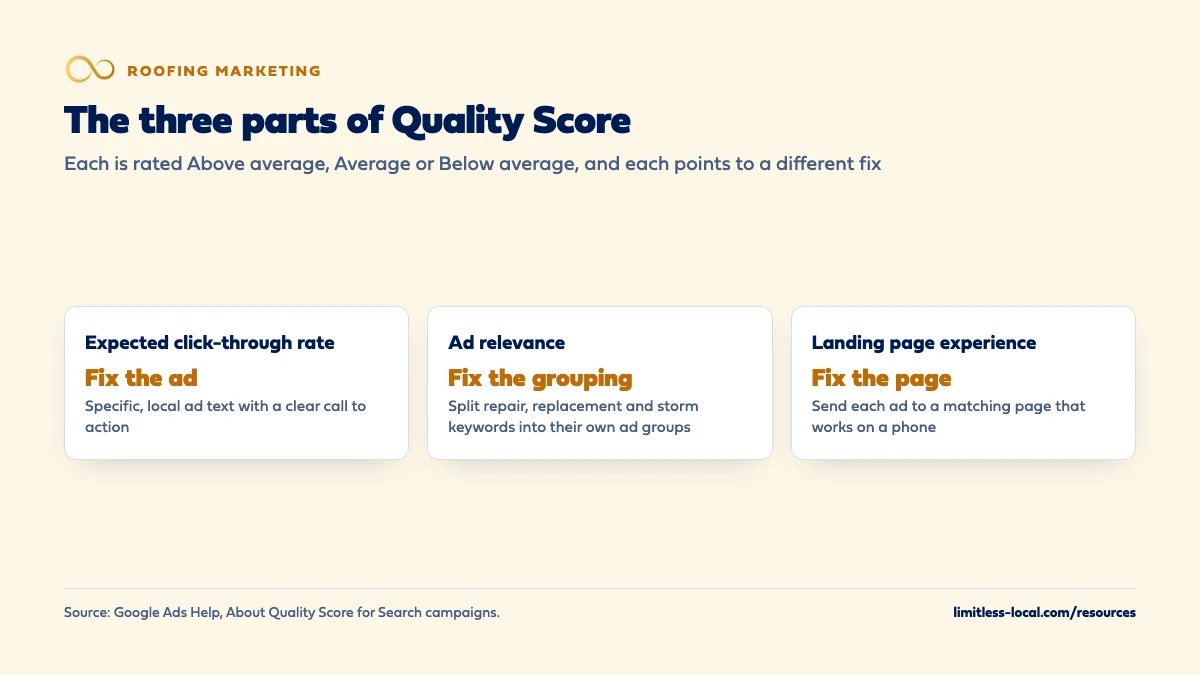
Google calculates the score from the combined performance of three components, each rated Above average, Average or Below average against other advertisers whose ads showed for the exact same search over the last 90 days:
- Expected click-through rate: how likely your ad is to be clicked when it shows.
- Ad relevance: how closely your ad matches the intent behind the search.
- Landing page experience: how relevant and useful your landing page is to people who click.
The component statuses are more useful than the single number, because each one points to a different fix. Google’s guide to using Quality Score says they tell you whether to update your ad text, your keyword selection or your landing page.
Where do I find Quality Score for my roofing keywords?
In Google Ads, open Keywords under the Campaigns menu, select the columns icon at the top right of the table, and open the Quality score section under Modify columns. Add the Quality Score column and the three component status columns.
If you see a dash instead of a number, Google says there weren’t enough searches that exactly match that keyword to score it. That’s common for long, specific roofing keywords in a small service area. It isn’t a problem in itself. Judge those keywords on calls and estimate requests instead, and use the scored keywords in the same ad group as a guide to how the ad and page are doing.
How do I fix below-average ad relevance?
Ad relevance usually drops when one ad group holds keywords that one ad can’t answer well. Google’s advice is to group keywords into themes, split ad groups whose keywords can’t be addressed by the same ad, and match your ad text more directly to the searches.
For a roofer, the most common culprit is a single ad group called Roofing that holds roof repair, roof replacement, storm damage, metal roofing and gutters. An ad that tries to speak to all of them speaks to none. Split them so a roof leak repair search sees an ad about fixing leaks, and a roof replacement search sees one about new roofs, financing or warranties. Whether to chase repairs or replacements covers which of those deserves the bigger share of the budget.
Curious what your marketing is actually booking?
Get a free visibility audit — no obligation, no sales pitch.
How do I fix below-average expected click-through rate?
This one is about the ad text itself. Google suggests making the offer more compelling, matching the details in the ad to the intent of the keyword, highlighting what sets you apart, being more specific, and using clear calls to action such as Get a Quote. Its ad optimization guide also suggests writing several versions of the ad with different headlines, and adding ad assets such as a phone number or extra links, which can improve visibility and click-through rate.
For a roofer, specific usually beats clever: the towns you serve, the kind of roof work, free inspections if you offer them, the warranty, how long you’ve been local. Google adds a useful warning: a more specific ad can sometimes get fewer clicks but more conversions. That’s often a good trade for a roofer. A click from someone who was never going to hire you lowers nothing but your budget.
How do I fix below-average landing page experience?
Google defines landing page experience as an estimate of how relevant and useful your page will be to people who click your ad, and says pages with higher ratings are usually well organized, with text that relates to the search. A below-average status means you may want to change the page.
Its landing page advice comes down to a few things a roofer can check in an afternoon:
- Send each ad to the page that matches it, not the homepage. A storm damage ad should land on a storm damage page.
- Keep the message consistent from ad to page. If the ad offers a free inspection, the page should show how to book one.
- Make it work on a phone: quick to load, easy to contact you, simple to navigate.
- Put the important information at the top, and skip pop-ups that cover the page.
What a roofing website needs for estimate requests covers what goes on the page, and checking how your site works on phones covers the mobile side.
Do negative keywords and match types change my Quality Score?
Match types don’t. Google says Quality Score is based on historical impressions for exact searches of your keyword, so changing a keyword’s match type won’t change its score. Broadening a match type can help a keyword that shows a dash collect enough exact-match data to get one, but that’s all.
Negative keywords are a different story. Google’s advice is to monitor the search terms report and add negative keywords to stop your ads showing for irrelevant searches. In our view, that matters more for your spend than for the score: a click from someone searching for roofing jobs or shingle prices costs the same as a homeowner’s, whatever your Quality Score says. Which negative keywords a roofer should add has the list.

What doesn't affect Quality Score?
Google’s ad quality page lists several common misconceptions. Your bid can affect Ad Rank but doesn’t affect the assessment of your ad quality. Moving an ad group with the same ads and keywords to another campaign or account doesn’t change it, though moving a keyword into a new ad group with new ad text can. How often your ads show doesn’t affect it, and neither do the conversions you report.
That last point is worth knowing. A campaign that books plenty of roofs can still show middling Quality Scores, and a campaign with high scores can still lose money. The score describes the experience of searching and clicking, not whether the job got signed.
Should I try to get every keyword to a 10?
No. Google says to use Quality Score to diagnose low-quality ads rather than trying to optimize the 1-to-10 number, and to think of it as a pointer to where to focus. It also suggests using it alongside other numbers, such as click-through rate and conversion rate, to find keywords that might do even better with changes to ads and pages.
Our view: look for keywords that spend a lot and show a Below average component, fix that component, and then judge the result on cost per estimate request and cost per signed roof. A keyword with a modest score that books roofs is worth more than a perfect score that brings in browsers.
How long before a fix shows up in Quality Score?
Google doesn’t give a timeline. It does say the component statuses compare you with other advertisers over the last 90 days, so it makes sense to expect them to move gradually rather than overnight, and only once your keywords have had enough searches to measure.
Because of that, don’t wait on the score to tell you whether a change worked. Watch the numbers that move faster, such as click-through rate, cost per click and estimate requests, and give each change a few weeks of normal demand. How long to run roofing ads before judging them covers how much data you need before deciding.
Want to see where your company stands?
A free visibility audit shows where you show up on Google, Maps and AI answers, and what it's costing you in calls.
What's different about Quality Score for roofers
Roofing searches are many different jobs. A leak repair, a full replacement, hail damage, a metal roof and a commercial flat roof are different searches from different people with different budgets. In our experience, roofing accounts lose ad relevance mostly because those searches share one ad group and one ad. Splitting them is usually the first fix.
Roofing sites often have one services page. Many roofers send every ad to the homepage or a single page that lists everything. That’s the likeliest cause of a below-average landing page experience, and building a page for each main job, with its own photos, its own offer and the towns you serve, fixes ad relevance and landing page experience together.
Storm seasons change the competition. Quality Score compares you with other advertisers on the same searches. After a big storm, more companies advertise on the same roofing searches, some from out of town. Our judgement is that a clear local ad and a matching page are what set you apart in that crowd, and they’re what the components reward.
A worked example: why click price matters to a roofer
These numbers are made up to show the math, not a prediction of what any fix will save. Google doesn’t publish how much a better Quality Score lowers your cost per click, only that higher-quality ads typically cost less.
- Say your roof replacement ad group spends $2,000 a month at an average of $25 a click. That’s 80 clicks.
- You split the ad group into repair and replacement, rewrite the ads to match, and send each to its own page. Suppose the average click then costs $20. The same $2,000 now buys 100 clicks.
- If one in ten clicks turns into an estimate request in both cases, that’s 8 requests at $250 each before, and ten requests at $200 each after.
Whether those estimate requests turn into signed roofs depends on your follow-up and close rate, not on Quality Score. The point is that the same budget reaches more homeowners when the ads and pages match the searches, and every cost you care about downstream, per estimate and per signed roof, starts from the cost per click.
If you’d rather hand the ad work off, our Essentials package is $3,500 a month and includes Google Ads management up to $2,500 a month in ad spend and one landing page. Ad spend is paid to Google separately.
Frequently asked questions
Is a Quality Score of 5 bad for a roofing keyword?
Google doesn’t publish a cutoff. Look at the three component statuses instead: an Average status may still be worth improving, and a Below average one is the place to start.
Does raising my bid improve Quality Score?
No. Google says your bid can affect Ad Rank but doesn’t affect the assessment of your ad quality. A higher bid can buy a higher position; it doesn’t fix the ad or the page.
Does Quality Score apply to Performance Max or Local Services Ads?
Google’s Quality Score help page covers Search campaigns, where the score is reported for each keyword. Judge other campaign types on the calls, estimate requests and signed roofs they bring in.
Will moving my keywords into a new campaign reset Quality Score?
Google says moving an ad group with the same ads and keywords to another campaign or account doesn’t change ad quality. Moving a keyword into a new ad group with new ad text can, because the ad people see has changed.
Can my website's speed hurt Quality Score?
Landing page experience measures how relevant and useful your page is to people who click. Google’s landing page advice includes keeping the mobile page quick and easy to contact you from, so a slow page works against you.
Should I pause keywords with low Quality Scores?
Not on the score alone. Check whether the keyword brings calls and estimate requests at a cost you can live with. If it does, fix the weak component; if it doesn’t, pause it or add the junk searches as negatives.
Key takeaways
- Quality Score is a 1-to-10 diagnostic per keyword, compared with other advertisers on the same searches.
- The score isn’t used in the auction, but the ad quality behind it affects position and click cost.
- Use the three component statuses to decide whether to fix the keywords, the ad or the page.
- For roofers, splitting repair, replacement and storm keywords is usually the first fix.
- Send each ad to a matching page that works on a phone.
- Judge changes on cost per estimate and per signed roof, not on the score.
Not sure what's working right now?
Start with a free visibility audit: rankings, Google profile, reviews and tracking, checked against your service area.
More in this section
- How long should I run roofing Google Ads before judging them?
- How do I get commercial roofing leads with Google Ads?
- Are Google Local Services Ads worth it for a roofing company?
- How should a roofer split budget between Google Ads and LSAs?
- Do Local Services Ads help a roofer rank on Google Maps?
Sources
- About Quality Score for Search campaigns — Google Ads Help
- About ad quality — Google Ads Help
- About Ad Rank — Google Ads Help
- 5 ways to use Quality Score to improve your performance — Google Ads Help
- Landing page experience: Definition — Google Ads Help
- Optimize your ads and landing pages — Google Ads Help