
What lead-to-booked-job rate should a restoration company expect?

- What percentage of restoration leads should turn into booked jobs?
- Is there a standard booking rate for restoration leads?
- What should count as a lead before I work out the rate?
- Should I track one booking rate or two?
- Where do restoration leads leak between the call and the job?
- How do I find out why an answered call didn't book?
- Does the time of day change my booking rate?
- Do water, mold, fire and sewage leads book at different rates?
- Should form, chat and message leads count the same as phone calls?
- How do junk leads from a channel distort the rate?
- How does my booking rate change what I can afford to pay per lead?
- What's a realistic goal for raising my booking rate?
- What's different about booking rates in restoration
- A worked example: one month of restoration leads, measured properly
- Frequently asked questions
- Key takeaways
- More in this section
- Sources
The short version
- No restoration benchmark exists; the cross-trade figure is 42% of calls booked.
- Remove vendors, existing customers and wrong-service calls before calculating.
- Track two rates: lead to inspection, and inspection to signed job.
- Split by time of day, job type and source to find where leads leak.
For restoration owners who want to know whether their leads are booking at a healthy rate, and where the rest are going.
Get a free visibility audit · Book a growth call
What percentage of restoration leads should turn into booked jobs?
There’s no reliable published booking rate for restoration specifically; the best-known figure is ServiceTitan’s cross-trade data, where a typical shop booked 42% of its calls in June 2022. In our judgement, treat that as a floor to beat, not a target: emergency water and sewage callers need help the same day, so a restoration company that answers fast should book a larger share of its real job requests. Work out your own rate on genuine job requests only, split it into lead-to-inspection and inspection-to-signed-job, and fix the biggest leak first.
Most of what moves a restoration booking rate happens after the phone rings, which is why our automation add-ons, such as after-hours answering, calendar and reminders, and unified messaging, plug into any package of our restoration marketing. Every package also includes call tracking with recording and transcription, source tagging and a monthly report, so you can see the booking rate by channel instead of guessing. For the bigger picture on channels and budget, see the guide to restoration marketing; the rest of the restoration marketing questions library goes question by question.
Is there a standard booking rate for restoration leads?
Not one with a reliable source behind it. The best-known published figure covers the trades in general, not restoration. ServiceTitan’s report on call booking rates found that in June 2022 a typical shop booked 42% of its calls, just over 4 in 10, across trade businesses of different sizes and locations. By trade, plumbing led at 43%, with electrical at 41% and HVAC at 38%. Restoration isn’t broken out.
The same report shows how wide the spread is. Businesses with 25 or more technicians booked 59% of calls, while those with fewer than five booked 24%. Advisors quoted in the report think a 90% booking rate is attainable. So the honest answer to “what percentage should I book?” is a range you measure yourself, with the cross-trade figure as a floor to beat rather than a target to settle for.
In our judgement, a restoration company has a reason to expect better than the cross-trade average on true emergency calls: a homeowner with water on the floor has already decided to hire someone today. The EPA’s brief guide to mold and moisture says water-damaged areas and items should be dried within 24 to 48 hours to prevent mold growth, so the caller isn’t shopping around for a week. If those calls aren’t booking, something between the ring and the signature is losing them.
What should count as a lead before I work out the rate?
Only real requests for work you do, in an area you serve. The rate means nothing if the bottom of the fraction is full of vendors, wrong numbers and existing customers asking when the drying equipment gets picked up.
ServiceTitan’s CSR dashboard metrics show one way to draw the line: a lead is an inbound call lasting at least 60 seconds whose call type isn’t excused, and “Percent Booked” is the share of those lead calls booked into jobs. Calls tied to an existing job, or marked as not a service request, are excused. Its guide to call classifications warns that if you don’t set up call reasons, any call longer than 60 seconds is classified as a lead, which drags the booking rate down and makes your marketing reports unreliable.
If you use call tracking instead, CallRail’s help page on qualifying leads describes marking each call or form as qualified or not, by hand, with keypad scoring right after the call, or with automation rules. Whatever tool you use, take these out before you calculate:
- Vendors, sales calls and spam
- Existing customers calling about a job already in progress
- Calls from outside your service area
- Requests for work you don’t do
Keep the out-of-area and wrong-service calls on a separate count. They aren’t a booking problem, but they are a targeting problem worth fixing in the ads.
Should I track one booking rate or two?
Two, because restoration jobs usually book in two steps. Our recommendation:
- Lead to inspection: the share of real job requests where a technician gets on site, or an inspection is scheduled.
- Inspection to signed job: the share of those visits that end with a signed work authorization.
Multiply the two and you get your overall lead-to-job rate. Splitting it tells you where to look. A low first rate points at the phone: missed calls, slow callbacks, a person answering who can’t dispatch. A low second rate points at what happens on site: how the technician explains the work, how insurance questions are handled, and whether another company got there first.
Use the same definition of a booked job every month. The page on cost per booked job sets out one we’d use: the property owner has signed your work authorization and you’re on site or scheduled to be.
Where do restoration leads leak between the call and the job?
In our judgement, almost every lost restoration lead falls into one of five gaps. Count each one separately for a month and the biggest leak usually shows itself:
- Never answered: the call rang out or went to voicemail, and nobody called back in time. ServiceTitan’s call classifications count these as abandoned calls, which can’t be linked to a customer or job.
- Answered, not booked: a person picked up, but the call ended without a scheduled visit. ServiceTitan calls this an unbooked call.
- Booked, never visited: the inspection was scheduled, then cancelled, or the homeowner stopped answering.
- Visited, not signed: the technician went out, and the job went to someone else or didn’t happen.
- Signed, then cancelled: the authorization was signed but the work stopped, often over an insurance question.
The first gap is usually the cheapest to close. What missed calls cost works through the money side of the unanswered call, so this page stays on the rate itself.
How do I find out why an answered call didn't book?
Listen to it. ServiceTitan’s guide describes an unbooked call as one a CSR answered, lasting over 60 seconds, with no job booked, and suggests listening to the call to see why. Many call tracking tools record calls, so the same habit works with any of them.
Pick ten unbooked calls a week and sort each one by reason. In our judgement, the reasons that come up most in restoration are:
- The caller wanted a price over the phone and didn’t get a clear next step
- The caller asked whether insurance would pay and the answer stalled the call
- Nobody offered a time for a technician to come out
- The caller was told someone would call back, and nobody did
On insurance, the person answering doesn’t need to promise anything. In our view a call books better when the answer is “we work with your insurance company and we’ll document everything when we’re there” followed by a time slot. What a claim will cover is between the property owner, the adjuster and the policy, so leave coverage questions to them.
Curious what your marketing is actually booking?
Get a free visibility audit — no obligation, no sales pitch.
Does the time of day change my booking rate?
A lot, according to ServiceTitan’s data. Mornings had the highest booking rates. For large businesses, the rate fell from a 61% peak to 21% after 6 p.m.; for small ones, from 26% to 9%. The report covers the trades in general, not restoration specifically.
Restoration calls don’t keep office hours. A pipe that bursts late at night becomes a call late at night. In our judgement, that makes the after-hours drop more expensive for a restoration company than for most of the trades in that report, because a bigger share of your best leads arrive when your booking rate is lowest. Split your booking rate by business hours and after hours. If the after-hours number is far lower, the fix is answering, not more ads. How fast to answer emergency calls and who answers after hours cover the options.
Do water, mold, fire and sewage leads book at different rates?
In our judgement, yes, and you should expect them to. An active water or sewage emergency is a decision already made; the homeowner needs someone today. A mold call is often someone who has noticed a smell or a stain and wants to know what it is and what it costs, so more of those calls end as an inspection or a quote, and fewer sign on the first visit. Fire jobs are rarer, bigger and more tied up with the insurance process.
Comparing one blended rate month to month hides all of that. If last month had more mold calls than usual, your overall rate can drop even though nothing went wrong. Tag each lead by job type when it comes in, and compare each type with its own history. Tracking which marketing books jobs covers how to keep that tag attached to the job file.
Should form, chat and message leads count the same as phone calls?
Count them, but report them separately. A form filled in at midnight, or a Local Services Ads message lead, behaves differently from a live call: the person may be collecting options rather than ready for a truck. If you mix them in with calls, a month with more forms looks like a month with worse booking.
Many field service tools can report this split. Housecall Pro’s conversion rate reporting, for example, shows lead conversion by date, by lead source and by employee, along with which leads are still open. Whatever you use, the useful view is the booking rate by source and by lead type, side by side, every month.
How do junk leads from a channel distort the rate?
They lower it without anyone on your team doing anything wrong. If one channel sends a lot of wrong-service or out-of-area calls, its booking rate looks poor even when your team books every real job it sends.
Google’s page on automated Local Services Ads lead credits says leads judged invalid or low quality aren’t charged, and charged leads can be credited later if they turn out to be low quality, in most cases within 30 days. It also says Google no longer supports credits for “job type not serviced” and “geo not serviced” leads, and suggests revisiting your service areas, job types and categories if you’re receiving unwanted leads. For a restoration company, that means a wrong-service lead is your settings to fix, not a credit to chase. What restoration LSA leads cost goes into the cost side.
Our recommendation: report each channel’s booking rate on real job requests only, and track its junk share as a separate number. A channel with a high junk share and a high booking rate on what’s left is a targeting fix. A channel with a clean lead list and a low booking rate is a phone or follow-up fix.
How does my booking rate change what I can afford to pay per lead?
Directly. The most you can pay for a lead is the most you can pay for a booked job multiplied by your booking rate. Raise the booking rate and every channel gets cheaper per job without a change to the ads. The cost per booked job page shows how to set that ceiling from gross profit, so we won’t repeat it here. The point for this page: before cutting a channel that looks expensive, check whether its booking rate dropped.
What's a realistic goal for raising my booking rate?
A small, specific step from where you are now. In ServiceTitan’s report, one HVAC company that started paying attention found its booking rate was in the sixties; it trained its call takers, set expectations and asked them to hit 70 by the next month. The person quoted calls that baby steps.
In our judgement, the same approach works for restoration: measure a clean baseline for a month, pick the biggest leak from the five gaps above, fix that one, and measure again. Set the goal on your own numbers, not on a figure from another company, because your mix of water, mold, fire and sewage calls shapes what’s possible. Nobody can honestly promise a booking rate; what you can control is knowing where the leads go.
Not sure which of these is costing you jobs?
A free visibility audit checks the Google profile, reviews, site and tracking, and shows what to fix first.
What's different about booking rates in restoration
Urgency cuts both ways. A homeowner with active water damage is ready to hire today, which should help your rate, but they’ll also hire whoever answers first, which punishes every missed call.
Two steps, not one. Most restoration jobs need someone on site before the authorization is signed, so track lead to inspection and inspection to signed job separately.
Insurance questions on the first call. Many callers ask about coverage before anything else. How your team handles that question moves the rate more than in trades where the customer pays directly.
Job mix swings the average. A month heavy on mold inspections or light on storm water will look different. Compare each job type with its own history.
A worked example: one month of restoration leads, measured properly
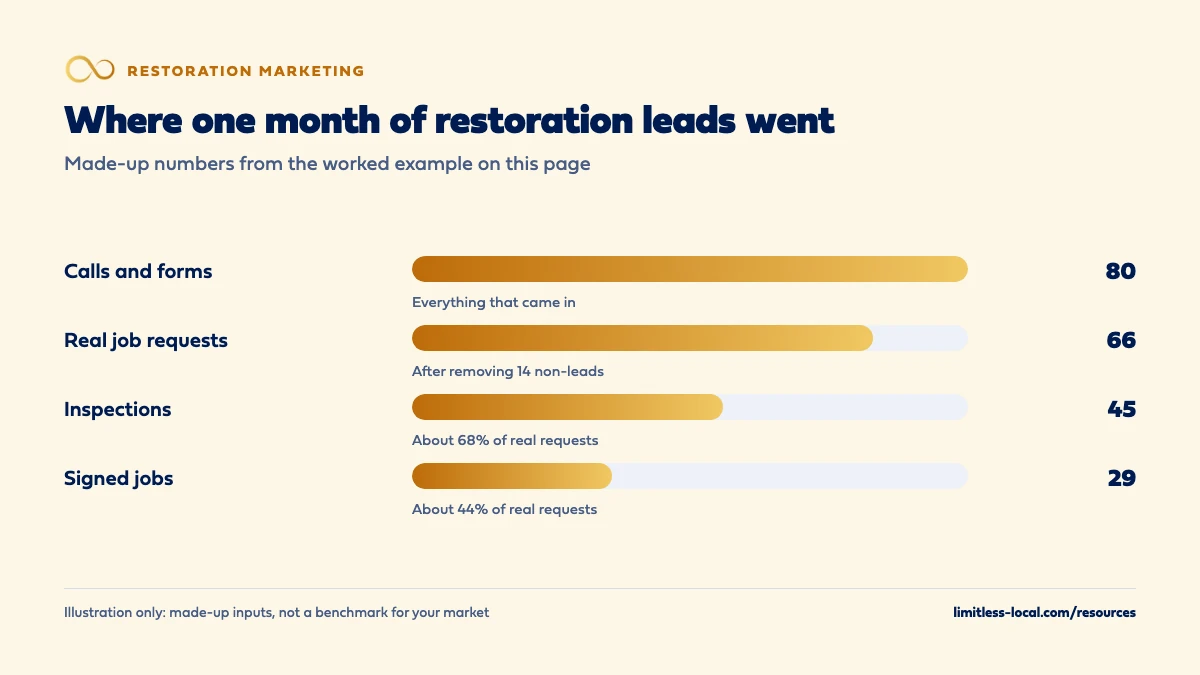
These numbers are made up to show the math, not a benchmark for your market. Say your call tracking shows 80 calls and forms in a month. You go through them and take out 14: vendors, existing customers, two calls from outside your area and a few requests for work you don’t do. That leaves 66 real job requests.
Of those 66, a technician got on site or had an inspection scheduled for 45. That’s a lead-to-inspection rate of 45 ÷ 66, about 68%. Of the 45 visits, 29 ended in a signed authorization: an inspection-to-job rate of 29 ÷ 45, about 64%. Your overall booking rate is 29 ÷ 66, about 44%.
If you’d divided by all 80 contacts instead, you’d have reported 29 ÷ 80, about 36%, and blamed your team for calls that were never jobs.
Now you listen to the unbooked calls and find most of the lost inspections came after hours, when calls went to voicemail. You fix answering, and the next month, from the same 66 real requests, you get on site six more times: 51 inspections. Your team signs 33 of them, about 65%. Overall booking rises to 33 ÷ 66, or 50%, without a dollar more in ads.
Frequently asked questions
Should I count a lead that books an inspection but never signs?
Count it in your lead-to-inspection rate, not in your booked jobs. Tracking the two steps separately is how you see whether you’re losing jobs on the phone or on site.
Does a repeat customer calling about a new loss count as a lead?
Yes, if it’s a new job request. A call about a job already in progress doesn’t count; ServiceTitan, for example, excuses calls tied to an existing job.
How many leads do I need before the booking rate means anything?
In our judgement, at least a full month, and longer for job types that come in rarely, such as fire. A handful of calls can swing the percentage wildly, so compare the same job type over the same length of time.
Is a low booking rate always the call taker's fault?
No. Junk leads from a channel, a heavy month of mold inspections or calls that were never answered all pull the rate down. Clean the lead list and split by source and job type before you judge anyone.
Can a marketing company promise me a booking rate?
Not honestly. Most of the booking happens on your phone and at the property, which no marketing company controls. What it can do is send leads you can measure and show you the booking rate by source every month.
Should mold inspection leads have their own target?
Yes. In our judgement mold calls more often end as a quote or an inspection than as a same-day job, so compare them with your own mold history rather than with water emergencies.
Key takeaways
- There’s no reliable restoration benchmark; ServiceTitan’s cross-trade figure was 42% of calls booked in June 2022.
- Remove vendors, existing customers, out-of-area and wrong-service calls before you work out the rate.
- Track two rates: lead to inspection, and inspection to signed job.
- Split by time of day, job type and source; after-hours calls are where booking rates fall hardest.
- Listen to unbooked calls, fix the biggest leak first, then measure again.
Want a second set of eyes on your setup?
We'll look at how you show up locally and where calls are leaking, then send you a plain-English breakdown.
More in this section
- What is a good cost per booked job for a restoration company?
- How should a restoration company follow up on leads that don't book?
- How do I track which marketing brings in booked restoration jobs?
- How fast does a restoration company need to answer emergency calls?
- How much do missed calls cost a restoration company?
Sources
- Typical call-booking rate for ServiceTitan users? — ServiceTitan
- Dashboard CSR metrics — ServiceTitan Help
- Understand call classifications — ServiceTitan Help
- How to qualify leads in CallRail — CallRail Help Center
- Conversion Rate Reporting — Housecall Pro Help Center
- About Automated Local Services Ads lead credits — Local Services Help
- A Brief Guide to Mold, Moisture and Your Home — U.S. EPA