
How do I grow a small electrical business with marketing?

- How do I grow my electrical business past word of mouth?
- Why does a referral-only electrical business stop growing?
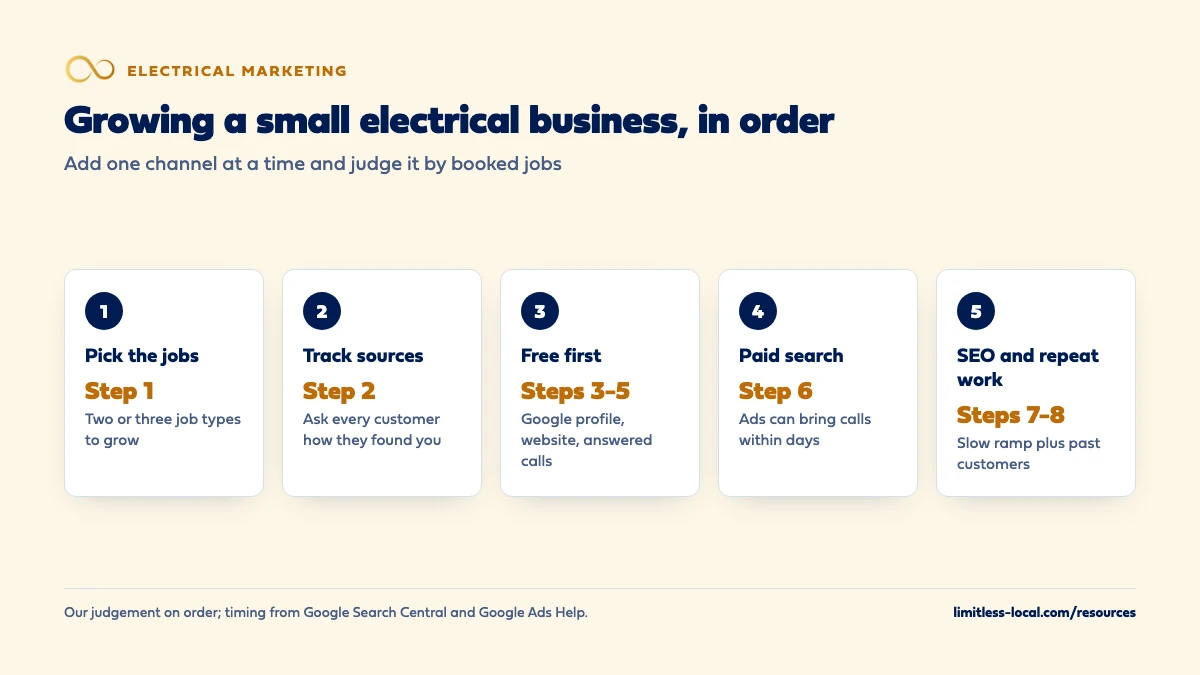
- Step 1: Decide which jobs you want more of
- Step 2: Find out where your jobs come from now
- Step 3: Get the free Google listing working for you
- Step 4: Make your website turn visits into calls
- Step 5: Stop losing the calls you already get
- Step 6: Add paid search for the jobs you want, fast
- Step 7: Start SEO as the long ramp
- Step 8: Turn past customers into repeat work
- How much should a growing electrical shop spend on marketing?
- When is a small electrical shop ready to grow faster?
- What's different about growing an electrical business
- A worked example: growing one job type at a time
- Frequently asked questions
- Key takeaways
- More in this section
- Sources
The short version
- Pick the jobs you want more of: panel upgrades, EV chargers, generators, service calls or commercial.
- Find out where today's jobs come from before you spend more.
- Free first: Google Business Profile, reviews, a website that gets calls, an office that answers.
- Then paid search for fast calls and SEO for the slow, compounding ramp.
- Judge each channel by booked jobs, and grow crews alongside leads.
For owners of established small electrical shops, one to a few trucks, who have lived on referrals and want a steadier flow of the jobs they actually want.
Get a free visibility audit · Book a growth call
How do I grow my electrical business past word of mouth?
Grow a small electrical business by deciding which jobs you want more of, measuring where your current jobs come from, and then adding channels in order: a complete Google Business Profile and steady reviews first, a website that turns visits into calls, an office that answers, then paid search for fast calls and SEO for the long ramp. Add one channel at a time and judge each by booked jobs, not clicks. Growth stops where your crews run out, so plan hiring alongside the marketing.
That’s the order we work in with owners: foundation first, then lead flow, then monthly tuning based on calls, leads and revenue. Our marketing packages show what each tier includes, and our electrical contractor marketing page covers how it applies to electricians. The full electrical marketing questions library goes deeper on each step.
Why does a referral-only electrical business stop growing?
Referrals are the best jobs most electricians get: the customer already trusts you, rarely shops price and often books the bigger work. The problem is that you can’t turn them up. Referrals arrive when past customers happen to need something or happen to talk to a neighbor, so the schedule swings from slammed to empty and you can’t plan hiring around it.
The other limit is reach. Referral work stays inside the circle of people who already know you. Homeowners who just bought an EV, need a panel upgrade to sell a house or want a standby generator before storm season mostly start with a search, not a phone call to a friend. If you’re not there, someone else gets the estimate.
Growing with marketing doesn’t mean replacing referrals. It means adding channels you can control, one at a time, so the phone rings for the work you want even when word of mouth is quiet.
Step 1: Decide which jobs you want more of
“More work” is too vague to market. Electrical work covers small service calls, panel and service upgrades, EV charger installs, generators, rewiring older homes, lighting, and commercial or new-construction work for builders and general contractors. Each one is found differently and carries a different marketing cost per job.
Write down the two or three job types you most want to grow, based on margin, what your crew is licensed and equipped to do, and what keeps trucks busy in your slow months. That list decides what your website pages say, which services you add to your Google profile, which keywords you pay for, and which customers you ask for referrals. In our judgement, a small shop that tries to market everything at once ends up visible for nothing in particular.
If commercial work is part of the plan, treat it as its own track; it’s won through bids and relationships more than search, so plan it separately.
Step 2: Find out where your jobs come from now
Before you spend more, know what’s already working. The U.S. Small Business Administration’s post on getting the most from a marketing budget says tracking results is key, and that it can be as simple as reminding staff to ask new customers where they heard about you. For print or direct mail, it suggests a different code on each piece so you can see which one brought the customer.
For a small electrical shop, a practical setup is:
- A “How did you hear about us?” field in Jobber, Housecall Pro, ServiceTitan or whatever runs your jobs, filled in on every booking.
- A tag for the job type, so you can see which sources bring panel upgrades and which bring small service calls.
- A monthly count: jobs and revenue by source.
Three months of that data tells you more than any benchmark. If you want to go further, our guide to tracking which marketing books jobs covers call tracking and source tagging.
Step 3: Get the free Google listing working for you
Google says a Business Profile lets you manage how your business shows up on Maps and Search at no charge (Google Business Profile Help). For most electricians it’s the highest-value free asset you have, because “electrician near me” searches show the map results before most websites.
Google’s page on improving your local ranking says local results are mainly based on relevance, distance, and popularity. Relevance comes from complete, detailed business info, so fill in your categories, services, service area, hours and photos of real jobs. The same page says more reviews and positive ratings can help your local ranking.
For a growing shop, this step is a check, not a project: is the profile complete, and are reviews still coming in every month? If not, fix it before spending on ads. Our pages on optimizing an electrician Google profile and marketing on a tight budget cover the free groundwork step by step.
Step 4: Make your website turn visits into calls
Once more people find you, the website decides whether they call. In our judgement, a growing electrical shop’s site needs a few things before it needs more traffic:
- Your phone number and a short estimate form on every page, easy to tap on a phone.
- A separate page for each job type you chose in Step 1, so a homeowner looking for an EV charger install lands on a page about EV chargers.
- Your license, insurance, service area and real photos of your crew’s work, since homeowners are comparing you with handymen and other electricians.
- Reviews or short testimonials near the call button.
If the site is slow, outdated or missing pages for your main services, fix that before paying to send clicks to it.
Curious what your marketing is actually booking?
Get a free visibility audit — no obligation, no sales pitch.
Step 5: Stop losing the calls you already get
Growth is often hiding in calls you already paid for or earned. When the owner and every electrician are on jobs, calls go to voicemail, and many callers simply try the next electrician on the list. Before spending more to make the phone ring, check how many calls are missed and how fast estimate requests get a reply.
Practical fixes include someone in the office during the hours you advertise, a call-forwarding plan for when the office is empty, and a same-day rule for returning calls and web forms. Our page on stopping missed calls covers the options in detail.
In our judgement, this is the cheapest growth step on the list: fixing follow-up makes every other channel cost less per booked job.
Step 6: Add paid search for the jobs you want, fast
Paid search is the channel you can turn up when you want more calls this month. Ads can start bringing leads within days of launch, while SEO typically takes months. For electricians, there are two main options on Google:
- Google search ads: you choose the keywords and pay per click, so you can aim at specific jobs like panel upgrades or EV chargers.
- Local Services Ads: Google says you pay for valid leads, such as calls and messages, rather than clicks, and that Local Services Ads are moving into Google Ads as Performance Max campaigns with pay-per-lead goals, and its migration page names electrical among the first categories (Google Ads Help).
Start with one, in a tight service area, aimed at the job types from Step 1, and track booked jobs from day one. Our page on choosing LSAs, Google Ads or SEO helps you pick which to start with.
Step 7: Start SEO as the long ramp
SEO is how you get calls from the regular Google results and the map pack without paying per click, but it’s slow. Google’s own SEO Starter Guide says some changes take effect in a few hours and others could take several months, and that you’ll likely want to wait a few weeks to judge whether a change helped. In our planning, SEO typically takes 3 to 6 months to show meaningful growth.
That’s why it goes alongside paid search rather than instead of it. Ads fill the schedule now; SEO builds pages, reviews and local visibility that keep working when ad budgets change. For a small shop, the core of SEO is the same work as Steps 3 and 4: a strong Google profile, a page for each main service and town you want, and steady reviews.
Step 8: Turn past customers into repeat work
Your past customers already trust you, which makes them the cheapest source of the next job. A homeowner who had a panel upgrade may want an EV charger next year; a landlord who called for one repair may own five more units. Growth that ignores the customer list leaves money on the table.
Keep every customer’s contact and job history in your field software, follow up after the job, and stay in touch a few times a year with something useful, such as a seasonal reminder about generator maintenance or surge protection. Ask every customer for a review when the job is done, and ask for referrals when a customer is clearly pleased.
How much should a growing electrical shop spend on marketing?
There’s no fixed answer. The SBA post says there’s no hard and fast rule, that many businesses use a percentage of revenue as a guide, and that consumer-facing businesses generally need to budget more than business-to-business ones. It also warns about a trap: sales drop, you cut marketing, and sales drop further.
A more useful check for a growing shop is job math: how many more booked jobs you want a month, times what a booked job costs you in marketing. If that number fits your margins and your crews can handle the work, the budget is about right. Our page on electrical marketing budgets walks through it.
When is a small electrical shop ready to grow faster?
In our judgement, you’re ready to add spend when three things are true: you know your cost per booked job for at least one channel, you’re answering most calls, and you have the licensed electricians to take on more work, or a hiring plan to get them. If any of those is missing, more leads mostly means more missed calls, longer wait times and worse reviews.
Crew capacity is the real ceiling for most electrical contractors. Marketing can fill a schedule quickly; finding and training qualified electricians usually takes longer. Plan the two together, and aim marketing at the job types your current crew can handle well while you hire.
Not sure which of these is costing you jobs?
A free visibility audit checks the Google profile, reviews, site and tracking, and shows what to fix first.
What's different about growing an electrical business
Licensing is a selling point. Homeowners don’t always know the difference between a licensed electrician and a handyman. Put your license, insurance and permits front and center on your website and Google profile; it’s a reason to choose you, not paperwork.
Service calls and projects pay for marketing differently. A small repair can’t carry much marketing cost; a panel upgrade, rewire or generator install can carry far more. Grow the job types with room in the margin first.
New technology is where much of the new demand is. EV chargers, battery backup, solar tie-ins and smart-home work bring customers who search for the specific job. A page and a campaign for each is often the fastest way to grow without competing on general “electrician” searches.
Commercial growth runs on relationships. Builders, general contractors and property managers award work through bids and trust. Search marketing helps them check you out, but the growth comes from follow-up and track record.
A worked example: growing one job type at a time
These numbers are made up to show the math, not a benchmark for your market. Say a two-truck shop books about 40 jobs a month, mostly from referrals, and wants to add panel upgrades.
- Where jobs come from: three months of tracking shows 28 of those jobs come from referrals and repeat customers, 9 from the Google profile and 3 from the website.
- The goal: 6 more panel upgrades a month.
- The test: a Google search campaign aimed only at panel upgrade searches in the shop’s core towns, plus a panel upgrade page on the website.
- The math: if tracking shows a booked panel upgrade costs about $350 in ad spend, 6 jobs cost about $2,100 a month in ads, before any management fee.
If a panel upgrade leaves enough margin to carry that, the owner keeps the campaign and adds the next job type. If not, the owner fixes the page, the follow-up or the targeting before spending more.
Frequently asked questions
Should I stop relying on referrals?
No. Referrals are usually your best jobs. The goal is to add channels you control so the schedule doesn’t depend on who happens to talk to a neighbor this month.
Can I grow an electrical business without paid ads?
Yes, but more slowly. A complete Google profile, steady reviews, a strong website and SEO can bring calls without paying per click; SEO typically takes months to show meaningful growth.
Is social media worth it for a small electrical shop?
It can support trust, showing real jobs and your crew, and the SBA lists social media among the low-cost ways to reach the public. In our judgement it rarely drives as many booked jobs as search for most electrical work.
Should I hire a marketing agency to grow?
Only once you know what a booked job is worth to you and can answer the calls. Ask any agency how it reports cost per booked job and what the cancellation terms are. We work month to month and ask for three months, but we won’t make you stay.
How long does it take to see growth from marketing?
Paid search can bring calls within days of launch. SEO typically takes 3 to 6 months to show meaningful growth. Nobody can honestly promise a set number of jobs.
What if I don't have time to do the marketing myself?
Start with the steps that take the least owner time and pay back most: the Google profile, review requests and answering every call. Hand off paid search and SEO when the budget allows.
Key takeaways
- Pick two or three job types to grow before choosing channels.
- Track where every job comes from; three months of data beats any benchmark.
- Do the free work first: Google profile, reviews, a website that gets calls, and answered phones.
- Add paid search for fast calls and SEO for the slower ramp, one channel at a time.
- Judge every channel by cost per booked job, and plan hiring alongside the marketing.
Want a second set of eyes on your setup?
We'll look at how you show up locally and where calls are leaking, then send you a plain-English breakdown.
More in this section
- How should I market a small electrical business on a tight budget?
- How can a small electrical company compete with bigger competitors?
- Should I hire an agency or DIY my electrical marketing?
- Where should I advertise my electrical business?
- How should an electrical contractor market to commercial customers?
Sources
- How to Get the Most From Your Marketing Budget — U.S. Small Business Administration
- Get started with Google Business Profile — Google Business Profile Help
- Tips to improve your local ranking on Google — Google Business Profile Help
- SEO Starter Guide: The Basics — Google Search Central
- Local Services Ads transition to Performance Max campaigns with pay-per-lead goals — Google Ads Help