
Should I hire an agency or DIY my electrical marketing?

- Is it better for an electrician to outsource marketing or keep it in-house?
- Can an electrician really do their own marketing?
- How much time does do-it-yourself electrical marketing take each week?
- Which electrical marketing tasks should I keep in-house?
- Which electrical marketing tasks are worth outsourcing?
- Should I hire a full-service agency or pay for just Google Ads or SEO?
- What would it cost to hire a marketing employee instead?
- How does an agency's cost compare with doing it myself?
- When does hiring an agency become the better decision?
- What should stay in my name no matter who does the work?
- How do I check an agency before I hire one?
- What's different about this decision for electricians
- A worked example: pricing your own marketing time
- Frequently asked questions
- Key takeaways
- More in this section
- Sources
The short version
- You can handle your Google profile, reviews and phones yourself; they depend on knowing the business.
- Google Ads, Local Services Ads, the website and tracking take steady weekly hours and specialist skill.
- A split often fits best: keep what only you can do, outsource the platform work.
- Whoever does it, keep your accounts in your name and judge results on cost per booked job.
For electrical contractors deciding whether to keep doing their own marketing, hand it off, or split the work.
Get a free visibility audit · Book a growth call
Is it better for an electrician to outsource marketing or keep it in-house?
A small electrical shop can do a good part of its own marketing, especially its Google Business Profile, review requests and answering the phone, because those depend on knowing the business. The parts that usually justify outside help are the ones where money moves every day or skills are specialized: Google Ads, Local Services Ads, the website and call tracking. Many electricians do best with a split: keep the work only you can do, hand off the hours-heavy platform work, and judge the result on cost per booked job.
We build that split with owners: you keep the phones, the reviews and the say on which jobs you want, and we run the ads, SEO, listings and tracking, with a monthly report on cost per booked job. Our packages page shows what each tier covers, and our electrical contractor marketing page explains how we approach residential and commercial electrical work. The rest of the electrical marketing questions library goes question by question.
Can an electrician really do their own marketing?
Yes, a good part of it. Google’s own page on whether you need an SEO says that a small local business can probably do much of the work itself, and points owners to its free starter guide. The same page says a professional can help and can save you time, and that a careless one can damage your site and reputation.
So the question isn’t whether you can. It’s where the hours come from. For most electrical owners, marketing time comes out of evenings after a day of service calls, or out of hours that would otherwise go to estimates, permits, hiring and getting paid. That trade-off decides more than skill does.
How much time does do-it-yourself electrical marketing take each week?
More than most owners plan for, and it doesn’t come in one tidy block. In our judgement, a realistic week of doing it yourself looks something like this:
- Google Ads: checking the search terms report, adding negative keywords, adjusting bids and budgets. Several short check-ins a week, plus a longer review each month.
- Google Business Profile: a post, new job photos, answering questions and replying to reviews.
- Reviews: asking customers after each job and following up with the ones who said yes but didn’t post.
- Website: fixing anything broken, adding a service page now and then, keeping prices and hours current.
- Tracking: matching calls and forms to booked jobs, so you know what worked.
The weekly total depends on how many channels you run and how big your service area is. The bigger risk is the gaps: a busy month when nobody checks the ad account can cost more than the help would have. The worked example below puts a price on the time.
Which electrical marketing tasks should I keep in-house?
The ones that depend on knowing the business and the customers, and cost mostly attention:
- Answering the phone. The best campaign in town is wasted if calls ring out while everyone is in an attic. No agency can do this part for you, though automation can help. Stopping missed calls covers the options.
- Asking for reviews. You and your electricians know which jobs went well. The ask is strongest before the truck leaves the driveway.
- Job photos. Panel swaps, EV chargers, generators and clean service work, taken on the job.
- Marking the lead source. If you use ServiceTitan, Housecall Pro or Jobber, picking a source on every new job takes seconds and makes every later decision easier.
- Deciding what you want more of. Which jobs, which towns, residential or commercial. That call is yours, whoever runs the campaigns.
Which electrical marketing tasks are worth outsourcing?
In our judgement, the ones where money moves daily or the skills are specialized:
- Google Ads. Keywords, negative keywords (“how to wire a light switch” is a do-it-yourselfer), budgets by day and hour, and landing pages. Left alone, an account can keep spending on clicks that never call.
- Local Services Ads in 2026. Google is moving them into Google Ads as Performance Max campaigns with pay-per-lead goals, and electrical is in the first phase that began in August 2026 for select advertisers, according to Google’s transition page. The setup you learned before may not be the one you have now.
- The website and service pages. Pages for panel upgrades, EV chargers, generators and rewiring, built to load fast on a phone and turn visits into calls.
- Call tracking and reporting. Tracking numbers, form tracking and matching leads to invoices.
- Listings across the web. Keeping your name, address and phone consistent on directories. Which local citations matter for electricians covers that work.
None of this is beyond a determined owner. It just takes steady hours and punishes gaps.
Curious what your marketing is actually booking?
Get a free visibility audit — no obligation, no sales pitch.
Should I hire a full-service agency or pay for just Google Ads or SEO?
It depends on where your gap is. If your Google profile, reviews and website are in good shape and you just can’t keep up with the ad account, paying a specialist for Google Ads alone can make sense. If calls aren’t coming from anywhere, a single service may fix one leak while others stay open.
Two cautions with buying piece by piece. First, someone has to own the whole picture: an ads specialist sending traffic to a slow website, or an SEO firm ranking pages for jobs you don’t want, is money spent at cross purposes. Second, tracking has to cover every channel, or you’ll end up comparing reports from vendors who each count leads their own way. In our judgement, if you split the work across several vendors, you or someone in your office should own the tracking and the monthly review.
What would it cost to hire a marketing employee instead?
More than the salary. The U.S. Bureau of Labor Statistics’ Occupational Outlook Handbook puts the median annual wage for market research analysts and marketing specialists at $78,760 in May 2025, meaning half earned more and half earned less. A separate BLS release, Employer Costs for Employee Compensation, found that in June 2026 wages and salaries made up 70% of what private employers spent on compensation, with benefits the other 30%. That 70% is an average across all private-industry jobs, not a figure for marketing roles.
Putting the two together gives a rough estimate, not a quote, since they come from different BLS surveys and dates: $78,760 divided by 0.70 puts a median-paid marketing hire at roughly $112,500 a year, or about $9,400 a month, before software, ad spend or your time managing them. Pay in your area may be higher or lower. And one person is rarely strong at Google Ads, SEO, web design and tracking all at once. A hire makes most sense when there’s a full week of marketing work every week, for example several locations or a large commercial push.
How does an agency's cost compare with doing it myself?
Doing it yourself costs your hours plus tools such as call tracking and a website platform, plus the ad spend. An agency costs a monthly fee plus the same ad spend, which goes straight to Google or Meta either way. For reference, our Essentials package is $3,500 a month and covers Google Ads management for up to $2,500 a month in ad spend at one location; Growth is $4,500 a month and adds Local Services Ads management, Meta remarketing and Google Ads management for up to $5,000 a month in spend. Ad spend isn’t included in either.
The fair comparison isn’t fee versus zero. It’s fee versus what your hours are worth, plus what mistakes cost while you learn. The SBA’s page on marketing and sales suggests a simple cost-benefit analysis for decisions like this: add up the benefits and the costs over the same period and compare. What a marketing agency costs an electrician covers how agency pricing is structured.

When does hiring an agency become the better decision?
Usually when two or three of these are true:
- You’re spending real money on Google Ads or Local Services Ads and can’t check the account every week.
- You can’t say what a booked panel upgrade or EV charger install cost you in marketing last month.
- The phone is busy with small service calls, but the larger planned work isn’t coming in.
- Your Google profile, reviews or website have gone stale for months because jobs came first.
- You’re adding a truck, a crew or a town and need the calls to arrive in step with the new capacity.
If none of those are true and the schedule is full, keep doing it yourself. If you’re just starting out, how a new electrical contractor gets its first customers covers what to do before paying anyone.
What should stay in my name no matter who does the work?
Everything that would be painful to rebuild. Give helpers their own access instead of your password:
- Google Ads. Google lets you grant different access levels. Keep yourself as an admin on your own account; only admins can give or change access.
- Google Business Profile. Stay the primary owner and add the agency or employee as a manager. Google’s page on owners and managers explains what each role can do.
- Your domain and website, registered in your business’s name with your login.
- Tracking phone numbers. Ask in writing what happens to them if you part ways.
If an employee leaves or you change agencies, you keep the history, the reviews and the phone numbers customers already have.
How do I check an agency before I hire one?
Google’s tips for hiring an SEO double as a good interview for any marketing agency. Ask for examples of past work, what results they expect and in what timeframe, how they measure success, and whether they’ll share every change they make. Google also says no one can guarantee a number one ranking, and its guidance on third-party SEO services says Google doesn’t evaluate those services, so be wary of any that claim Google’s approval.
A good agency asks about your business before it pitches: which electrical jobs you want more of, residential or commercial, and how many more jobs your crews can take. Be honest with yourself about timelines too: ads can bring calls within days of launch, while SEO typically takes 3-6 months to show meaningful growth. Red flags that an agency will waste your money lists the warning signs to watch for.
Not sure which of these is costing you jobs?
A free visibility audit checks the Google profile, reviews, site and tracking, and shows what to fix first.
What's different about this decision for electricians
The owner is often the licensed electrician on the job. In many small shops, the person who’d run the marketing is also the person pulling permits and finishing panel swaps. Every marketing hour competes with billable work.
Service calls and projects need different marketing. Emergency and service calls are won by answering fast and showing up in Maps. Panel upgrades, EV chargers and generators are planned purchases that need service pages, reviews and quote follow-up. A do-it-yourself plan that only covers one side leaves the other to chance.
Commercial work runs on relationships. Bids for builders, general contractors and property managers are usually won by the owner, not by ads. That part tends to stay in-house even when the residential marketing is handed off.
Crew capacity sets the pace. There’s no point paying for more calls than your licensed electricians can take. Grow the marketing in step with hiring.
A worked example: pricing your own marketing time
These numbers are made up to show the math, not a benchmark or a forecast.
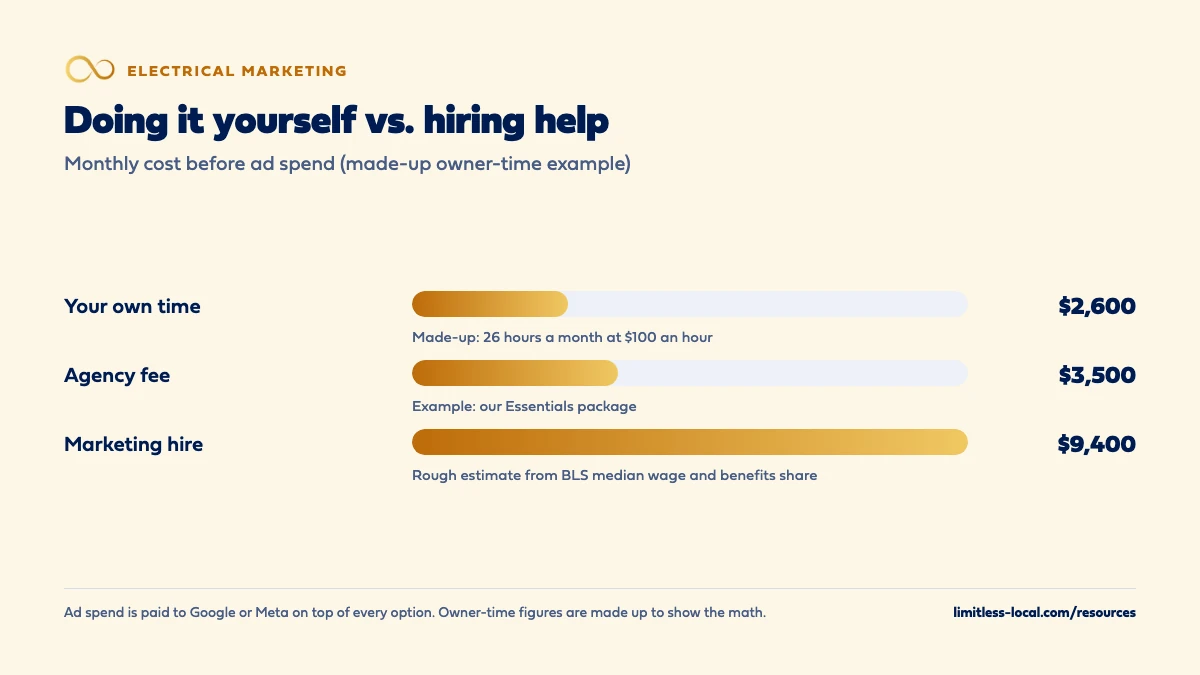
Say you spend six hours a week on marketing: ads, your Google profile, reviews and the website. That’s about 26 hours a month (six hours times 4.33 weeks). If an hour of your time is worth $100 to the business, in estimates you could have run or jobs you could have finished, your marketing time costs about $2,600 a month, before tools or ad spend.
- Doing it yourself: about $2,600 a month of your time, plus tools and ad spend.
- An agency: for example, our Essentials fee of $3,500 a month, plus the same ad spend, and most of those hours back.
- A marketing hire: roughly $9,400 a month from the BLS-based estimate above, plus ad spend.
On those inputs the agency costs $900 a month more than your time. Whether that’s worth it depends on whether the work gets done better and more consistently, which shows up in cost per booked job. That’s the comparison a free visibility audit is meant to help you make.
Frequently asked questions
Can I start doing it myself and hire an agency later?
Yes. Keep your accounts in your own name and mark the lead source on every job from the start. Then any agency you hire later starts from your real history instead of a guess.
Is a freelancer a good middle ground?
It can be, for one channel such as Google Ads or the website. Ask the same questions you’d ask an agency: who owns the accounts, how results are reported, and who covers the work when they’re unavailable.
Do I still have to do anything if I hire an agency?
Yes. You answer the phone, ask for reviews, share job photos and tell the agency which jobs and towns you want. Most of the hours move to the agency, but those parts stay with you.
What should I do first if I'm doing it myself?
Fix the basics that every other channel depends on: a complete Google Business Profile, a steady flow of reviews and a phone that gets answered. Then add paid ads.
How long should I give an agency before deciding?
Judge ads on a month or two of data and SEO on three to six months, compared over a rolling few months rather than one. We ask for three months, written into the contract, but we won’t make you stay.
Key takeaways
- Your Google profile, reviews and phones depend on knowing the business; they’re good to keep in-house.
- Google Ads, Local Services Ads, the website and tracking take steady hours and specialist skill.
- A split often fits best, with one person owning tracking and the monthly review.
- A median-paid marketing hire costs roughly $9,400 a month by a rough BLS-based estimate.
- Keep your accounts in your name and judge any option on cost per booked job.
Want a second set of eyes on your setup?
We'll look at how you show up locally and where calls are leaking, then send you a plain-English breakdown.
More in this section
- How much does a marketing agency cost for an electrician?
- How do I know if my electrical marketing agency is getting results?
- How should I market a small electrical business on a tight budget?
- How much should an electrical contractor spend on marketing?
- How do I grow a small electrical business with marketing?
Sources
- Do you need an SEO? — Google Search Central
- Google Search's guidance on using third-party SEO tools, services, and advice — Google Search Central
- Market Research Analysts: Occupational Outlook Handbook — U.S. Bureau of Labor Statistics
- Employer Costs for Employee Compensation Summary — U.S. Bureau of Labor Statistics
- Manage your business — U.S. Small Business Administration
- About access levels in your Google Ads account — Google Ads Help
- Manage your Business Profile owners & managers — Google Business Profile Help
- Local Services Ads transition to Performance Max campaigns with pay-per-lead goals — Google Ads Help