
Should a pool builder use call tracking?

- Is call tracking worth setting up for a pool construction company?
- What is call tracking, in plain terms?
- Why does call tracking matter more for a pool builder than a service company?
- Where should a pool builder use tracking numbers?
- How does call tracking work on my website?
- Will call tracking numbers hurt my Google Business Profile?
- Do I still need call tracking if I run Google Ads?
- Should I record calls from pool leads?
- What should I look for in the call reports?
- When is call tracking not worth it for a pool builder?
- What happens to the numbers if I change call tracking providers?
- What's different about call tracking for pool builders
- A worked example: what labeled calls change
- Frequently asked questions
- Key takeaways
- More in this section
- Sources
The short version
- Call tracking gives each marketing source its own phone number that forwards to your office, so every call arrives labeled with where it came from.
- On your website, a script can swap the number based on how the visitor arrived, so web calls get credited to the right ad or search.
- On Google, keep your real business number on your profile; CallRail's integration puts the tracking number first and your real number as a secondary one.
- Recordings help you hear whether calls were real pool buyers, but recording laws vary by state, so get advice before you switch it on.
For pool builders who spend money on ads, signs, shows or a website and want to know which of them actually makes the phone ring with real pool buyers.
Get a free visibility audit · Book a growth call
Is call tracking worth setting up for a pool construction company?
Yes, if you spend money on more than one way of getting found, because call tracking gives each source its own phone number that rings your office, so you can see which ads, listings, signs and shows produce calls. For a pool builder, where a handful of calls can turn into a season’s worth of contracts, knowing where those calls started is what lets you judge each channel by signed contracts. Set it up carefully on your Google Business Profile, keep your real number listed, and check your state’s call recording rules before you record.
Call tracking is part of how we measure pool marketing: every one of our marketing packages includes call tracking with recording and transcription, source tagging and a monthly report with a cost-per-lead breakdown. The lead follow-up and automation page covers what happens after the phone rings, and the pool builder marketing page shows how we run marketing for pool companies. More questions are answered one at a time in the pool builder marketing questions library.
What is call tracking, in plain terms?
Call tracking means giving each place you advertise its own phone number. Each number forwards to the phone you already answer, so nothing changes for your office except that every call now arrives with a label: this one came from the Google ad, that one from the yard sign at the Miller build, that one from the home show booth.
CallRail’s source tracking basics describe it exactly that way: one tracking number per campaign you want to measure, for example Google visitors, a yellow pages ad and a direct mail campaign, each forwarding to your main business phone number. The tracking service then logs each call against the source whose number was dialed.
Without it, you’re left with “How did you hear about us?”, which is worth asking anyway but gets answered with “Google” for almost everything, including searches for your own name after a neighbor recommended you.
Why does call tracking matter more for a pool builder than a service company?
Because each call is worth more and there are fewer of them. A service company gets enough calls each week that a rough sense of what’s working is often good enough. A pool builder might get a modest number of serious calls in a month, and a few of them become contracts worth more than everything else that month combined. Lose track of where two or three of those started and your picture of which channel works can flip.
The other reason is time. Pool sales take months from first call to signature, so by the time a contract is signed, nobody remembers how that homeowner first got in touch. A tracking number captures the source on day one, while it’s still true. Our page on tracking which marketing produces signed pool contracts covers how to carry that source all the way to the contract; this page is about getting the call labeled in the first place.
Where should a pool builder use tracking numbers?
On every paid or physical source you’d like to judge separately. A typical pool builder’s list:
- Google Business Profile. Often the biggest source of calls, and worth its own number (set up carefully, see below).
- Website. One number pool for the site, so the script can credit each visitor’s source.
- Yard signs at builds. A dedicated number on the signs shows whether neighbors of your builds call.
- Home and garden shows. One number per show, on the booth and the handouts, so you can tell a good show from a bad one. Our page on whether home shows are worth it leans on exactly this.
- Print, mailers and truck wraps. One number each, if you spend real money on them.
- Directories and lead sites you pay for.
Don’t bother with a number for every small thing. If a source costs little and you’d never change your spending based on it, leave it on your main line.
How does call tracking work on my website?
Through what’s usually called dynamic number insertion. CallRail’s dynamic number insertion overview explains the setup: you install a small script on every page of your site, much like Google Analytics, and create tracking numbers either for single sources or as a website pool. When a visitor arrives from a source you’re tracking, the script swaps the number shown on your site for the matching tracking number. CallRail calls the number it looks for the swap target, which by default is your own business number.
The practical upshot for a pool builder: a homeowner who clicked your Google ad, browsed your gallery for twenty minutes and then called from the contact page still gets credited to the Google ad, not to “website”. Without the swap, every web call looks the same.
One thing to check after setup: the number in your site header, footer, contact page and any image or button. CallRail notes that numbers inside images need their own handling, so a phone number baked into a banner graphic won’t swap on its own.
Curious what your marketing is actually booking?
Get a free visibility audit — no obligation, no sales pitch.
Will call tracking numbers hurt my Google Business Profile?
They don’t have to, if you set them up the way Google’s rules allow. Google’s guidelines for representing your business say to provide a phone number that connects to your individual business location, that the number must be under the business’s direct control, and that you shouldn’t use numbers that redirect callers to anyone other than the actual business. A tracking number that rings straight through to your office, on an account you control, fits that.
Two more details matter. Google’s help page on editing your profile says you can add up to two more phone numbers besides the primary one. And CallRail’s Google Business Profile integration puts the tracking number in as the primary number and sets your actual business number as a secondary number, which it says keeps your name, address and phone consistent. That’s the setup to copy if you do it by hand.
The real risk is mismatched numbers scattered across directories. In our judgement, keep your real number everywhere else and use the tracking number only on the profile itself.
Do I still need call tracking if I run Google Ads?
Google Ads can track some calls on its own, but only the calls from your ads. Google’s page about call reporting explains that when call reporting is on, Google assigns a forwarding number to your call assets, location assets and call ads, which lets you see details such as call duration and count calls as conversions. Calls from your Business Profile, your yard signs or your home show booth never pass through it.
Google’s page also notes that if you’d rather show your own number or use third-party call tracking, you can turn call reporting off. In our judgement, a pool builder running several paid channels is better served by one call tracking service across every source, so that the Google ad calls and everything else land in one report, with the ad calls sent back to Google Ads as conversions. Whether that’s worth the trouble depends on your budget. If you’re still deciding whether Google Ads are worth it for pool builders, start with Google’s own call reporting and add a tracking service once you’re running two or more paid channels.
Should I record calls from pool leads?
Recordings are one of the most useful parts of call tracking for a pool builder. They let you hear whether a call was a homeowner ready for a design consultation, a renovation question, a service request or a sales pitch, and they show how your office handled it. That’s how you find out that a channel isn’t bad, the calls just went to voicemail on Saturdays.
But recording has legal rules. CallRail’s inbound call recording page says laws on recording differ across U.S. states and federal agencies, that some states require both parties to consent while others require only one, and that you can add an automated greeting telling callers the line is recorded. It also says you can turn recording off on a tracking number if you need to.
This isn’t legal advice. Check your state’s rules, ideally with an attorney, before you turn recording on, and add a recording notice if there’s any doubt.
What should I look for in the call reports?
Not just the count. A pool builder should sort calls into a few plain buckets and look at them by source:
- New pool or renovation inquiry from someone in your service area. These are the calls you’re paying for.
- Existing customers, warranty or service questions.
- Out-of-area or wrong-fit calls, such as above-ground pools if you don’t sell them.
- Sales calls and spam.
- Missed calls, by hour of the day.
Then follow the new pool inquiries forward: how many booked a design consultation, and later how many signed. A channel that sends lots of calls that are mostly service questions isn’t doing the same job as one that sends fewer calls that are mostly new builds.
Missed calls deserve their own look. If a chunk of your best source’s calls come in after hours and go unanswered, the fix is in the office, not the marketing. Our page on how fast a pool builder should respond covers what to do about it.
When is call tracking not worth it for a pool builder?
When there’s nothing to compare. If almost all your work comes from referrals and past customers and you don’t pay for ads, listings, shows or signs, a tracking service mostly tells you what you already know. Asking every caller how they found you, and writing it down, is enough for now.
It’s also not worth it if nobody will look at the reports. Tracking numbers on everything, with no one sorting the calls or tying them to consultations, is just another monthly bill.
And it isn’t a fix for weak marketing. It tells you which channel is weak; it doesn’t make that channel better. Once you have a few months of labeled calls, though, decisions like whether to renew a show booth or raise an ad budget get much easier, because you’re looking at your own numbers instead of a sales rep’s.
What happens to the numbers if I change call tracking providers?
Plan for this before you print anything. Tracking numbers live in the provider’s account, so if you leave, you need to take the numbers with you or every yard sign, truck wrap and mailer still carrying them goes dead. CallRail has a help page on how to port a phone number away from CallRail to another provider, so moving numbers is possible, but it takes steps and time.
Two habits protect you. Keep the call tracking account in your company’s name, not your agency’s, so you control the numbers. And keep long-lived printed items, like signs you’ll reuse for years, on numbers you’re confident you’ll keep. Our page on who owns a pool builder’s ad accounts and website covers the same ownership question for the rest of your marketing.
Want to see where your company stands?
A free visibility audit shows where you show up on Google, Maps and AI answers, and what it's costing you in calls.
What's different about call tracking for pool builders
Few calls, big tickets. A single mislabeled call can swing a channel’s results, because one signed pool can outweigh a month of smaller work. That makes clean labels worth more than they are for a high-volume trade.
Physical sources matter. Yard signs at active builds, home and garden show booths and truck wraps are a bigger part of the mix for pool builders than for many trades, and they’re invisible to web analytics. A tracking number is the only clean way to count them.
Builds, renovations and service share one phone. If you do all three, sort calls by project type, so a source that sends resurfacing jobs isn’t judged against one that sends new construction.
Seasons skew the reports. Calls bunch up when homeowners start thinking about summer. In our judgement, compare a source with the same months last year, not with last month.
A worked example: what labeled calls change
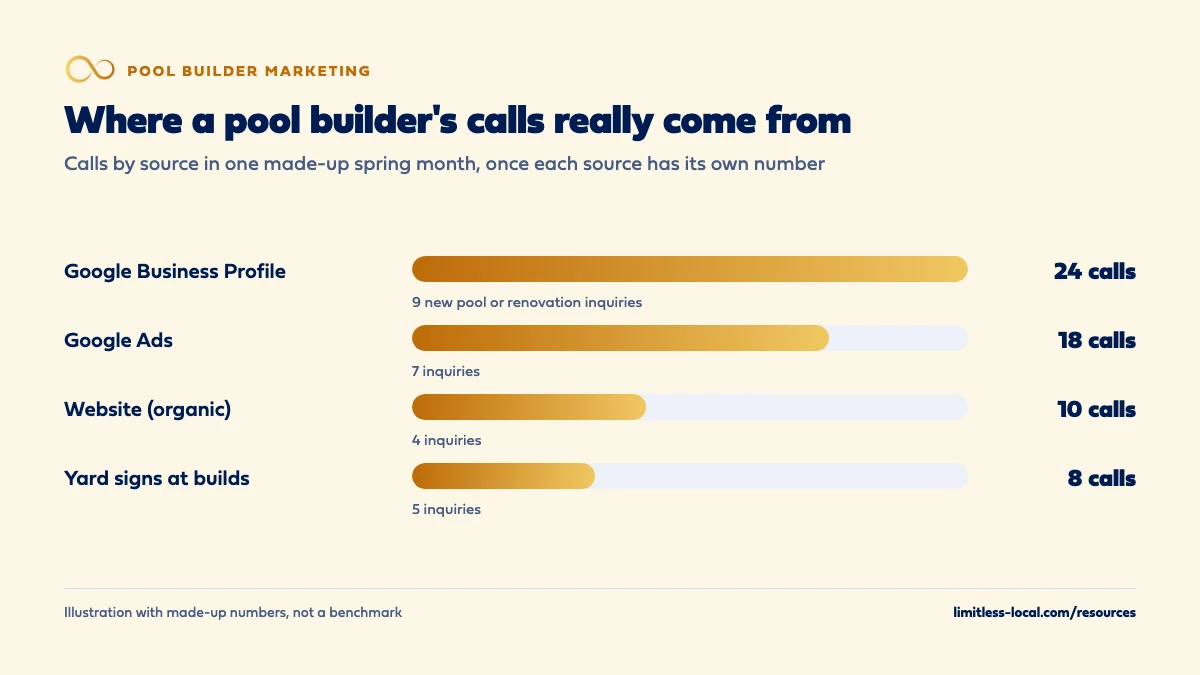
These numbers are made up to show the math, not a benchmark. Say a pool builder gets 60 calls in a spring month and, before call tracking, assumes most came from Google Ads because that’s the biggest bill.
With tracking numbers in place, the same month sorts out like this:
- Google Business Profile: 24 calls, 9 new pool or renovation inquiries.
- Google Ads: 18 calls, 7 new pool or renovation inquiries.
- Website (organic): 10 calls, 4 inquiries.
- Yard signs at builds: 8 calls, 5 inquiries.
That’s 25 real inquiries out of 60 calls. The yard signs, which cost almost nothing, produced 5 inquiries from 8 calls, the best ratio on the list. The ads still matter, but they weren’t carrying the month on their own. Follow those 25 inquiries to consultations and signed contracts over the next few months, and you’ll know which source to fund for next season.
Frequently asked questions
Do customers notice they're calling a tracking number?
Usually not. The number forwards to your normal line and your office answers as usual. If you play a recording notice, callers will hear that, but the call itself works the same.
Can I use a tracking number on my truck or yard signs?
Yes, and for pool builders those are some of the most useful places, because nothing else can count calls from them. Use numbers you plan to keep for as long as the signs and wraps last.
Can call tracking count text messages too?
Many tracking services can receive texts on tracking numbers, but features vary by provider and plan. Check before you print a number you expect people to text.
Does call tracking tell me which calls signed a contract?
Not by itself. It labels the call. You still need to record that source on the lead and add the consultation and contract when they happen, in a CRM or a spreadsheet.
How many tracking numbers does a pool builder need?
One per source you’d actually make a decision about, plus a small pool for the website. For many pool builders that’s somewhere around a handful to a dozen, not dozens.
Key takeaways
- Call tracking gives each source its own forwarding number, so every call arrives labeled.
- For a pool builder, a few calls can be worth a season of contracts, so clean labels matter more than in high-volume trades.
- On your Business Profile, use a tracking number that rings straight to you and keep your real number as a secondary one.
- Check your state’s call recording rules before you record; this isn’t legal advice.
- Keep the tracking account in your company’s name so the numbers on your signs and wraps stay yours.
Not sure what's working right now?
Start with a free visibility audit: rankings, Google profile, reviews and tracking, checked against your service area.
More in this section
- Does a pool builder need a CRM to manage leads?
- How should pool builders follow up on leads during a long sales cycle?
- Does direct mail work for pool builders?
- How do pool builders qualify leads before the design consultation?
- How do I track which marketing produces signed pool contracts?
Sources
- Source tracking basics — CallRail Help Center
- Dynamic number insertion overview — CallRail Help Center
- Google Business Profile integration — CallRail Help Center
- Guidelines for representing your business on Google — Google Business Profile Help
- Edit your Business Profile — Google Business Profile Help
- About call reporting — Google Ads Help
- Inbound call recording — CallRail Help Center
- Port a phone number away from CallRail — CallRail Help Center