
Who owns a pool builder’s ad accounts and website?

- Should my pool company or my marketing agency own the ad accounts, website and domain?
- Why does ownership matter so much for a pool builder?
- Who should own the Google Ads account?
- Who should own the Facebook and Instagram ad account?
- Who should own my Google Business Profile?
- Do I own my website if my marketing agency built it?
- Who should own the domain name?
- Who should own Google Analytics and Search Console?
- What happens to my tracking phone numbers if I leave?
- What happens to my leads if I stop working with an agency?
- What should a pool builder check in an agency contract?
- How do I take back control if the agency owns everything?
- Why ownership matters more for pool builders
- A worked example: an ownership audit in one sitting
- Frequently asked questions
- Key takeaways
- More in this section
- Sources
The short version
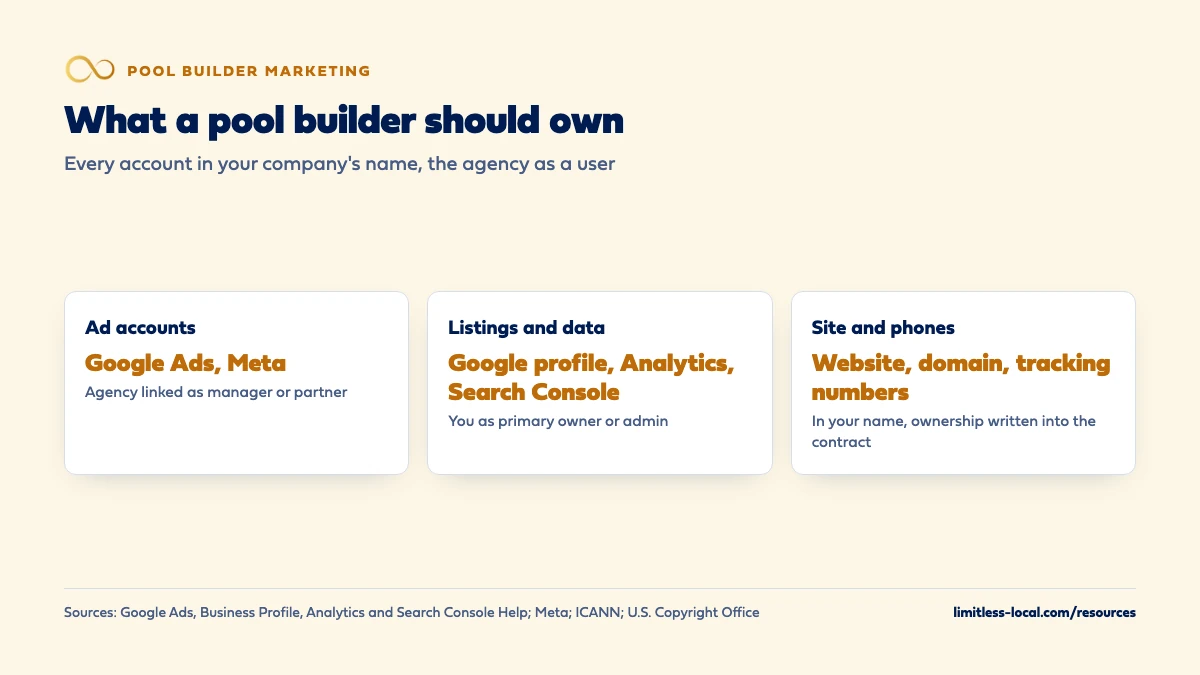
- Your company should own every account, with the agency added as a user or manager.
- That covers ad accounts, Google profile, website, domain, analytics, tracking numbers and lead records.
- Get ownership written into the contract before work starts, including the website's copyright.
- Keep a list of every login and who holds admin access, and check it twice a year.
For pool builders working with an agency, or about to, who want to make sure the accounts, website, domain and lead history stay with the company if the relationship ends.
Get a free visibility audit · Book a growth call
Should my pool company or my marketing agency own the ad accounts, website and domain?
The pool builder should own them: the Google Ads and Meta ad accounts, the Google Business Profile, the website, the domain, Google Analytics and Search Console, the tracking phone numbers and the lead records, all in the company’s name, with the agency added as a user or manager. Google says a client Google Ads account still owns its data even when an agency’s manager account has ownership access, and can remove that access by unlinking. Settle ownership in writing before work starts, because untangling it after a breakup can take weeks and cost you your history.
Whoever you hire, the accounts should outlast the relationship. Limitless Local doesn’t do long-term contracts: ours is month-to-month, which means we earn the business every month. The standard ask is three months, written into the contract, but we won’t make you stay. What’s included at each level is on the packages page, and the pool builder marketing page shows the work we do for pool companies. The rest of the agency questions are in the pool builder marketing questions library.
Why does ownership matter so much for a pool builder?
Because the value of your marketing builds up in the accounts. A Google Ads account holds years of data on which searches turned into consultations. A Google profile holds your reviews and photos. A website holds the pages that rank. A tracking number may be printed on yard signs and trucks. If those sit in someone else’s name, leaving an agency can mean starting over in the middle of a season.
In our judgement, ownership is also the best test of an agency before you hire it. One that’s happy to work inside accounts you own has nothing to hide. The wider list of hiring questions is in what to ask before hiring a pool marketing agency; this page goes deeper on ownership itself.
Who should own the Google Ads account?
You, with the agency linked through its manager account. Google explains that an agency’s manager account can be made the “owner” of a client account, which gives it full administrative and data access, but that this doesn’t take data ownership or administrative rights away from the client account. The client account still owns its data and can remove the manager’s ownership access by unlinking. A client account can have only one owner manager, and if a manager creates a new account, the manager automatically becomes its owner. Source: About ownership of client accounts.
That last point is the one to watch. If an agency creates a brand-new Google Ads account for you, ask that it be set up with your own login as an admin and your payment method on it from day one. If they link your existing account instead, the manager doesn’t get ownership unless your account enables it.
Who should own the Facebook and Instagram ad account?
Your company’s business portfolio in Meta Business Suite. Meta says an ad account can only be in one business portfolio. If an agency wants to work on an ad account owned by another business, it requests access, and the owner or someone with full control of that portfolio approves it. Source: Add an Ad Account to Your Business Portfolio in Meta Business Suite.
In practice, that means your company creates the business portfolio and the ad account, and the agency requests access as a partner. If the agency built the ad account inside its own portfolio, ask before you sign anything new how it will be handed over, because moving it later depends on their cooperation.
Who should own my Google Business Profile?
You should be the primary owner. Google allows one primary owner per profile, with full control, plus other owners and managers; managers can do most daily work but can’t add or remove users. Source: Manage your Business Profile owners & managers. Add the agency as a manager using its own Google account, not yours.
For a pool builder, the profile is where years of reviews and project photos live. In our judgement, it’s the account you can least afford to lose access to, and the one an agency has the least reason to own.
Do I own my website if my marketing agency built it?
Not automatically. This is general information, not legal advice; ask a lawyer to review any contract. The U.S. Copyright Office explains that ordinarily the person who creates a work is its author, and that a “work made for hire” is the exception. A work counts as made for hire in two situations: when an employee creates it as part of their regular duties, or when certain types of work are specially ordered or commissioned and both parties sign a written agreement saying it’s a work made for hire. In those cases, the hiring party is the author and the copyright owner. Source: Circular 30: Works Made for Hire.
An agency or freelancer isn’t your employee, so in our judgement the safe path is a written clause in the contract that transfers ownership of the site’s design, content and photos to your company once it’s paid for. Also ask what happens to any themes, plugins or page builders licensed in the agency’s name, and whether the site can be moved to your own hosting.
Curious what your marketing is actually booking?
Get a free visibility audit — no obligation, no sales pitch.
Who should own the domain name?
Your company, as the registered name holder, in an account you control. ICANN explains that changing who holds a domain is done through the current registrar, which asks the registered name holder to confirm, and that a change of registrant can trigger a 60-day lock on moving the domain to a different registrar. Source: FAQs for Registrants: Transferring Your Domain Name.
In our judgement, the domain is the one asset that’s hardest to recover once it’s in someone else’s name, because everything else (your website, your email, the links from your Google profile) points to it. Check today whose name and email are on your domain registration. If it isn’t yours, fix it before anything else.
Who should own Google Analytics and Search Console?
You, with the agency added as a user.
- Google Analytics. Adding, changing and deleting users requires the Administrator role, and deleting users requires it at the account level. Source: Add, edit, and delete Analytics users and user groups. Keep at least one company email as an account-level administrator.
- Search Console. Owners have full control and can add and remove users. A property must have at least one verified owner, and Google warns that if the only verified owner leaves, you need to verify ownership again to keep access. Source: Managing owners, users, and permissions.
These hold your history: which pages brought visitors, which searches found you, and what changed when. That’s the evidence you’ll need to judge whether an agency is working, as covered in how to know if a pool marketing agency is working.
What happens to my tracking phone numbers if I leave?
It depends on whose account they’re in. If the numbers sit in the agency’s call tracking account, ask before you sign whether you can take them with you. Moving a number takes time: CallRail, for example, says the receiving provider starts the port and the process typically takes four to six weeks, during which you shouldn’t deactivate the numbers or close the account. Source: Port a phone number away from CallRail.
For a pool builder, tracking numbers can end up on yard signs, trucks and printed brochures that last for years. In our judgement, any number printed on something physical should be one your company controls. Setting up tracking you own is covered in call tracking for pool builders.

What happens to my leads if I stop working with an agency?
Your leads should be in a CRM or lead log your company owns, not only in the agency’s dashboard. A pool builder’s open leads include homeowners planning to build next season, and losing that list means losing paid-for inquiries at exactly the point they might sign.
In our judgement, the contract should say that all lead and customer data belongs to you and that the agency will export it on request in a usable format, such as a spreadsheet. Better still, keep the system of record in your own CRM from the start. Choosing one is covered in using a CRM to manage pool leads.
What should a pool builder check in an agency contract?
This is general information, not legal advice. In our judgement, look for clear answers on:
- Account ownership: each account named as the client’s, with the agency as user or manager.
- Website and content: a written transfer of ownership of the design, copy and photos once paid for.
- Domain: registered in the client’s name.
- Data: leads, call recordings and reports belong to the client and are exported on request.
- Ad spend: paid by the client directly to the platform, or fully itemized if passed through.
- Ending the relationship: notice period, handover steps, and how long access stays open after the last payment.
How do I take back control if the agency owns everything?
Ask in writing for each account to be transferred or for your company to be made the owner or primary owner, account by account, and keep a copy of every request. Start with the domain and the Google Business Profile, because those are hardest to replace. Don’t cancel the agency’s service or close accounts until the transfers are confirmed, especially tracking numbers that are mid-port. The steps for starting over cleanly are in restarting marketing after a bad agency.
Want to see where your company stands?
A free visibility audit shows where you show up on Google, Maps and AI answers, and what it's costing you in calls.
Why ownership matters more for pool builders
Long sales cycles live in the data. A pool builder’s lead records and ad history include homeowners who inquired months ago and may sign next season. Losing that history costs more than it would for a trade that books jobs the same week.
Printed numbers last for years. Yard signs, truck wraps and home-show brochures carry phone numbers long after a campaign ends. A tracking number you don’t control can keep ringing someone else’s account.
The project gallery is the product. Your website’s photos of finished pools are your most persuasive marketing. Make sure the contract says they’re yours.
Season timing. Untangling accounts in March or April, as the selling season starts, is the worst time to be offline. Settle ownership in the off-season.
A worked example: an ownership audit in one sitting
This is an illustration of the process, not legal advice. Say a pool builder opens a spreadsheet with one row per asset: Google Ads, Meta ad account, Google Business Profile, website hosting, website files, domain, Google Analytics, Search Console, call tracking numbers and the CRM. That’s ten rows.
For each one, it records four things: whose name the account is in, which company email holds admin or owner access, whether the agency is a user or the owner, and what the contract says happens on exit. Say the audit finds the domain registered to the agency’s email, the tracking numbers in the agency’s call tracking account, and no website ownership clause in the contract. Those three are the priorities, in that order, because the domain controls the website and email, the numbers are printed on trucks, and the website clause is easiest to fix before a dispute than after one.
Frequently asked questions
Should I give my agency my Google password?
No. Add the agency as a user or manager with its own account on each platform. Nobody needs your password that way, and you can remove access cleanly.
Can an agency keep my Google Ads account when I leave?
Google says the client account owns its data and can remove a manager’s ownership access by unlinking. Problems arise when the agency created the account and you have no admin login, so get one from day one.
Who owns the ads and landing pages the agency wrote?
That depends on your contract. Ask for a clause transferring ownership of creative and content you’ve paid for. This is general information, not legal advice.
Is it a red flag if an agency wants to own my accounts?
In our judgement, yes. There are few good reasons for an agency to own a client’s accounts rather than be added as a user or manager.
What if a former employee set up my accounts?
Find which email holds owner access on each account and move it to a company email you control. In Search Console, Google says to verify ownership again if the only verified owner leaves.
How often should I check who has access?
In our judgement, twice a year and whenever someone leaves your company or you change agencies. Remove access you no longer need.
Key takeaways
- Your company should own every account, with the agency added as a user, manager or partner.
- Google says a client Google Ads account keeps its data and can unlink an agency’s manager account.
- A website isn’t automatically yours because you paid for it; get ownership in writing.
- Put the domain in your company’s name first; everything else points to it.
- Keep leads in a system you own and settle ownership before the selling season.
Not sure what's working right now?
Start with a free visibility audit: rankings, Google profile, reviews and tracking, checked against your service area.
More in this section
- How do I advertise a pool construction company?
- Are Google Ads worth it for pool builders?
- Which online listings should a pool builder have besides Google?
- Does a pool builder need a pool-specific or general marketing agency?
- Do Facebook and Instagram ads work for pool builders?
Sources
- Manager Accounts (MCC): About ownership of client accounts — Google Ads Help
- Add an Ad Account to Your Business Portfolio in Meta Business Suite — Meta Business Help Center
- Manage your Business Profile owners & managers — Google Business Profile Help
- Circular 30: Works Made for Hire — U.S. Copyright Office
- FAQs for Registrants: Transferring Your Domain Name — ICANN
- Add, edit, and delete Analytics users and user groups — Google Analytics Help
- Managing owners, users, and permissions — Search Console Help
- Port a phone number away from CallRail — CallRail Help Center