
Will AI-written content hurt my plumbing website’s Google rankings?

- How do I make sure using AI-generated content won't get my plumbing website penalized by Google?
- Does Google penalize AI-written content?
- What kind of AI content does get plumbing sites in trouble?
- What happens if Google decides my pages are spam?
- Can I use AI to write my plumbing service pages?
- How do I check an AI draft before I publish it?
- Should I tell visitors that AI helped write my pages?
- Is AI content riskier for blog posts or for city pages?
- Can AI-written content help my plumbing company show up in AI answers?
- What should I do with AI pages I've already published?
- What's different about AI content for plumbers
- A worked example: forty AI town pages or six real ones
- Frequently asked questions
- Key takeaways
- More in this section
- Sources
The short version
- Google judges the quality of the page, not whether AI wrote it.
- Mass-producing pages with AI mainly to rank breaks Google's spam policies.
- Thin, near-identical city and service pages are the biggest risk for plumbers.
- Use AI for drafts; add real plumbing detail, check facts and edit before publishing.
For plumbing owners using, or tempted by, AI to write service pages, city pages and blog posts, and wondering where Google draws the line.
Get a free visibility audit · Book a growth call
How do I make sure using AI-generated content won't get my plumbing website penalized by Google?
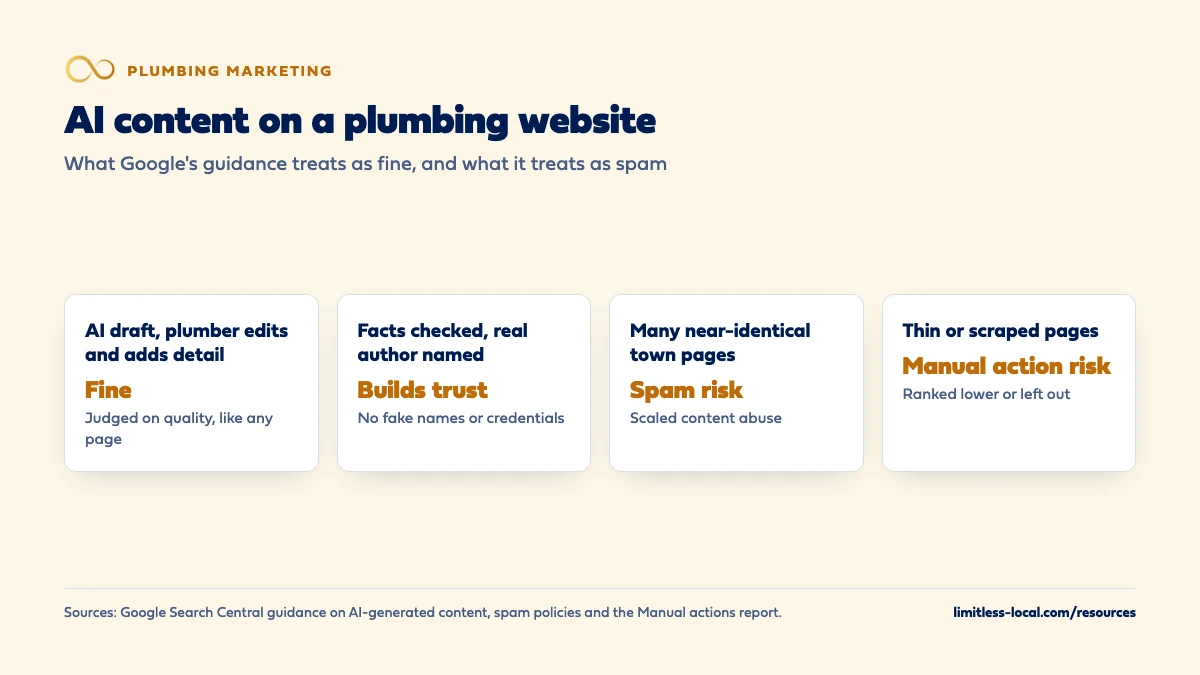
AI-written content won’t hurt your plumbing website’s rankings just because AI wrote it; Google says it rewards helpful, original content however it’s produced. What can hurt you is using AI to churn out lots of thin, near-identical pages mainly to rank, such as dozens of city pages that only swap the town name, which Google’s spam policies call scaled content abuse. Use AI for drafts, then have someone who knows your plumbing work add real detail, check every claim and publish only pages a customer would find useful.
Good plumbing pages come from what you actually do, which AI can’t know on its own. Our local SEO work builds service and area pages around the jobs and towns you want, alongside Google Business Profile and listing work, and we don’t guarantee rankings because nobody honestly can. See how we approach plumbing marketing, or browse the rest of the plumbing marketing questions library.
Does Google penalize AI-written content?
Not for being AI-written. Google’s guidance about AI-generated content says its ranking systems aim to reward original, high-quality content that shows expertise, experience, authoritativeness and trustworthiness, focusing on the quality of content rather than how it’s produced. Its FAQ answers “Is AI content against Google Search’s guidelines?” with: appropriate use of AI or automation is not.
The same page draws the line clearly. Using automation, including AI, to generate content with the primary purpose of manipulating rankings violates Google’s spam policies. And it says using AI doesn’t give content any special gains: if a page is useful, helpful and original it might do well; if it isn’t, it might not.
So the honest answer for a plumber is that AI is neither a penalty nor a shortcut. The page has to earn its place either way.
What kind of AI content does get plumbing sites in trouble?
Volume without value. Google’s spam policies define scaled content abuse as generating many pages mainly to manipulate rankings rather than help users, no matter how it’s created. Its examples include:
- Using generative AI tools to generate many pages without adding value for users.
- Scraping or rewording other sites’ content, including by synonymizing or translating it.
- Stitching content from different pages together without adding value.
- Pages that make little sense to a reader but contain search keywords.
For a plumbing company, in our judgement, the usual version is a batch of pages like “Drain cleaning in [town]” for forty towns, each the same AI paragraph with the town name swapped. Those pages tell a homeowner nothing about you, and they’re exactly the pattern the policy describes. Building city pages without spam covers how to do area pages properly.
What happens if Google decides my pages are spam?
Two things can happen. Google’s automated systems may simply rank the pages poorly. Or a person at Google may take a manual action.
Google’s Manual actions report page says a manual action is issued when a human reviewer has determined that pages on a site don’t comply with the spam policies, and that most issues reported there will result in pages or sites being ranked lower or left out of search results. One listed type is “thin content with little or no added value”, with doorway pages and scraped content among the examples.
If it happens, Google notifies you in Search Console. You fix the issues on all affected pages and request a review; Google says most reconsideration reviews take several days or weeks. In our judgement, it’s far cheaper not to publish the pages in the first place, which is why Search Console should be set up on every plumbing site.
Can I use AI to write my plumbing service pages?
Yes, as a starting point. Google’s guide to creating helpful, people-first content asks whether your content clearly shows first-hand expertise and depth of knowledge, and whether a reader leaves feeling they’ve learned enough to reach their goal. An AI draft can’t supply first-hand expertise. A plumber can.
In our judgement, a plumbing service page is worth publishing when it includes things only your company knows:
- What the job actually involves in your area: the pipe materials, slab or crawl space homes, water hardness, older sewer lines.
- How you do it, what affects the price, and how long it usually takes.
- Photos of your own crews on real jobs.
- Answers to the questions your office actually hears.
How many service pages a plumbing website needs covers which pages to build first.
Curious what your marketing is actually booking?
Get a free visibility audit — no obligation, no sales pitch.
How do I check an AI draft before I publish it?
Read it as a homeowner and as a plumber. Google’s helpful content guide lists warning signs, including content made mainly to attract search visits, extensive automation producing content on many topics, mainly summarizing others without adding value, and pages that leave readers needing to search again.
In our judgement, a practical checklist for each plumbing page:
- Is every fact right? AI can invent codes, permit rules, prices and warranties. Cut anything you can’t confirm.
- Does it say what you really do? Remove services, areas and hours you don’t offer.
- Is there something here a competitor’s page doesn’t have? If you could swap in another plumber’s name and nothing would change, it isn’t done.
- Would a homeowner know what to do next? Clear next step, real phone number.
- Does it read like a person? Cut filler and repetition.
Safety topics deserve extra care. Google says its systems give even more weight to content with strong experience, expertise, authoritativeness and trustworthiness on topics that could significantly affect people’s health, financial stability or safety. Gas lines, backflow and water contamination are not places for unchecked AI text.
Should I tell visitors that AI helped write my pages?
Google leaves it to judgement. Its guidance says AI or automation disclosures are useful where someone might reasonably wonder “How was this created?”, and that you should consider adding them when that would be expected. It also says giving AI an author byline is probably not the best approach.
Where Google is firm is deception. Its helpful content guide says fabricating creator profiles, such as AI-generated headshots, made-up names or false credentials to make content look like it was written by experts, is a form of deception and a signal of a low-quality page.
In our judgement, for a plumbing site that means: if a page carries a name, it should be a real person at your company who reviewed it, and any license or certification mentioned should be real and current. Making your plumbing company look trustworthy online covers what to show instead.
Is AI content riskier for blog posts or for city pages?
City and service-area pages, in our judgement, because they’re the pages owners are most tempted to mass-produce. A handful of blog posts on genuine questions, each edited and checked, carry little risk. Dozens of town pages generated in an afternoon carry the most.
Blogs have their own trap: AI makes it easy to publish lots of posts on loosely related topics. Google’s warning signs include producing lots of content on many different topics in the hope some of it ranks, and writing about things because they seem trending rather than because your audience needs them. A plumbing blog does better, in our judgement, with fewer posts that answer real customer questions than with daily filler.

Can AI-written content help my plumbing company show up in AI answers?
Only through the same route as search: being useful and accurate. In our judgement there’s no special AI format that gets a plumber recommended. Clear service pages, consistent business details across the web and real reviews are what both Google and AI assistants can draw on.
Google’s spam policies also list attempts to manipulate generative AI responses in Google among practices they cover. Getting recommended by ChatGPT covers what helps there.
What should I do with AI pages I've already published?
Audit them. In our judgement, sort each AI-written page into one of three piles:
- Keep and improve: pages on services and towns you really serve. Add real job detail, photos and accurate facts.
- Merge: near-duplicate pages that say the same thing. Combine them into one stronger page and redirect the others.
- Remove: pages for services you don’t offer or towns you don’t serve. Google’s spam policy page says that if you’re hosting scaled content, you should exclude it from Search.
Then check Search Console’s Manual actions report. If there’s nothing listed, fixing the pages is ordinary site cleanup. If there is, follow Google’s reconsideration steps after every page is fixed. Either way, don’t expect overnight changes: SEO typically takes months to show meaningful growth. How long plumbing SEO takes covers the timeline.
What's different about AI content for plumbers
Plumbing pages tend to look alike. Drain cleaning, water heaters and leak repair read much the same from one company to the next, so AI drafts of them come out generic. In our judgement, the detail that makes a plumbing page worth ranking is local and first-hand: your area’s pipes, homes and water, and your own photos.
Many plumbers serve lots of towns. That makes the city-page shortcut tempting and makes scaled content abuse the most likely way a plumbing site gets into trouble with AI.
Some plumbing topics touch safety. Gas lines, backflow prevention and water quality can affect people’s health. AI can state rules that don’t apply in your state; a licensed plumber should check those pages.
Want to see where your company stands?
A free visibility audit shows where you show up on Google, Maps and AI answers, and what it's costing you in calls.
A worked example: forty AI town pages or six real ones
These numbers are made up to show the trade-off, not a benchmark. Say an owner could publish 40 town pages in a day with AI, each the same text with a different town name. Or he could publish 6 pages for the towns he most wants work in, each starting from an AI draft and then reviewed by a plumber for about 1 hour: local housing, common jobs in that town, photos from real jobs there.
The first option takes a day and produces exactly the pattern Google’s spam policies describe: many pages, little added value. The second takes about 6 hours of a plumber’s time plus editing, and produces pages a homeowner in those towns would find useful.
In our judgement, the second is the only version worth publishing. More towns can follow, one real page at a time.
Frequently asked questions
Can Google tell if my content was written by AI?
Google says it focuses on quality, not on how content is produced, and that its systems look for spam however it’s made. Write for quality, not to avoid detection.
Is it safe to use AI to rewrite a competitor's plumbing page?
No. Google’s spam policies list rewording other sites’ content, including by synonymizing, as scaled content abuse when it adds little value.
Should my plumbing pages have an author byline?
Where a reader would expect one, yes, and it should be a real person at your company. Google advises against fabricated author profiles.
How much AI is too much on a plumbing site?
There’s no percentage. The test is whether each page is accurate, useful to a homeowner and different from what’s already out there.
Will AI-written Google Business Profile posts hurt my rankings?
We haven’t found a Google rule against them. In our judgement, posts should still be accurate and specific, with real photos, or they’re not worth posting.
Do I need to delete all my AI pages?
Not necessarily. Improve the ones about services and towns you really serve, merge duplicates, and remove pages that don’t help anyone.
Key takeaways
- Google judges the page, not whether AI helped write it.
- Using AI to mass-produce pages mainly to rank is scaled content abuse under Google’s spam policies.
- Near-identical town pages are the biggest AI risk for plumbing sites.
- Use AI for drafts; add first-hand plumbing detail, check every fact and edit before publishing.
- Never invent authors or credentials, and take extra care on safety topics.
- Audit existing AI pages: improve, merge or remove them, and check Search Console for manual actions.
Not sure what's working right now?
Start with a free visibility audit: rankings, Google profile, reviews and tracking, checked against your service area.
More in this section
- Will call tracking numbers hurt my plumbing Google rankings?
- How do I rank my plumbing website in Google's organic results?
- Will Google AI Overviews take calls from my plumbing company?
- If I stop Google Ads, will my plumbing leads drop?
- What keywords should my plumbing Google Ads target?
Sources
- Google Search's guidance about AI-generated content — Google Search Central Blog
- Spam policies for Google web search — Google Search Central
- Creating helpful, reliable, people-first content — Google Search Central
- Manual actions report — Search Console Help