
How do I make my HVAC company look trustworthy online?

- How do I make my HVAC company look trustworthy enough to get chosen online?
- What do homeowners check before they trust an HVAC company online?
- What should my Google reviews show a nervous homeowner?
- Do real photos make my HVAC company look more trustworthy than stock photos?
- Should I show my license and insurance on my website?
- What does the Google Verified badge do for an HVAC company?
- Does it matter if my name and phone number differ from site to site?
- What should my website say about who we are?
- Can I put customer testimonials on my website?
- What makes an HVAC company look untrustworthy online?
- How long before trust work shows up in my calls?
- What's different about trust for HVAC companies
- A worked example: two HVAC profiles side by side
- Frequently asked questions
- Key takeaways
- More in this section
- Sources
The short version
- Reviews with replies, real photos and a stated license and insurance do most of the work.
- Keep your name, phone number and service area identical everywhere.
- Your website should say who owns the company and who will show up at the door.
- Remove the red flags: keyword-stuffed names, stock photos, '24/7' nobody answers.
For HVAC owners who do honest work but suspect their Google profile and website don’t show it.
Get a free visibility audit · Book a growth call
How do I make my HVAC company look trustworthy enough to get chosen online?
Show homeowners proof they can check: a steady flow of real Google reviews with replies, real photos of your own trucks, crews and jobs, your license and insurance stated plainly, and the same business name, phone number and service area everywhere you’re listed. Make your website say who owns the company, who will show up and where you work, because Google’s own guidance says trust is the most important part of the experience, expertise, authority and trust it looks for in content. If you run Local Services Ads, the Google Verified badge adds a third-party check, since Google treats HVAC as an urgent category and adds a level of screening that includes background checks on service professionals.
Trust is what turns a profile view into a call, so it’s where we start when we look at an HVAC company’s online presence. Business listing cleanup, Google Business Profile management, review response and a website that says who you are are part of our HVAC marketing work, from local SEO to HVAC websites, and we sync your name, address and phone across 50+ directories. The HVAC marketing guide covers how a website homeowners trust fits with the other channels, and the rest of the HVAC marketing questions library goes question by question.
What do homeowners check before they trust an HVAC company online?
In our judgement, a homeowner deciding whether to let a stranger into their house and their mechanical room runs a quick, mostly unconscious checklist:
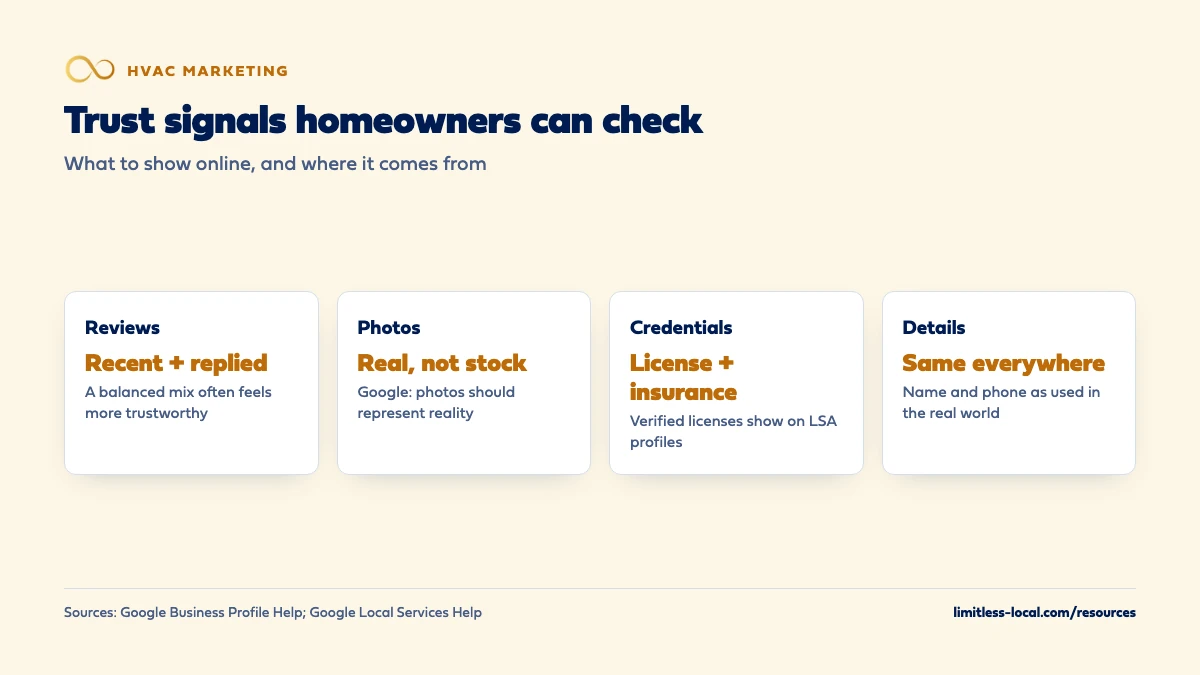
- Do other people vouch for them? Reviews, how many, how recent, and how the company answers the bad ones.
- Are they real and local? Photos of actual trucks, crews and finished jobs; a service area that includes my town.
- Are they legitimate? A license number, insurance, and any verification badge.
- Do the details add up? The same name and phone number on Google, the website and the truck.
- Will someone answer? Hours that match reality and a phone that gets picked up.
None of these is clever marketing. Each is proof that’s either there or missing, and most of it costs time rather than money. The rest of this page goes through them one by one.
What should my Google reviews show a nervous homeowner?
Volume, recency and replies. A handful of old five-star reviews says less than a steady stream of recent ones that mention real jobs. Google says honest and balanced reviews help customers decide, that a mix of positive and negative feedback often feels more trustworthy, and that replying shows customers their feedback matters.
The reply to a bad review is part of your trust signal, because the next homeowner reads it. Google’s advice: protect the reviewer’s privacy, acknowledge mistakes, explain what you can and can’t do, and apologize when it’s earned. For how much reviews move your phone, and how to get more of them inside Google’s rules, see how much Google reviews affect calls. Source: Tips to get more reviews.
Do real photos make my HVAC company look more trustworthy than stock photos?
Yes, and Google’s own photo rules point the same way. Google says Business Profile photos should be in focus, well lit and free of significant alterations or excessive filters or AI; in its words, the image should represent reality. For service businesses it suggests at least three photos at work that represent the services you offer, and at least three team photos that show a more personal side of the business.
For an HVAC company, that means your techs at a condenser or furnace, an install in progress, a clean finished mechanical room, your trucks, and the people a homeowner will actually meet. In our judgement, a homeowner can usually tell a stock photo from a real one, and the stock photo quietly says “we don’t want to show you who we are.” Use the same real photos on your website. Source: Tips for business-specific photos on your Business Profile.
Should I show my license and insurance on my website?
Yes. In our judgement, it’s one of the cheapest trust signals there is: your state license number, the fact that you carry liability insurance, and the training or certifications your techs actually hold, stated in plain words on your website and on estimates. Check with your state licensing board on whether your license number has to appear in your ads and on your trucks.
Google checks licenses too, at least for Local Services Ads: it says it verifies applicable state-level business and owner licenses where it can, checks them against state databases, and displays the verified licenses on the business’s profile. Insurance checks, where required, mean submitting a certificate of insurance whose name matches the name you used to sign up for Local Services Ads. Source: Understand the screening and verification process.
Curious what your marketing is actually booking?
Get a free visibility audit — no obligation, no sales pitch.
What does the Google Verified badge do for an HVAC company?
The Google Verified badge is Google’s single badge for Local Services Ads advertisers who complete its screening and verification. It shows on your Local Services Ads profile, may appear on other Google surfaces where it adds value for customers, and the verifications you completed are called out on your profile. Google says the switch to the new badge doesn’t affect Local Services Ads ranking.
Google calls HVAC an urgent category, because people call in a hurry, for example with a broken heater in freezing weather, so HVAC companies go through an additional level of screening that includes background checks on the service professionals. The requirements Google lists for HVAC include business and owner checks and state business and owner licenses, each of them marked as applying to select advertisers only. One thing the badge no longer carries: Google discontinued the money-back guarantee that came with the old Google Guarantee badge, so don’t promise homeowners a Google-backed refund. Whether the ads are worth running is covered in whether Local Services Ads are worth it. Sources: About Google Verified badge and Business screening and verification requirements (United States).
Does it matter if my name and phone number differ from site to site?
It matters for trust as much as for ranking. Google asks businesses to represent themselves the way they’re consistently represented in the real world, across signage, stationery and other branding, and says your name on Google should be the real-world name used on your storefront, website and paperwork. In our judgement, a homeowner who sees one phone number on Google, another on your website and a third on an old directory listing starts wondering whether they’ve found the right company, or whether you’re still in business.
Cleaning that up across the web is its own job, covered step by step in fixing your name, address and phone online. Source: Guidelines for representing your business on Google.
What should my website say about who we are?
Who owns the company, how long you’ve been doing this, who will show up at the door, where you work, and how to reach a person. Google’s guidance on helpful content asks whether a page presents information in a way that makes you want to trust it, including background about who’s behind the site, such as an About page, and says that of experience, expertise, authoritativeness and trust, trust is the most important. Google also notes that this isn’t a single ranking factor; it’s a description of what its systems try to reward.
For an HVAC website, that translates into an About page with the owner’s name and photo, a team page with your real techs, a service area page that lists the towns you actually serve, and contact details that match your Google profile. The pages an HVAC website should have covers the full list. Source: Creating helpful, reliable, people-first content.
Can I put customer testimonials on my website?
Yes, if they’re real. The FTC’s rule on consumer reviews and testimonials makes it a violation for a business to write or create a testimonial that misrepresents whether the person exists, whether they used your service, or what their experience was. If a testimonial comes from an officer, manager, employee or agent of the business, the rule requires a clear disclosure of that relationship when it isn’t otherwise obvious. Source: 16 CFR Part 465, Rule on the Use of Consumer Reviews and Testimonials.
Our recommended practice: use the customer’s own words, with their permission, their first name and town, and the kind of job you did. Don’t trim a mixed review into a glowing one. Linking to your Google reviews from the website lets a homeowner see the whole picture, which in our judgement is more convincing than a hand-picked carousel.
What makes an HVAC company look untrustworthy online?
A few red flags show up again and again, and most of them are quick fixes:
- A keyword-stuffed business name. “Best AC Repair Springfield 24/7” reads as spam to homeowners, and Google says adding unnecessary information to your name isn’t permitted and could get the profile suspended.
- “Open 24 hours” when nobody answers. The first unanswered emergency call turns into a bad review. List the hours someone actually picks up.
- An address customers can’t visit. Google says businesses showing an address should have permanent signage there; if you go to customers and don’t serve them at your shop, use a service area instead.
- Unanswered bad reviews. Silence reads as either not caring or not knowing.
- Stale details. Last year’s promotion, a broken contact form or a team page full of people who left.
And if the phone does ring, the trust you built can be lost in the first minute; how fast you respond to new leads covers that part. Source: Guidelines for representing your business on Google.
How long before trust work shows up in my calls?
Some of it shows the day you do it: new photos, replies to old reviews, corrected hours and a clean business name are visible as soon as Google publishes them. Reviews build month by month. The ranking side of the work is slower; SEO typically takes three to six months to show meaningful organic growth, so don’t judge a cleanup by its first few weeks.
What you can’t do is skip the work and buy the result. There’s no badge, plugin or review package that makes a company trustworthy if the proof behind it isn’t real, and the shortcuts that fake it, such as bought reviews or invented testimonials, are against Google’s rules and the FTC’s.
Not sure which of these is costing you jobs?
A free visibility audit checks the Google profile, reviews, site and tracking, and shows what to fix first.
What's different about trust for HVAC companies
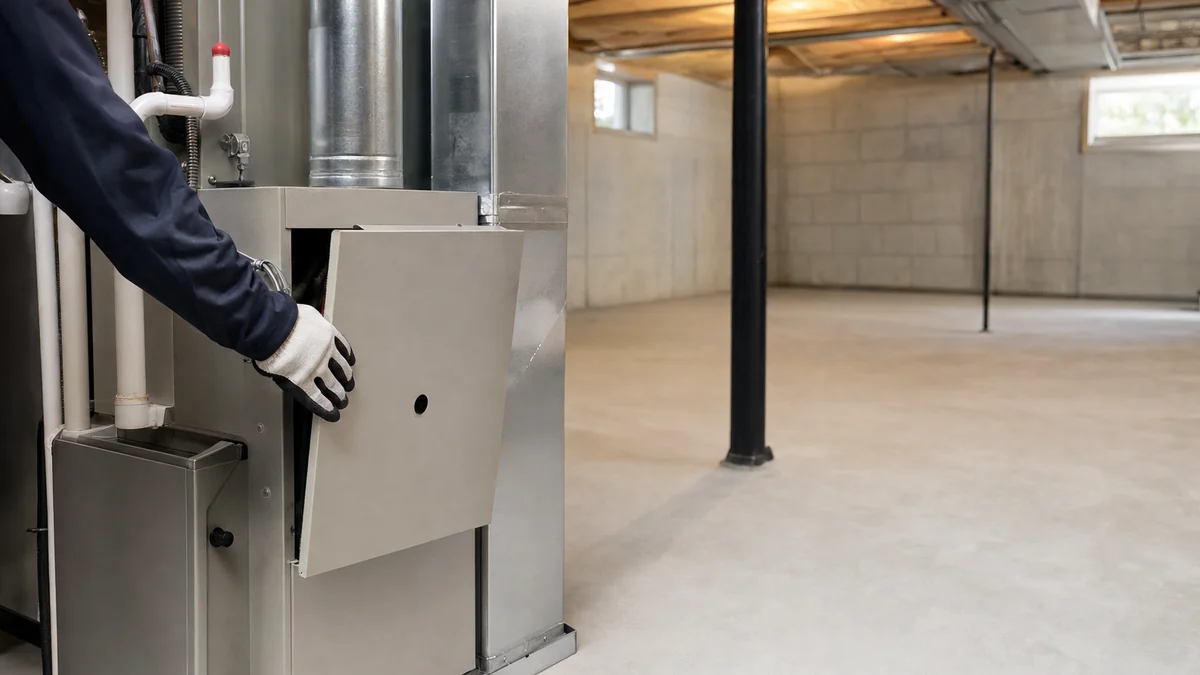
You’re going inside the house. An HVAC tech goes into basements, attics and utility closets, sometimes with only one adult at home. Google already screens HVAC more heavily for Local Services Ads, which it ties to how urgent HVAC calls are, and in our judgement the same in-home access is why team photos with names and a line about background checks (if you run them) carry more weight for HVAC than for most trades.
Urgency cuts both ways. A homeowner with no heat decides fast, so the trust signals that show at a glance, like rating, review count, photos and a badge, matter most at night and in peak season.
Replacements are big, rare decisions. A homeowner spending thousands on a new system reads more: the About page, the install photos, the reviews that mention installs. Make sure there’s something real there to read.
Price fears are trust fears. Many homeowners worry about being upsold. Clear explanations of how you diagnose and quote do more than a discount banner; attracting fewer price shoppers goes further.
A worked example: two HVAC profiles side by side
These profiles are made up to show the comparison a homeowner makes, not a benchmark. Company A has a 4.6 rating from 38 reviews, most from the last year, with a short reply under every one, including two critical reviews where the owner explained what happened and how it was fixed. Its photos show branded trucks, named techs and a finished furnace install, and its name and phone number match the website.
Company B has a 4.9 rating from 6 reviews, the newest one more than a year old, no replies, three stock photos of a smiling technician, and a business name with a city and “24/7” added on.
On stars alone, B wins. In our judgement, most homeowners call A, because everything on A’s profile can be checked and adds up, and almost nothing on B’s can. The good news for B is that every gap on its profile is fixable in a few weeks of steady work, except the reviews, which take longer to build.
Frequently asked questions
Should I show my home address so the company looks established?
No. Google says businesses showing an address should keep permanent signage there, and a business that travels to customers without a storefront gets a service-area profile instead. Source: Guidelines for representing your business on Google.
Is the Google Verified badge the same as Google Guaranteed?
It replaced it. Google moved to a single Google Verified badge and discontinued the money-back guarantee that came with the old Google Guarantee badge.
Can I use AI-edited or heavily filtered photos on my Google profile?
Google says photos should have no significant alterations or excessive use of filters or AI, and should represent reality. Real job-site photos are the safer choice.
Do manufacturer dealer badges help homeowners trust us?
In our judgement they help when they’re current and real, because they’re another thing a homeowner can check. Only show programs you’re in today, and follow the manufacturer’s rules for using its logo.
Does showing prices on my website build trust?
It can, especially for maintenance plans and diagnostic fees, because it removes a fear. Full replacement pricing is harder to post honestly; attracting fewer price shoppers covers how to frame it.
Do I need an About page if my Google profile looks good?
Yes. In our judgement, many homeowners click through to the website before calling, and Google’s own content guidance points to background about who is behind a site, such as an About page, as something that builds trust.
Key takeaways
- Trust online is proof a homeowner can check: reviews, real photos, credentials and consistent details.
- Use real photos of your own trucks, techs and jobs; Google wants photos that represent reality.
- State your license and insurance plainly; Google verifies licenses for Local Services Ads.
- Say who owns the company and who will show up; Google calls trust the most important quality signal.
- Remove red flags such as stuffed names, ’24/7′ nobody answers and unanswered bad reviews.
Want a second set of eyes on your setup?
We'll look at how you show up locally and where calls are leaking, then send you a plain-English breakdown.
More in this section
- How should a commercial HVAC company market itself?
- What can I do myself to improve my HVAC company's Google ranking?
- How does an HVAC company earn backlinks?
- How do I get my HVAC company recommended by ChatGPT and AI search?
- How do I fix my HVAC company's name, address and phone online?
Sources
- Tips to get more reviews — Google Business Profile Help
- Tips for business-specific photos on your Business Profile — Google Business Profile Help
- Guidelines for representing your business on Google — Google Business Profile Help
- About Google Verified badge — Google Local Services Help
- Understand the screening and verification process — Google Local Services Help
- Business screening and verification requirements (United States) — Google Local Services Help
- Creating helpful, reliable, people-first content — Google Search Central
- 16 CFR Part 465: Rule on the Use of Consumer Reviews and Testimonials — Electronic Code of Federal Regulations (FTC rule)