
What marketing traps waste the most money for plumbers?

- Which plumbing marketing mistakes burn the most budget in 2026?
- Which plumbing marketing mistakes cost the most over a year?
- Are my Google Ads paying for searches I don't want?
- Are my ads showing to people outside my service area?
- Is Display Expansion spending my search budget somewhere else?
- Am I paying for plumbing calls nobody answers?
- Am I paying Local Services Ads for jobs I don't do?
- Am I judging my marketing by clicks and leads instead of booked jobs?
- Should I pay for a guaranteed Google ranking?
- Can buying reviews or paying for good ones backfire?
- What if my marketing company owns my ad account?
- Are directory listings and lead-buying sites a trap?
- What's different about wasted marketing money for plumbers
- A worked example: what two small leaks cost in a year
- Frequently asked questions
- Key takeaways
- More in this section
- Sources
The short version
- Read the search terms report and block searches that will never book.
- Target people in your service area, not just people interested in it, and check Display Expansion.
- Answer every hour you advertise, because missed calls can still be charged.
- Judge every channel by cost per booked job, and keep every account in your own name.
For plumbing company owners who suspect part of the marketing budget is leaking and want to know where to look first.
Get a free visibility audit · Book a growth call
Which plumbing marketing mistakes burn the most budget in 2026?
The traps that waste the most money for plumbers are the quiet ones that repeat every month: ads showing for searches and towns you don’t want, leads you pay for but nobody answers, and spending judged by clicks or leads instead of booked jobs. Close behind are paying for promises no one can keep, like a guaranteed Google ranking or a batch of reviews, and building ad accounts that someone else owns. Most of these are fixed with settings and a tracking habit, not a bigger budget.
Every one of these traps shows up in the same number: what each booked job cost. That’s what our reporting is built around. Every package includes call tracking with recording, source tagging and a monthly cost-per-lead breakdown, and ad spend is paid to Google directly, so you see exactly what Google charged. What each tier covers is on our marketing packages page, how it fits a plumbing company is on our plumbing marketing page, and the rest of the plumbing marketing questions library goes channel by channel.
Which plumbing marketing mistakes cost the most over a year?
The expensive ones are rarely the big, obvious bets. A billboard that flops costs you once. The traps that drain the most are small leaks that repeat every month: a setting left on its default, a phone that rings out after 5 p.m., a report that counts clicks instead of jobs. Each looks minor on one invoice. Over twelve invoices, in our judgement, they usually add up to more than any single bad decision.
They also hide well, because the phone still rings. The only way to see them is to look where the money goes: which searches triggered your ads, where those people were, which calls were answered, and which ones became booked jobs.
Are my Google Ads paying for searches I don't want?
Very possibly, and you won’t know until you look. The keywords you pick and the searches people actually type are not the same thing. Google’s search terms report shows how your ads performed when they were triggered by actual searches (Google Ads Help: About the search terms report). For a plumbing company, that list often turns up searches you’d never pay for on purpose: people looking for plumbing jobs, plumbing school, parts, how to fix it themselves, or a trade you don’t do.
Those clicks cost money just like a click from a homeowner with water on the floor. The fix is to read the report, then add the bad-fit words as negative keywords so your ads stop showing for them. How to build that list for a plumbing account is covered in using negative keywords to stop wasted plumbing ad spend. In our judgement, it’s the cheapest fix on this page.
Are my ads showing to people outside my service area?
They can be, by default. Google’s location setting reaches people who are likely to be in or regularly in the area you target, plus people who have shown interest in it, and Google calls that the default and recommended option (Google Ads Help: About advanced location options). People can show interest through what they search, places they were recently, or content they view about the location.
For a plumber, interest isn’t enough. Someone two states away researching your town can’t use a drain cleaning tomorrow morning. The alternative, called Presence, shows ads only to people who are likely to be located, or regularly located, in your targeted areas. Google notes that most campaigns see fewer impressions after switching away from the default, which is the point if those impressions were never going to book. You can also exclude towns your trucks don’t go to.
Is Display Expansion spending my search budget somewhere else?
Check this one setting if you run search ads. Display Expansion on Search campaigns can show your ads on the Google Display Network, a collection Google describes as more than 3 million websites, videos and apps, using your Search campaign settings wherever possible (Google Ads Help: About Display Expansion on Search campaigns).
Someone reading a news site isn’t searching for a plumber right now. In our judgement, emergency and repair budgets usually do better kept on search, where the person asked for help. Google is also changing this setting: as of October 2026 you can give the Display Network a High or Low priority and an optional percentage cap on its share of the daily budget, and starting in February 2027 Search campaigns with Display Expansion move to that model automatically, which Google says may shift spending between Search, Search partners and the Display Network. Decide on purpose whether you want it.
Am I paying for plumbing calls nobody answers?
With Local Services Ads, yes, you can be. Google counts a missed call during your business hours as a charged lead when the caller stays on the line for more than 20 seconds. A call that goes to voicemail or an automated greeting during business hours is treated as a connected call and charged the same way, whether or not the caller leaves a message (Local Services Help: How leads work). Business hours are the hours on your Google Business Profile.
Search ads have the same problem in a different form: an ad that runs into the evening can send a caller to a phone nobody picks up. Either answer the hours you advertise or advertise only the hours you answer. Stopping lost after-hours plumbing calls covers the coverage options.
Curious what your marketing is actually booking?
Get a free visibility audit — no obligation, no sales pitch.
Am I paying Local Services Ads for jobs I don't do?
If your job types or service area are set wider than the work you want, probably. Google no longer gives credits for leads marked “job type not serviced” or “geo not serviced” (Local Services Help: About Automated Local Services Ads lead credits). Those leads are yours to pay for.
So a profile that lists every plumbing job type, or a service area drawn two counties past where your trucks go, quietly buys leads you’ll turn away. Google’s own advice for unwanted leads is to revisit your service areas, job types and categories, and it warns that tightening them could reduce the number of leads you get. That’s the trade: fewer leads, more of them worth driving to. Google may still credit leads it later judges low quality, in most cases within 30 days, but a real customer asking for work you don’t do isn’t low quality in Google’s eyes.
Am I judging my marketing by clicks and leads instead of booked jobs?
This is the trap underneath most of the others. Clicks and leads are easy to count, and a report full of them can look healthy while the schedule stays thin. A channel with cheap leads that rarely book can cost more per job than one with expensive leads that usually do. Unless each call is tied to whether it became a booked job and what that job was worth, you can’t tell which is which.
The fix is a tracking habit, not a new channel: separate tracking numbers or source tags per channel, the call outcome marked in the software you book jobs in (ServiceTitan, Housecall Pro, Jobber or FieldPulse), and a monthly look at cost per booked job by channel. Tracking which plumbing marketing books jobs walks through the setup.
Should I pay for a guaranteed Google ranking?
No. Google’s own guidance for hiring an SEO says no one can guarantee a #1 ranking on Google. It warns you not to trust anyone who claims to guarantee rankings, claims a “special relationship” with Google, or advertises a “priority submit” to Google (Google Search Central: Do you need an SEO?). Google also says it never accepts money to include or rank sites in its search results.
A contract built around a promised position usually means one of two things: the promise is about a search nobody types, or the work behind it is the kind that can get a site in trouble. We don’t guarantee rankings, lead counts or revenue either; nobody honestly can, because platforms change how they work. What you can fairly ask for is a clear list of the work, a timeline that’s honest about how long SEO takes, and reporting in calls and booked jobs.

Can buying reviews or paying for good ones backfire?
Yes, and it can cost more than the money you paid. The FTC’s rule on consumer reviews and testimonials took effect on October 21, 2024, and it authorizes courts to impose civil penalties for knowing violations (FTC: The Consumer Reviews and Testimonials Rule, Questions and Answers). The FTC’s guidance says the rule doesn’t ban incentives for reviews as long as there’s no express or implied requirement that the reviews express a particular sentiment, so paying only for good ones is out. It also says advertising agencies, review brokers and reputation management companies aren’t immune: they could be liable if they write, create or sell fake reviews. And a business that puts fake or false testimonials on its own website could be liable too.
So a review package that promises a batch of five-star reviews is a trap twice: the reviews are worthless if they’re removed, and the risk can land on your business as well as the seller. Asking every real customer for an honest review is free and doesn’t carry that risk. This isn’t legal advice; if you’re unsure whether a review offer is allowed, ask an attorney.
What if my marketing company owns my ad account?
Then the money you spent building it may walk out the door with them. Google says that when a manager account creates a new Google Ads account, the manager automatically becomes the owner of that account, and an account can have only one owner (Google Ads Help: About ownership of client accounts). The client account still owns its data and can remove a manager’s ownership access by unlinking, but only someone with admin access to it can make those changes.
Someone else managing the account is normal. The trap is the account, domain, Google Business Profile or tracking numbers set up in someone else’s name, so your history and phone numbers are hard to get back when you leave. Who owns your plumbing website and ad accounts lists what to check and how.
Are directory listings and lead-buying sites a trap?
Not automatically, but both get oversold. Getting your name, address and phone right on the listings that matter is worth doing. Paying every month for hundreds of extra directory listings usually isn’t, in our judgement; most of the value comes from a cleanup of the major platforms and occasional checks. Whether directory citations are worth paying for goes through which ones matter.
Lead-buying sites are a different trade-off. You pay for access to someone who may be comparing several plumbers at once, so the price per lead can look fair while the price per booked job doesn’t. They become a trap when they replace the channels you own, because when you stop paying, the calls stop and nothing you built carries over.
Not sure which of these is costing you jobs?
A free visibility audit checks the Google profile, reviews, site and tracking, and shows what to fix first.
What's different about wasted marketing money for plumbers
Urgent calls punish slow answers. A lot of plumbing work starts with water where it shouldn’t be. That caller rarely waits for a callback, so every unanswered call during advertised hours is money spent on a job another plumber gets. In Local Services Ads it can be money spent on a charged lead as well.
One budget, two kinds of job. A drain clog and a whole-house repipe can come from the same town on the same day, and they’re worth very different amounts. Lumping them into one campaign and one cost-per-lead number hides which searches pay. Separate them so you can see each one’s cost per booked job.
Freezes and storms change the math overnight. A hard freeze can flood the phones, and a budget that was right last week can run out by noon, or buy calls you have no crew to run. Knowing when to raise or cut your plumbing marketing budget keeps a spike from turning into a trap.
A worked example: what two small leaks cost in a year
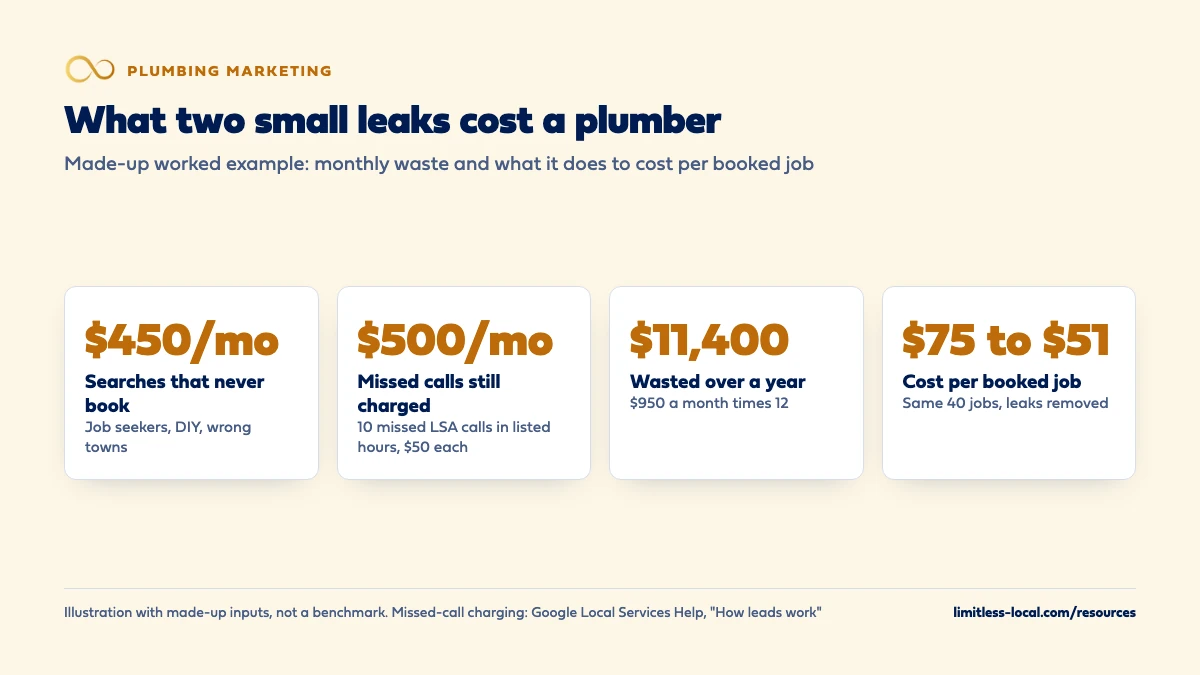
These numbers are made up to show the math, not a benchmark for your market. Say a plumbing company spends $3,000 a month on ads and books 40 jobs from them. That’s $3,000 divided by 40, or $75 per booked job.
Now say a look at the reports turns up two leaks. About $450 a month is going to clicks from searches that never book: jobs seekers, DIY questions and a town the trucks don’t serve. And 10 Local Services Ads calls a month ring out in the evening, inside the hours listed on the Google Business Profile but after the office has gone home, so they still count as charged leads, at a made-up $50 each, or $500. Together that’s $950 a month, or $11,400 over a year.
If those leaks booked nothing, the same 40 jobs really cost $3,000 minus $950, or $2,050, which is about $51 per booked job. Closing the leaks doesn’t need a bigger budget, just the settings and answering habits above. A free visibility audit is a quick way to see whether any of them are running in your accounts.
Frequently asked questions
Does a Local Services Ads call that goes to voicemail cost me?
It can. Google says a call that goes to voicemail or an automated greeting during your business hours is treated as a connected call and charged if the caller stays on the line for more than 20 seconds, whether or not they leave a message.
Can I limit or turn off Display Expansion?
Yes. Google says you can manage it through channel prioritization settings at the account level or override it per campaign, including setting the Display Network to Low priority with an optional percentage cap on its share of the daily budget.
How often should I read my search terms report?
In our judgement, weekly for the first month of a new campaign, then at least monthly. New bad-fit searches keep appearing, so it’s a habit, not a one-time cleanup.
Is a cheap cost per lead a sign everything is fine?
Not on its own. A cheap lead that rarely books can cost more per job than an expensive lead that usually does, so check what each booked job cost before you move money.
Is a long marketing contract a trap?
It depends on what you can take with you and how you leave. We work month-to-month. Our standard ask is three months, written into the contract, but we won’t make you stay.
Key takeaways
- The costliest traps are small monthly leaks, not single bad bets.
- Read the search terms report and add negative keywords for searches that never book.
- Use Presence location targeting and check Display Expansion so search money stays on search.
- Missed calls and wrong job types can still cost you in Local Services Ads.
- No one can guarantee a Google ranking, and paying for reviews can carry penalties.
- Judge every channel by cost per booked job, with every account in your name.
Want a second set of eyes on your setup?
We'll look at how you show up locally and where calls are leaking, then send you a plain-English breakdown.
More in this section
- Which marketing works best for emergency vs planned plumbing jobs?
- How much should a plumbing company spend on marketing each month?
- When should a plumbing company raise or cut its marketing budget?
- How much control do plumbers give up by outsourcing marketing?
- How should a plumbing company market to commercial customers?
Sources
- About the search terms report — Google Ads Help
- About advanced location options — Google Ads Help
- About Display Expansion on Search campaigns — Google Ads Help
- How leads work — Google Local Services Help
- About Automated Local Services Ads lead credits — Google Local Services Help
- Do You Need an SEO? Tips for Hiring an SEO — Google Search Central
- The Consumer Reviews and Testimonials Rule: Questions and Answers — Federal Trade Commission
- Manager Accounts (MCC): About ownership of client accounts — Google Ads Help