
How can I tell if restoration SEO is working before leads arrive?
- What early signs show restoration SEO is working in the first few months?
- Why does SEO show up in Google's numbers before it shows up as calls?
- Are my new restoration pages even in Google's index?
- Are impressions growing for the searches that bring jobs?
- Is my average position improving on those searches?
- Is my Google Business Profile getting seen more?
- Are more people searching for my company by name?
- Can I just Google my company to check rankings?
- Is the SEO work itself getting done?
- What are the warning signs that restoration SEO isn't working?
- When should the early signs turn into calls?
- What's different for restoration companies
- A worked example: a water damage page in its first four months
- Frequently asked questions
- Key takeaways
- More in this section
- Sources
The short version
- Check that new pages are indexed, using Search Console's URL Inspection tool.
- Watch impressions and average position for hiring searches with town names, not total traffic.
- Watch your Google profile's views and searches in its Performance report.
- Expect calls to lag the early signs; SEO typically takes three to six months to show meaningful growth.
For restoration owners a few months into SEO who want to know whether it’s on track before the calls start, without waiting on faith.
Get a free visibility audit · Book a growth call
What early signs show restoration SEO is working in the first few months?
Look for a sequence of early signs in Google’s own free tools: your new and updated pages get indexed, impressions grow for water damage, mold and fire searches with your town names in them, average position on those searches improves, and your Google Business Profile gets more views and searches. Those signs usually appear weeks or months before organic calls do, and SEO typically takes three to six months to show meaningful organic growth. If none of them is moving after a few months, and the work list each month is thin, that’s the time to ask hard questions.
We report SEO this way ourselves: the work done, the early signs in Search Console and the Google profile, and then the calls and jobs, in a real-time dashboard and a monthly report. We don’t guarantee rankings, lead counts or revenue, because nobody honestly can; what we promise is that you’ll know what we did, why, and what it produced. Our local SEO page explains the work, and our restoration marketing page covers water, fire and mold companies. For every channel side by side, start with the restoration marketing guide, or browse the restoration marketing library.
Why does SEO show up in Google's numbers before it shows up as calls?
Because organic calls come at the end of a chain. Google has to find and index a page before it can show it. It has to show the page (an impression) before anyone can click. The page has to sit high enough on the results for people to click, and only some of the people who click will call. Each step shows up in a report before the next one does.
Google’s SEO Starter Guide says every change takes some time to be reflected on Google’s end: some might take effect in a few hours, others could take several months, and in general you’ll want to wait a few weeks to assess whether the work helped. So in the first months, the questions aren’t “how many calls did SEO bring?” but “is each link in the chain getting stronger?”
The tools for this are free, and you should own the accounts: Google Search Console for the website and your Google Business Profile’s Performance report for Maps and Search.
Are my new restoration pages even in Google's index?
This is the first check, and it’s quick. If your SEO work added a mold remediation page, a sewage cleanup page or town pages, paste each address into Search Console’s URL Inspection tool. Google says it shows information about Google’s indexed version of a page, why Google could or couldn’t index it, and lets you request indexing for a page.
A page that isn’t indexed can’t rank, so no amount of waiting will make it bring in calls. If pages from two months ago still aren’t indexed, that’s an early sign that something’s wrong with the site or the pages, and it’s worth raising now rather than at month six.
Also open the Manual actions report once. Google says that if a site has a manual action, some or all of it won’t be shown in search results. Most sites never see one, but it takes a minute to rule out.
Are impressions growing for the searches that bring jobs?
Impressions are the earliest sign that Google is starting to show your pages. Google defines an impression as how often someone saw a link to your site on Google. In the Search Console Performance report, switch on Impressions, then look at the Queries and Pages tabs.
What to look for:
- Hiring searches, not reading searches. “Water damage restoration” or “mold removal” with a town name is a hiring search. “How long does drywall take to dry” is reading. Use the query filter to look at searches that contain your service words and town names.
- Service pages on their own. Group by page and look at the water, mold, fire and sewage pages separately from the blog.
- A fair comparison. Compare the last three months with the three before, or with the same months last year, so one storm doesn’t make a month look better than it was.
Impressions on hiring searches rising month over month is the first real sign the work is landing.
Is my average position improving on those searches?
Once impressions show up, watch average position for the same queries and pages. Google says the number is the topmost position your site held in search results, averaged across all queries where it appeared. A page that moves from the bottom of page two to the middle of page one is on the way to producing clicks, even if it hasn’t yet.
Read it with care. Average position only counts searches where your site was actually seen, and an average across many queries can hide a lot. In our judgement, it’s more useful for one service page and a handful of its queries than for the whole site. Filter to a single page, such as your water damage page, and watch its position for searches with your main towns in them.
Curious what your marketing is actually booking?
Get a free visibility audit — no obligation, no sales pitch.
Is my Google Business Profile getting seen more?
For most restoration companies, the Google profile is where local SEO shows first, because, in our judgement, many local searches show the Maps results before anyone scrolls to a website. The profile’s Performance report shows:
- Views: how many people viewed your profile on Search and Maps. Google counts unique visitors, and a person only once a day.
- Searches: the search terms people used to find your profile. Google updates this at the start of each month, and it might take up to 5 days to show up.
- Interactions: calls, website clicks, direction requests and messages.
Rising views and more searches for service terms (not just your company name) are a sign you’re showing up for more of the right searches in Maps. Google says its local results are mainly based on relevance, distance and popularity, so steady new reviews and a complete, accurate profile feed the same numbers.
Are more people searching for my company by name?
Searches for your company name show that people are remembering you, often from a yard sign, a truck, a review or an earlier visit to your site. Search Console now has a branded queries filter that splits queries into branded and non-branded. Google says it is only available for top-level properties and for sites with enough queries and impressions, so a smaller site may not see it. If yours doesn’t, type your company name into the query filter instead.
Keep the two apart when you judge SEO. Google notes that branded queries typically lead to higher-ranking pages and higher click-through rates, while non-branded queries show how new people find you without already intending to visit your site. Growth in non-branded impressions is the better sign that SEO is reaching people who don’t know you yet.
Can I just Google my company to check rankings?
It’s a rough check at best. Google says search results are specific to the time, place, device and recent history of the person searching, which is why a query can appear in your Search Console report and your site still not show when you run the same search yourself. Searching from your office also puts you right next to your own address, which can make your Maps position look better than it is across town.
In our judgement, the better habit is to use Search Console and your Google profile’s reports as the record, and to spot-check from a phone in different parts of your service area if you want to see the Maps results with your own eyes.
Is the SEO work itself getting done?
Before results, there’s the work. A month of SEO should leave something you can see: pages added or improved, profile posts and photos, technical fixes, directory corrections and real local links. Ask for that list every month, with links, and check a few items yourself.
If the list is vague and the early signs above aren’t moving either, the problem may be that not much is being done. What monthly restoration SEO work should include covers what a real month of work looks like and how to tell it from filler.
What are the warning signs that restoration SEO isn't working?
- New pages still not indexed weeks after they went live.
- No growth in impressions on hiring searches after several months, while the report talks about total traffic.
- Traffic growth that’s all blog reading, from searches nobody in your area would make before hiring.
- “Rankings” for terms with no impressions in Search Console. Ranking for a search nobody makes doesn’t help.
- Flat profile views and searches while reviews and photos aren’t being added.
- No access. If you can’t see your own Search Console and Google profile, you can’t check any of this.
One sign on its own can be noise. Several together, three or four months in, are worth a direct conversation. Whether your restoration marketing agency is producing real jobs lists the questions to ask.
When should the early signs turn into calls?
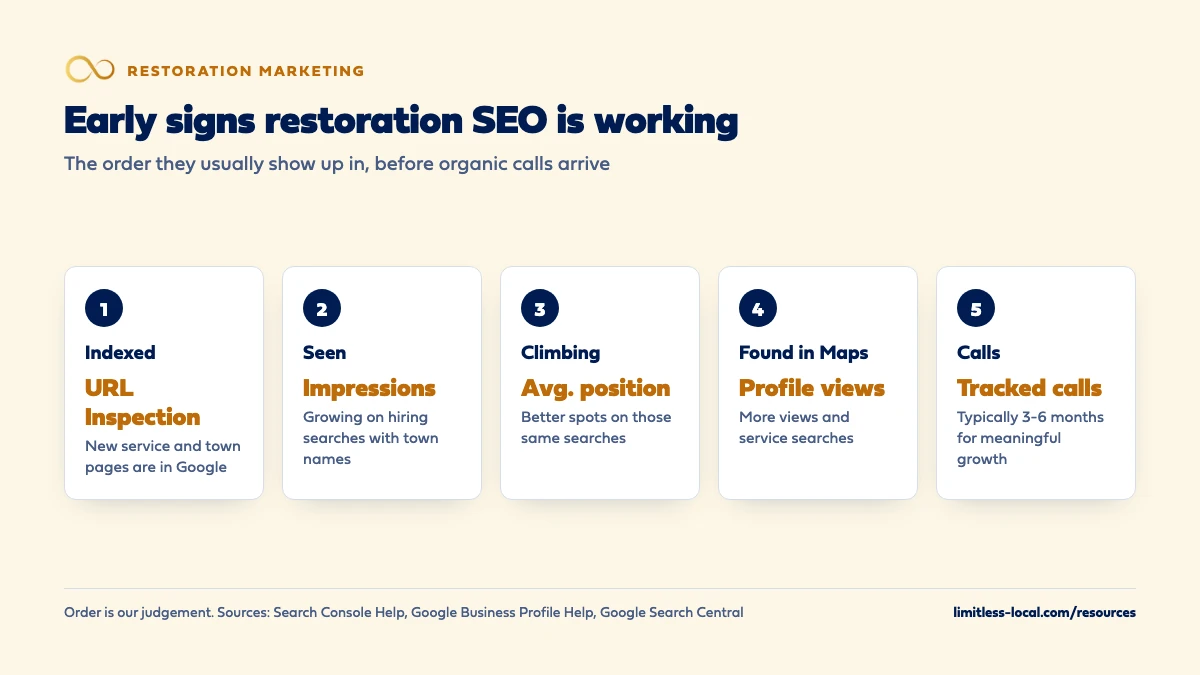
SEO typically takes 3-6 months to show meaningful organic growth, and calls lag the other signs. The order you’d usually expect is indexing first, then impressions, then better positions, then clicks and profile actions, then calls. Ads can produce calls within days of launch, which is why many restoration companies run them while SEO builds; how fast each restoration marketing channel produces leads compares them side by side.
When calls do start, make sure they’re counted. Organic calls often come through the Google profile and a website tracking number, not as form fills, and the difference between website traffic and phone calls explains why the visit count and the call count rarely move together.
Want to see where your company stands?
A free visibility audit shows where you show up on Google, Maps and AI answers, and what it's costing you in calls.
What's different for restoration companies
Storms distort the numbers. A freeze or a regional storm can push impressions and profile views up for a few weeks whatever your SEO is doing. Compare against the same season, or look at the trend across several months, before you credit or blame the work.
Each loss type is its own search. Water, mold, fire, sewage and storm damage are different searches from different people. Track the early signs for each service page separately, because one can be climbing while another is stuck.
Emergency searches are mostly on phones. In our judgement, it’s worth checking the Devices tab in Search Console for your water damage pages, because that’s where the urgent searches tend to happen and where a slow or awkward page costs you.
Reading traffic is large. Mold and insurance questions bring visitors from everywhere. Leave them out when you judge whether SEO is reaching people who hire.
A worked example: a water damage page in its first four months
These numbers are made up to show what an on-track page can look like, not a forecast for your market. A restoration company adds a new water damage page for its main town.
- Month 1: URL Inspection shows the page is indexed. Search Console shows 120 impressions for water damage searches with the town name, at an average position of 31. Two clicks. No organic calls on the website tracking number.
- Month 2: 480 impressions, average position 18, 9 clicks. Still no calls you can tie to the page.
- Month 4: 1,300 impressions, average position 9, 41 clicks, and the website tracking number logs its first few organic calls.
Most owners would look at month 2 and see nothing, because the phone didn’t ring. The early signs said otherwise: the page was indexed, Google was showing it about four times as often as the month before, and it had climbed most of the way to page one. If month 2 had shown the page still not indexed, or impressions flat, that would have been the time to ask why.
Frequently asked questions
Is a drop in website traffic during SEO a bad sign?
Not necessarily. Check whether the drop is in blog reading traffic or on your service pages. A drop in reading traffic matters far less than flat or falling impressions on hiring searches.
Do I need paid rank-tracking software?
Not to start. Search Console and your Google profile’s Performance report are free and show impressions, positions, views and searches from Google itself. Paid tools can add a view of Maps positions across your service area.
Should my SEO provider have access to my Search Console?
Yes, so they can report from it, but keep the account in your company’s name and add them as a user. That way the history stays with you if you ever change providers.
How often should I check these numbers?
Monthly is enough for most owners. Weekly checks mostly show noise, especially in a restoration market where storms move searches around.
What if my rankings improve but impressions don't?
You may be climbing for searches few people make. Look at which queries the better positions are on, and whether they include the services and towns that bring you jobs.
Key takeaways
- Organic calls come at the end of a chain: indexing, impressions, position, clicks, then calls.
- Check new pages in Search Console’s URL Inspection tool first; a page that isn’t indexed can’t rank.
- Watch impressions and average position on hiring searches with town names, service page by service page.
- Your Google profile’s views and searches are often the first place local SEO shows.
- SEO typically takes 3-6 months to show meaningful organic growth; several flat signs after a few months deserve a direct conversation.
Not sure what's working right now?
Start with a free visibility audit: rankings, Google profile, reviews and tracking, checked against your service area.
More in this section
- How should a restoration company follow up on leads that don't book?
- How fast do restoration marketing channels produce leads?
- How do I track which marketing brings in booked restoration jobs?
- Can a restoration owner do their own SEO instead of hiring someone?
- Why is my restoration website getting clicks but no calls?
Sources
- SEO Starter Guide: The Basics — Google Search Central
- URL Inspection tool — Search Console Help
- Manual actions report — Search Console Help
- What are impressions, position, and clicks? — Search Console Help
- Performance report (Search results): Overview and basic setup — Search Console Help
- Introducing the branded queries filter in Search Console — Google Search Central Blog
- Understand your Business Profile performance & insights — Google Business Profile Help
- Tips to improve your local ranking on Google — Google Business Profile Help