
What website content helps electrician customers choose me?

- What kinds of website content help customers choose my electrical company over others?
- What is a customer deciding when they look at an electrician's website?
- How do I prove I'm licensed and insured without just saying it?
- Which photos help customers choose an electrician?
- How should I choose which reviews to show on my site?
- Should my website show who will come to the house?
- What pricing information helps customers choose?
- How should I word the warranty on my site?
- What should each service page say to win the job?
- Do claims like "best electrician in town" help?
- Does trust content also help my site on Google?
- What's different about trust content for electricians
- A worked example: checking whether new content helps
- Frequently asked questions
- Key takeaways
- More in this section
- Sources
The short version
- Answer the homeowner's worries: licensed, insured, safe, tidy, on time, fairly priced.
- Use your own job photos, crew photos and reviews that mention the work.
- Put the proof on each service page, next to the call button.
- Make warranty and pricing wording specific, true and current.
For electrical contractors whose website gets visits but not enough calls, who want to know which proof and trust content wins the choice between you and the next electrician.
Get a free visibility audit · Book a growth call
What kinds of website content help customers choose my electrical company over others?
The content that wins the choice answers what a homeowner worries about before letting an electrician into the house: proof you’re licensed and insured, real photos of your own work and crew, genuine reviews that mention the job, who will show up and when, how pricing works, and what you’ll stand behind afterward. Put that proof on the service pages people land on, not only on an About page, and make it specific to the job, like a panel upgrade or an EV charger install. Keep every claim true and current, because the FTC expects advertising to be truthful and backed by evidence.
If you’d rather have a site built around this kind of content than write it yourself, our website design page covers how we build sites for local service businesses; a themed site is $3,750, or $3,000 with any Limitless Engine package, with up to 25 pages and 30 days of post-launch support. Our electrical contractor marketing page explains how it fits an electrical shop, and more answers are in the electrical marketing questions library.
What is a customer deciding when they look at an electrician's website?
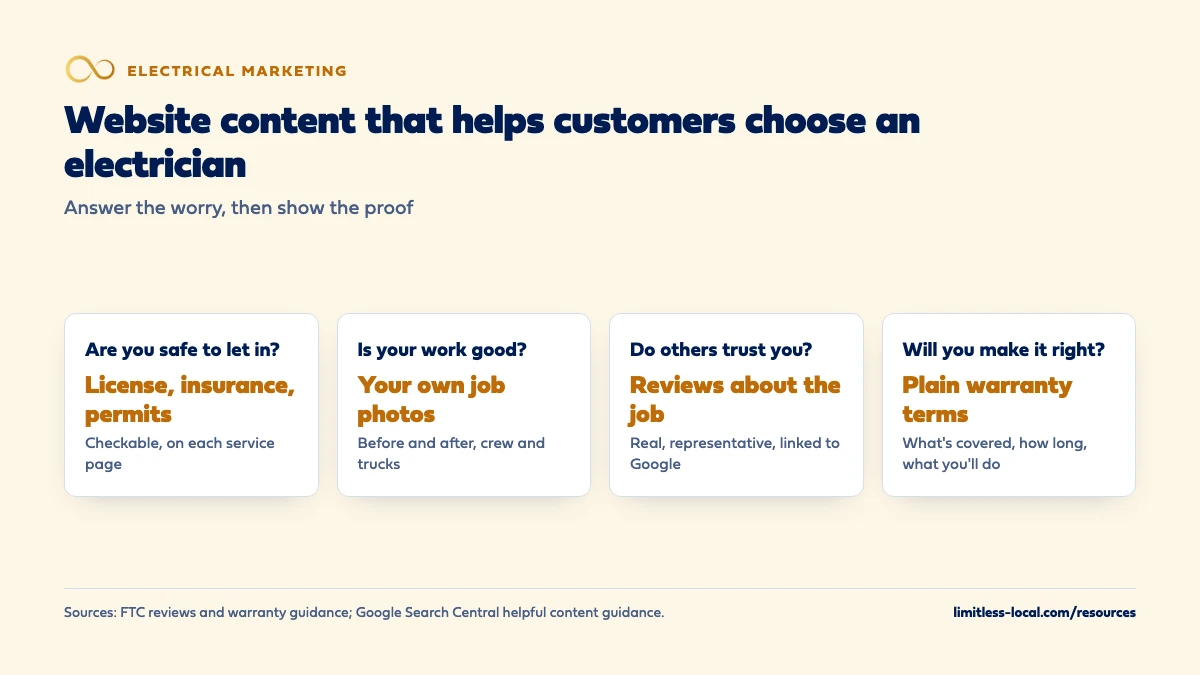
Usually not who knows the electrical code best. They can’t judge that. In our judgement, they’re deciding whether you’ll be safe to let into the house, whether you’ll show up, whether the price will be fair, and whether you’ll make it right if something goes wrong. The content that wins answers those worries plainly, with proof.
That’s different from the pages a site needs to rank or to have a place to send ads, which what an electrician’s website needs to get more calls covers. This page is about what goes on those pages to tip the decision your way once someone is reading.
How do I prove I'm licensed and insured without just saying it?
In our judgement, “licensed and insured” is a line so many contractors use that on its own it doesn’t set you apart. Make it checkable and specific:
- Show your license number, and say which state issued it.
- Name what your insurance covers in plain words, and offer a certificate on request.
- Say who on the crew holds the license, and whether a licensed electrician is on every job or supervises it.
- If you pull permits and schedule inspections for the customer, say so on the service pages where it applies.
License display rules vary by state, so check with your state’s licensing board for what’s required. Whether to show your electrical license number in your marketing covers where it goes and which number to use.
Which photos help customers choose an electrician?
Your own, from real jobs. In our judgement, a homeowner can tell a stock photo from a real panel in a real garage, and only the real one tells them anything about you. The photos that do the most work:
- Before and after on panel upgrades, rewiring and service changes, where the difference is obvious even to someone who doesn’t know electrical work.
- Finished installs such as EV chargers, generators, lighting and outlets, shown clean and labeled.
- The crew and the trucks, so customers know what to expect at the door.
- Tidy job sites, such as drop cloths, covered floors and a cleaned-up work area.
Keep house numbers, license plates and customers’ faces out of frame unless you have permission. Put photos on the matching service page rather than one gallery nobody clicks to.
How should I choose which reviews to show on my site?
Pick reviews that describe the job, like a same-day repair, a panel swap that passed inspection or a tidy EV charger install, and put them on the page for that kind of work. They answer the worry better than a star rating in the header.
Choose honestly, though. In its guidance on the consumer reviews and testimonials rule, the FTC says reviews a business features in its advertising or marketing become testimonials, and a business that puts testimonials on its own website can be liable if they’re fake or false. It also says using non-representative reviews in marketing could be deceptive under the FTC Act, and that organizing reviews so customers find it hard to see negative ones could be an unfair or deceptive practice. This isn’t legal advice. In practice: use real reviews you can trace to a real job, don’t edit their meaning, and link to your full Google reviews so visitors can see the rest.
Curious what your marketing is actually booking?
Get a free visibility audit — no obligation, no sales pitch.
Should my website show who will come to the house?
Yes, in our judgement it’s one of the most underused trust builders for electricians. A homeowner is about to let a stranger into the basement or the attic, so tell them who that stranger is:
- Photos and first names of your electricians, with how long they’ve been with you.
- What they’ll wear and drive, so the customer recognizes them.
- How you confirm the appointment and the arrival window, and whether you call or text when you’re on the way.
- Any screening you actually do, such as background checks or drug testing, only if it’s true and current.
Don’t promise anything the office can’t deliver every time. A stated arrival window you regularly miss does more harm than saying nothing.
What pricing information helps customers choose?
Enough to show you’re not hiding anything. In our judgement, people choose more easily when the site explains how you charge: whether there’s a service call or trip fee, what it covers, which jobs you price flat and which need a visit first, and what changes the price of bigger jobs like panel upgrades, EV chargers and generators.
Whatever you publish has to be a price you’ll honor and keep current. The detail on which prices to post and how to word a range is in whether electricians should show prices on their website, so this page won’t repeat it.
How should I word the warranty on my site?
Plainly and specifically. A line like “100% satisfaction guaranteed” invites the question of what happens if the customer isn’t satisfied. The FTC’s guide to federal warranty law uses sample warranties that spell out:
- What is covered.
- How long coverage lasts.
- What the business will do if something goes wrong.
- What is not covered.
That structure works for workmanship on your installs too. Two cautions from the same guide: the words “full” and “limited” have legal meanings for written warranties on consumer products that are far narrower than everyday use, so avoid using them loosely. The guide is written about warranties on consumer products, and the panels, chargers and generators you install may also carry the manufacturer’s own warranty, so say which coverage is yours and which is theirs. Separately, the FTC’s advertising guidance says offering a money-back guarantee is not a substitute for having proof of your claims. This isn’t legal advice; have a lawyer read your warranty wording.

What should each service page say to win the job?
Answer the questions people have about that job before they have to call to ask. For a panel upgrade page, for example:
- What’s included, and what isn’t.
- Whether you handle the permit, the utility and the inspection.
- How long the power is off, and how long the job usually takes.
- What the customer needs to do to get ready.
- Photos and a review from a panel job.
- How your pricing works for that job.
Do the same for EV chargers, generators, rewiring and commercial work. Which service pages to build in the first place is covered in which service pages an electrical contractor’s website should have.
Do claims like "best electrician in town" help?
Rarely, and they can create risk. The FTC’s advertising guidance for small businesses says advertising must be truthful and non-deceptive, that advertisers must have evidence to back up their claims, and that the law requires that proof before the ad runs. A specific, checkable claim needs that proof too: if your site says “same-day service” or “most calls answered by a person,” you need to be able to show it.
In our judgement, specifics persuade better anyway. “We’ll give you an arrival window and text when we’re on the way” tells a customer more than “fastest electrician around,” and it’s something you can actually deliver. This isn’t legal advice.
Does trust content also help my site on Google?
It lines up with what Google says its systems are designed to prioritize: helpful, reliable information created to benefit people. Google’s guidance on helpful, people-first content asks whether content presents information in a way that makes you want to trust it, such as clear sourcing, evidence of the expertise involved and background about the author or the site, for example through an About page. It also asks whether content clearly demonstrates first-hand expertise and depth of knowledge.
Real job photos, the license, who does the work and specific answers about each job are exactly that kind of first-hand content. A page full of generic text could belong to any electrician anywhere. If you’re tempted to fill pages quickly, whether you can use AI to write electrical website content covers how to keep it specific and safe.
Want to see where your company stands?
A free visibility audit shows where you show up on Google, Maps and AI answers, and what it's costing you in calls.
What's different about trust content for electricians
Safety is the unspoken worry. Customers know bad electrical work can start a fire. In our judgement, content about permits, inspections and licensed work speaks to that worry without scare tactics.
Emergency visitors skim; project visitors read. Someone with no power wants the phone number, the hours and proof you’re real in one glance. Someone planning a panel upgrade or a generator will read the details, look at photos and compare a few estimates.
Old homes raise extra questions. Owners of older houses worry about what you’ll find behind the walls. A page that explains how you handle surprises, and how you price them, answers that before it becomes a reason not to call.
Commercial buyers want different proof. Property managers and builders look for insurance certificates, capacity and past commercial work, so give them their own page.
A worked example: checking whether new content helps
These numbers are made up to show the math, not a benchmark or a forecast. Say your panel upgrade page gets about 500 visits a month and produces 5 tracked calls and quote requests, or 1% of visits. You add before-and-after photos, two reviews from panel jobs, a short section on permits and inspections, and plain warranty wording.
Over the next few months, with roughly the same 500 visits a month, the page produces 10 calls and requests, or 2% of visits. If your office books and closes panel jobs at the same rate as before, the extra calls are what the content is worth. If visits changed a lot at the same time, compare the percentage, not the raw count, because more visits alone can raise the count.
This only works with call and form tracking on the page, so set that up before you change anything.
Frequently asked questions
Should I use stock photos until I have my own?
Use as few as possible. In our judgement, a handful of real phone photos of your own work does more than polished stock images, and you can replace them as better shots come in.
Can I copy my Google reviews onto my website?
You can feature real reviews, but the FTC says reviews a business features in its marketing become testimonials, so use genuine ones, don’t change their meaning, and avoid picking only unrepresentative ones. This isn’t legal advice.
Should I post a video on my electrical website?
A short, plain video of you or your crew explaining a common job can help people feel they know who’s coming. Keep it real rather than scripted, and put it on the matching service page.
How many reviews should I show on each service page?
A few that describe that specific kind of job, plus a link to your full Google reviews. There’s no set number; relevance to the job matters more than volume.
Is it worth writing up individual jobs as project stories?
For bigger jobs, often yes. A short write-up of a real panel upgrade or rewiring job, with photos and what you found, is the kind of first-hand content customers can’t get from a competitor’s site. Leave out the customer’s address and name unless they agree.
Should I mention my years in business?
Yes, if it’s accurate, and pair it with something checkable, like your license and the towns you’ve worked in. A specific, true detail is more persuasive than a round number.
Key takeaways
- Content that wins the choice answers the homeowner’s worries: safe, licensed, on time, fairly priced and willing to make it right.
- Put your own job photos, crew photos and job-specific reviews on each service page, next to the call button.
- Show who will come to the house and how arrival works, but promise only what the office delivers every time.
- Word warranties plainly: what’s covered, how long, what you’ll do and what isn’t covered.
- Keep every claim true, current and provable; the FTC expects evidence before an ad runs.
Not sure what's working right now?
Start with a free visibility audit: rankings, Google profile, reviews and tracking, checked against your service area.
More in this section
- What should an electrician's website have to get more calls?
- Which service pages should an electrical contractor's website have?
- Which local citations and directories matter for electricians?
- Should electricians show prices on their website?
- Which Google Business Profile categories should an electrician choose?
Sources
- The Consumer Reviews and Testimonials Rule: Questions and Answers — Federal Trade Commission
- Advertising FAQ's: A Guide for Small Business — Federal Trade Commission
- Businessperson's Guide to Federal Warranty Law — Federal Trade Commission
- Creating Helpful, Reliable, People-First Content — Google Search Central