
What mistakes do roofers make choosing SEO, Google Ads or LSAs?
- Which mistakes cost roofers the most when they pick between SEO, Google Ads and Local Services Ads?
- Why do roofers so often end up in the wrong channel?
- Mistake: expecting SEO to bring calls this month
- Mistake: thinking ads or LSAs will lift your free Maps ranking
- Mistake: turning on LSAs before you can win the ranking
- Mistake: picking LSAs or Google Ads without checking the job types
- Mistake: comparing cost per click with cost per lead
- Mistake: choosing without any tracking in place
- Mistake: judging a channel after a week or two
- Mistake: spreading a small budget across all three
- Mistake: assuming your LSA account works the way it used to
- What's different about choosing channels for a roofing company
- A worked example: the same month, judged two ways
- Frequently asked questions
- Key takeaways
- More in this section
- Sources
The short version
- SEO is a ramp of months; ads and LSAs can bring leads much sooner.
- Google says no one can pay for a better local ranking, so ad spend doesn't lift your free Maps position.
- LSAs rank on responsiveness and reviews as well as your bid, so get those ready first.
- Compare channels on cost per signed roof, which needs tracking from day one.
For roofing owners deciding where the next marketing dollar goes, and wanting to avoid the choices that make a good channel look bad.
Get a free visibility audit · Book a growth call
Which mistakes cost roofers the most when they pick between SEO, Google Ads and Local Services Ads?
The most common mistakes are picking a channel by habit or by whoever pitched it last, expecting SEO to bring calls in the first month, and believing that paying for ads or Local Services Ads lifts your free Maps ranking, which Google says it doesn’t. Roofers also judge paid channels after a week or two, compare a cost per click with a cost per lead, and choose without tracking which calls became signed roofs. Pick by your timeline, the jobs you want and your budget, and compare channels on cost per signed job.
Comparing channels on cost per signed roof needs tracking from the start, which is why our marketing packages include call, web and form tracking with attribution from the start. Essentials ($3,500 a month) covers local SEO and Google Ads management up to $2,500 a month in ad spend; Growth ($4,500 a month) adds Local Services Ads management. Ad spend is paid to Google directly. For every roofing channel in one place, the roofing marketing guide covers the full picture, our roofing marketing page explains how we work with roofers, and the rest of the roofing marketing questions library goes question by question.
Why do roofers so often end up in the wrong channel?
Because the choice usually gets made for them. A salesperson calls with a pitch for one channel, a roofer down the road says something worked for him, or last year’s storm season made one channel look great. None of those tells you which one fits your towns, your crews and the jobs you want.
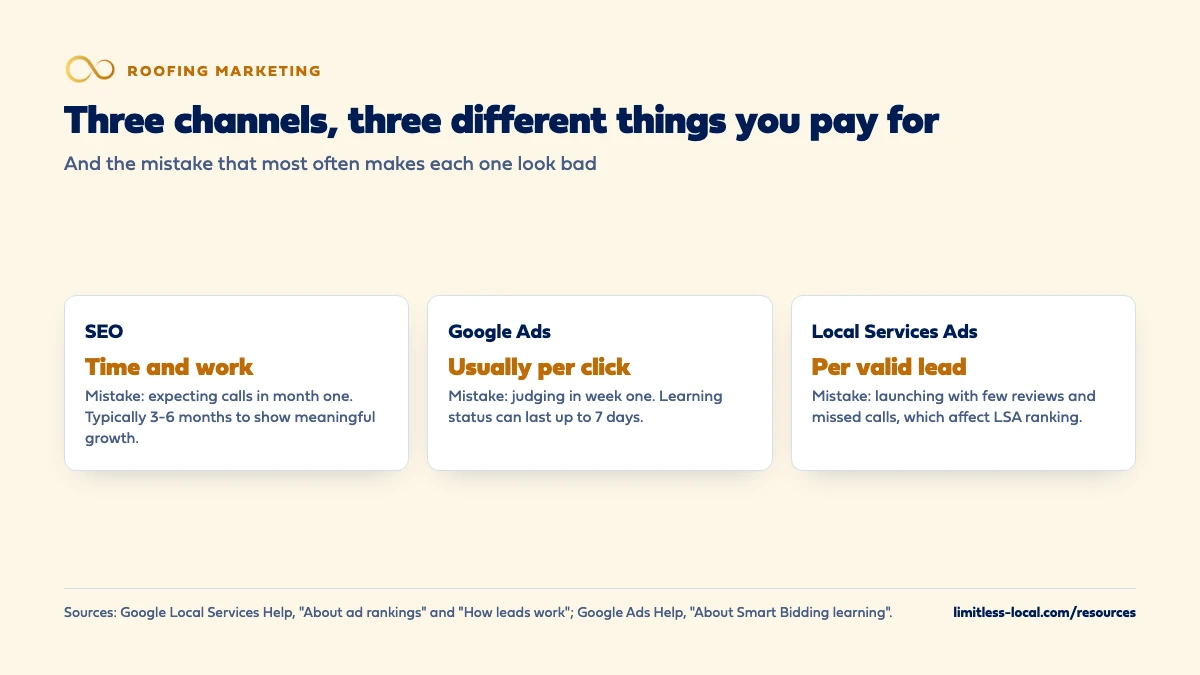
SEO, Google Ads and Local Services Ads do different jobs. In short:
- SEO builds free visibility in Google’s regular results and the map pack over months. You pay in time and work, not per click.
- Google Ads search campaigns put you at the top of searches you choose by keyword, usually paid per click, and can start within days.
- Local Services Ads charge per valid lead, target by job type and service area instead of keywords, and need Google’s screening first.
The mistakes below are the ones that make a good channel look bad, or a bad fit look fine, in our judgement.
Mistake: expecting SEO to bring calls this month
SEO is a ramp. Ads can generate leads within days of launch, while SEO typically takes 3 to 6 months to show meaningful organic growth. Google’s own SEO guide says some changes take effect in a few hours and others could take several months, and that you’ll likely want to wait a few weeks to assess whether your work helped (SEO Starter Guide).
The mistake isn’t choosing SEO. It’s choosing it alone when the schedule needs work now, then giving up at month two because the phone hasn’t changed. If you need calls soon and want SEO for the long run, the usual answer is both, in order: ads to fill the schedule while the SEO builds. The fastest way for a roofer to get leads online ranks each channel by how quickly it starts.
Mistake: thinking ads or LSAs will lift your free Maps ranking
They won’t. Google says there’s no way to request or pay for a better local ranking. Local results are mainly based on relevance, distance and popularity, and how well-known a business is depends partly on how many websites link to it and how many reviews it has (Tips to improve your local ranking on Google).
So if the goal is to show up in the free map pack, paying for Local Services Ads or Google Ads isn’t the route to it; your Google Business Profile, reviews and website are. Ads can still bring calls while that work builds, and jobs from them can bring reviews. Whether Local Services Ads help a roofer rank on Google Maps covers what carries over and what doesn’t.
Mistake: turning on LSAs before you can win the ranking
Local Services Ads are ordered by an auction that weighs your bid against your profile. Google lists your responsiveness (missed calls may hurt it) and your profile quality, including your rating, number of reviews, average response time, photos and the verification checks you’ve completed (About ad rankings).
A roofer with a handful of reviews and an office that lets calls ring out can spend money on LSAs and still rank below competitors who answer every call. That isn’t proof that LSAs don’t work for roofing. It’s a sign the setup wasn’t ready. Also plan for the wait: Google says screening and verification takes 3 to 4 weeks on average after you submit your documents (Business screening and verification requirements). Whether Local Services Ads are worth it for a roofing company lists what to have ready first.
Curious what your marketing is actually booking?
Get a free visibility audit — no obligation, no sales pitch.
Mistake: picking LSAs or Google Ads without checking the job types
The two paid channels target differently. Local Services Ads are keywordless: you choose service categories, job types and areas, and after the move into Google Ads they stay keywordless (Local Services Ads transition to Performance Max campaigns with pay-per-lead goals). Google Ads search campaigns let you choose the searches, so you can go after the jobs you want most, such as full replacements, and leave out the ones you don’t.
This matters because Google no longer gives Local Services Ads credits for leads about a job type you don’t service or an area you don’t serve (About Automated Local Services Ads lead credits). If your job types are left wide open, those calls are on you. If most of your margin is in replacements and LSAs keep bringing small repairs, the fix may be a tighter job type list, Google Ads aimed at replacement searches, or both. How to split budget between Google Ads and LSAs covers running them side by side.
Mistake: comparing cost per click with cost per lead
A Google Ads click and a Local Services Ads lead aren’t the same thing. With LSAs you pay for a valid lead, such as a call you answer, a missed call during business hours where the caller stays on the line for more than 20 seconds, a message or a booking request (How leads work). With a search campaign you typically pay for a click, and only some clicks call or fill out a form.
So a $50 LSA lead isn’t automatically worse than a $12.50 click, or better. Those figures are made up (the worked example below uses them); the point is that you can’t compare them directly. Take each channel down to the same number: what each signed roof cost. That’s the only fair way to pick between them, and it needs tracking, which is the next mistake.
Mistake: choosing without any tracking in place
If you can’t tell which calls came from which channel, every choice is a guess. Google Ads can count calls from ads, calls to the number on your website after an ad click, and clicks on a phone number on your mobile site, and you can import call conversions from another system such as a CRM to count only calls that turned into sales (About phone call conversion tracking). Local Services Ads show each lead in the account. SEO calls are the hardest to see without your own tracking numbers or source fields.
Set up tracking before you choose, or at least before you judge. How a roofer can track calls and forms from Google walks through it step by step, and in our judgement it’s the one piece of work that makes every later decision easier.
Mistake: judging a channel after a week or two
Paid channels need time to settle. Google says a bid strategy can show a Learning status for up to 7 days after major changes, that your ads keep running during it, and that new campaigns without history may see temporary swings while performance stabilizes over your conversion cycle (About Smart Bidding learning). A roofing lead often needs an inspection and an estimate before anyone signs, so that cycle can run weeks.
Killing a campaign in week two, or switching channels every month, means you never get a fair read on any of them. Set a review date before you start and judge on signed jobs. How long to run roofing Google Ads before judging them gives the stages.
Mistake: spreading a small budget across all three
It feels safer to try everything. On a small budget, it usually means three channels that each get too little money to produce enough leads to judge. In our judgement, a roofer with a tight budget does better putting it into one paid channel in their best towns, doing the free Google Business Profile and review work alongside, and adding a second channel only once the first has a cost per signed job they trust.
The order matters more than the split. Which channel goes first depends on your starting point: an established profile with lots of reviews favors LSAs, a clear focus on replacements favors Google Ads search, and a long-term plan to work the same towns for years makes SEO worth starting early.
Mistake: assuming your LSA account works the way it used to
Google is moving Local Services Ads into Google Ads as Performance Max campaigns with pay-per-lead goals, and roofing is named in the first phase, which began in August 2026 for select advertisers. Budgets become daily instead of weekly, with monthly spend capped at your daily average budget times 30.4, and your old performance reports don’t carry over, and Google’s help page explains how to back up your history before you move (Google Ads Help).
If you’re choosing between channels based on old LSA reports or an old dashboard, check whether your account has moved first. The comparison still comes down to cost per signed roof, but the settings you’ll manage have changed.
Want to see where your company stands?
A free visibility audit shows where you show up on Google, Maps and AI answers, and what it's costing you in calls.
What's different about choosing channels for a roofing company
Storms distort the test. Any channel looks good in the weeks after hail. If you judge a channel only on storm-season results, or start one in a dead winter month, you’ll pick wrong. In our judgement, compare channels over the same stretch of time, and note any storm weeks in your tracking.
The job you want decides the channel. A repair-heavy, emergency-leak business and a replacement-focused business can reasonably choose differently. Leak calls come fast and need someone answering; replacements take longer to sign and are worth paying more to win.
Insurance work stretches the cycle. When an adjuster is involved, a lead can take weeks to sign, so give any channel longer before you call it. This page isn’t insurance advice; it’s about when to judge the marketing.
A worked example: the same month, judged two ways
These numbers are made up to show the math, not a benchmark for your market. A roofer spends $2,000 on Google Ads and gets 160 clicks at $12.50 each, then spends $2,000 on Local Services Ads and gets 40 charged leads at $50 each.
Judged on price alone, Google Ads looks four times cheaper. Now follow both to signed roofs. Say 1 in 10 of those clicks became a lead, so 16 leads, and 4 of them signed. Say 1 in 8 of the LSA leads signed, so 5 roofs. Cost per signed roof: $500 for Google Ads and $400 for LSAs. The cheaper click lost.
Flip the close rates and the answer flips too. That’s why the choice can’t be made from a price per click or per lead, and why one month on its own proves little. Run the same check with your own numbers; a free visibility audit helps set up the tracking to do it.
Frequently asked questions
Should a new roofing company start with SEO, Google Ads or LSAs?
If you need calls soon, start with a paid channel and do the free Google Business Profile and review work alongside it. A new profile with few reviews can struggle in LSAs, which weigh reviews and responsiveness, so Google Ads search is often the easier first paid channel, in our judgement.
Can I run SEO, Google Ads and LSAs at the same time?
Yes, if each one gets enough budget to be judged and you can tell their calls apart. If the budget is small, run one paid channel well before adding a second.
Is it a mistake to stop SEO once ads are working?
It can be. Ads stop when the spend stops, while SEO work can keep bringing calls from the free results. Whether it’s worth keeping depends on whether you plan to work the same towns for years.
Do Local Services Ads replace the need for reviews?
No. Google counts your rating and number of reviews in LSA profile quality, and reviews also help your free local ranking, so they matter in both places.
Why do my LSA leads include jobs I don't do?
Usually because the job types or service areas are set wider than the work you want. Google no longer credits leads for job types or areas you don’t serve, so tighten those settings.
What's the single most expensive mistake?
In our judgement, choosing and judging channels without tracking, because it turns every later decision into a guess. Set up call and form tracking before you spend.
Key takeaways
- Choose a channel by your timeline, the jobs you want and your budget, not by habit or the last pitch.
- SEO is a ramp of months; paid channels can bring leads within days of launch.
- Google says no one can pay for a better local ranking, so ads don’t lift your free Maps position.
- Get reviews, responsiveness and job types right before you turn on LSAs.
- Compare channels on cost per signed roof, with tracking in place from the start.
Not sure what's working right now?
Start with a free visibility audit: rankings, Google profile, reviews and tracking, checked against your service area.
More in this section
- How should a roofer split budget between Google Ads and LSAs?
- Are Google Local Services Ads worth it for a roofing company?
- Can a roofing company do its own SEO?
- Do Local Services Ads help a roofer rank on Google Maps?
- How do I get commercial roofing leads with Google Ads?
Sources
- Tips to improve your local ranking on Google — Google Business Profile Help
- SEO Starter Guide: The Basics — Google Search Central
- About ad rankings — Google Local Services Help
- Business screening and verification requirements – United States — Google Local Services Help
- How leads work — Google Local Services Help
- About Automated Local Services Ads lead credits — Google Local Services Help
- About Smart Bidding learning — Google Ads Help
- Local Services Ads transition to Performance Max campaigns with pay-per-lead goals — Google Ads Help