
Can a roofing company do its own SEO?
- Can a roofing owner handle SEO without hiring an agency or a freelancer?
- Can a roofer really do SEO without hiring anyone?
- Which roofing SEO tasks can an owner handle?
- Where should a roofer start: the Google profile or the website?
- What should a roofer write on the website?
- What free tools does a roofer need for DIY SEO?
- How does a roofer get links without breaking Google's rules?
- Which SEO tips can a roofer safely ignore?
- Which parts of roofing SEO are hard to do yourself?
- How much time does DIY roofing SEO take?
- When should a roofer stop doing SEO alone?
- What's different about DIY SEO for roofing companies
- A worked example: what DIY SEO costs in an owner's time
- Frequently asked questions
- Key takeaways
- More in this section
- Sources
The short version
- Google says a small local business can probably do much of its SEO itself.
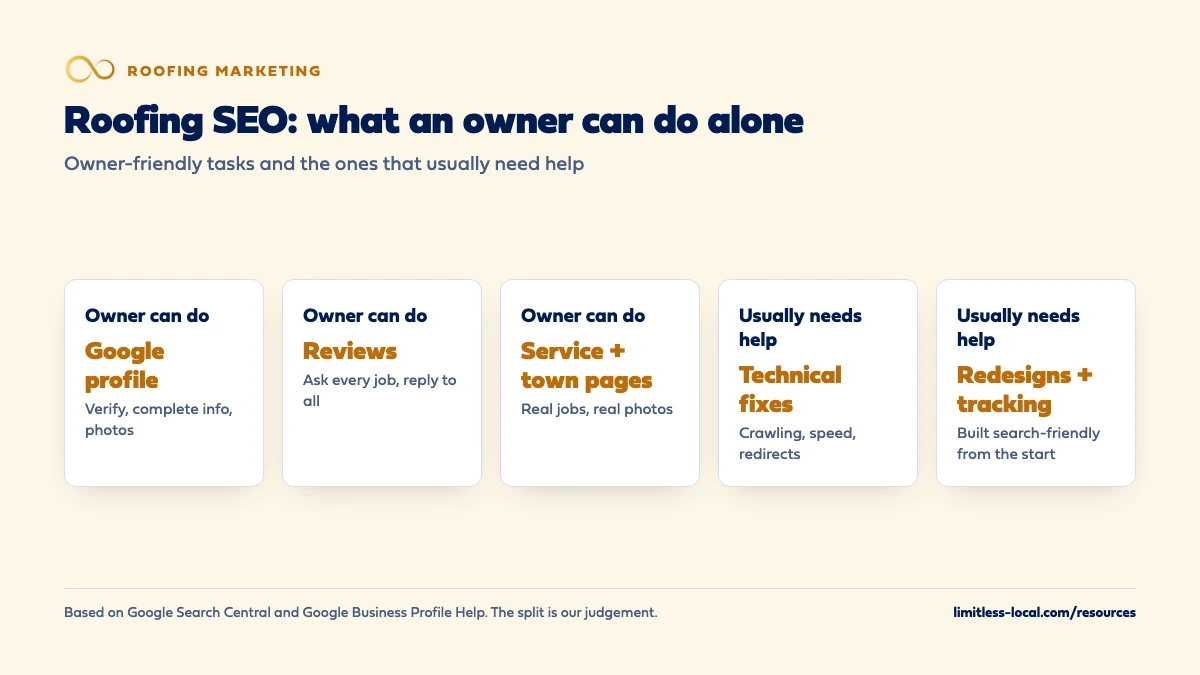
- Owner-friendly: Google profile, reviews, service and town pages, photos, Search Console.
- Harder alone: technical fixes, redesigns, tracking, and month-after-month consistency.
- Avoid shortcuts: bought links and copy-paste town pages break Google's spam policies.
For roofing owners weighing whether to learn SEO themselves, which parts are realistic on nights and weekends, and when it stops being worth their time.
Get a free visibility audit · Book a growth call
Can a roofing owner handle SEO without hiring an agency or a freelancer?
Yes, a roofing company can do much of its own SEO, and Google itself says a small local business can probably do much of the work itself. The parts an owner can realistically handle are the Google Business Profile, asking for and replying to reviews, writing a clear page for each roofing service and the towns you really serve, adding real job photos, and checking Google’s free Search Console. The parts that usually justify help are technical website problems, a redesign or move to a new site, tracking, and keeping the work going every month, because SEO typically takes months to pay off and stalls when the owner gets busy.
When the time or technical side runs out, our local SEO service covers Google profile management, listings, content and links for contractors; the roofing marketing page shows how it fits a roofing company. If you’re comparing outside help, choosing a roofing SEO company covers the hiring side, and the roofing marketing guide covers every channel. More owner questions are in the roofing marketing questions library.
Can a roofer really do SEO without hiring anyone?
For a single-location roofer, much of it, yes. Google’s guidance on hiring an SEO says plainly that if you run a small local business, you can probably do much of the work yourself, and it recommends starting with its SEO Starter Guide. It also says that even if you hire someone in the end, knowing the basics helps you spot a technique that’s not recommended.
Google describes SEO as helping search engines understand your content and helping people find your site and decide whether to visit. It also says there are no secrets that will automatically rank a site first. For a roofer, that mostly means being clear about what you do and where, showing proof that you do it well, and keeping it up. None of that needs special software. It needs time and consistency, which is where most owners run short.
Which roofing SEO tasks can an owner handle?
In our judgement, these are realistic for an owner or office manager with a few hours a week:
- The Google Business Profile. Accurate categories, services, service area, hours and photos.
- Reviews. Asking every finished customer and replying to every review.
- Service pages. One clear page each for roof replacement, repair, storm inspections and any specialty you want, such as metal or flat roofs.
- Town pages for the towns you actually work in, with real jobs from each.
- Job photos on the site and the profile.
- Local links from suppliers, manufacturers’ contractor directories, local associations and community sponsorships.
- Checking Search Console once a month.
These are also the tasks that need your knowledge most. Nobody else knows which towns you want, what your warranty covers or which shingle lines you install.
Where should a roofer start: the Google profile or the website?
In our judgement, start with the Google Business Profile: it’s what many homeowners see first when they search for a roofer nearby, and it’s quicker to fix than a website. Google’s tips for improving local ranking are a short list: verify your business, keep your information complete and accurate, respond to reviews and add photos and videos. Google says local results are mainly based on relevance, distance and popularity, and that more reviews and positive ratings can help your local ranking.
Google also says there’s no way to request or pay for a better local ranking, so the work is the only route. If the profile isn’t showing up at all, why a roofing company isn’t showing up on Google Maps covers the usual causes. Then move to the website, which is slower to pay off but reaches searches the profile can’t.
What should a roofer write on the website?
Write what a homeowner needs to decide to call you. Google says content that people find compelling and useful will likely influence your site’s presence in search results more than any other suggestion in its starter guide, and its guidance on helpful content asks whether your content shows first-hand expertise and a depth of knowledge. That’s a roofer’s advantage: you’ve been on the roofs.
In our judgement, each service page should say what the job involves, which materials you install, how inspections and estimates work, what your warranty covers, which towns you serve, and what happens after someone calls, with photos of your own work. Google also says there’s no magical word count target, so write until the questions are answered and stop.
Town pages need the most care. How many city pages a roofing website should have covers how far to go before they turn into copies.
Curious what your marketing is actually booking?
Get a free visibility audit — no obligation, no sales pitch.
What free tools does a roofer need for DIY SEO?
Mostly Google’s own, and they’re free:
- Search Console. Google says it helps you confirm Google can find and crawl your site, fix indexing problems and request re-indexing, see which searches show your site and how often people click, get alerts about indexing or spam issues, and see which sites link to you.
- The site: search. Google’s starter guide suggests searching Google for your site with the site: operator to check whether your pages are in the index at all.
- Your Business Profile performance. Views, calls and website clicks from the profile.
Google says business owners who won’t use Search Console themselves should still know it exists and know the basics, which is a fair minimum even if someone else does the work.
How does a roofer get links without breaking Google's rules?
Earn them from real relationships. Google’s spam policies define link spam as creating links primarily to manipulate rankings, and its examples include buying links or posts that contain links, exchanging goods or services for links, excessive link swaps and using automated programs to create links. In our judgement, those shortcuts can hurt more than they help.
In our judgement, the honest sources for a roofer are the ones you already have: the manufacturers whose products you install and their contractor listings, your suppliers, local trade and business associations, the youth team or charity you sponsor (support it for its own sake, not as a way to buy a link), and local news when you do something worth covering. How a roofing company gets links from local websites goes through them one by one.
Which SEO tips can a roofer safely ignore?
Google’s starter guide lists several things it believes you shouldn’t focus on. The ones roofers hear about most:
- Meta keywords. Google Search doesn’t use the keywords meta tag.
- Keyword stuffing. Repeating “roofer in [town]” over and over is against Google’s spam policies.
- Keywords in the domain name. Google says they have hardly any effect on ranking beyond appearing in breadcrumbs.
- Word counts. There’s no magical minimum or maximum.
- Duplicate content panic. Content reachable under more than one address isn’t something that causes a manual action, though copying other sites’ content is a different story.
If a tool or a salesperson pushes any of these as the fix, be skeptical.
Which parts of roofing SEO are hard to do yourself?
In our judgement, these are where owners most often get stuck:
- Technical problems. Pages Google can’t crawl, slow pages, broken redirects after a website change.
- Redesigns and new websites. Google calls a site redesign or new site launch a great time to hire an SEO, the earlier the better, so the site is built search-friendly from the start.
- Tracking. Knowing which searches turned into calls and signed roofs takes setup most owners haven’t done before.
- Town pages at scale. Google’s spam policies list pages targeted at specific cities or regions that funnel users to one page as an example of doorway abuse.
- Consistency. The work stops when the crews get busy, which is exactly when the reviews and photos are easiest to collect.
How much time does DIY roofing SEO take?
Two kinds of time. The first is your hours: in our judgement, a few hours a week keeps the profile, reviews and a steady trickle of new pages going for a single-location roofer, with a bigger push at the start to fix the profile and write the core service pages.
The second is waiting. SEO typically takes 3-6 months to show meaningful organic growth, and Google says some changes take effect in a few hours while others could take several months, so you’ll likely want to wait a few weeks before judging whether a change helped. That’s why DIY SEO fails most often by being dropped, not by being done wrong. If you need calls sooner, ads can generate leads within days while the organic side builds.
When should a roofer stop doing SEO alone?
In our judgement, it’s time to bring in help when:
- The work keeps stopping in busy season and never restarts.
- Search Console shows technical problems you can’t fix.
- You’re planning a new website or a redesign.
- You want to expand into towns where your profile can’t reach, and need pages and links to get there.
- Your time on estimates is worth more to the business than the cost of help.
If you do hire, Google suggests granting only read access to Search Console for an initial audit, asking whether they’ll share every change they make, and finding someone else if they promise their changes will give you first place. You can also split the work: which roofing marketing tasks to do yourself or hand off covers keeping reviews and photos in-house while handing off the technical side.
Want to see where your company stands?
A free visibility audit shows where you show up on Google, Maps and AI answers, and what it's costing you in calls.
What's different about DIY SEO for roofing companies
Your best content is on the roof. Before-and-after photos, tear-off shots and finished roofs on local streets show first-hand experience in a way no writer can fake. Crews have to take them, so build it into the job.
Busy season kills consistency. The months when SEO work matters most for next year are the months the owner has least time. In our judgement, a plan that only works in the slow season needs a simple busy-season version: one review ask and one photo per job.
Storm and insurance pages need care. A storm damage page should explain inspections and estimates, never promise what an insurer will pay.
Service areas are wide. Roofers often drive further than plumbers or electricians, which tempts owners into dozens of near-identical town pages. Fewer, better pages for towns with real jobs are safer.
A worked example: what DIY SEO costs in an owner's time
These numbers are made up to show the math, not a benchmark and not a client result. An owner sets aside 4 hours a week for SEO: an hour on the Google profile and review replies, two hours writing or improving one page, and an hour on photos, links and Search Console.
That’s 4 hours times 52 weeks divided by 12 months, or about 17 hours a month. If an hour of the owner’s time on estimates and crews is worth $100 to the business (also a made-up figure), the DIY SEO costs about $1,700 a month in time, before any software.
That’s a fair trade if the work gets done every week and the owner enjoys it. It’s a bad trade if it stops every storm season. For comparison, our Essentials package is $3,500 a month and includes Google Business Profile management with a weekly post, two blog posts a month, link building, review response and basic review generation, and Google Ads management up to $2,500 a month in ad spend (paid to Google separately), so it covers more than SEO alone. SEO typically takes 3-6 months to show meaningful organic growth whoever does it.
Frequently asked questions
Do I need paid SEO software to do my own roofing SEO?
Not to start. Google’s Search Console is free and shows which searches find your site, indexing problems and which sites link to you. Paid tools can help later.
Will running Google Ads help my roofing SEO?
No. Google says advertising with Google won’t have any effect on your site’s presence in its search results. Ads and SEO are separate.
Can I use ChatGPT to write my roofing pages?
It can help with drafts, but Google’s helpful content guidance asks whether content shows first-hand expertise. In our judgement, an AI draft needs your own jobs, photos and details before it’s worth publishing.
Should I pay for links to my roofing website?
No. Google’s spam policies list buying links, or posts that contain links, for ranking purposes as link spam.
Is a keyword-rich domain name worth buying for a roofing company?
Google says keywords in the domain name have hardly any effect on ranking beyond appearing in breadcrumbs. Pick a name that’s good for your business.
How do I know if my DIY SEO is working?
Watch Search Console for more searches showing your site and more clicks, and your Google profile for more calls, then check whether those calls turn into booked inspections. Judge over months, not weeks.
Key takeaways
- Google says a small local business can probably do much of its own SEO; roofers are no exception.
- Start with the Google Business Profile and reviews, then clear service and town pages with your own photos.
- Use Google’s free Search Console, and skip myths like meta keywords and word-count targets.
- Never buy links or build near-identical town pages that funnel visitors to one page; both are in Google’s spam policies.
- Bring in help for technical fixes, redesigns and tracking, or when the work keeps stopping in busy season.
Not sure what's working right now?
Start with a free visibility audit: rankings, Google profile, reviews and tracking, checked against your service area.
More in this section
- How does a roofing company get links from local websites?
- Do Local Services Ads help a roofer rank on Google Maps?
- How can my roofing company stand out from other roofers online?
- Can a roofing company use a Facebook page instead of a website?
- How should a roofing company market commercial roofing?
Sources
- Do You Need an SEO? Tips for Hiring an SEO — Google Search Central
- SEO Starter Guide: The Basics — Google Search Central
- Creating Helpful, Reliable, People-First Content — Google Search Central
- Spam Policies for Google Web Search — Google Search Central
- About Search Console — Search Console Help
- Tips to improve your local ranking on Google — Google Business Profile Help