
How much control do I get over plumbing leads in each channel?

- Can I choose which plumbing jobs and areas my ads bring in?
- Which plumbing channels can I turn up or down quickly?
- What can I control in Google search ads?
- What can't I control in Google search ads?
- What can I control in Local Services Ads?
- What changed about Local Services Ads control after the move into Google Ads?
- How much control do I have over Google Maps and the map pack?
- How much control do I have over SEO leads?
- What can I control on lead marketplaces?
- How much control do I have over referrals and repeat customers?
- Which channel should I use to steer my job mix fast?
- What's different about controlling leads for plumbers
- A worked example: shifting a month toward water heater jobs
- Frequently asked questions
- Key takeaways
- More in this section
- Sources
The short version
- Fast dials: Google search ads, Local Services Ads, lead marketplaces.
- Slow dials: your Google Business Profile, SEO, referrals and repeat customers.
- No channel gives total control; Google can still show ads near the towns you pick.
- Use fast channels to steer the job mix now and slow ones to cut costs later.
For plumbing owners who want to know which marketing they can steer this week, and which only responds to months of work.
Get a free visibility audit · Book a growth call
Can I choose which plumbing jobs and areas my ads bring in?
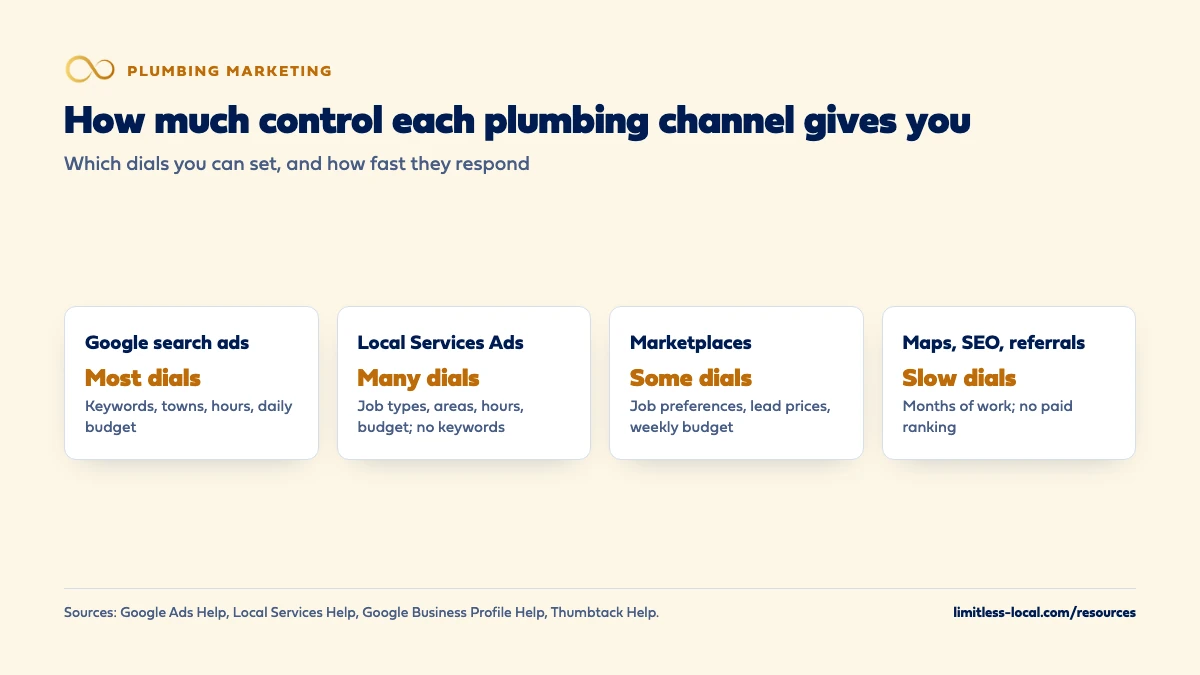
You get the most control in Google search ads, a good deal in Local Services Ads, some on lead marketplaces, and the least in your Google Maps listing, SEO and referrals. Search ads let you choose keywords, towns, hours and an average daily budget you can change at any time. Local Services Ads let you pick job types, service areas, ad hours and budget, but not keywords, and marketplaces let you set job preferences, lead prices and a weekly budget. Maps, SEO and referrals respond to work done over months, so they can’t be turned up or down on demand.
Knowing which dials move fast is how we plan budgets: paid channels for the job mix you want this month, and local SEO and your Google profile for calls that cost less over time. Our local ads work covers Google Ads management on every package and Local Services Ads management from the Growth tier up, and ad spend is always paid to Google directly. How it fits a plumbing shop is on our plumbing marketing page, and the rest of the plumbing marketing questions library goes channel by channel.
Which plumbing channels can I turn up or down quickly?
Think of each channel as a set of dials, and ask two questions: which dials it has, and how fast they respond.
- Fast: Google search ads, Local Services Ads and lead marketplaces. Change a budget, a job type or a town, and the change applies to the leads you get from then on. Ads can generate leads within days of launch.
- Slow: your Google Business Profile and Maps ranking, SEO and your website, referrals and repeat customers. You influence them through work that builds up, and SEO typically takes three to six months to show meaningful organic growth.
Fast dials cost money for every lead, so they’re the ones to use when you need to steer volume or job mix now. Slow dials are cheaper per call once they’re working, but you can’t switch them on for a freeze next week.
What can I control in Google search ads?
More than in any other channel:
- Which searches. You choose keywords, so you can run water heater and repipe searches in their own campaigns, and block searches you don’t want with negative keywords. Which negative keywords stop wasted plumbing ad spend lists the usual ones.
- Which towns. Location targeting lets you aim ads at areas you serve, and choose whether ads show to people physically in those areas, people who’ve shown interest in them, or both.
- Which hours. Campaigns show ads all day by default, and an ad schedule lets you pick the hours and days they run and raise or lower bids for specific times.
- How much. You set an average daily budget for each campaign and can edit it at any time. Google says that on any one day you won’t pay more than twice your average daily budget for most campaigns, and in a month no more than 30.4 times it.
That makes search ads the channel to use when you want more of one job type this week, or none of another.
What can't I control in Google search ads?
A few things stay with Google and with your market:
- Exact geography. Google says that when you target an area it may also show your ad in nearby, closely related areas, and that because location signals vary, 100% accuracy isn’t guaranteed in every situation.
- Daily spend. Google spends more on some days and less on others, within those daily and monthly limits, so a single day can look high.
- Who searches. If nobody searches for your keywords during the hours you’ve scheduled, your ads don’t show. You can’t create demand with settings.
- What the click does next. You pay for the click whether or not the person calls.
So the control is over where your money goes, not over how many calls come back. Check results by town and by hour, and adjust from there.
What can I control in Local Services Ads?
A good set of dials, but not keywords. Google lets you choose job types and service areas, adding or excluding areas by county, city or zip code. Since Local Services Ads began moving into Google Ads, your service areas, ad schedule and business categories sit in campaign settings, and Google says they can be customized independently of your Google Business Profile.
Two settings matter most for plumbers. First, job types: switch off the work you don’t want, so you aren’t paying for leads you’d turn down. Second, broad search: Google opts advertisers into their industry’s general category, so ads can show for searches like “plumber near me” that don’t name a service. You can opt out, and Google says that may reduce leads, and may suit businesses that only want customers searching for specific services.
You can also pause the campaign at any time and turn it back on, and edit the phone number your call and message leads ring to.
Curious what your marketing is actually booking?
Get a free visibility audit — no obligation, no sales pitch.
What changed about Local Services Ads control after the move into Google Ads?
Plumbing is named in the first phase of the move, which began in August 2026 for select home and storefront service advertisers in the United States, and Google says service-area businesses without physical storefronts follow in late 2026, so your account may already have moved or may move soon. Google lists these changes:
- Budgets are daily. Your old weekly budget is divided by 7, and monthly spend is capped at your daily average budget times 30.4.
- No manual bidding. Setting your own maximum cost per lead is no longer supported. You can review and adjust bidding targets.
- One bidding target per campaign. Separate targets for different business categories in one campaign are replaced by a single campaign-level target. Google says separate campaigns per category keep separate bidding rules.
- Business details come from your profile. Name, address and hours sync one way from your Google Business Profile and can’t be edited in Google Ads.
Net effect: you keep control of what, where and when, and give up some control over the price of each lead.
How much control do I have over Google Maps and the map pack?
Less, and none of it is paid. Google says there’s no way to request or pay for a better local ranking, and that local results are mainly based on relevance, distance and popularity. You can work on relevance with complete, accurate profile details, and on popularity with reviews and replies, but you can’t change how far a searcher is from your business.
You do control what your profile says. Google uses plumbers as its example of a service-area business, one that visits customers rather than serving them at its address, and you can set up to 20 service areas by city, zip code or other area. Google says the overall area shouldn’t be more than about 2 hours of driving time from where your business is based. Google says your service area shows customers where you work; in our judgement, listing a town doesn’t make you rank there. Whether your plumbing company can rank on Google Maps outside its office area goes into that.
How much control do I have over SEO leads?
Control over what you’re found for, not over when. You choose which job types and towns get their own pages on your website, so over time SEO leans toward the work you want: a strong water heater page brings water heater searches, and a page for a town you don’t want to drive to shouldn’t exist.
What you can’t do is turn SEO up for a busy month or down for a slow one. Pages take months to build up, and once they rank, calls keep coming whether or not the schedule has room. In our judgement, that makes SEO the channel for the long-term job mix and lower cost per call, not for this month’s gaps. Which towns a plumber should target first helps decide where to point it.

What can I control on lead marketplaces?
On Thumbtack, a useful amount. Standard leads arrive based on the job preferences you set, your lead prices tell Thumbtack how much you’re willing to pay per lead, and your budget controls your total weekly spending.
Two limits are worth knowing. Thumbtack says its smart matching may send you leads outside your usual preferences when it predicts they’re a strong fit, and its Opportunities aren’t based on your job preferences at all. And you don’t control how many other pros a homeowner contacts. Whether it is worth paying for plumbing leads covers how to judge what those leads cost per booked job.
How much control do I have over referrals and repeat customers?
The least over timing, but real control over the habits that feed them. In our judgement, referrals and repeat work come from doing good work, asking for reviews and referrals at the end of the job, and staying in touch with past customers about maintenance. None of that can be switched on for next Tuesday.
The upside is cost: once those habits are in place, the calls they bring don’t carry a per-lead charge. The downside is that you can’t steer them toward a job type or a town. Treat them as the base the fast channels sit on top of.
Which channel should I use to steer my job mix fast?
Use the fast dials for this month and the slow dials for next year. If you want more water heater replacements now, a search campaign on water heater searches with its own daily budget is the most direct lever, followed by making sure that job type is switched on in Local Services Ads. If drain calls are swamping the schedule, lower their budget or switch the job type off.
For a lasting shift, build the website pages and Google profile details for the work you want, and give them months. Which plumbing channel brings the highest-quality leads and how much budget and time each channel needs help you decide where to put the money while the slow channels build.
Want to see where your company stands?
A free visibility audit shows where you show up on Google, Maps and AI answers, and what it's costing you in calls.
What's different about controlling leads for plumbers
Freezes call for fast dials. A hard freeze can flood the phones with burst-pipe calls overnight. Search ads and Local Services Ads are the channels you can turn up ahead of a forecast and back down when the schedule fills. SEO and Maps can’t respond that quickly.
Hours matter as much as towns. Plumbing emergencies come in at night and on weekends. If nobody can take a call at 2 a.m., the ad schedule is a more important setting than the service area.
Emergency and planned work need separate dials. Burst pipes and water heater replacements bring different customers and different margins. Separate campaigns or job types let you turn one up without turning up the other.
A worked example: shifting a month toward water heater jobs
These numbers are made up to show how the dials work, not a recommended budget. A plumbing owner’s schedule is full of small drain calls and short on water heater replacements. For the next month:
- Google search ads: a new campaign for water heater searches, scheduled for the hours the office answers, with an average daily budget of $50. Google’s limits mean it can spend up to $100 on a busy day and no more than $1,520 for the month.
- Local Services Ads: the drain cleaning job types are switched off for the month, and the water heater job types are checked and switched on.
- Slow dials: a better water heater page on the website and fresh water heater photos on the Google profile. These won’t change this month’s calls but should help later.
At the end of the month the owner compares cost per booked water heater job with what those jobs leave in gross profit, and keeps, raises or cuts the $50. Our Essentials package includes Google Ads management for up to $2,500 a month in ad spend, and Local Services Ads management starts at Growth. A free visibility audit shows which of your dials are set right today.
Frequently asked questions
Can I stop Google Ads from showing in a town I don't serve?
You can target only the areas you serve, but Google says it may also show ads in nearby, closely related areas, and location accuracy isn’t guaranteed. Check results by location and adjust.
Can I choose keywords in Local Services Ads?
No. Google describes these campaigns as keywordless; targeting is based on the service categories and areas you offer and the other settings you choose.
Can I pause Local Services Ads when I'm booked up?
Yes. In Google Ads you can set the campaign to Paused and turn it back to Enabled when you want leads again.
Can I pay Google to rank higher on Maps?
No. Google says there’s no way to request or pay for a better local ranking. Ads are a separate, paid placement, not a ranking.
Will changing my Google Business Profile hours change my Local Services Ads?
Your business hours sync one way from your Google Business Profile into Google Ads, so yes, they carry over. The ad schedule itself can be set separately in the campaign.
Which channel gives me the most control over job type?
Google search ads, because you choose the searches. Local Services Ads come next, through job types.
Key takeaways
- Google search ads give the most dials: searches, towns, hours and a daily budget you can change any time.
- Local Services Ads let you set job types, areas, hours and budget, but not keywords or a maximum price per lead.
- Marketplaces let you set job preferences, lead prices and a weekly budget, with some leads outside them.
- Maps, SEO and referrals can’t be bought or switched on quickly; they build over months.
- Steer this month with fast dials; build next year’s job mix with slow ones.
Not sure what's working right now?
Start with a free visibility audit: rankings, Google profile, reviews and tracking, checked against your service area.
More in this section
- Which plumbing channel brings the highest-quality leads?
- How do I cut down on junk plumbing leads?
- How do I get more plumbing leads?
- How much can I afford to pay for a plumbing lead?
- How much control do plumbers give up by outsourcing marketing?
Sources
- About targeting geographic locations — Google Ads Help
- About Ad Scheduling — Google Ads Help
- About average daily budgets — Google Ads Help
- Edit your industries, service areas, and job types — Google Local Services Help
- Local Services Ads transition to Performance Max campaigns with pay-per-lead goals — Google Ads Help
- Tips to improve your local ranking on Google — Google Business Profile Help
- Manage your service areas for service-area & hybrid businesses — Google Business Profile Help
- What are leads, preset jobs, and opportunities? — Thumbtack Help