
What plumbing marketing should I keep in-house vs. outsource?

- Which marketing tasks can my office manager handle for my plumbing company?
- How should I decide what to keep and what to hand off?
- Which plumbing marketing tasks should stay in-house?
- What can my office manager handle?
- Should I manage my own Google Business Profile?
- Should I run my own Google Ads and Local Services Ads?
- Should I do my own SEO and website?
- Who should own call tracking and reporting?
- Which tasks should I never fully hand off?
- What does it cost to outsource versus keep it in-house?
- How do I hand off tasks without things falling through the cracks?
- What's different about splitting marketing work in a plumbing shop
- A worked example: a plumbing office manager's marketing week
- Frequently asked questions
- Key takeaways
- More in this section
- Sources
The short version
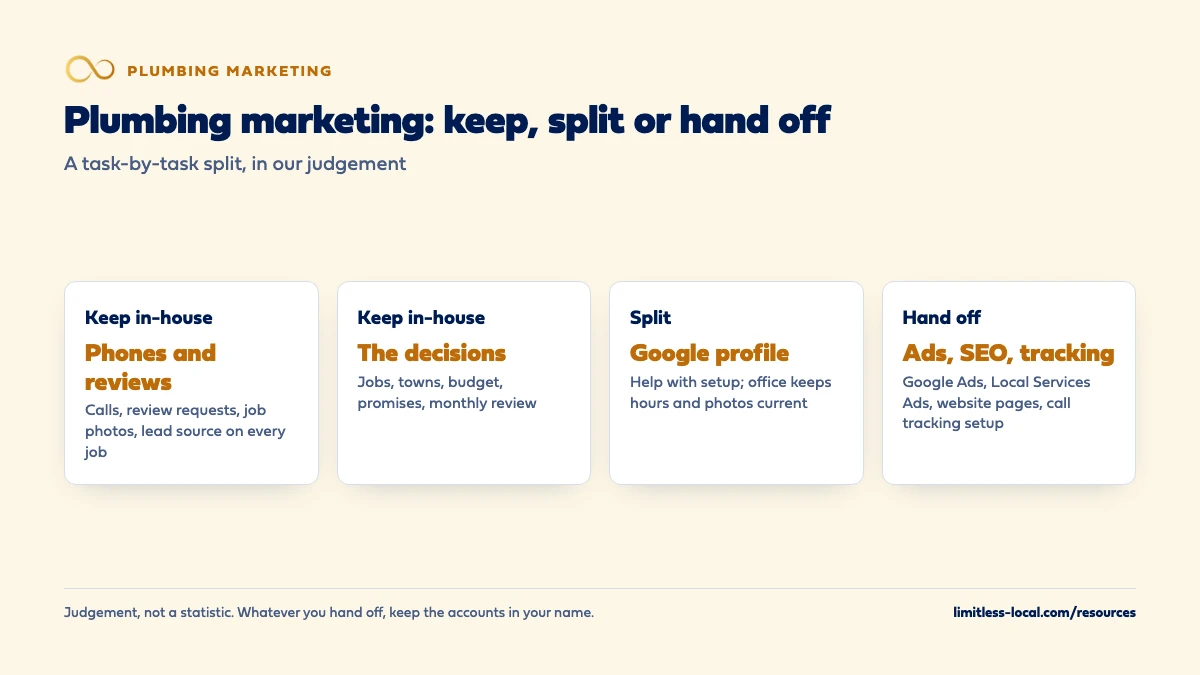
- Keep in-house: phones, review requests, job photos, lead source on every job, and the business decisions.
- Outsource: Google Ads, Local Services Ads, SEO, website pages and tracking setup.
- Split: your Google Business Profile, with you as primary owner.
- Whatever you hand off, keep the accounts and the budget in your name.
For plumbing owners splitting marketing between the office, the crew and outside help, one task at a time.
Get a free visibility audit · Book a growth call
Which marketing tasks can my office manager handle for my plumbing company?
Keep the work that depends on knowing your shop and happens on the phone or at the job: answering calls, asking for reviews, taking job photos, marking where each job came from, and deciding which jobs, towns and budgets to go after. Outsource the work that takes platform skill and steady hours and fails quietly when nobody watches it: Google Ads and Local Services Ads, SEO and website pages, and call tracking setup. Your Google Business Profile can be split, with your office keeping hours and photos current and outside help handling setup and posts, as long as every account stays in your name.
That split is how our work is set up: the ads, local SEO, Google profile management and tracking are ours to do, and the phones, the crews and the decisions stay with you. Every package includes call tracking and a monthly report with a cost-per-lead breakdown, and the tiers are on our marketing packages page. How it fits a plumbing shop is on our plumbing marketing page, and the rest of the plumbing marketing questions library goes question by question.
How should I decide what to keep and what to hand off?
In our judgement, three questions sort almost every plumbing marketing task:
- Does it need knowledge only your shop has? Which jobs went well, which customers are happy, who’s on call tonight. Outsiders can’t do these well.
- Does it happen at the job or on the phone? Review requests, photos and call handling happen where your people already are.
- Does it fail quietly and cost money every day if nobody watches it? Ad accounts, tracking and website problems can run for weeks before anyone notices. These reward someone whose job is to watch them.
Tasks that say yes to the first two stay in-house. Tasks that say yes to the third are the best candidates to hand off. Google’s own advice on SEO points the same way: if you run a small local business, it says, you can probably do much of the work yourself, and it says a great time to hire is when you’re considering a site redesign or planning to launch a new site. If you’re still deciding whether to hire help at all, whether to hire a plumbing marketing agency or do it yourself covers that bigger choice.
Which plumbing marketing tasks should stay in-house?
- Answering the phone. No agency can answer your calls the way your office can, and every paid lead depends on it. How fast your plumbing office should answer a new call covers the standard to aim for.
- Asking for reviews. The best moment is when the tech finishes a job and the customer is happy, which only your crew sees. Getting your plumbing techs to ask for reviews covers how to make it a habit.
- Job photos. Before-and-after shots of water heaters, repipes and clean installs come from the people on site.
- Marking the lead source on every job in ServiceTitan, Housecall Pro or Jobber. It takes seconds at booking, and without it nobody can tell which marketing paid off.
- The business decisions. Which jobs you want more of, which towns are worth the drive, how much to spend and what you promise customers.
None of these needs marketing skill. They need someone who’s there and a routine.
What can my office manager handle?
More than most owners expect, as long as the tasks are routine and the expectations are written down. In our judgement, a good office manager can own:
- Sending review requests after every finished job. Google lets you create a review link or QR code from your Business Profile and suggests sharing it on receipts and in thank-you emails.
- Replying to reviews. Google’s tips for review replies suggest keeping them professional, short and personal, and replying to negative reviews with empathy and honesty.
- Keeping the Google profile current: holiday hours, new services and fresh photos. Google Business Profile managers can edit info, respond to reviews and manage posts.
- Lead source on every booking, and a weekly check that nothing was left blank.
- Listening to a few recorded calls each week to spot missed bookings.
- Being the contact for outside help: telling whoever runs your ads when hours, crews or prices change.
What an office manager usually shouldn’t own is the inside of an ad account. It isn’t a skill most offices have time to build, and mistakes there cost money by the day.
Should I manage my own Google Business Profile?
Split it. The setup work, choosing categories, writing services and descriptions and fixing your business details wherever they’re listed, is worth getting help with once. The ongoing work, hours, photos, review replies and the occasional post, is light enough to keep in the office or share.
Whoever does the work, keep control. Google says a profile can have multiple owners but only one primary owner, and that managers have mostly the same access as owners except that they can’t add or remove users or remove the profile. Make yourself primary owner and give outside help manager access. Google’s review rules also apply no matter who does the asking: offering incentives, like free or discounted services, in exchange for reviews is strictly prohibited.
Curious what your marketing is actually booking?
Get a free visibility audit — no obligation, no sales pitch.
Should I run my own Google Ads and Local Services Ads?
For most plumbing shops, in our judgement, this is the first thing to hand off. Search ads need weekly attention: search terms to block, budgets by hour and day, and calls to check against booked jobs. Local Services Ads have just changed too. Google is moving them into Google Ads, with plumbing in the first phase that began in August 2026 for select US advertisers, which brings daily budgets, no manual bidding and a new place to manage leads. That’s a lot to relearn for an owner who’s also running crews.
Keep the account yours while someone else runs it. Google Ads has access levels: Admin can give account access, change access levels and add or remove product links, while Standard can edit campaigns but not manage users. A sensible setup is Admin for you and Standard for whoever manages the campaigns, with ad spend billed to your company.
The exception: if you or someone on your team has real time each week and wants to learn, a small, tightly set campaign can be run in-house. Just be honest about whether that time will still be there in a busy month.
Should I do my own SEO and website?
Split this one by type of work. The knowledge is yours: what each job involves, what homeowners ask on the phone, which towns you serve and what makes your shop different. The building is usually worth handing off: page structure, technical setup, speed, tracking and the steady publishing that SEO needs.
Google says a small local business can probably do much of its SEO itself, starting with its SEO starter guide, and that it’s useful to know the basics even if you hire help, so you can spot a technique that’s not recommended. In practice, the question is hours. SEO typically takes three to six months to show meaningful organic growth, and it only gets there with steady work. If nobody in your shop will write and update pages month after month, that’s the part to hand off, and you supply the answers they’re built on.
Who should own call tracking and reporting?
Hand off the setup and keep the review. Tracking numbers, form tracking and matching calls to booked jobs are fiddly to set up and easy to break, so they suit someone who does it often. Reading the results is your job: once a month, look at cost per booked job by channel, total spend on ads and on management, and a handful of recorded calls.
Keep the phone numbers in your name, so they go with you if you change who helps. And make sure booked-job numbers come from your field software, not from the ad platforms, because that’s where you see which calls became paid jobs.
Which tasks should I never fully hand off?
- Ownership of accounts: the domain, your Google Business Profile, Google Ads, tracking numbers and customer data.
- The total budget. Others can recommend; you decide.
- Promises to customers: offers, warranties on your work, pricing claims and what ads say about response times.
- The phones. An answering service can cover nights, but the standard for how calls are handled is yours.
- The monthly review. An hour a month with the numbers is enough to keep everyone honest.
How much control plumbers give up by outsourcing marketing goes deeper on keeping these decisions while handing over the hours.
What does it cost to outsource versus keep it in-house?
Doing it yourself saves a management fee, not the whole bill. Ad spend, website hosting, software and your own hours stay either way; what you still pay for if you do plumbing marketing yourself lists them. On the other side, our Essentials package is $3,500 a month and Growth is $4,500 a month, with ad spend paid to Google separately.
The fair comparison is cost per booked job, not the fee. If keeping ads in-house saves the fee but your account spends on searches that never call, the cheaper option costs more per job. If outside help runs a sharp account but your office misses half the calls, the fee buys little. In our judgement, the split in this article tends to give the lowest cost per booked job for a small or mid-size plumbing shop because each task goes to whoever does it best.
How do I hand off tasks without things falling through the cracks?
- Write down who owns each task, in-house or outside, with a name next to it.
- Agree on what triggers a message: new hours, a crew out sick, a job type you want more or less of, a price change. Each one should reach whoever runs your ads the same day.
- Share one source of truth for booked jobs, usually your field software, so everyone judges results the same way.
- Set a monthly review with the numbers and a short list of changes.
- Vet whoever you hand off to. How to know if a marketing agency really knows plumbing has the questions to ask.
Most handoffs that go wrong fail at step two: the ads keep running to a phone nobody can answer, because nobody told the people running them.
Not sure which of these is costing you jobs?
A free visibility audit checks the Google profile, reviews, site and tracking, and shows what to fix first.
What's different about splitting marketing work in a plumbing shop
Your phones can’t be outsourced away. Plumbing is full of urgent calls, and in our judgement the shop that answers first often gets the job. Whatever else you hand off, the call-handling standard and the on-call schedule stay yours, and whoever runs your ads needs to know both.
Your techs are your best marketers. Reviews, photos and the moment a service call turns into a water heater or repipe quote all happen on site. Build those into the job routine rather than hoping an outside team can make up for them.
Freezes need a plan in advance. If an outside team runs your ads, agree before winter how fast budgets can rise when a hard freeze is forecast, and who can say yes when you’re out on calls.
A worked example: a plumbing office manager's marketing week
This split is made up to show what in-house marketing can look like for a small shop. It isn’t a rule. Say the office manager keeps these tasks and outside help runs ads, SEO, the website and tracking:
- 40 minutes sending the review link after finished jobs and replying to new reviews.
- 15 minutes checking that every new booking has a lead source.
- 45 minutes listening to a handful of recorded calls and flagging missed bookings.
- 20 minutes updating the Google profile with hours, photos from the techs and any changes.
That’s 120 minutes, or two hours a week, of work that needs someone inside the shop. Everything else on the list needs platform skill and steady attention more than local knowledge. Our Essentials package, at $3,500 a month with ad spend paid to Google separately, includes Google Business Profile management, Google Ads management and call, web and form tracking. A free visibility audit is a reasonable way to see which of your tasks are being done today, and by whom.
Frequently asked questions
Can my techs handle social media posts?
They can supply the photos, which is the hard part. In our judgement, someone in the office or outside help should do the posting, so it happens on a schedule rather than when a tech remembers.
Should I hire a full-time marketing person instead of outsourcing?
It depends on how much work there is. In our judgement, one person rarely covers ads, SEO, the website and tracking equally well, so a split between the office and outside help is often easier to staff.
What access should I give whoever runs my Google Ads?
Standard access lets them edit campaigns; keep Admin for yourself, because Admin is the level that can give account access and change access levels.
Can someone outside my company reply to my Google reviews?
Yes, managers on your Business Profile can respond to reviews. In our judgement, it’s worth approving replies to negative reviews yourself, because future customers read them.
Is it fine to offer a discount for a Google review if my office asks?
No. Google says offering incentives, like free or discounted goods or services, in exchange for reviews is strictly prohibited, whoever does the asking.
How often should I check on outsourced work?
Monthly for results, and right away for anything that changes your hours, crews or prices. In our judgement, an hour a month with the numbers and a few recorded calls is enough.
Key takeaways
- Keep the tasks that need your shop’s knowledge and happen on the phone or at the job.
- Hand off the tasks that need platform skill and fail quietly: ads, SEO, website pages, tracking setup.
- Split the Google profile, with you as primary owner and outside help as manager.
- An office manager can own review requests, profile updates, lead sources and call spot-checks.
- Never hand off account ownership, the budget, promises to customers or the monthly review.
- Judge the split by cost per booked job, not by the fee you save.
Want a second set of eyes on your setup?
We'll look at how you show up locally and where calls are leaking, then send you a plain-English breakdown.
More in this section
- Should I hire a plumbing marketing agency or do it myself?
- How much control do plumbers give up by outsourcing marketing?
- What will I still pay for if I do plumbing marketing myself?
- What makes a good plumbing marketing company?
- What should a complete plumbing marketing plan include?
Sources
- Create a Google link or QR code to request reviews — Google Business Profile Help
- Tips to get more reviews — Google Business Profile Help
- Manage your Business Profile owners & managers — Google Business Profile Help
- Do You Need an SEO? Tips for Hiring an SEO — Google Search Central
- About access levels in your Google Ads account — Google Ads Help
- Local Services Ads transition to Performance Max campaigns with pay-per-lead goals — Google Ads Help