
How do I judge a local SEO package for my plumbing company?

- Is a local SEO package worth it for my plumbing company, and how do I tell a good one?
- What should a plumbing local SEO package actually include?
- Which line items do the real work for a plumber?
- Which line items are usually filler?
- Which promises should make me walk away?
- What questions should I ask before signing a plumbing SEO package?
- How do I compare two SEO packages priced differently?
- What should a local SEO report show me each month?
- How long before I can judge a local SEO package?
- What does a local SEO package cost a plumbing company?
- When is a local SEO package not worth it for a plumber?
- What's different about judging SEO for plumbers
- A worked example: comparing two plumbing SEO proposals
- Frequently asked questions
- Key takeaways
- More in this section
- Sources
The short version
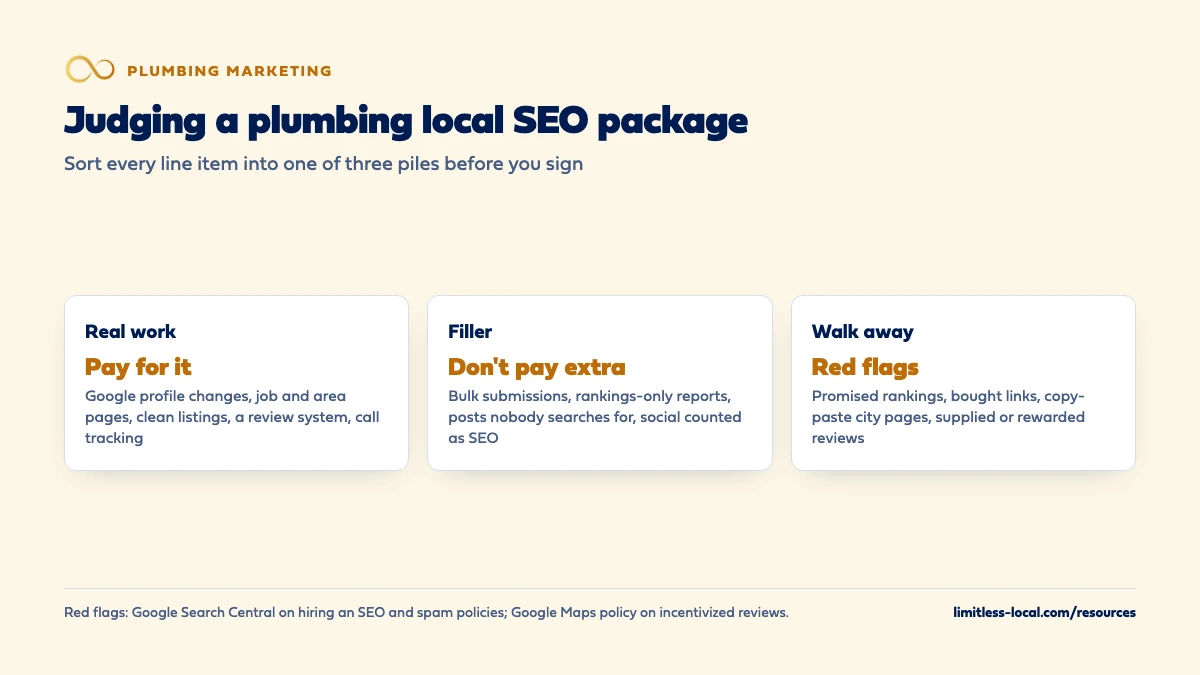
- Real work: your Google profile, job and area pages, clean listings, real reviews, tracking.
- Filler: bulk submissions, rankings-only reports, posts nobody searches for.
- Walk away: promised rankings, bought links, copy-paste city pages, supplied reviews.
- Judge the result on calls and booked jobs over months, not on rankings in week two.
For plumbing owners holding one or two SEO proposals and trying to work out what’s real work, what’s filler, and what to ask before signing.
Get a free visibility audit · Book a growth call
Is a local SEO package worth it for my plumbing company, and how do I tell a good one?
Judge a local SEO package on whether its line items move the things Google says local results mainly depend on, relevance, distance and popularity, and whether it reports calls and booked jobs instead of just rankings. A good plumbing package covers your Google Business Profile, a website page for each job and area you want, consistent listings, a steady flow of real reviews and tracking you can check. Walk away from promised rankings, bought links, copy-paste city pages and any offer to supply reviews.
Local SEO is part of every package we sell, and none of them are SEO-only: Essentials pairs it with Google Ads management, a monthly report and a real-time dashboard. Our local SEO page shows what’s included, our plumbing marketing page shows how it fits a plumbing shop, and the rest of the plumbing marketing questions library covers each piece in more depth.
What should a plumbing local SEO package actually include?
Start with what Google says drives local results. Its guide to improving your local ranking says local results are mainly based on relevance, distance and popularity. Relevance is how well your profile matches the search. Distance is how far you are from the searcher. Prominence, as Google calls it there, is how well known you are, and it’s based partly on how many websites link to you and how many reviews you have. It also says there’s no way to request or pay for a better local ranking.
So a package worth paying for should cover five things:
- Your Google Business Profile: right categories, services, service areas, hours, photos and replies to reviews.
- Website pages: one for each job you want more of, and real pages for the main areas you serve.
- Consistent listings: your name, address and phone the same everywhere they appear.
- Reviews: a steady system for asking real customers.
- Tracking and reporting: calls, forms and booked jobs, not just rankings.
You can’t change distance, so a package that promises to rank you everywhere in a big metro is promising something no one controls.
Which line items do the real work for a plumber?
- Profile work that changes something. “Google profile management” should mean fixing categories, adding services like water heater replacement and drain cleaning, uploading real job photos, posting regularly and replying to reviews. Ask for a list of what changed each month. Optimizing your plumbing Google profile shows what good looks like.
- Service pages with substance. A water heater page that covers tank and tankless, repair and replacement, and how fast you can come out does more than five thin pages.
- Listing cleanup. Fixing an old address or a wrong phone number where it’s listed online is real work.
- A review system. Review links in texts or on invoices, and a habit of asking on every finished job.
- Links from real local sources: suppliers, associations, local sponsorships, local news.
- Tracking: a way to see which calls came from your profile and website, and which ones booked.
Which line items are usually filler?
Some line items look busy and do very little:
- “Submitted to hundreds of search engines” or “thousands of directories.” Google’s page on hiring an SEO calls submitting your site to thousands of search engines a typically useless exercise. A handful of listings that matter, kept accurate, beats hundreds nobody visits. Whether directory citations are worth paying for covers which ones count.
- Rankings-only reports. A list of 30 keywords and their positions, with no calls, forms or booked jobs, tells you very little about whether the work pays.
- Blog posts nobody searches for. Content should answer what your customers actually look up, like what to do when a water heater leaks, not generic filler.
- Social posting counted as SEO. It can be worth doing, but it isn’t what moves Maps.
- Vague “technical optimization” with no list of what was fixed.
Filler isn’t always a scam. It’s just not what you should be paying SEO money for.
Which promises should make me walk away?
- Promised rankings. No one can guarantee a #1 ranking on Google. Be wary of anyone claiming a special relationship with Google or a “priority submit.”
- Bought links. Google’s spam policies list buying or selling links for ranking purposes as link spam, along with low-quality directory links and automated link building.
- Copy-paste city pages. The same policies count pages targeted at specific regions or cities that funnel visitors to one page as doorway abuse. A page per town with only the town name swapped is a risk, not an asset. Building city pages without spam shows how to do them properly.
- Supplied or rewarded reviews. Google’s policy on incentivized reviews covers reviews influenced by a payment, discount, free service or any other benefit. A package that offers reviews, or discounts for reviews, puts your profile at risk.
- Secrecy. If they won’t say what they’ll change on your site and profile, that’s your answer.
Curious what your marketing is actually booking?
Get a free visibility audit — no obligation, no sales pitch.
What questions should I ask before signing a plumbing SEO package?
Start with the basics: examples of past work, whether they follow Google Search Essentials, what results to expect and when, how they measure success, and their experience in your industry and city. For a plumbing company, add these:
- Which jobs and towns will you build pages for in the first three months?
- What exactly will you change on my Google profile each month?
- How will I see which calls came from SEO, and which of them booked?
- Will the website, profile and Search Console stay in my name, with me as owner?
- What do I keep if I leave, and how much notice do you need?
- Do you write the pages, or use a template you reuse for other plumbers?
A good provider asks you questions too: which jobs pay best, where your trucks are, who your competitors are, and how customers find you now. If they don’t, they’re selling a package, not a plan.
How do I compare two SEO packages priced differently?
Put them on one page with the same rows, then compare work, not page count:
- Scope: how many locations, service areas and job types are covered?
- Monthly work: what gets done each month on the profile, the website, listings and reviews?
- Pages: how many new pages in the first quarter, and for which jobs?
- Reporting: rankings only, or calls, forms and booked jobs?
- Ownership: whose name is on every account?
- Terms: how long, how to leave, what you keep?
- What’s bundled: are ads, tracking or a website included, or extra?
A cheaper package that leaves out tracking can cost more in the end, because you can’t tell what it’s doing. A pricier one that bundles ads may replace a second bill. What a plumbing marketing agency costs per month covers how fees usually break down.
What should a local SEO report show me each month?
Results first, then the work behind them:
- Calls and website clicks from your Google profile.
- Calls and forms from the website, with sources.
- Booked jobs tied to those calls, once your tracking allows it.
- New reviews and your average rating.
- Search Console impressions and clicks for your main job pages.
- A short list of what changed this month and what’s next.
Ask for access, not just a PDF. In Search Console, an owner has full control and can add and remove users, while a full user can view all data and take some actions, according to Google’s Search Console permissions page. You should be the owner; the provider can be a user. If someone offers an audit first, give them read access only at that stage.

How long before I can judge a local SEO package?
Longer than an ads campaign. SEO typically takes 3 to 6 months to show meaningful organic growth, and ads can generate leads within days of launch. So judge an SEO package in two stages:
- Months one to three: is the work getting done? Profile fixed, pages live, listings cleaned, reviews coming in, impressions starting to grow.
- Months three to six: are calls from the profile and website going up, and are they booking?
If the work isn’t visible by month three, that’s the time to ask hard questions, not month nine. How long plumbing SEO takes to bring calls covers what speeds it up and slows it down.
What does a local SEO package cost a plumbing company?
There’s no official rate card, so prices swing with scope: locations, number of pages, how many towns, and whether ads, tracking and reporting are bundled. Compare on what’s included, not the headline price.
Our packages bundle local SEO with ads rather than selling it alone. Essentials is $3,500 a month for one location, and covers listing cleanup and buildout, Google profile management with one post a week, up to 10 new pages, two blog posts a month, link building, review responses and basic review generation, Google Ads management, and call, web and form tracking. We sync your name, address and phone across 50+ directories. Ad spend is paid directly to Google on top.
Whatever you pay, the test is the same: total monthly cost divided by the booked jobs you can trace to it, once the SEO has had time to work.
When is a local SEO package not worth it for a plumber?
- When the phone isn’t being answered. More calls into a voicemail box won’t pay for anything. Fix coverage first.
- When your schedule is full for months and you’re not hiring. Keep your profile and reviews in shape and save the money.
- When you have the time and want to do it yourself. A small local business can probably do much of the work itself, and Google’s SEO Starter Guide is a good place to start.
- When the package doesn’t cover your real area or jobs. A one-size package built for a single city won’t help a plumber covering a whole county.
Whether to hire an agency or do it yourself walks through that choice.
Not sure which of these is costing you jobs?
A free visibility audit checks the Google profile, reviews, site and tracking, and shows what to fix first.
What's different about judging SEO for plumbers
Most plumbers are service-area businesses. If customers don’t come to your shop, your profile should list service areas, not a storefront. A package should handle that correctly, and shouldn’t promise rankings in towns far from where your business is based.
Emergency searches behave differently. Someone with a burst pipe searches on a phone and calls one of the first plumbers they see on the map. That makes the profile and reviews carry more weight for emergency work than blog posts do.
Big-ticket jobs need their own pages. Water heaters, repipes and sewer lines are where the money is, and people research them before calling. A package should build real pages for those jobs, not one “services” page that lists everything.
A worked example: comparing two plumbing SEO proposals
These packages and numbers are made up to show the comparison, not real quotes.
- Proposal A, $1,200 a month: submission to 40 directories, four blog posts a month, and a monthly rankings report for 30 keywords. No profile work listed, no tracking, no pages for specific jobs.
- Proposal B, $2,000 a month: monthly Google profile work with a change list, eight new job and area pages in the first quarter, a review request system, call tracking on the profile and website, and a monthly report with calls and booked jobs.
A is cheaper, but most of it is filler, and you’ll never know what it booked. Say B, by month six, can be tied to eight booked jobs a month. That’s $250 per booked job, a number you can compare with what a job is worth to you. With A, you can’t work out a cost per job at all, which is the real problem with it.
Frequently asked questions
Is a local SEO package worth it for a small plumbing company?
It can be, if the phones are answered and you have room on the schedule. If you have the time, you can do much of the basic work yourself and pay for help later.
Should a plumbing SEO package include a new website?
Not necessarily. It should include pages for the jobs you want. If your current site can’t be edited or is very slow, a new one may make sense, but price it separately.
How many pages should a plumbing SEO package build?
Enough to cover each main job and the main areas you serve, written properly. A few strong pages beat dozens of near-copies.
Is it a red flag if a provider won't share logins?
Yes. Your website, Google profile and Search Console should be in your name, with the provider added as a user.
Do I need SEO if I'm already running Local Services Ads?
Usually, yes. Ads stop when the budget stops, while your profile, reviews and pages keep bringing calls. Your reviews help both.
What should happen if the package isn't working at month six?
Ask for the list of work done, the calls and booked jobs it’s tied to, and what changes next. If none of that exists, it’s time to move on.
Key takeaways
- Google says local results mainly depend on relevance, distance and popularity; line items should move those.
- Pay for profile work, job and area pages, clean listings, a review system and tracking.
- Don’t pay extra for bulk submissions, rankings-only reports or posts nobody searches for.
- Walk away from promised rankings, bought links, copy-paste city pages and supplied reviews.
- Keep every account in your name, and judge the package on calls and booked jobs over 3 to 6 months.
Want a second set of eyes on your setup?
We'll look at how you show up locally and where calls are leaking, then send you a plain-English breakdown.
More in this section
- Should my plumbing company start with LSAs, Google Ads or SEO?
- Are Google Local Services Ads worth it for plumbers?
- How does competition affect how fast plumbing SEO works?
- How long does plumbing SEO take to bring in calls?
- Should plumbers pay for ads before fixing reviews and local SEO?
Sources
- Do you need an SEO? Tips for hiring an SEO — Google Search Central
- Tips to improve your local ranking on Google — Google Business Profile Help
- Spam policies for Google Web Search — Google Search Central
- Incentivized or Biased Reviews — Maps User Generated Content Policy Help
- Managing owners, users, and permissions — Search Console Help